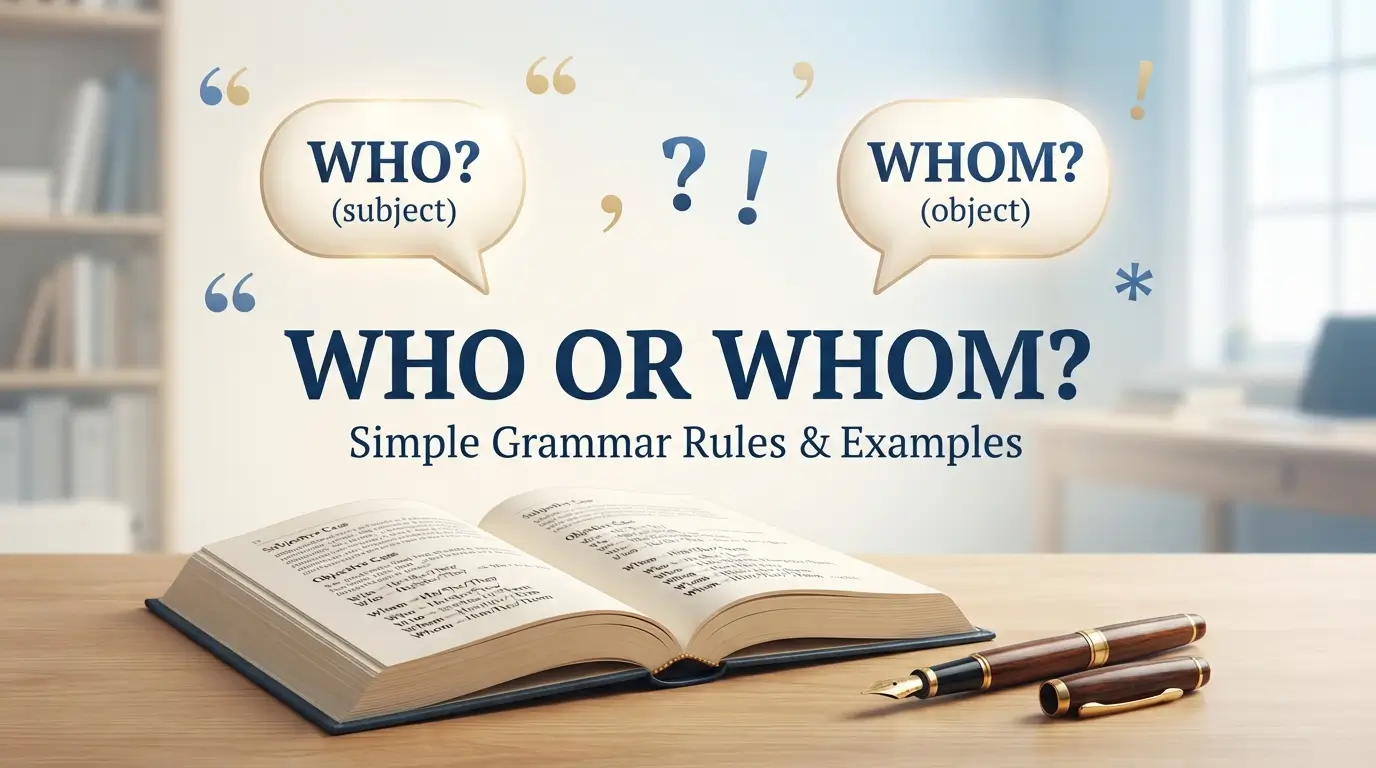
Choosing between who or whom can make even a simple sentence feel difficult. You may know what you want to say, but then you stop and wonder: Who should I contact? Or should it be Whom should I contact?
This confusion is common because who and whom both refer to people, but they do different jobs in a sentence. The basic rule is simple: who usually acts as the subject, while whom usually acts as the object.
Although modern English is flexible, who is often used where traditional grammar would expect whom, especially in everyday speech.
People search for “who or whom” because they want to write correctly in emails, essays, applications, professional messages, and formal documents. They also want to know whether whom is still necessary and whether British and American English use different rules.
This guide gives you a quick answer first, then explains the history, grammar, regional differences, common mistakes, real-life examples, and current usage patterns.
Who or Whom – Quick Answer
The easiest rule is:
- Who = the person doing the action.
- Whom = the person receiving the action or following a preposition.
Examples
Who called you?
Here, who is doing the action of calling.
Whom did you call?
Here, whom receives the action of calling.
A useful trick is to replace who/whom with he/him or she/her.
- If such as they works, use who.
- If him/her works, use whom.
For example:
Who sent the email?
Try he sent the email. That works, so who is correct.
Whom did you invite?
Try: You invited him. That works, so whom is traditionally correct.
However, grammar rules and real-life usage are not always the same. In everyday English, many speakers say “Who did you invite?” rather than “Whom did you invite?” This is widely accepted, especially in informal speech. Merriam-Webster notes that whom can sound formal or unnatural in ordinary conversation.
Quick Comparison
| Word | Main role | Example |
| Who | Subject | Who called me? |
| Whom | Object | Whom did you call? |
| Who | Informal object | Who did you meet? |
| Whom | Formal object | Whom did you meet? |
| Whom | After a preposition | To whom should I speak? |
So, if you need a quick rule, remember:
Who does the action. Whom receives the action.
The Origin of Who or Whom
The difference between who and whom is not a modern invention. Both words have a long history in English.
Who comes from the Old English word hwā, which was used to ask about a person. Whom developed from the Old English hwām, the dative form of hwā. Over time, these forms developed into the modern English who and whom. Collins traces whom to Old English hwām, the dative form of hwā.
This history explains why the two words look and sound similar but perform different grammatical roles.
English once had a much stronger case system. Nouns and pronouns changed form depending on their role in a sentence. Modern English has lost much of that system, but a few pronouns still show case differences.
For example:
- I → me
- he → him
- she → her
- who → whom
The pattern is easy to see:
He called me.
and:
Who called whom?
As English changed, whom became less common in everyday speech. Speakers increasingly used who for both subjects and objects.
This is why modern English has two layers of usage. Traditional grammar still recognizes whom as the object form, while everyday English often uses who instead.
Cambridge explains that whom is mainly used in formal styles and writing, while who is common in normal speech, even when it functions as an object.
Why Do People Think There Is a Spelling Difference?
There is actually no British-versus-American spelling difference between who and whom.
Both varieties spell the words the same way:
- British English: who / whom
- American English: who / whom
- Canadian English: who / whom
- Australian English: who / whom
The important difference is usage, not spelling.
British English vs American English Spelling
If you are looking for a spelling rule, the answer is simple: British and American English spell who and whom the same way.
The difference appears more clearly in how often whom is used.
British English still uses whom in formal writing, especially after prepositions and in carefully edited text. However, who is also common in informal British English.
American English follows a similar pattern. Whom remains correct in formal contexts, but many Americans prefer who in everyday conversation and less formal writing.
Oxford gives examples such as “Whom did they invite?” and “To whom should I write?”, while noting that whom is formal and less common in spoken English.
British vs American Usage
| Feature | British English | American English |
| Spelling | who / whom | who / whom |
| Who as subject | Very common | Very common |
| Whom as formal object | Common in formal writing | Common in formal writing |
| Who as object | Very common in speech | Very common in speech |
| After a preposition | Whom is preferred in formal writing | Whom is preferred in formal writing |
| Everyday speech | Who is often preferred | Who is often preferred |
| Formal documents | Whom may be preferred | Whom may be preferred |
Examples
British formal style:
To whom should I send the application?
American formal style:
To whom should I send the application?
Everyday British or American style:
Who should I send the application to?
There is no spelling change. The choice mainly depends on formality, sentence structure, and audience.
Which Spelling Should You Use?
Since who and whom are not spelling alternatives, the better question is: Which word should you use?
The answer depends on your audience and the level of formality.
For Everyday Conversation
Use who in most cases.
Who did you see?
Who are you talking to?
These sound natural and normal.
For Casual Emails and Messages
Who is usually the best choice.
Should I contact about this?
Who did you send the file to?
Using whom here can sound overly formal.
For Academic Writing
Use whom when it is grammatically appropriate and fits the style of your writing.
The researcher interviewed several participants, some of whom had worked in the field for years.
This is a natural formal use of whom.
For Business Writing
Both can be correct.
Informal:
Who should I contact?
Formal:
Whom should I contact?
A business email does not automatically require whom. Clear, natural writing is more important than forcing formal grammar.
For US Audiences
Use who in normal conversation and informal writing. Use whom when writing formally or when it follows a preposition in a formal construction.
For UK and Commonwealth Audiences
The same general advice applies. Whom is still recognized and useful in formal writing, but who is common in everyday English.
For a Global Audience
Choose the simplest natural form. In most casual situations, who will be understood and accepted.
Use whom when:
- You are writing formally.
- It follows a preposition in a formal sentence.
- It creates a polished tone.
- The grammatical object relationship is important.
Common Mistakes with Who or Whom
The biggest mistake is treating whom as simply a “more correct” version of who.
It is not.
The words have different grammatical functions.
Mistake 1: Using Whom as the Subject
Incorrect:
Whom called you yesterday?
Correct:
Who called you yesterday?
Why? Who acts calling.
Mistake 2: Always Using Who
In casual English, this is often fine:
Who did you invite?
But in highly formal writing, you may prefer:
Whom did you invite?
The second version follows the traditional object rule.
Mistake 3: Forgetting the Preposition
Formal:
To whom should I speak?
Informal:
Who should I speak to?
Both are used. The first is more formal.
Mistake 4: Using Whom Because It Sounds Formal
Incorrect reasoning:
“Whom sounds professional, so I should always use it.”
This can make writing sound unnatural.
Instead, check the grammatical role.
Mistake 5: Confusing Who With Whose
Who asks about a person.
Who is calling?
Whose shows possession.
Whose phone is this?
Whom is the object form.
Whom did you call?
These three words have different jobs.
Mistake 6: Thinking Whom Is Outdated
Whom is not dead or incorrect. It is still used, especially in formal writing, academic writing, legal language, and after prepositions.
Cambridge and Oxford both describe whom as a formal object pronoun rather than an obsolete word.
Who or Whom in Everyday Examples
Understanding real examples is often easier than memorizing grammar rules.
In Emails
Casual:
Who should I contact about the meeting?
Formal:
To whom should I address my request?
Both can be correct. The second has a more formal tone.
In News Writing
News writing may use whom, especially in formal constructions:
The committee questioned several officials, two of whom later resigned.
But news writers may also use who in less formal structures:
The officials who the committee questioned later resigned.
On Social Media
People normally use who:
Who are you voting for?
Who did you meet at the event?
Social media favors natural, conversational English, so whom can sound stiff.
In Formal Writing
Whom is useful when it clearly functions as an object:
The professor, whom I met last year, helped with the research.
Here, I met him confirms that whom is the object.
After a Preposition
This is one of the clearest uses of whom:
With whom are you traveling?
To whom did you give the document?
For whom was the letter written?
These forms are grammatically traditional and strongly associated with formal English.
In everyday conversation, speakers often move the preposition to the end:
Who are you traveling with?
Who did you give the document to?
Oxford specifically notes this difference between formal and conversational English.
In Relative Clauses
Formal:
The manager whom I contacted replied quickly.
Informal:
The manager who I contacted replied quickly.
Even simpler:
The manager I contacted replied quickly.
In defining relative clauses, the object pronoun can often be omitted altogether.
Who or Whom – Google Trends & Usage Data
Search interest in “who or whom” reflects a wider problem: English speakers frequently want quick answers about grammar choices.
However, it is important to understand what Google Trends can and cannot tell us. Google Trends shows relative search interest, not an exact number of searches. A trend score is not the same as a total search volume figure.
Interest in who vs whom is driven by several situations:
- Students checking grammar.
- Writers editing formal work.
- Job seekers preparing applications.
- Professionals writing emails.
- English learners studying pronouns.
- Teachers creating grammar lessons.
- Editors checking formal English.
The general usage pattern is clear across wide English varieties: who is much more common in everyday communication, while whom survives mainly in formal, written, and specific grammatical structures.
Dictionary and grammar references from Cambridge, Oxford, Collins, and Merriam-Webster all reflect this shift toward who in ordinary speech while retaining whom for formal object use.
Country and Context Comparison
| Audience/context | More natural choice |
| Everyday conversation | Who |
| Text messages | Who |
| Social media | Who |
| Casual email | Who |
| Formal email | Who or whom |
| Academic writing | Whom where appropriate |
| Legal/formal writing | Whom often preferred |
| After a formal preposition | Whom |
| Relative clauses | Who or whom, depending on structure |
| Global English | Usually who in informal contexts |
The key point is that whom has not disappeared. Instead, its range has become narrower as spoken English has moved toward simpler structures.
Who or Whom Comparison Table
| Feature | Who | Whom |
| Basic meaning | Refers to a person | Refers to a person |
| Main grammatical role | Subject | Object |
| Example | Who called? | Whom did you call? |
| After preposition | Less formal | Preferred in formal style |
| Everyday speech | Very common | Less common |
| Formal writing | Common | Common |
| Social media | Preferred | Rare |
| Academic writing | Common | Useful when grammatically appropriate |
| British spelling | Who | Whom |
| American spelling | Who | Whom |
| Pronunciation | /huː/ | /huːm/ |
| Possessive form | Whose | Whose |
| Modern usage | Very broad | More limited |
The Fastest Test
Use the he/him test.
Who/whom broke the window?
He broke the window.
So:
Who broke the window?
Now try:
Who/whom did you call?
I called him.
So traditionally:
Whom did you call?
This simple test solves most who-or-whom questions.
FAQs:
Is it “who or whom” or “who or who”?
The correct phrase is “who or whom” because who and whom are different forms of the same pronoun. Who is generally the subject form, while whom is traditionally the object form.
Is “whom” still correct?
Yes. Whom is still correct and remains useful in formal writing, especially after prepositions and in formal relative clauses. It is less common in everyday speech.
Is “Who did you call?” grammatically correct?
Yes. In modern English, “Who did you call?” is widely accepted, especially in everyday speech and informal writing. Traditional grammar would prefer “Whom did you call?” because the pronoun is the object of the verb ” call. Merriam-Webster notes that who is commonly used this way in modern English.
Should I say “Who should I contact?” or “Whom should I contact?”
Both occur. “Who should I contact?” is natural and widely accepted. “Whom should I contact?” is more formal and follows the traditional object rule.
For most business emails, who is perfectly natural.
Is “to whom” always correct?
When whom refers to the object of the preposition to, “to whom” is grammatically correct:
To whom should I send the report?
It is formal. In everyday English, people commonly say:
Who should I send the report to?
Do British and American English spell whom differently?
No. There is no spelling difference. Both British and American English use who and whom. The main difference is how formal or common whom is in particular contexts.
How can I remember who vs whom?
Use the he/him test.
If you can replace the word with they use who.
If you can replace it with him or her, use whom.
For example:
Who called?
He called.
Whom did you call?
I called him.
Conclusion:
The choice between who or whom is easier once you understand their basic roles. Who is traditionally the subject, the person doing the action. Whom is traditionally the object, the person receiving the action or following a preposition.
The good news is that modern English is flexible. You will often hear and read who where older grammar rules would use whom. This is especially common in conversation, social media, casual emails, and everyday writing.
Major English grammar references recognize this modern pattern while still supporting whom in formal contexts.
There is also no British-versus-American spelling difference. Both varieties spell the words who and whom in the same way. The real difference is style and usage.
For everyday communication, who is usually the safest and most natural choice. For formal writing, academic work, legal documents, and constructions after prepositions, whom can add precision and formality.
When unsure, use the he/him test. It is quick, simple, and works in most situations.
Read More Posts:
- Toward or Towards in American and British English (2026Guide)
- English or Spanish: Language Comparison (2026Guide)
- Bear With Me or Bare With Me: Easy Way to Remember Guide