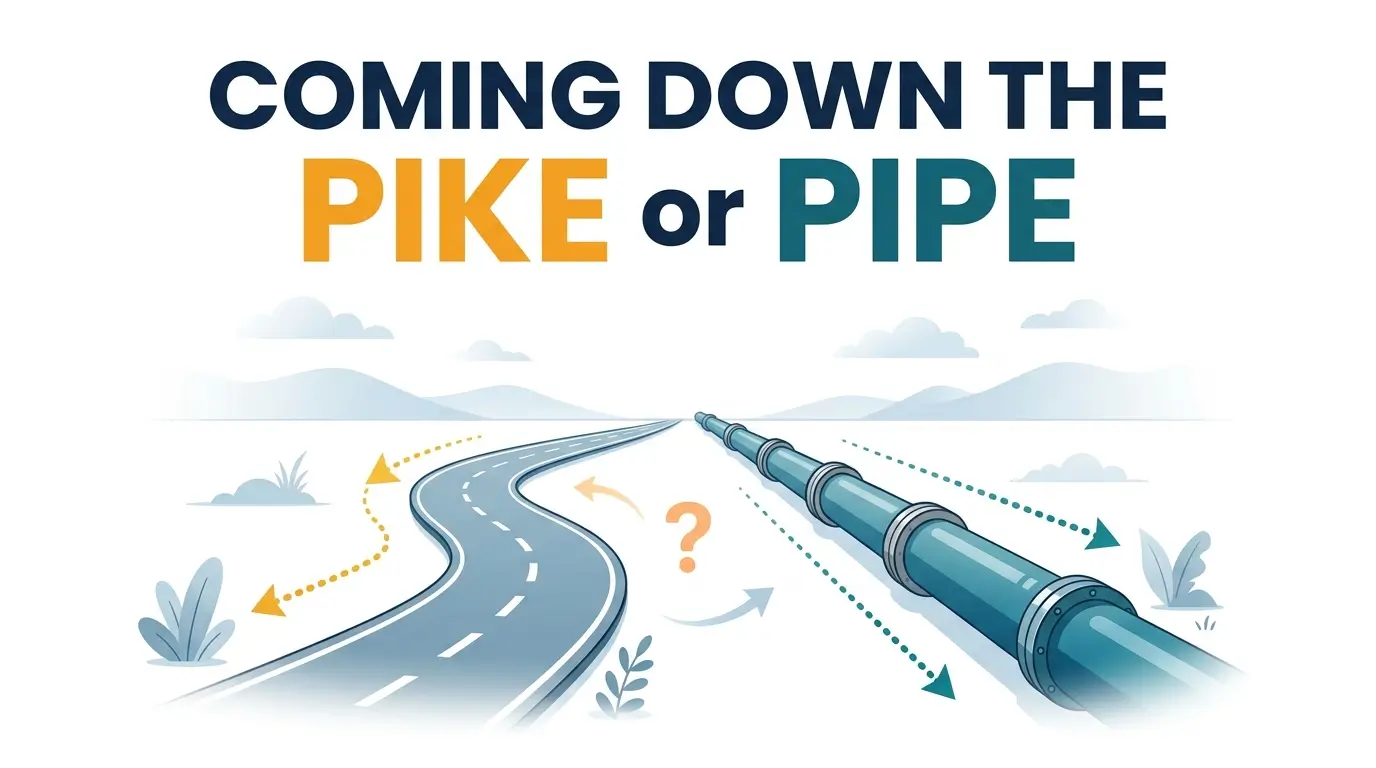
Have you ever heard someone say that a big change, new idea, or exciting event is “coming down the pike”? Or was the phrase “coming down the pipe”? Both expressions appear in English, so it is easy to wonder which one is correct.
The confusion comes from the fact that pike and pipe sound similar. Both words are real English words, but the traditional expression is “coming down the pike.” It means that something is likely to happen or arrive in the near future.
The phrase is often used when people talk about new plans, business changes, upcoming products, or future events. For example, a manager might say, “Several changes are coming down the pike.”
You may also see coming down the pipe. This version is sometimes used because people connect the phrase with water or other things flowing through a pipe. Although it appears in real usage, coming down the pike is the established idiom.
In this guide, you will learn the meaning, origin, correct usage, common mistakes, and differences between the two phrases. You will also find practical examples to help you use the expression with confidence.
Coming Down the Pike or Pipe – Quick Answer
“Coming down the pike” is the traditional and preferred expression. It means that something is coming soon or is expected to happen in the future.
Examples:
- Several new laws are coming down the pike.
- Big changes are coming down the pike at work.
- We have some exciting projects coming down the pike.
The word pike in this phrase refers to a turnpike, or a major road. The expression suggests that something is approaching along the road.
What Does Coming Down the Pipe Mean?
“Coming down the pipe” is also used by some English speakers. People may picture something moving through a pipe toward its destination.
For example:
- A new software update is coming down the pipe.
- More changes are coming down the pipe.
These sentences are easy to understand, but coming down the pike is the established idiom for something expected in the future.
Which Phrase Should You Remember?
- Coming down the pike: The traditional idiom for upcoming events or changes.
- Coming down the pipe: An alternative expression that appears in modern usage.
- Best general choice: Use coming down the pike, especially in edited or professional writing.
If you remember only one thing, remember that pike is the standard choice for this idiom.
The Origin of Coming Down the Pike or Pipe
The phrase coming down the pike has roots in the language of roads and travel. Understanding this connection makes the expression easier to remember.
What Does Pike Mean?
In this expression, pike is short for turnpike. A turnpike is a road, especially one that historically charged travelers a toll.
In the past, people used turnpikes to travel between places. Someone approaching along a road could be seen coming toward the people waiting ahead.
This idea became linked to events and changes that were expected to arrive in the future.
How Did the Expression Develop?
The expression coming down the pike came to mean that something was approaching or was likely to happen soon.
Over time, people began using it in a wider range of situations.
For example:
- A new law may be coming down the pike.
- A major company change may be coming down the pike.
- A new opportunity may be coming down the pike.
In each example, the phrase suggests that something is on its way.
Why Do People Say Coming Down the Pipe?
The word pipe creates a different mental picture. People often imagine water or another substance traveling through a pipe.
This makes “coming down the pipe” sound logical, even when the speaker means an upcoming event rather than something physically moving through a pipe.
The similarity in sound between pike and pipe also helps explain why the phrases can become confused.
Are Both Expressions Used Today?
Yes, both expressions appear in modern English. However, coming down the pike is the established idiom and the safer choice when you want to follow traditional usage.
The pipe version may be understood in context, but it is better to use pike when writing for an audience that expects standard idiomatic English.
British English vs American English Spelling
The difference between coming down the pike and coming down the pipe is not a simple American versus British spelling rule. The two phrases use different words, and the traditional idiom uses pike.
Coming Down the Pike in American English
The phrase is well established in American English. It often appears in discussions about business, politics, technology, and future plans.
Examples:
- New regulations are coming down the pike.
- We have several new products coming down the pike.
- Big changes are coming down the pike next year.
In these examples, the phrase means that the events or changes are expected in the future.
Coming Down the Pipe in American English
Some American speakers also use coming down the pipe. The expression is understandable, especially when the context suggests that something is moving toward the listener.
Examples:
- More updates are coming down the pipe.
- Several new features are coming down the pipe.
Although this version is used, coming down the pike remains the traditional idiom.
What About British English?
British English speakers may understand both phrases. However, this expression does not have a strict British versus American spelling distinction like color and colour.
If you are writing for a British audience, you can still use coming down the pike when you mean that something is approaching or expected in the future.
Comparison Table
| Feature | Coming Down the Pike | Coming Down the Pipe |
| Traditional idiom | Yes | No |
| Meaning | Something expected soon | Often used with a similar meaning |
| Main image | A road or turnpike | A pipe carrying something |
| American English | Established expression | Also used |
| British English | Understandable | Understandable |
| Professional writing | Preferred choice | Use with care |
| Best general option | Yes | Alternative usage |
The key difference is the idiom’s history and established form, not a change in spelling between American and British English.
Which Spelling Should You Use?
The best choice depends on what you mean and how formal your writing needs to be.
For American Readers
Use coming down the pike when you mean that something is expected in the future.
Example:
“Several major changes are coming down the pike this year.”
This form is suitable for business articles, news writing, reports, and everyday conversations.
For British Readers
You can also use coming down the pike. The phrase may be more familiar to some readers than others, but the traditional form remains the safest choice when using this idiom.
Example:
“Several important developments are coming down the pike.”
If the audience may not know the expression, use a clearer alternative such as “several important developments are expected soon.”
For Australian and Other English Speaking Audiences
The same general advice applies. Use coming down the pike if you want the established idiom, or choose simpler wording if you want to avoid regional expressions.
For Global English Writing
For an international audience, clarity matters most.
You can write:
- Several changes are coming down the pike.
- Several changes are expected soon.
- Several changes are planned for the near future.
The second and third options are more direct and may be easier for readers who are learning English.
For Professional and SEO Writing
Use coming down the pike when the idiom fits your sentence. If you are explaining the difference between pike and pipe, include both forms naturally and clearly explain which is traditional.
Do not force the phrase into unrelated content. It should sound natural and fit the subject.
Common Mistakes with Coming Down the Pike or Pipe
The two expressions are easy to confuse because they sound alike. Here are common mistakes and ways to avoid them.
Mistake 1: Assuming Pike Is a Typo
Some writers think pike must be a mistake because pipe is a more familiar everyday word.
Incorrect correction: “Several new laws are coming down the pipe.”
Preferred traditional form: “Several new laws are coming down the pike.”
The original idiom uses pike.
Mistake 2: Thinking Pipe Is Never Used
Although coming down the pike is the traditional expression, coming down the pipe also appears in modern English.
It is better to describe pike as the established form rather than claim that nobody uses pipe.
Mistake 3: Using the Phrase for Something That Already Happened
The expression usually points to something approaching or expected in the future.
Less suitable: “The new policy came down the pike five years ago.”
Clearer: “The new policy was introduced five years ago.”
You can use the phrase in different tenses, but make sure it fits the timeline of your sentence.
Mistake 4: Confusing the Idiom with a Physical Pipe
A pipe is a real object that can carry water, gas, or other materials.
Example: “Water is coming down the pipe.”
This sentence may describe a physical pipe, depending on the context. It is different from using coming down the pike to mean that a future event is approaching.
Mistake 5: Using the Idiom in Every Situation
The phrase is useful, but it is not always the clearest choice.
Instead of writing:
“Many developments are coming down the pike.”
You could write:
“Many developments are expected soon.”
The second sentence may be better for formal documents or readers who are unfamiliar with the idiom.
Mistake 6: Changing the Phrase to Coming Up the Pipe Without a Reason
Expressions such as coming up the pipe may occur in some contexts, but they are not the traditional wording of this idiom.
When you want to express the established meaning, use coming down the pike.
Coming Down the Pike or Pipe in Everyday Examples
The phrase is often used when people talk about plans, changes, news, and future events. Here is how it works in different situations.
1. In Emails
You can use the phrase to tell coworkers about future plans.
Example:
“We have several new projects coming down the pike, so please watch for updates.”
This tells the team that new projects are expected soon.
Another example:
“There may be some changes coming down the pike next month.”
This sentence suggests that changes are likely to happen in the near future.
2. In News Articles
News writers may use the phrase when discussing upcoming events or new plans.
Examples:
- Several new rules are coming down the pike.
- More changes to the education system may be coming down the pike.
- A new plan is coming down the pike to improve public services.
The phrase helps readers understand that something may happen soon.
3. On Social Media
The expression can also appear in casual posts.
Examples:
- “Big news is coming down the pike!”
- “A few exciting updates are coming down the pike.”
- “We have something special coming down the pike. Stay tuned!”
These examples create a sense of anticipation.
4. In Formal Writing
The phrase can work in reports and professional articles, but it may sound informal in some settings.
Examples:
- Several policy changes are coming down the pike.
- New requirements may be coming down the pike.
- The company expects further developments to come down the pike.
For a highly formal report, you may prefer “upcoming changes” or “expected developments.”
5. In Business Conversations
The expression is useful when discussing future products, plans, or projects.
Examples:
- We have a new product coming down the pike.
- Several projects are coming down the pike this year.
- More opportunities may be coming down the pike.
In each example, the phrase suggests that something is on its way.
6. In Everyday Conversation
| Situation | Example |
| Work | More changes are coming down the pike. |
| Technology | A new update is coming down the pike. |
| Education | New rules may be coming down the pike. |
| Business | Several products are coming down the pike. |
| Personal plans | Some exciting things are coming down the pike. |
| News | A major announcement is coming down the pike. |
If your listener is unfamiliar with the idiom, simply say that something is expected soon.
Coming Down the Pike or Pipe – Google Trends and Usage Data
People search for coming down the pike or pipe because they want to know which phrase is correct, what it means, and whether the two forms can be used in the same way.
Which Phrase Is More Common?
Coming down the pike is the traditional expression. It is especially established in American English and is used when discussing future events, plans, or changes.
Coming down the pipe also appears in modern writing and conversation. However, it is not the traditional form of the idiom.
What Does Google Trends Tell Us?
Google Trends can help compare search interest in the phrases over time and across countries. However, search interest is not the same as the frequency of an expression in books, news articles, or everyday speech.
No exact search volumes, percentages, or country rankings are included here because current figures have not been verified.
When comparing the phrases, keep these points in mind:
- Search interest can change over time.
- Regional usage may affect which phrase people search for.
- A phrase may appear in writing even when fewer people search for it.
- Search data alone cannot decide which form is the traditional idiom.
Why Do People Search for This Keyword?
The most common reasons include:
- Checking whether pike or pipe is correct.
- Learning the meaning of the expression.
- Understanding its origin.
- Improving professional or academic writing.
- Avoiding mistakes in emails and articles.
The most useful answer is simple: choose coming down the pike when you want the traditional idiom for something expected in the future.
Coming Down the Pike vs Coming Down the Pipe: Comparison Table
This table gives you a quick way to remember the difference.
| Feature | Coming Down the Pike | Coming Down the Pipe |
| Traditional expression | Yes | No |
| Common meaning | Something expected soon | Sometimes used with a similar meaning |
| Origin or image | A road or turnpike | A pipe carrying something |
| Suitable for casual speech | Yes | Used by some speakers |
| Suitable for professional writing | Preferred | Use with care |
| Clear alternative | Upcoming or expected soon | Upcoming or expected soon |
| Best choice for the idiom | Yes | Alternative usage |
Remember: Pike is the established word in this expression. If you are unsure, use “coming down the pike” or replace the idiom with “expected soon.”
Frequently Asked Questions
1. Is it coming down the pike or pipe?
Coming down the pike is the traditional and preferred expression. It means that something is expected to happen or arrive in the future. The pipe version is also used, but it is not the established form of the idiom.
2. What does coming down the pike mean?
It means that something is approaching or expected soon. It often refers to future changes, plans, products, events, or opportunities.
Example: “Several new projects are coming down the pike.”
3. Why do people say coming down the pike?
The word pike comes from turnpike, a type of road. The expression uses the idea of something approaching along a road to describe a future event that is on its way.
4. Is coming down the pipe wrong?
The expression coming down the pipe is used by some English speakers and can be understood from context. However, coming down the pike is the traditional idiom when referring to upcoming events.
5. Is coming down the pike American or British English?
The expression is especially established in American English. It can also be understood by British and other English speaking audiences. It is not a spelling difference like color and colour.
6. Can I use coming down the pike in formal writing?
Yes, but consider your audience and tone. It can work in business articles, reports, and professional communication. For highly formal writing, “expected developments” or “upcoming changes” may be clearer.
7. What is another way to say coming down the pike?
You can use several alternatives:
- Coming soon
- On the way
- Expected in the near future
- Upcoming
- In the pipeline
- Likely to happen soon
Choose the alternative that best fits your sentence.
8. Does coming down the pike mean the same as in the pipeline?
The meanings can overlap. Both expressions may refer to plans, projects, or changes expected in the future. However, they are different idioms and have different wording.
Example: “A new product is in the pipeline.”
Example: “A new product is coming down the pike.”
Both suggest that a new product is expected, though the emphasis may vary with context.
Conclusion
The correct traditional expression is “coming down the pike.” It means that something is approaching or expected to happen in the near future. People often use it when talking about new plans, business changes, upcoming products, or future events.
The word pike comes from turnpike, a type of road. The phrase creates the idea of something approaching along a road. The alternative coming down the pipe is also used in modern English, but it is not the traditional form of the idiom.
If you are writing an email, business report, news article, or SEO blog post, coming down the pike is the safest choice when you want to use this expression. If your readers may not know the phrase, use simpler wording such as “coming soon” or “expected in the near future.”
Remember that the difference is not a British versus American spelling rule. It is a question of idiom and established usage. By choosing the traditional phrase and using it in the right context, you can make your writing clear, natural, and professional.
Discover More Post
- Ect or Etc: Which Spelling Is Correct?
- Nosey or Nosy: Which Spelling Is Correct?
- Women or Woman: What Is the Difference and When Should You Use Each?

Toni Morrison is a celebrated American novelist known for her powerful storytelling, rich characters, and lasting impact on literature. At GrammerNests.com, she shares insights that help readers appreciate language, writing, and literary expression.







