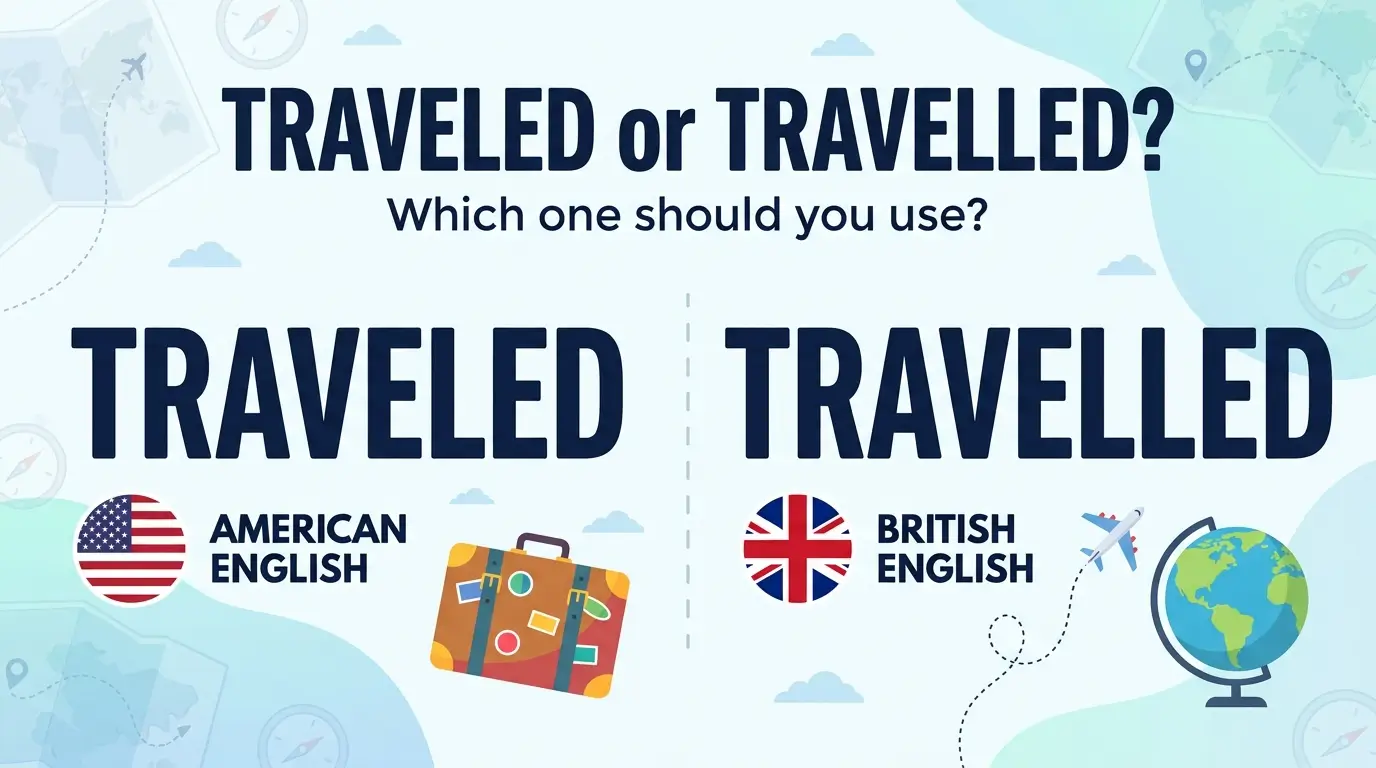
Have you ever wondered whether to write traveled or travelled? Both spellings are correct, but the right choice depends on the type of English you use. This small spelling difference often confuses students, bloggers, writers, and people who write in English at work.
In American English, traveled is the standard spelling. In British English, travelled is the usual spelling. Both words describe the same action: going from one place to another.
For example, an American writer may say, “I traveled to New York last year.” A British writer may write, “I travelled to London last year.” Neither sentence is wrong.
People often search for traveled or travelled because they want to avoid spelling mistakes in essays, emails, articles, and other writing. They may also wonder why one word has one l while the other has two.
In this guide, you will learn the meaning, origin, spelling rules, and common uses of both forms. You will also see examples, a comparison table, and tips to help you choose the right spelling for your readers.
Traveled or Travelled – Quick Answer
Both traveled and travelled are correct spellings of the past tense of the verb travel. They have the same meaning, but they follow different regional spelling rules.
- Traveled: Standard American English spelling.
- Travelled: Standard British English spelling.
- Meaning: Went from one place to another.
- Grammar: Both are past tense and past participle forms.
- Present tense: Travel.
Examples of Traveled
- I traveled to California last summer.
- She traveled by train to visit her family.
- We have traveled to many cities in the United States.
Examples of Travelled
- I travelled to London last summer.
- She travelled by train to visit her family.
- We have travelled to many cities in the United Kingdom.
Both sets of examples are grammatically correct. The difference is spelling, not meaning.
Remember this simple rule: use traveled for American English and travelled for British English.
The Origin of Traveled or Travelled
The difference between traveled and travelled comes from the way American and British English developed different spelling habits over time.
Where Does the Word Travel Come From?
The word travel has roots in the Old French word travailler, which meant to work or struggle. It entered English centuries ago, when travel could involve hard work and difficult journeys.
Over time, the meaning changed. Today, travel usually means going from one place to another, often for work, rest, study, or adventure.
For example:
- I travel for work.
- She travels to see her family.
- They traveled across the country.
Why Does Traveled Have One L?
American English often uses a single final consonant when adding certain endings to words that end in an unstressed vowel followed by a consonant.
In the United States, travel becomes traveled when the past tense ending ed is added.
Examples include:
- Travel → traveled
- Cancel → canceled
- Model → modeled
These spellings are common in American English.
Why Does Travelled Have Two Ls?
British English often doubles the final l when adding endings such as ed or ing to words like travel.
Examples include:
- Travel → travelled
- Cancel → cancelled
- Model → modelled
This is a familiar pattern in British spelling.
Who Made American Spelling Different?
American spelling was shaped in part by Noah Webster, an American lexicographer who supported spelling reforms in the late 18th and early 19th centuries. He helped promote simpler spellings in American English.
However, the difference between traveled and travelled is part of a wider history of spelling conventions. It is not the result of one person changing every word.
Today, both forms remain standard in their respective varieties of English.
British English vs American English Spelling
The main difference between traveled and travelled is the number of letters l. American English generally uses one l, while British English usually uses two.
Traveled in American English
American English uses traveled in schoolwork, business writing, news articles, books, and websites.
Examples:
- We traveled to Florida in June.
- He has traveled around the world.
- They traveled by car last weekend.
- The reporter traveled to the city to cover the event.
These sentences follow standard American spelling.
Travelled in British English
British English uses travelled in the same situations.
Examples:
- We travelled to Scotland in June.
- He has travelled around the world.
- They travelled by car last weekend.
- The reporter travelled to the city to cover the event.
These sentences follow standard British spelling.
Comparison Table: British vs American English
| Feature | American English | British English |
| Past tense | Traveled | Travelled |
| Past participle | Traveled | Travelled |
| Present participle | Traveling | Travelling |
| Noun | Traveler | Traveller |
| Common spelling rule | One final l | Double final l |
| Example | I traveled yesterday. | I travelled yesterday. |
The same pattern appears in several related words.
| American English | British English |
| Traveled | Travelled |
| Traveling | Travelling |
| Traveler | Traveller |
| Canceled | Cancelled |
| Canceling | Cancelling |
| Labeled | Labelled |
| Labeling | Labelling |
There are exceptions and differences across English speaking regions, so do not assume that every word follows exactly the same rule.
Does the Spelling Change the Meaning?
No. Traveled and travelled have the same meaning. The extra l does not change the action, tense, or pronunciation in ordinary use.
For example:
- She traveled to Paris.
- She travelled to Paris.
Both sentences describe a completed trip to Paris.
What About Traveled and Travelled in Different Tenses?
The spelling changes in some forms of the verb, but the basic meaning stays the same.
| Verb form | American English | British English |
| Present | Travel | Travel |
| Third person singular | Travels | Travels |
| Past tense | Traveled | Travelled |
| Past participle | Traveled | Travelled |
| Present participle | Traveling | Travelling |
This table can help you choose the correct form when writing about past trips or travel plans.
Which Spelling Should You Use?
The best spelling depends on your readers. Choose one variety of English and use it consistently throughout your writing.
If You Are Writing for an American Audience
Use traveled.
This is the standard choice for:
- US school assignments
- American news articles
- Business emails in the United States
- US focused blog posts
- College essays and reports
Example:
“I traveled to Chicago last month to attend a conference.”
This spelling will look natural to most American readers.
If You Are Writing for a British Audience
Use travelled.
This is the usual choice for:
- UK school assignments
- British newspapers and publications
- Business writing in the United Kingdom
- UK focused travel websites
- Formal letters and reports
Example:
“I travelled to Manchester last month to attend a conference.”
This spelling fits British English conventions.
What About Australia, Canada, and Other Countries?
Many British English conventions are common in Australia and other Commonwealth countries, but preferences can vary. Canada often uses British style spellings in some words and American style spellings in others.
If you are writing for readers in these countries, check a local dictionary or the style guide of the organization or publication.
Which Spelling Is Best for SEO?
Neither spelling has an automatic SEO advantage simply because it has one l or two.
Instead, consider your target audience and keyword research.
- For a US focused website, traveled is a natural choice.
- For a UK focused website, travelled is a natural choice.
- For an international website, choose a consistent spelling style.
If users search for either spelling, your article can explain both forms. You do not need to repeat both words unnaturally throughout the page.
Professional tip: Match your spelling to your audience, keep your content consistent, and focus on answering the reader’s question clearly.
Common Mistakes with Traveled or Travelled
Even though both spellings are correct, writers sometimes use them incorrectly or mix spelling styles. Here are common mistakes and ways to avoid them.
Mistake 1: Thinking One Spelling Is Always Wrong
Some people believe traveled is incorrect because it has one l. Others think travelled is wrong because it has two.
Both beliefs are incorrect.
- American English: “We traveled last week.”
- British English: “We travelled last week.”
Choose the form that matches your style of English.
Mistake 2: Mixing American and British Spellings
Mixing spelling styles can make an article look inconsistent.
For example:
“We traveled to London and cancelled our hotel booking.”
This sentence combines American traveled with British cancelled.
For consistent American English, write:
“We traveled to London and canceled our hotel booking.”
For consistent British English, write:
“We travelled to London and cancelled our hotel booking.”
Mixing spellings is not always a grammar error, but consistency makes your writing look more professional.
Mistake 3: Misspelling Traveling or Travelling
The same regional pattern applies to the ing form.
- American English: traveling
- British English: travelling
Incorrect spelling can distract readers, especially in schoolwork and professional documents. Check the spelling before you publish.
Mistake 4: Confusing Traveled with Travel
Travel is the base form, while traveled and travelled are past tense forms.
Incorrect: “Yesterday, I travel to Boston.”
Correct: “Yesterday, I traveled to Boston.”
The past tense is needed because the trip happened yesterday.
Mistake 5: Using the Wrong Past Participle
The past participle is used with helping verbs such as has, have, and had.
American English:
- She has traveled abroad.
- They had traveled before the storm began.
British English:
- She has travelled abroad.
- They had travelled before the storm began.
Both sets are correct. Use the spelling that matches your preferred English style.
Mistake 6: Thinking the Extra L Changes Pronunciation
In ordinary use, traveled and travelled are pronounced the same way. The spelling difference does not change their meaning or standard pronunciation.
Traveled or Travelled in Everyday Examples
Both forms appear in daily communication, news, social media, and formal writing. The best choice depends on the English variety used by your audience.
In Emails
American English:
Subject: Travel Report
Hi John,
I traveled to New York last week for the meeting. I will send you the full report tomorrow.
Best regards, Alex
British English:
Subject: Travel Report
Hi John,
I travelled to London last week for the meeting. I will send you the full report tomorrow.
Best regards, Alex
Both examples are suitable for professional communication.
In News Articles
American English:
“The president traveled to the state capital to meet with local leaders.”
British English:
“The prime minister travelled to the city to meet with local leaders.”
News organizations normally follow their own editorial spelling rules.
On Social Media
American English:
“I traveled to three amazing cities this summer!”
British English:
“I travelled to three amazing cities this summer!”
Both sentences are natural for social media posts. Use the form that fits your audience.
In Academic Writing
American English:
“The researchers traveled to several locations to collect data.”
British English:
“The researchers travelled to several locations to collect data.”
Academic writing should follow the required style guide, such as the one provided by your school or university.
In Formal Reports
American English:
“The team traveled to the project site to review the progress.”
British English:
“The team travelled to the project site to review the progress.”
Both forms are suitable for formal reports. The spelling alone does not make one version more professional than the other.
In Travel Blogs
American English:
“We traveled across the United States and visited many national parks.”
British English:
“We travelled across Europe and visited many historic towns.”
If you publish a travel blog, select the spelling style that matches your main audience and use it throughout your articles.
Traveled or Travelled – Google Trends & Usage Data
People search for traveled or travelled because they want to know which spelling is correct, why the words differ, and which form they should use in their writing.
The general regional pattern is clear: traveled is the standard American form, while travelled is the standard British form.
Which Countries Prefer Each Spelling?
| Country or region | Common preference |
| United States | Traveled |
| United Kingdom | Travelled |
| Australia | Travelled is common |
| New Zealand | Travelled is common |
| Canada | Both patterns may appear; follow local style |
| International audiences | Either, used consistently |
These are broad spelling conventions, not exact measurements of how often people use each word.
What About Google Trends?
Google Trends can help you compare interest in traveled and travelled across countries and over time. However, search interest does not directly measure how often people write or speak each form.
I have not verified live Google Trends figures for these keywords, so I will not provide unsupported search volumes or percentage estimates.
You can compare both terms here:
For a useful comparison:
- Select the United States and compare the two spellings.
- Repeat the comparison for the United Kingdom.
- Set the same time range for both terms.
- Check related searches to understand what users want to learn.
Why Does This Keyword Matter for SEO?
This keyword has a clear informational purpose. Searchers want a quick answer and enough detail to choose the correct spelling.
A useful article should provide:
- A direct answer near the beginning.
- Clear American and British English rules.
- Examples of both forms.
- A comparison table.
- Practical writing advice.
- Answers to common spelling questions.
For SEO, the goal is to satisfy the reader’s intent rather than repeat the keyword too many times. Clear explanations and natural examples make the article more useful.
Traveled vs Travelled: Quick Comparison Table
Use this table when you need to choose a spelling quickly.
| Word or form | American English | British English |
| Past tense | Traveled | Travelled |
| Past participle | Traveled | Travelled |
| Present participle | Traveling | Travelling |
| Person who travels | Traveler | Traveller |
| Standard usage | US focused writing | UK focused writing |
| Correct spelling? | Yes | Yes |
The key difference is the final l in the past tense and related forms. Both spellings are correct, but each belongs to a different regional convention.
Frequently Asked Questions
1. Is traveled or travelled correct?
Both are correct. Traveled is the standard American English spelling, while travelled is the standard British English spelling.
2. Is traveled American or British English?
Traveled is the standard American English spelling. It is widely used in US writing, including books, news articles, essays, and websites.
3. Is travelled British English?
Yes. Travelled is the standard British English spelling. It is also common in other regions that follow many British spelling conventions.
4. Why does travelled have two Ls?
British English usually doubles the final l in words such as travel when adding endings like ed or ing. American English often keeps one l in these forms.
5. Is it traveling or travelling?
Both are correct. Use traveling in American English and travelling in British English.
Examples:
- American: “I am traveling tomorrow.”
- British: “I am travelling tomorrow.”
6. Is traveler or traveller correct?
Both are correct. Traveler is the standard American spelling, while traveller is the standard British spelling.
7. Which spelling should I use in an SEO article?
Use traveled if your main audience is in the United States. Use travelled if your main audience is in the United Kingdom. For other audiences, check local conventions and follow one consistent style.
8. Do traveled and travelled have the same pronunciation?
Yes. They are generally pronounced the same way. The difference is in spelling, not meaning or standard pronunciation.
Conclusion
Both traveled and travelled are correct spellings. The main difference is the type of English you use. American English usually favors traveled, while British English usually favors travelled. Both words describe the same action and have the same pronunciation.
If you write for an American audience, choose traveled, traveling, and traveler. If you write for a British audience, choose travelled, travelling, and traveller. For readers in Australia, Canada, and other English speaking regions, follow local spelling rules or your organization’s style guide.
Remember that neither form is better in every situation. What matters most is using the right spelling for your audience and keeping it consistent throughout your writing.
For SEO articles, school assignments, business emails, and formal reports, clear writing should always come first. You can also include both spellings when explaining the difference, as long as your main text follows one consistent style.
The simple rule to remember is this: one L for American English, two Ls for British English. Once you know this pattern, choosing between traveled or travelled becomes easy.
Discover More Post
- Their or There: What Is the Difference? (2026 Guide)
- Afterward or Afterwards: Which Spelling Is Correct?
- Lay or Lie: What Is the Difference? Meaning, Rules, and Examples









2 thoughts on “Traveled or Travelled: Which Spelling Is Correct?”