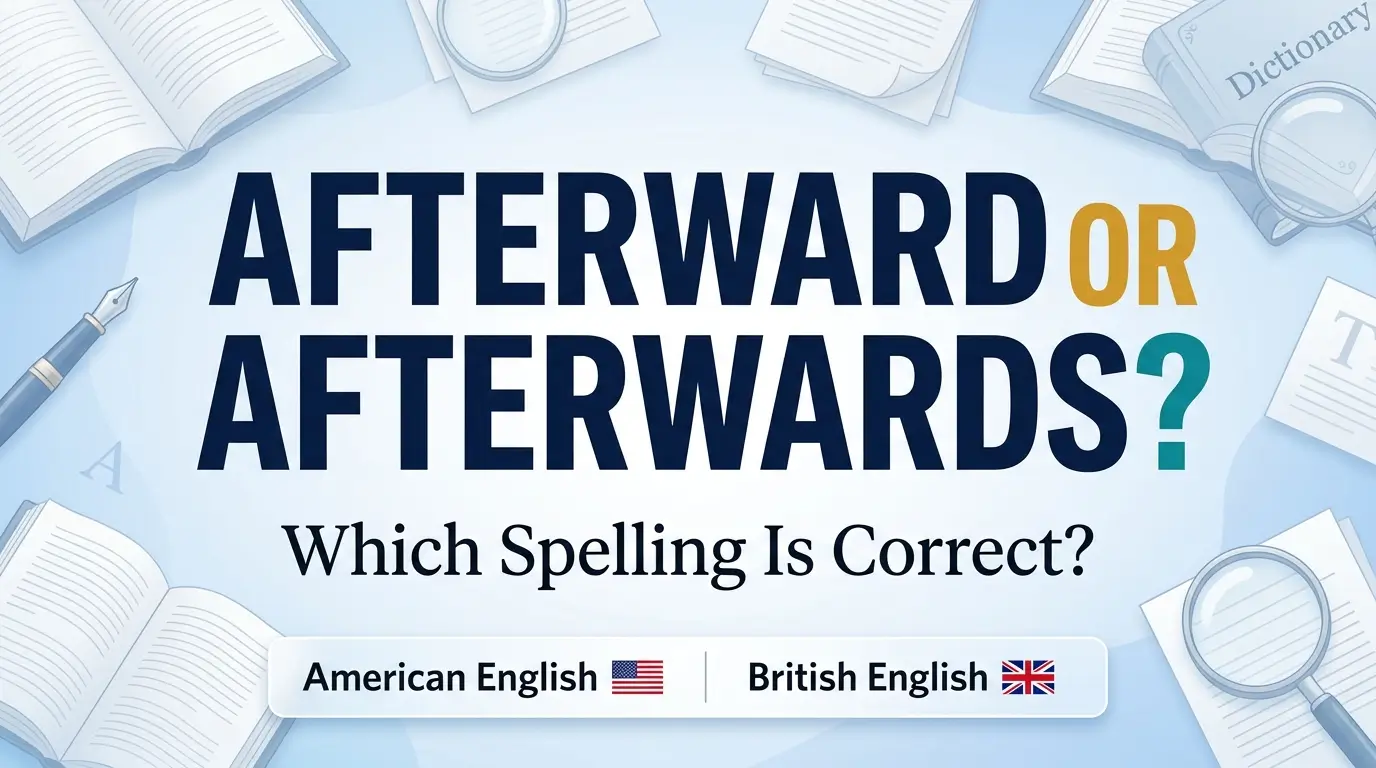
Both afterward and afterwards are correct. They have the same meaning: at a later time or after something has happened. The main difference is where each spelling is more common. American English often uses afterward, while British English often uses afterwards.
Afterward or Afterwards – Quick Answer
Both afterward and afterwards are correct English words. They are adverbs that mean later, after that, or at a time following an event.
The difference is mainly regional preference.
- Afterward: More common in American English.
- Afterwards: Especially common in British English.
- Meaning: The same in both forms.
- Grammar: Both are correct in everyday and formal writing.
Examples
Using afterward:
- We finished our dinner and went for a walk afterward.
- She called me shortly afterward.
- I realized my mistake afterward.
Using afterwards:
- We finished our dinner and went for a walk afterwards.
- She called me shortly afterwards.
- I realized my mistake afterwards.
All six sentences are correct. The final s in afterwards does not change the meaning.
Cambridge Dictionary identifies afterward with American English and afterwards mainly with British English.
The Origin of Afterward or Afterwards
The words afterward and afterwards developed from older forms of English. Their history helps explain why both spellings exist today.
The Meaning of the Word After
The word after has Old English roots. It has long been used to describe something that comes later in time or follows another event.
For example:
- We ate after the game.
- She arrived after her brother.
- They spoke after the meeting.
In these sentences, after shows the relationship between two events or times.
How Afterward Developed
The word afterward combines after with ward, an ending used to express direction or movement toward something. Over time, the word also came to express movement forward in time.
Today, afterward means something happens at a later time.
For example:
“We visited the museum and had lunch afterward.”
The word afterward tells us when lunch happened.
Why Does Afterwards Have an Extra S?
The form afterwards includes a final s. This form became established in English and is now especially common in British usage.
English has other word pairs with a similar pattern, including:
- Toward and towards
- Forward and forwards
- Backward and backwards
These pairs show that English sometimes has two accepted forms of a word. Their use may depend on regional habits and writing style.
The final s in afterwards does not make it plural. It is simply part of that established word form.
Are Both Forms Still Used Today?
Yes. Both forms are standard English. American writers often prefer afterward, while British writers commonly choose afterwards.
Neither spelling is universally better. The best choice depends on your audience and the style of English you follow.
British English vs American English Spelling
The difference between afterward and afterwards is easy to understand once you know the usual preferences in each variety of English.
American English tends to favor the shorter form. British English tends to favor the form ending in s. However, this is a general pattern, not a strict rule that makes the other form incorrect.
Afterward in American English
In the United States, afterward is the usual choice in many kinds of writing.
You may see it in school assignments, newspapers, business emails, novels, and websites.
Examples:
- We will discuss the report afterward.
- The manager spoke to the team afterward.
- She felt better shortly afterward.
- Please send me the details afterward.
These sentences sound natural in American English.
Afterwards in British English
In the United Kingdom, afterwards is a common and natural choice.
Examples:
- We went to the park and had lunch afterwards.
- She spoke to her teacher afterwards.
- They visited their friends shortly afterwards.
- The meeting ended, and everyone left afterwards.
British readers will generally find this form familiar.
Comparison Table: American vs British English
| Feature | Afterward | Afterwards |
| Meaning | At a later time | At a later time |
| Part of speech | Adverb | Adverb |
| American English | Usually preferred | Also correct |
| British English | Also correct | Commonly preferred |
| Formal writing | Appropriate | Appropriate |
| Informal writing | Appropriate | Appropriate |
| Example | We talked afterward. | We talked afterwards. |
Does Formal Writing Change the Rule?
No. Neither form is inherently more formal than the other.
For example, both sentences are suitable for a professional report:
- The team reviewed the results afterward.
- The team reviewed the results afterwards.
If your report follows American English, afterward is usually the better choice. If it follows British English, afterwards may fit better.
Always follow your organization’s style guide when one is provided.
Which Spelling Should You Use?
The right choice depends on who will read your writing. You do not need to learn two different meanings because both words express the same idea.
If You Are Writing for an American Audience
Choose afterward as your default.
This is a good choice for:
- US school assignments
- American business emails
- US news articles
- American English blogs
- College essays and reports
Example:
“We will review your application and contact you afterward.”
If You Are Writing for a British Audience
Choose afterwards as your default.
It is common in British English and fits many UK focused articles, emails, and reports.
Example:
“We will review your application and contact you afterwards.”
If You Are Writing for Australian or New Zealand Readers
Both forms are understood. Regional preferences and editorial rules can vary, so follow the style used by your publication or organization.
If you are unsure, check a trusted local dictionary or the style guide used by your workplace.
If You Are Writing for a Global Audience
Either form can work. The most important thing is to make your writing clear and consistent.
For example, if you use American English throughout your website, use afterward consistently. If you use British English, afterwards is a natural choice.
Professional advice: For a website aimed at US readers, use afterward. For a website aimed at UK readers, use afterwards. Do not change your spelling just because the other form appears in another article.
Common Mistakes with Afterward or Afterwards
These words are easy to use, but a few mistakes can confuse English learners.
Mistake 1: Thinking Afterwards Is Wrong
Some writers believe that afterwards is incorrect because it has an extra letter.
That is not true. Both forms are accepted English words.
Incorrect claim: “Afterwards is always wrong.”
Correct explanation: “Afterwards is correct, especially in British English.”
Mistake 2: Thinking Afterward Is Only Used in America
Although afterward is especially common in American English, it is not limited to the United States.
British readers can understand and use it too.
Example:
“We spoke to the manager afterward.”
This sentence is grammatically correct.
Mistake 3: Mixing Both Forms Without a Reason
Using both forms in one document is not necessarily a grammar error. However, switching between them without a clear reason can make your writing look inconsistent.
Less consistent:
“We went home afterward. We met our friends afterwards.”
More consistent in American English:
“We went home afterward. We met our friends afterward.”
More consistent in British English:
“We went home afterwards. We met our friends afterwards.”
Choose the form that fits your preferred style.
Mistake 4: Confusing Afterward with Afterword
This is an important spelling difference.
Afterward is an adverb meaning later.
Example: “We discussed the decision afterward.”
Afterword is a noun that refers to a section at the end of a book.
Example: “The author added an afterword to explain the story.”
These words look similar but have different meanings.
Mistake 5: Writing After Word as Two Words
When you mean later, write afterward or afterwards as one word.
Incorrect: “We talked after word.”
Correct: “We talked afterward.”
Mistake 6: Using Both Words Together
Avoid unnecessary repetition.
Wordy: “We finished the meeting and discussed it afterward later.”
Better: “We finished the meeting and discussed it afterward.”
The word already tells the reader that something happened later.
Afterward or Afterwards in Everyday Examples
Both forms work in many situations. The following examples show how to use them naturally in different types of writing.
In Emails
American English:
“Thank you for attending the meeting. I will send you the notes afterward.”
British English:
“Thank you for attending the meeting. I will send you the notes afterwards.”
Both versions are polite and professional.
In News Articles
American English:
“The company announced the new plan and explained its impact afterward.”
British English:
“The company announced the new plan and explained its impact afterwards.”
News writers should follow the spelling conventions of their publication.
On Social Media
American English:
“We had a great time at the concert! We went out for dinner afterward.”
British English:
“We had a great time at the concert! We went out for dinner afterwards.”
Both sound natural in casual posts.
In Academic Writing
American English:
“The researchers collected the data and analyzed it afterward.”
British English:
“The researchers collected the data and analyzed it afterwards.”
In academic writing, consistency is more important than choosing one form as universally correct.
In Formal Reports
American English:
“The committee reviewed the proposal and issued its recommendation afterward.”
British English:
“The committee reviewed the proposal and issued its recommendation afterwards.”
Both sentences are clear and professional.
At the Beginning of a Sentence
You can also place either word at the start of a sentence.
- Afterward, we returned to the office.
- Afterwards, we returned to the office.
A comma after the opening word is appropriate in these examples.
With the Word Shortly
Both combinations are correct:
- Shortly afterward, the doors opened.
- Shortly afterwards, the doors opened.
The word shortly means soon, so these phrases mean soon after the event being discussed.
Afterward or Afterwards – Google Trends & Usage Data
People search for afterward or afterwards because the two words look almost identical, and many English learners want to know which spelling is correct. The answer depends mainly on regional usage, not grammar.
Which Countries Use Each Form?
Afterward is generally the preferred form in American English. It is a useful default for US focused blogs, essays, and professional documents. Afterwards is especially common in British English and is a natural choice for UK focused writing.
Australia and other English speaking regions
Both forms are understood. The preferred form can depend on local usage and the publication’s style guide.
These are general usage patterns, not exclusive rules. Both forms are correct English.
What Does Google Trends Tell Us?
Google Trends can help compare search interest for afterward and afterwards over time and across countries. However, search interest is not the same as actual word usage.
I have not verified a live Google Trends comparison for these terms, so I will not give made up search volumes, percentages, or country rankings.
You can explore the comparison directly here:
Compare afterward vs afterwards on Google Trends
When reviewing the results, select a country such as the United States or United Kingdom and compare the terms over the same period. Remember that Google Trends uses a relative interest scale from 0 to 100, not exact search counts.
Why Do People Search for This Keyword?
Common reasons include:
- They want to know whether both spellings are correct.
- They are writing an essay, email, or blog post.
- They want to follow American or British English rules.
- They are learning English and need a simple grammar explanation.
- They want to avoid spelling mistakes in professional writing.
For this keyword, the most useful answer is straightforward: both spellings are correct, and regional preference is the main difference.
Afterward vs Afterwards: Comparison Table
Use this table for a quick review of the two forms.
| Comparison | Afterward | Afterwards |
| Correct spelling? | Yes | Yes |
| Meaning | Later; after that | Later; after that |
| Grammar | Adverb | Adverb |
| Common in US English | Yes | Less typical |
| Common in UK English | Used | Yes |
| Suitable for emails | Yes | Yes |
| Suitable for essays | Yes | Yes |
| More formal? | No | No |
| Example | I called afterward. | I called afterwards. |
The choice does not change the meaning of your sentence. Pick the form that matches your audience and use it consistently.
Frequently Asked Questions
1. Is afterward or afterwards correct?
Both are correct. Afterward is more common in American English, while afterwards is especially common in British English. Both mean “at a later time.”
2. Is afterwards one word or two?
Afterwards is one word. When you mean “later,” do not write it as two separate words.
Correct: “We talked afterwards.”
Incorrect: “We talked after wards.”
3. Is afterward American or British English?
Afterward is especially associated with American English. However, it is also understood and used in British English.
4. Is afterwards British English?
Yes. Afterwards is especially common in British English. It is also used in other varieties of English, including American English, although it is less typical in the United States.
5. Can I use afterward in formal writing?
Yes. Afterward is suitable for formal writing, including reports, essays, academic work, and professional emails. Use it when it fits your chosen style of English.
6. Do afterward and afterwards mean the same thing?
Yes. Both mean “later” or “after something has happened.” The extra s does not change the meaning.
For example:
- We ate dinner afterward.
- We ate dinner afterwards.
Both sentences mean that dinner happened after an earlier event.
7. What is the difference between afterword and afterward?
Afterward means later, while afterword is a section at the end of a book.
Examples:
- We discussed the plan afterward.
- The writer added an afterword to the book.
Do not confuse these two words.
8. Should I use afterward or afterwards in an SEO article?
Choose based on your target audience. If your article targets readers in the United States, afterward is generally the better default. If it targets readers in the United Kingdom, afterwards is a natural choice.
Use your chosen form consistently, but do not force the keyword into every paragraph. Clear, natural writing should come first.
Conclusion
Both afterward and afterwards are correct English words. They have the same meaning and grammatical role, so you do not need to worry that one form is always wrong. The main difference is regional preference.
In American English, afterward is generally more common. In British English, afterwards is especially common. Both forms are suitable for everyday conversations, emails, school assignments, reports, and other types of writing.
If you are writing for an American audience, choose afterward. If your readers are mainly British, afterwards is a natural choice. For a global audience, either form works well, provided you follow your preferred style consistently.
Remember to distinguish these words from afterword, which means a section at the end of a book. This small spelling difference changes the meaning completely.
Ultimately, the best answer to “afterward or afterwards” is simple: both are correct, and your audience determines which form is the better choice.
Discover More Post
- Ageing or Aging: Which Spelling Is Correct?
- Period Inside or Outside Quotes? American vs. British Rules
- Their or There: What Is the Difference? (2026 Guide)
Toni Morrison is a celebrated American novelist known for her powerful storytelling, rich characters, and lasting impact on literature. At GrammerNests.com, she shares insights that help readers appreciate language, writing, and literary expression.








3 thoughts on “Afterward or Afterwards: Which Spelling Is Correct?”