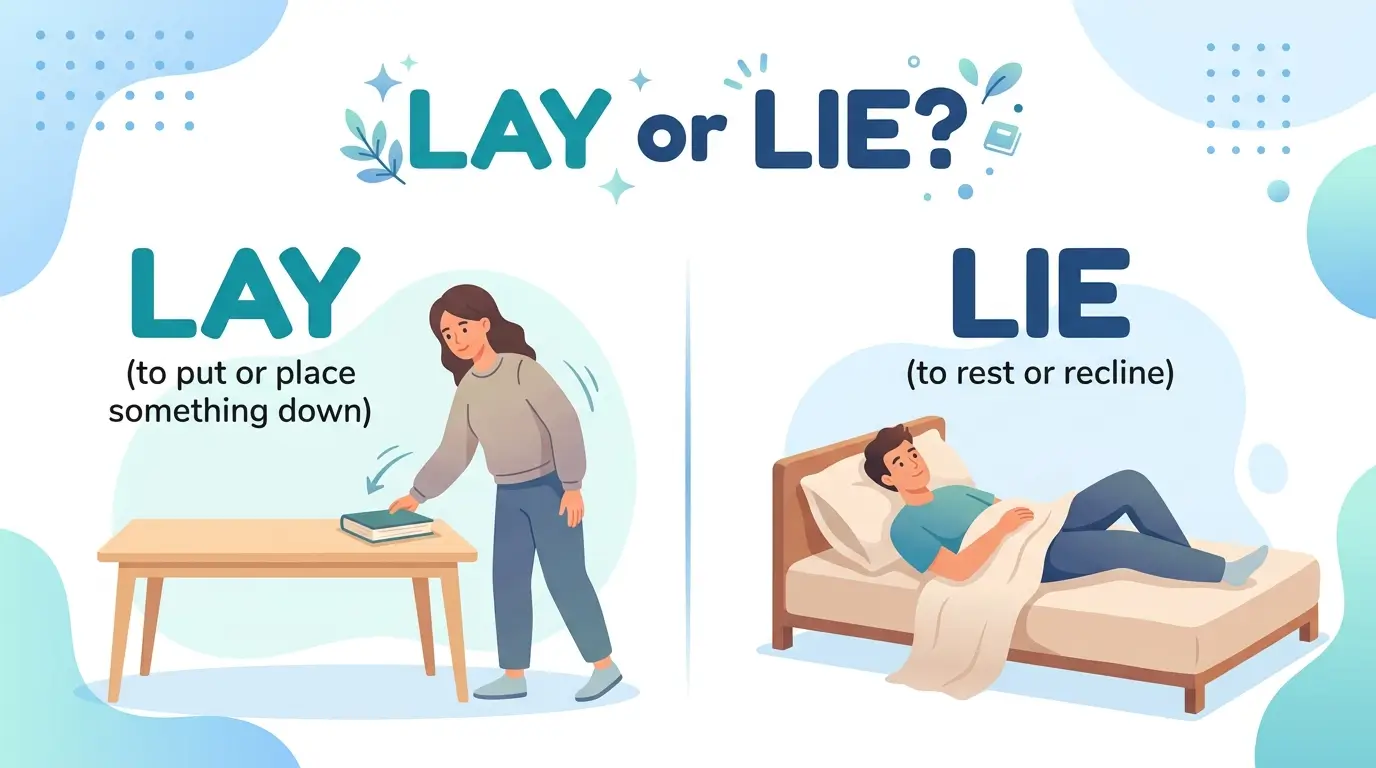
Have you ever stopped while writing because you were unsure whether to use lay or lie? You are not alone. These two words confuse many English learners and even native speakers. They look similar, sound similar, and have forms that can make the rules seem harder than they are.
The main difference is simple: lay means to put something down, while lie means to rest or recline. The tricky part is that the past tense of lie is lay. This overlap often causes mistakes in emails, school assignments, blog posts, and everyday conversations.
For example, you can lay a book on a table, but you can lie on a bed. The book is the thing you put down. You are the person who rests.
In this guide, you will learn the meanings of lay and lie, their word origins, American and British usage, common mistakes, and easy examples. You will also learn how to choose the correct word in both everyday and formal writing.
By the end, you will have a simple way to remember the difference and use both words with confidence.
Lay or Lie – Quick Answer
The quickest way to remember the difference is this:
- Lay means to put something down. It needs an object.
- Lie means to rest or be in a flat position. It does not need an object.
Cambridge Dictionary explains this key grammar rule in its guide to these verbs.
When to Use Lay
Use lay when you put a person or thing somewhere.
Examples:
- Please lay the book on the table.
- I lay my phone beside my bed every night.
- She lays the baby in the crib.
Ask yourself: What am I putting down? If you can name the thing, lay may be the correct verb.
When to Use Lie
Use lie when you or another person or thing rests or stays in a position.
Examples:
- I want to lie down.
- She lies on the sofa after work.
- The dog is lying near the door.
Ask yourself: Is the person or thing resting? If yes, lie is usually the right choice.
The Tricky Part: Past Tense
The past tense of lie, meaning to rest, is lay. That is where many people get confused.
- Today: I lie on the bed.
- Yesterday: I lay on the bed.
- Every night: I lay the blanket on the bed.
- Yesterday: I laid the blanket on the bed.
Notice that lay can be a present-tense verb meaning “put something down” or a past-tense verb meaning “rested.”
The Origin of Lay or Lie
The words lay and lie have long histories in English. Their meanings are related, but their grammar is different.
The Origin of Lay
Lay comes from Old English lecgan, which meant to place or set something down. Its basic meaning remains much the same today.
For example:
- Lay your keys on the desk.
- She laid the clothes on the bed.
- They have laid the foundation for a new building.
The verb lay usually acts on something. In grammar, that thing is called a direct object.
In “Lay your keys on the desk,” the word keys is the object.
The Origin of Lie
Lie, meaning to rest or recline, comes from a different Old English verb, licgan. It referred to being in a resting or horizontal position.
Examples include:
- I lie on the sofa.
- The cat lies beside the window.
- He lay on the grass yesterday.
Unlike lay, this verb does not need a direct object.
Why Are Lay and Lie So Easy to Confuse?
The main reason is that their verb forms overlap.
The forms of lay are:
- Present: lay
- Past: laid
- Past participle: laid
- -ing form: laying
The forms of lie, meaning to rest, are:
- Present: lie
- Past: lay
- Past participle: lain
- -ing form: lying
The word lay is both the base form of one verb and the past form of another. This overlap makes the difference harder to remember.
There is also another verb, lie, meaning to say something that is not true. Its forms are lie, lied, lied, and lying.
These different meanings and verb forms explain why even fluent English speakers sometimes make mistakes.
British English vs American English Spelling
Unlike words such as colour and color, lay and lie are not mainly a British-versus-American spelling issue. The same basic grammar rules apply in both varieties of English.
The real difference is between the meanings and verb forms.
Lay and Lie in American English
American English uses the standard distinction between the two verbs.
Examples:
- I need to lie down for a while.
- Please lay the papers on my desk.
- Yesterday, I lay on the couch.
- Yesterday, I laid the papers on my desk.
In casual American speech, some people say “I need to lay down” when they mean “I need to lie down.” However, lie down is the standard choice when the subject is resting without an object.
Lay and Lie in British English
British English follows the same core distinction.
Examples:
- I am going to lie down.
- Please lay the table before dinner.
- She lay on the bed yesterday.
- She laid the book on the desk yesterday.
In British English, the expression lay the table means to put plates, cutlery, and other items on a table before a meal. This is a correct use of lay because the items are being placed.
Comparison Table: American vs British English
| Feature | American English | British English |
| Put something down | Lay | Lay |
| Rest or recline | Lie | Lie |
| Past tense of resting lie | Lay | Lay |
| Past tense of placing lay | Laid | Laid |
| Past participle of resting lie | Lain | Lain |
| Present participle of resting lie | Lying | Lying |
| Common casual expression | “I need to lay down” is heard | “I need to lay down” is also heard |
| Standard formal choice for resting | Lie down | Lie down |
The standard grammar is the same in both countries. For formal writing, use the correct verb form rather than relying on casual speech.
Which Spelling Should You Use?
Choosing between lay and lie is not about choosing American or British spelling. It is about understanding what the verb means in your sentence.
If You Are Writing for an American Audience
Follow the standard grammar rules:
- “I want to lie down.”
- “Lay the book on the desk.”
- “I lay down yesterday.”
- “I laid the book down yesterday.”
These forms are suitable for US schoolwork, blogs, business emails, and professional reports.
If You Are Writing for a British Audience
Use the same rules:
- “I want to lie down.”
- “Lay the book on the desk.”
- “I lay down yesterday.”
- “I laid the book down yesterday.”
You do not need to change these verbs to match British spelling conventions.
If You Are Writing for a Global Audience
Use standard grammar and choose examples that readers can understand easily.
For example:
“Please lay your bag on the chair. You can lie down and rest afterward.”
This sentence uses both verbs correctly. Lay describes placing the bag, while lie describes resting.
Professional Advice for Bloggers and Students
If you write articles, essays, or website content, focus on the meaning of the sentence instead of the country you are writing for.
A useful rule is:
Lay something; lie down.
Remember that the past tense changes this simple rule:
- Present: I lie down.
- Past: I lay down.
This distinction will help you write more clearly and avoid common grammar mistakes.
Common Mistakes with Lay or Lie
These are some of the most frequent errors and how to correct them.
Mistake 1: Saying “I Want to Lay Down”
Incorrect in standard grammar: “I want to lay down.”
Correct: “I want to lie down.”
Why? The person is resting. No object is being placed.
However, “I want to lay my baby down” is correct because baby is the object.
Mistake 2: Using Laid as the Past Tense of Resting Lie
Incorrect: “Yesterday, I laid on the bed.”
Correct: “Yesterday, I lay on the bed.”
The past tense of lie meaning to rest is lay, not laid.
Mistake 3: Writing “Layed”
Incorrect: “She layed the book on the table.”
Correct: “She laid the book on the table.”
The past tense of lay is laid. The spelling layed is incorrect for this verb.
Mistake 4: Confusing Lain and Laid
Incorrect: “I have laid in bed all morning.”
Correct: “I have lain in bed all morning.”
Use lain as the past participle of lie meaning to rest. Use laid as the past participle of lay meaning to put something down.
Mistake 5: Confusing Lying with Laying
Incorrect: “The dog is laying on the floor,” when you mean that the dog is resting.
Standard form: “The dog is lying on the floor.”
But this sentence is correct: “The dog is laying its toy on the floor,” because the toy is the object being placed.
Mistake 6: Confusing Lie with the Meaning “Tell an Untruth”
The verb lie also means to say something false. Its forms are different.
- Present: I lie about my age.
- Past: I lied about my age.
- Past participle: I have lied about my age.
Do not use lay or lain when you mean telling an untruth.
Mistake 7: Forgetting to Check the Object
Ask whether the sentence tells you that someone is placing something down or resting.
- “She laid the jacket on the chair.” Correct.
- “She lay on the chair.” Correct in the past tense.
- “She lies on the chair.” Correct in the present tense.
Looking for the object is one of the easiest ways to choose the right verb.
Lay or Lie in Everyday Examples
You can use both verbs in emails, news reports, social media posts, and formal writing. The important thing is to use the correct form for the meaning and tense.
In Emails
Correct:
“Please lay the documents on my desk before the meeting.”
Correct:
“I am feeling tired, so I may lie down before the meeting.”
The first sentence asks someone to place documents. The second describes resting.
In News Articles
Correct:
“The rescue team laid the injured man on a stretcher.”
Correct:
“The injured man lay on the stretcher while the team prepared to move him.”
The first sentence describes an action done to someone. The second describes the man’s position.
On Social Media
Correct:
“I just want to lie down and watch a movie.”
Correct:
“I laid my phone on the table and forgot about it.”
Both sentences are natural and easy to understand.
In Formal Writing
Correct:
“The committee laid out its plan for the next year.”
Correct:
“The documents have lain on the desk since Monday.”
The phrase laid out means presented or explained. In the second example, lain describes where the documents have remained.
In Everyday Conversation
Here are a few more examples:
- I lie down when I feel tired.
- My cat lies near the window.
- I lay down for an hour yesterday.
- I laid the towel on the chair.
- She has laid the plates on the table.
- The children have lain in the grass for an hour.
The key is to check both the meaning and the time of the action.
Lay or Lie – Google Trends & Usage Data
The keyword lay or lie is useful for people who want to improve their English grammar. Many learners search for this phrase because the verbs have similar meanings but different grammatical rules.
Why Do People Search for Lay or Lie?
Common reasons include:
- They want to know whether to write “lay down” or “lie down.”
- They are unsure about the past tense of lie.
- They need help with schoolwork or English tests.
- They want to write correct emails and articles.
- They want to understand the difference between laid, lay, and lain.
This keyword has clear educational intent. A useful article should answer the question quickly and then explain the rules with simple examples.
Which Countries Search for Lay or Lie?
English grammar questions can attract readers from many countries, including the United States, the United Kingdom, Canada, Australia, India, and Pakistan. However, without verified comparative data, it would be misleading to rank these countries by search interest for this exact keyword.
You can check current interest using Google Trends:
Google Trends lets you select countries, time periods, and search categories. Its interest scores are relative values, not exact search volumes.
What Does This Mean for SEO?
For an article targeting lay or lie, focus on the questions readers want answered:
- What is the difference between lay and lie?
- Is it “lay down” or “lie down”?
- What is the past tense of lie?
- Is it “laid” or “lain”?
- How do you use lay and lie in a sentence?
These questions closely match the keyword’s educational purpose. Answering them with clear examples can make the article more useful to readers.
Lay vs Lie: Comparison Table
Use this table to compare the main verb forms at a glance.
| Verb form | Lay (put something down) | Lie (rest or recline) |
| Present | Lay | Lie |
| Third-person present | Lays | Lies |
| Past tense | Laid | Lay |
| Past participle | Laid | Lain |
| -ing form | Laying | Lying |
| Needs a direct object? | Yes | No |
| Example | I lay the book down. | I lie on the bed. |
| Past example | I laid the book down. | I lay on the bed. |
| Perfect tense | I have laid the book down. | I have lain on the bed. |
Important: This table covers lie in the sense of resting. The separate verb lie, meaning to tell an untruth, follows a different pattern: lie, lies, lied, lied, lying.
Frequently Asked Questions
1. What is the main difference between lay and lie?
Lay means to put something down, while lie means to rest or recline. Lay takes an object; lie does not.
Example: “Lay the book on the desk” and “Lie on the bed.”
2. Is it lay down or lie down?
Use lie down when you mean to rest.
Correct: “I need to lie down.”
Use lay down when you put something down.
Correct: “I need to lay the baby down.”
In the past tense, however, “I lay down yesterday” is correct.
3. What is the past tense of lie?
When lie means to rest, its past tense is lay.
Example: “I lie on the sofa every evening. Yesterday, I lay there for an hour.”
When lie means to tell an untruth, the past tense is lied.
4. Is it laid or lain?
Use laid for the past tense and past participle of lay, meaning to put something down.
Use lain as the past participle of lie, meaning to rest.
Examples:
- “I laid the book on the table.”
- “I have lain in bed all morning.”
5. Is it correct to say “I laid down”?
It depends on the meaning. If you mean that you rested, the standard form is “I lay down” for the past tense. If you mean that you placed something down, laid down can be correct when an object is understood or stated.
For formal writing, use the standard distinction.
6. Is “laying in bed” correct?
If you mean that someone is resting in bed, the standard form is “lying in bed.”
Example: “She is lying in bed.”
Use laying when someone is putting something down.
Example: “She is laying the blanket on the bed.”
7. Do American and British English use lay and lie differently?
The core grammar rules are the same in American and British English. Both use lay for putting something down and lie for resting. Casual speech may differ, but formal writing should follow the standard forms.
8. How can I remember the difference between lay and lie?
Remember this short rule: Lay something; lie down.
- Lay the phone on the table.
- Lie on the sofa.
- I laid the phone down yesterday.
- I lay on the sofa yesterday.
The last two examples show why checking the tense matters.
Conclusion
The difference between lay and lie becomes easier when you focus on what the sentence means. Use lay when someone puts something down. Use lie when someone or something rests or stays in a position.
The most confusing part is the past tense. The past tense of lay is laid, while the past tense of lie, meaning to rest, is lay. Its past participle is lain. The separate verb lie, meaning to tell an untruth, uses lied for its past tense and past participle.
These rules apply to both American and British English. You may hear people use lay instead of lie in casual speech, but the standard forms are the better choice for schoolwork, professional emails, and website content.
When you are unsure, ask two questions: Am I putting something down, or am I resting? What tense do I need? These simple checks will help you choose the right word.
With practice, you can use lay, lie, laid, and lain with greater confidence and make your writing clearer.
Discover More Post
- Period Inside or Outside Quotes? American vs. British Rules
- Their or There: What Is the Difference? (2026 Guide)
- Afterward or Afterwards: Which Spelling Is Correct?

Emily Dickinson is one of America’s most influential poets, recognized for her unique style and thought-provoking poetry. Through GrammerNests.com, she contributes valuable perspectives on language, creativity, and the beauty of written expression.








2 thoughts on “Lay or Lie: What Is the Difference? Meaning, Rules, and Examples”