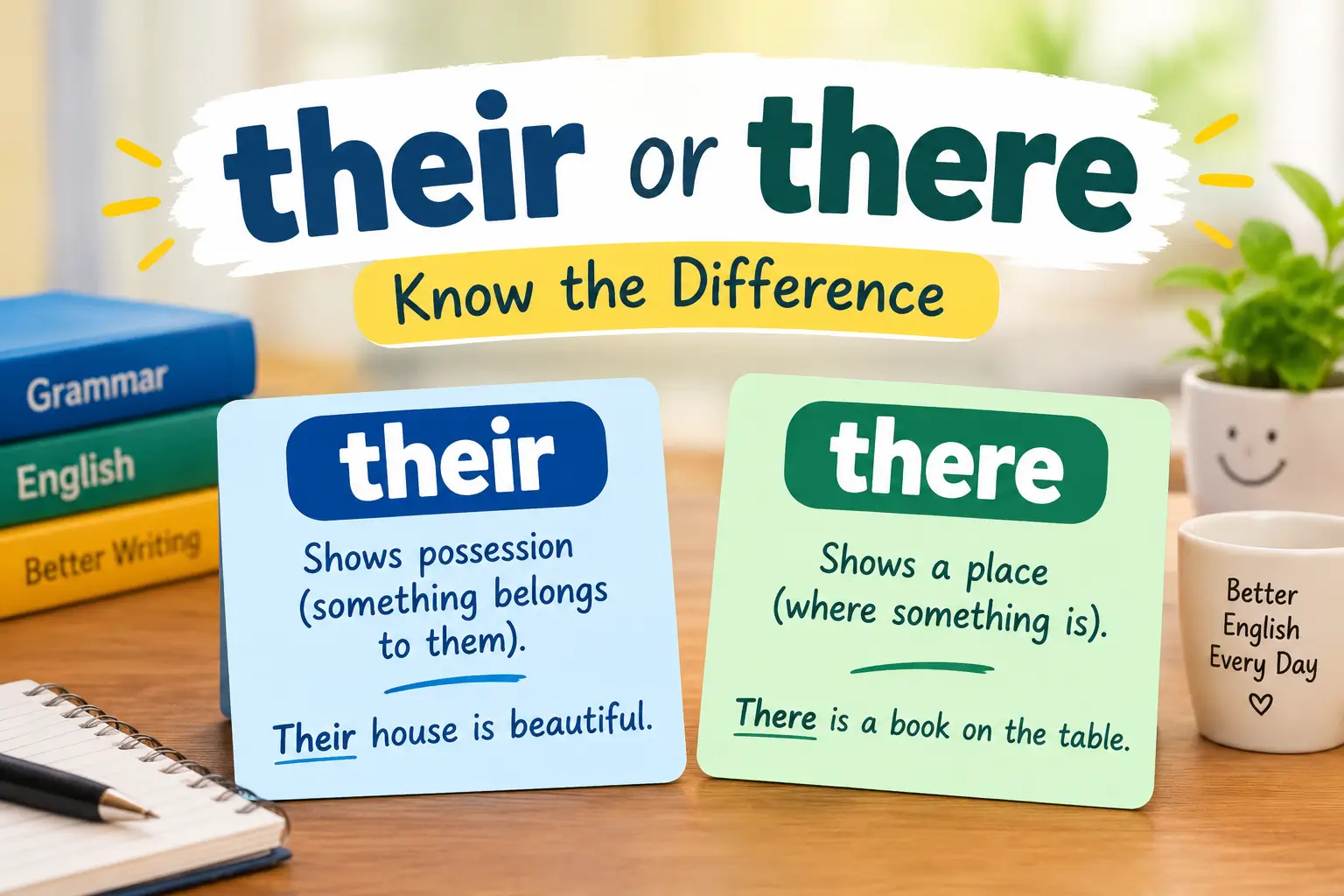
Do you ever stop while writing and wonder If to use their or there? You are not alone. These two words sound the same, but they have different meanings. Using the wrong word can make your writing look careless or change the meaning of a sentence.
Many students, English learners, bloggers, and professional writers search for “their or there” because these words are easy to mix up. They sound alike, so it can be hard to know which spelling is correct. However, each word has a clear purpose.
Their shows that something belongs to people or a group. For example, “The students brought their books.”
There points to a place or tells us that something exists. For example, “The books are over there” or “There is a book on the desk.”
The good news is that you can learn the difference with a few simple rules. In this guide, you will learn their meanings, origins, spelling rules, common mistakes, and everyday uses. You will also find clear examples and answers to common questions. By the end, you will know how to choose the right word in schoolwork, emails, social media posts, and formal writing.
Their or There – Quick Answer
The main difference between their and there is their meaning.
- Their: Shows ownership. It means that something belongs to two or more people, animals, or things.
- There: Refers to a place or shows that something exists.
Examples of Their
- The children packed their bags.
- The workers finished their tasks.
- The dogs wagged their tails.
- My friends shared their ideas.
In each sentence, “their” shows who owns something.
Examples of There
- Put your shoes over there.
- There is a cat outside.
- There are three books on the table.
- We went there yesterday.
In these sentences, “there” refers to a place or introduces something that exists.
Easy memory trick: Their has the word “heir,” which can help you think about inheritance and ownership. There contains the word “here,” which can remind you of a place.
Remember, this is only a memory trick. The meaning of the full sentence tells you which word to use.
The Origin of Their or There
The words “their” and “there” have different histories. Their meanings developed over time, which explains why English uses two different spellings.
The Origin of Their
The word “their” came into English through Old Norse influences. It developed from a form related to the Old Norse word þeira, meaning “of them.”
Old Norse was spoken by people in Scandinavia. Their language influenced English during the Viking Age.
Before “their” became common, English used other words to show ownership. Over time, “their” became a regular possessive word.
Today, we use it to show that something belongs to a group.
Examples:
- The teachers checked their lessons.
- The players wore their uniforms.
- The neighbors cleaned their gardens.
In modern English, “their” can also refer to one person when that person’s gender is unknown or when they use they/them pronouns.
Example: “Someone left their phone here.”
The Origin of There
The word “there” comes from Old English þǣr. It was used to refer to a place or location.
Over many centuries, the spelling changed as English developed. The modern form “there” became the standard spelling.
Today, “there” has two main uses.
First, it can point to a place.
Example: “Your jacket is over there.”
Second, it can introduce something that exists.
Example: “There is a problem with the computer.”
These uses have remained important in modern English.
Why Are Their and There Different?
English contains many words that sound alike but have different meanings and spellings. These words are called homophones.
“Their” and “there” are homophones because they usually sound the same in speech.
However, their meanings are different. One shows ownership, while the other refers to a place or existence.
Their shared pronunciation can cause mistakes, especially when people write quickly or rely on sound instead of meaning.
British English vs American English Spelling
British and American English use the same standard spellings for “their” and “there.”
Unlike words such as “colour” and “color,” these two words do not change spelling between the United Kingdom and the United States.
The difference is not about location or spelling rules. It is about how each word works in a sentence.
Comparison Table
| Feature | Their | There |
| Main meaning | Ownership | Place or existence |
| Part of speech | Possessive determiner | Adverb or introductory word |
| British spelling | Their | There |
| American spelling | Their | There |
| Example | They love their home. | Their home is over there. |
| Common error | Using it for a place | Using it to show ownership |
British English Examples
British writers use “their” to show ownership.
Example: “The pupils brought their lunch.”
They use “there” to refer to a place or show existence.
Example: “There are two buses outside.”
American English Examples
American writers follow the same rules.
Example: “The students finished their homework.”
Example: “There is a new store nearby.”
Do the Meanings Change by Country?
No. The basic meanings remain the same in British, American, Canadian, Australian, and other forms of English.
The words may appear in different accents, but their standard spellings do not change.
This makes the choice simple: focus on the meaning of the sentence rather than the country where the writer lives.
Which Spelling Should You Use?
You should choose “their” or “there” based on what you want to say. Your audience does not change the basic rule.
For American Readers
Use “their” when you mean that something belongs to people or a group.
Example: “The employees received their schedules.”
Use “there” when referring to a place or existence.
Example: “There is a meeting at noon.”
These rules apply to school assignments, websites, business emails, and everyday messages.
For British Readers
British English follows the same rules.
Example: “The children put their coats away.”
Example: “There is a train at the station.”
You do not need to change either spelling for a British audience.
For Canadian and Australian Readers
Canadian and Australian English also use both words in the same way.
Example: “The students submitted their work.”
Example: “There are many parks in the city.”
For Global English Writers
If you write for an international audience, focus on clear sentences.
Before publishing an article or sending a message, ask yourself:
- Does the sentence show ownership? Use “their.”
- Does it refer to a place? Use “there.”
- Does it say that something exists? Use “there.”
These questions help you avoid errors in any form of English.
Common Mistakes with Their or There
Many people confuse these words because they sound alike. The following mistakes are common, but they are easy to correct.
Mistake 1: Using There to Show Ownership
Incorrect: The students forgot there books.
Correct: The students forgot their books.
Why? The books belong to the students, so “their” is correct.
Mistake 2: Using Their to Refer to a Place
Incorrect: Put the bag over their.
Correct: Put the bag over there.
Why? The sentence refers to a location, not ownership.
Mistake 3: Confusing Their With They’re
“They’re” is a contraction of “they are.”
Incorrect: Their going to the park.
Correct: They’re going to the park.
You can also write: “They are going to the park.”
Remember these meanings:
- Their = belonging to them.
- There = a place or existence.
- They’re = they are.
Mistake 4: Using Their Instead of There Is
Incorrect: Their is a new shop near my house.
Correct: There is a new shop near my house.
Why? “There is” introduces something that exists. It does not show ownership.
Mistake 5: Choosing by Sound Alone
Incorrect: I left my keys over their.
Correct: I left my keys over there.
Why? The sentence tells you where the keys are, so “there” is needed.
Mistake 6: Making the Same Error in Formal Writing
Incorrect: The company changed there policies.
Correct: The company changed their policies.
Why? The policies belong to the company.
This type of error can make a report, email, or website article appear less professional. Always check the meaning before submitting your work.
Their or There in Everyday Examples
Understanding these words becomes easier when you see them in real situations.
In Emails
Professional emails often use “their” to discuss people, teams, or organizations.
Example: “All team members should bring their reports to the meeting.”
Use “there” to describe a place or situation.
Example: “There will be a meeting at 10 a.m.”
Both words are useful in workplace communication.
In News Articles
News writers use “their” when reporting on people and groups.
Example: “The players celebrated their victory after the match.”
They use “there” to introduce facts or events.
Example: “There were several delays at the airport.”
Correct word choice helps readers understand the news without confusion.
On Social Media
People often type quickly on social media, which can lead to spelling mistakes.
Incorrect: “Your friends are waiting over their.”
Correct: “Your friends are waiting over there.”
Another example:
Incorrect: “There photos look amazing.”
Correct: “Their photos look amazing.”
Before posting, read the sentence again. Check whether you mean a place or ownership.
In School Assignments
Students need both words for essays, reports, and homework.
Example with “their”: “The students shared their opinions.”
Example with “there”: “There are several reasons for this change.”
Using the correct word makes your writing easier to understand.
In Formal Writing
Formal writing requires careful grammar and spelling.
Incorrect: “The researchers presented there findings.”
Correct: “The researchers presented their findings.”
Another example:
“There is strong evidence to support this claim.”
These examples show how the words serve different purposes in academic and professional work.
Their or There – Google Trends and Usage Data
People search for “their or there” when they want to improve their spelling, understand English grammar, or correct a sentence.
The topic is especially useful for students, English learners, teachers, bloggers, and people who write for work.
Why Do People Search for This Keyword?
There are several reasons.
1. English learning
People learning English often find homophones difficult because different words can sound alike.
2. School and homework
Students may search for the difference while writing essays, completing grammar exercises, or preparing for tests.
3. Professional writing
Workers and business owners need correct spelling in emails, reports, and documents.
4. SEO and content writing
Bloggers and website owners want to avoid grammar mistakes that may reduce reader trust.
Which Countries Use These Words?
“Their” and “there” are used in English-speaking countries around the world, including:
- United States
- United Kingdom
- Canada
- Australia
- New Zealand
- Ireland
English learners in Pakistan, India, and other countries also use these words when studying or writing in English.
What Does Google Trends Tell Us?
Google Trends can help compare search interest for phrases such as “their or there,” “their vs there,” and “there vs their.”
However, search interest is not the same as the number of searches. Google Trends uses a normalized scale, typically from 0 to 100, to show relative interest within the selected time and region.
Without a live Google Trends comparison, exact country rankings, current search volumes, and popularity scores cannot be confirmed here.
You can explore the topic directly using the Google Trends comparison tool.
For content writers, the practical lesson is simple: answer the reader’s main question early, explain the differences with examples, and include related questions naturally.
Their vs There: Comparison Table
Use this table to review the two words at a glance.
| Sentence | Correct Word | Reason |
| They washed ___ cars. | Their | Shows ownership |
| Put the box over ___. | There | Refers to a place |
| ___ is a dog outside. | There | Shows existence |
| The children lost ___ toys. | Their | Shows ownership |
| We went ___ last week. | There | Refers to a place |
| The workers finished ___ jobs. | Their | Shows ownership |
| ___ are five people in the room. | There | Introduces people who exist |
| They invited ___ friends. | Their | Shows ownership |
A Simple Test
Try replacing the word with “belonging to them.”
If the sentence still makes sense, “their” may be correct.
Example: “They brought their books.”
They brought the books belonging to them. This makes sense.
For “there,” try replacing it with “in that place” when the sentence refers to a location.
Example: “The children are there.”
The children are in that place. This makes sense.
For sentences such as “There is a book,” think of “there” as a word that introduces something that exists.
These quick tests can help you choose the right spelling.
FAQs About Their or There
1. What is the main difference between their and there?
“Their” shows ownership, while “there” refers to a place or introduces something that exists.
Example: “Their house is over there.”
2. Is their or there correct?
Both words are correct, but they have different meanings. Choose “their” for ownership and “there” for a place or existence.
3. How do I remember their vs there?
Use “their” when something belongs to people. Use “there” when you refer to a place or say that something exists.
4. Is their used in British English?
Yes. British English uses “their” to show ownership, just like American English.
5. Is there used in American English?
Yes. American English uses “there” to refer to a place or introduce something that exists.
6. What is the difference between their, there, and they’re?
“Their” shows ownership. “There” refers to a place or existence. “They’re” means “they are.”
Examples:
- Their dog is friendly.
- Their dog is over there.
- They’re playing outside.
7. Can their and there be used in the same sentence?
Yes. Both words can appear in one sentence because they have different meanings.
Example: “Their bags are over there.”
“Their” shows who owns the bags, while “there” tells you where the bags are.
8. Why do their and there sound the same?
They are homophones in most English accents. Their spellings and meanings differ, even though their pronunciation is usually the same.
Conclusion
Understanding their or there is an important step toward better English writing. Although these words sound the same, they have different meanings and uses. The easiest way to choose the correct word is to focus on the sentence rather than its sound.
Use “their” when you want to show ownership. For example, “The students brought their books.” Use “there” when you refer to a place, as in “The books are over there.” You can also use “there” to introduce something that exists, as in “There are two books on the desk.”
Remember that British, American, Canadian, and Australian English follow the same spelling rules for these words. You do not need to change their spelling based on your audience.
If you are unsure, pause and ask yourself what the sentence means. A quick check can prevent common errors in emails, schoolwork, social media posts, and professional documents.
With regular practice, you will learn to use both words correctly. Keep these simple rules in mind, and your writing will become clearer, more accurate, and easier to read.
Discover More Post
- Lay Down or Lie Down: Which Is Correct?
- Ageing or Aging: Which Spelling Is Correct?
- Period Inside or Outside Quotes? American vs. British Rules









1 thought on “Their or There: What Is the Difference? (2026 Guide)”