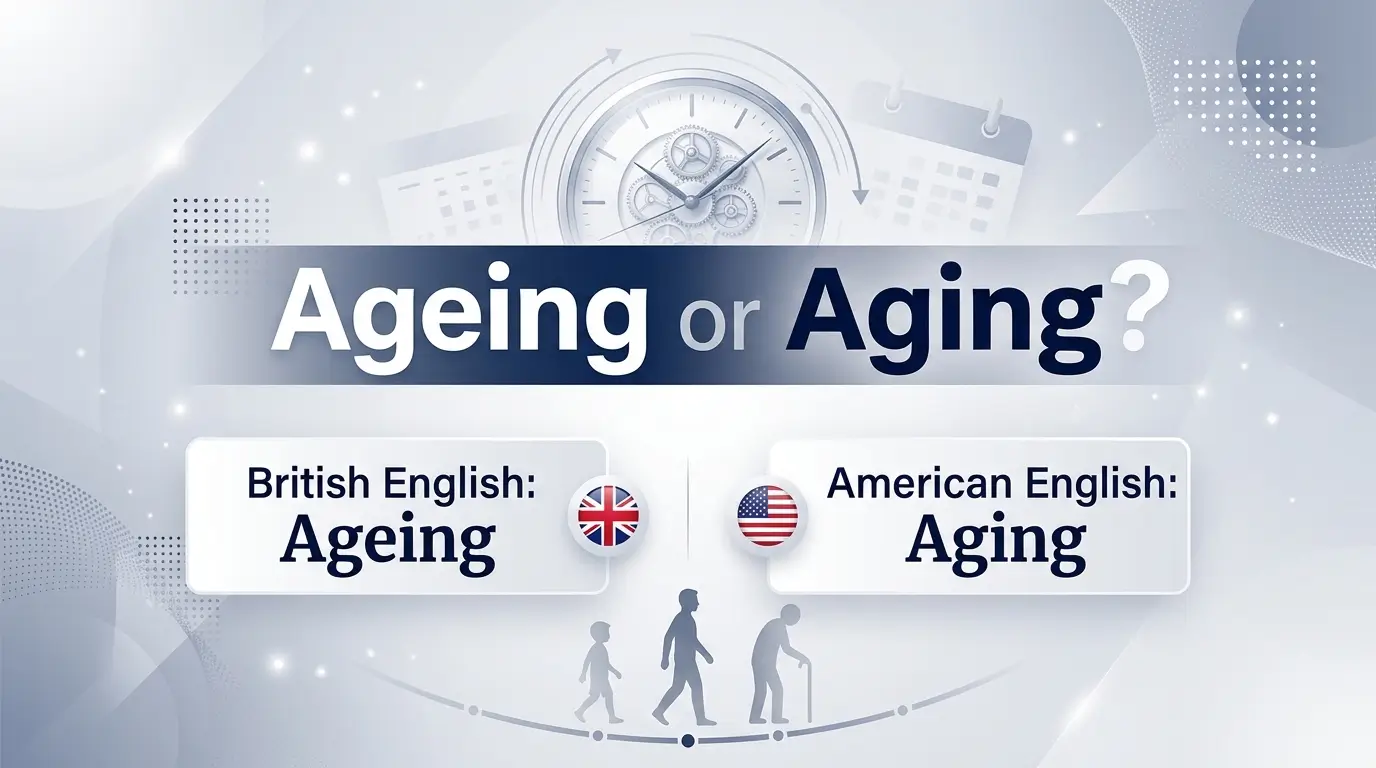
If you have ever written “ageing” or “aging” and stopped to wonder which spelling is correct, you are not alone. Both forms are correct, but the right choice depends mainly on the type of English you are using.
People often search for “ageing or aging” because British and American English use different spelling patterns. This can cause confusion in school assignments, emails, websites, reports, and professional writing.
The good news is simple: “ageing” is the standard British spelling, while “aging” is the standard American spelling. The meaning is the same. Both words describe the process of becoming older or causing something to become older.
For example, a British writer may say, “The population is ageing.” An American writer would normally write, “The population is aging.”
This guide explains the difference between ageing and aging, where the spellings come from, which form you should use, common mistakes, and real life examples. By the end, you will know exactly which spelling fits your audience.
Ageing or Aging – Quick Answer
Both ageing and aging are correct spellings.
The main difference is regional English:
- Ageing = preferred in British English
- Aging = preferred in American English
Both forms come from the verb age.
Examples
British English:
The population is ageing rapidly.
American English:
The population is aging rapidly.
The meaning does not change.
The same difference appears with other words ending in ing. British English often keeps the final e in some words, while American English may remove it.
For example:
| British English | American English |
| ageing | aging |
| ageing population | aging population |
| ageing process | aging process |
So, if you write mainly for readers in the United States, choose aging. If your audience is mainly in the United Kingdom, choose ageing.
The Origin of Ageing or Aging
The word age has a long history. It comes from Old French and ultimately traces back to Latin roots connected with a period or stage of life.
The verb age means to grow older or to make something older. When we add ing, we create the present participle:
age + ing
Over time, English developed different spelling conventions in different regions.
British English generally retained ageing, while American English commonly adopted aging.
This difference is part of a wider pattern between British and American English. English spelling changed in several ways as American English developed its own conventions.
American spelling became more standardized in the 18th and 19th centuries. Writers and dictionaries helped establish forms that were sometimes shorter or different from traditional British spellings.
This does not mean that one spelling is correct and the other is wrong.
Ageing is not an old fashioned mistake, and aging is not an incorrect shortened version. Both are accepted forms.
The important point is consistency. If you start a formal document using British spelling, it is usually better to continue using British spelling throughout the document.
British English vs American English Spelling
The clearest difference is regional preference.
British English normally uses ageing, while American English normally uses aging.
British English
In British English, ageing is widely used.
Examples:
- The ageing population needs better healthcare.
- Scientists study the ageing process.
- Ageing can affect physical and mental health.
- The building is showing signs of ageing.
American English
In American English, aging is the normal spelling.
Examples:
- The aging population needs better healthcare.
- Scientists study the aging process.
- Aging can affect physical and mental health.
- The building is showing signs of aging.
Comparison Table
| Meaning | British English | American English |
| Becoming older | ageing | aging |
| Population becoming older | ageing population | aging population |
| Process of getting older | ageing process | aging process |
| Signs of getting older | signs of ageing | signs of aging |
| Related research | ageing research | aging research |
| Effects of getting older | effects of ageing | effects of aging |
The pronunciation and meaning are essentially the same. The spelling is the main difference.
Which Spelling Should You Use?
Your choice should depend on your audience.
If You Write for the United States
Use aging.
For example:
The aging population is creating new challenges.
If your website targets American readers, aging is usually the better choice.
If You Write for the United Kingdom
Use ageing.
For example:
The ageing population is creating new challenges.
This spelling fits British English conventions.
If You Write for Commonwealth Countries
Countries such as the United Kingdom, Australia, and other regions influenced by British English often use ageing.
However, English usage can vary by country, institution, publication, and style guide. When writing professionally, follow the spelling preferred by your target publication or organization.
If You Write for a Global Audience
Either spelling can work, but consistency matters most.
If your website mainly targets American readers, use aging throughout your content.
If your website follows British English, use ageing throughout.
Do not switch between the two forms without a reason.
Common Mistakes with Ageing or Aging
Many mistakes happen because writers are unsure whether the word should keep the e.
Mistake 1: Mixing Both Spellings
A writer may use ageing in one paragraph and aging in another.
For example:
The ageing population is growing. Aging is becoming an important social issue.
This is not necessarily grammatically wrong, but it creates inconsistent spelling.
Better: Choose one spelling based on your target audience.
Mistake 2: Thinking “Ageing” Is Wrong
Some American readers may think ageing is a spelling mistake.
It is not.
Ageing is a standard British English spelling.
Mistake 3: Thinking “Aging” Is Wrong
Likewise, aging is not an incorrect spelling.
It is the standard American English form.
Mistake 4: Changing the Spelling Without Checking the Audience
A writer may automatically change aging to ageing because they believe the longer form is more correct.
The opposite can also happen.
Always consider who will read your content.
Mistake 5: Using Both Forms in SEO Content
If you are writing an article for a specific country, keep the preferred spelling consistent.
For a US audience:
aging
aging population
aging process
For a UK audience:
ageing
ageing population
ageing process
Ageing or Aging in Everyday Examples
The spelling difference becomes easier to understand when you see the words in real situations.
In Emails
British English:
We are reviewing our services for an ageing population.
American English:
We are reviewing our services for an aging population.
Both sentences are correct.
In News Writing
British English:
The government has announced new plans to support the ageing population.
American English:
The government has announced new plans to support the aging population.
News organizations usually follow their own style guides, so their preferred spelling may depend on location.
On Social Media
A British user might write:
Ageing is a natural part of life.
An American user might write:
Aging is a natural part of life.
Social media is less formal, but regional spelling still appears.
In Formal Writing
British English:
The study examines the effects of ageing on health.
American English:
The study examines the effects of aging on health.
For academic or professional writing, follow the spelling rules required by your school, university, employer, or publication.
Ageing or Aging – Google Trends & Usage Data
Search interest for ageing and aging varies strongly by country.
This makes sense because people generally search using the spelling they see in their local version of English.
In the United States, searches and online content commonly use aging.
In the United Kingdom, ageing is more common.
The same regional pattern can appear in other English speaking countries, although individual usage can vary.
For SEO, this difference is important.
If you are creating content for an American audience, your main keyword should normally use aging.
If your target audience is British, ageing may be the better primary keyword.
You can still mention the alternative spelling naturally. For example:
In American English, “aging” is preferred, while British English usually uses “ageing.”
This helps your article answer both forms without making the content look unnatural.
Search trends can also change over time. Google Trends is useful for comparing regional interest, but search volume should not be treated as a fixed number. It changes based on location, time period, and search behavior.
Regional Usage Comparison
| Search or writing context | More common form |
| United States | aging |
| United Kingdom | ageing |
| British style English | ageing |
| American style English | aging |
| Global English | Either, depending on audience |
| US academic writing | aging |
| UK academic writing | ageing |
Ageing vs Aging: Side by Side Comparison
Here is the difference in one place:
| Feature | Ageing | Aging |
| Meaning | Growing older | Growing older |
| Standard variety | British English | American English |
| Pronunciation | Same | Same |
| Grammar | Same | Same |
| Common US usage | Less common | Preferred |
| Common UK usage | Preferred | Less common |
| Correct? | Yes | Yes |
| Best for US websites | No | Yes |
| Best for UK websites | Yes | No |
The key difference is spelling, not meaning.
FAQs About Ageing or Aging
Is ageing or aging correct?
Both are correct. Ageing is the standard British spelling, while aging is the standard American spelling.
Is aging American or British?
Aging is primarily the American English spelling. British English generally prefers ageing.
Is ageing only used in British English?
It is most strongly associated with British English, although it can also appear in other English speaking regions and international writing.
Why does British English use ageing?
British English traditionally uses ageing with the final e before ing in this word. American English commonly uses the shorter form aging.
Should I use aging or ageing for a US website?
Use aging if your website primarily targets readers in the United States. It matches normal American English usage.
Should I use ageing or aging in the UK?
Use ageing for most British English writing. It is the standard spelling used in British contexts.
Can I use both ageing and aging in the same article?
You can mention both when explaining the spelling difference. However, if you are writing for one specific audience, it is better to use one spelling consistently.
Is “aging population” correct?
Yes. Aging population is the standard American English form. In British English, ageing population is preferred.
Conclusion
The difference between ageing and aging is simple once you know the regional spelling rule. Both words have the same meaning, pronunciation, and grammatical function. The main difference is where the spelling is commonly used.
Ageing is the preferred form in British English, while aging is the preferred form in American English. Neither spelling is wrong.
If you are writing for a US audience, choose aging. If you are writing for a UK audience, choose ageing. For a global audience, choose the spelling that matches your main readers or the style guide you follow.
The most important rule is consistency. Do not switch between the two forms without a clear reason. This is especially important in websites, academic papers, business documents, and professional content.
So, when you ask “ageing or aging?”, the answer is: both are correct; your audience determines which one you should use.
Discover More Post
- Quite or Quiet: What Is the Difference and Which Word Is Correct?
- Among or Amongst: Which One Should You Use?
- Lay Down or Lie Down: Which Is Correct?

Toni Morrison is a celebrated American novelist known for her powerful storytelling, rich characters, and lasting impact on literature. At GrammerNests.com, she shares insights that help readers appreciate language, writing, and literary expression.








2 thoughts on “Ageing or Aging: Which Spelling Is Correct?”