Have you ever stopped while writing a sentence to ask, “Does the period go inside or outside the quotation marks?” You are not alone. This is a common question for students, bloggers, writers, and people who write emails every day.
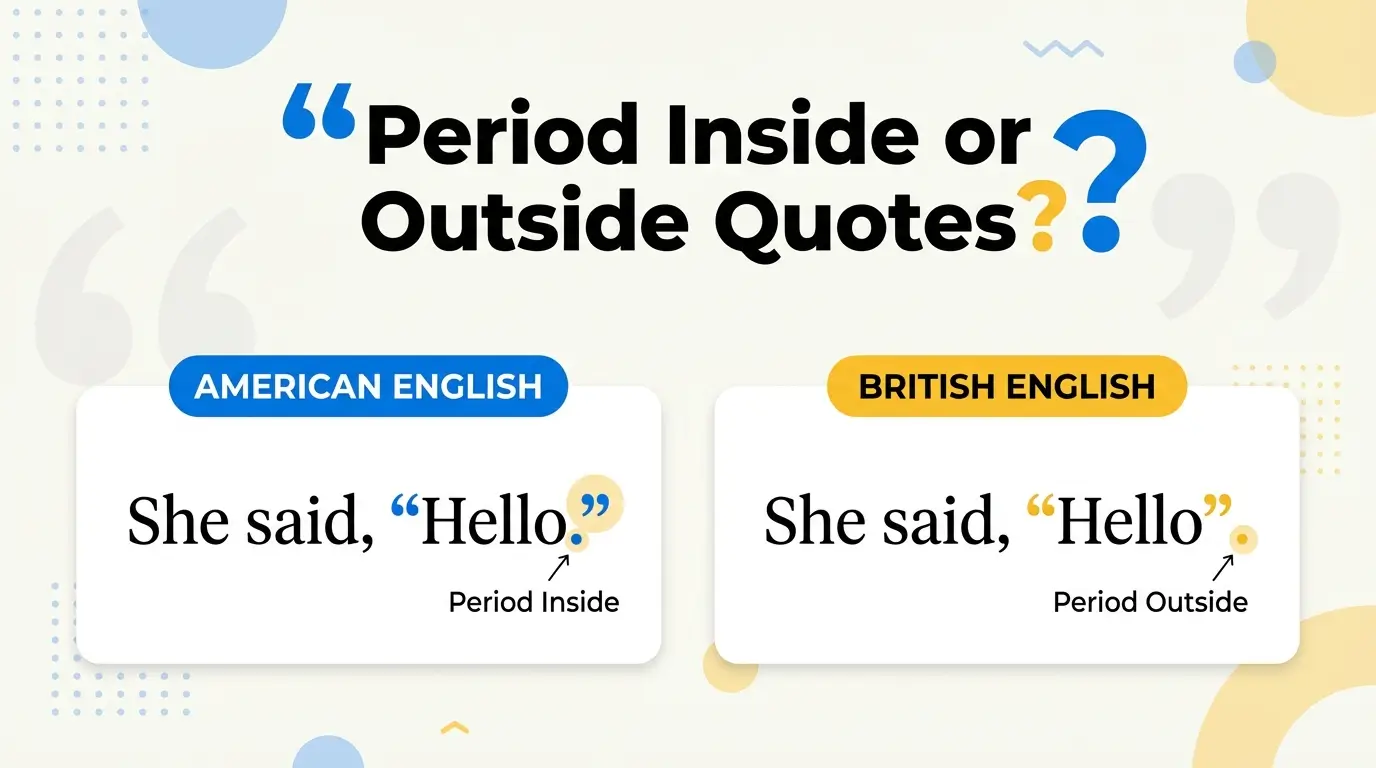
The answer depends on which style of English you use. In American English, periods usually go inside quotation marks. In British English, periods often go outside quotation marks when they are not part of the quoted words. However, British rules also depend on the meaning of the sentence and the style guide you follow.
This small punctuation rule can make a big difference in your writing. It can help your blog posts look professional, make schoolwork easier to read, and prevent common grammar mistakes.
In this guide, you will learn when to put a period inside or outside quotes, how American and British rules differ, and how to use quotation marks in everyday writing. You will also see clear examples, common mistakes, and practical tips to help you choose the right punctuation style.
Period Inside or Outside Quotes – Quick Answer
The period goes inside quotation marks in American English. In British English, it often goes outside quotation marks if the period is not part of the quoted text.
Here are the basic rules:
- American English: The period usually goes inside the closing quotation mark.
- British English: The period often goes outside if it does not belong to the quoted words.
- Exact quotations: Keep punctuation that belongs to the original text when accuracy requires it.
- Style guides: Follow the rules of your school, publisher, or website.
American English Example
Correct: She called the movie “amazing.”
In American English, the period goes inside the closing quotation mark.
British English Example
Correct: She called the movie “amazing”.
In this British-style example, the period stays outside because it belongs to the full sentence, not to the quoted word.
What About a Full Quoted Sentence?
When a complete sentence is quoted, the period usually goes inside the quotation marks in both American and British English.
Example: She said, “The movie was amazing.”
The key is to know whether you are following American punctuation rules or a British style that places punctuation according to meaning.
The Origin of Period Inside or Outside Quotes
The difference between putting a period inside or outside quotation marks comes from the development of English writing and publishing rules.
Quotation marks became more common as printers and writers developed ways to show direct speech, quoted text, and words used in a special sense. Over time, different English-speaking countries adopted different punctuation habits.
How American English Developed Its Rule
American English generally follows a system in which commas and periods go inside closing quotation marks. This rule is widely used in books, newspapers, school assignments, and online content in the United States.
The rule is often called typesetting punctuation or conventional American punctuation. It provides a consistent visual pattern, even when the period is not part of the quoted material.
For example:
- Correct: The word is “color.”
- Correct: She described it as “useful.”
The periods appear inside the quotation marks in both cases.
How British English Developed Its Rule
British English often uses a system called logical punctuation. Under this approach, punctuation is placed according to whether it belongs to the quoted words or to the surrounding sentence.
For example:
- The word “colour” has six letters.
- He called the plan “unusual”.
In the first sentence, the period follows the closing quotation mark because the quotation is only one word. In the second, the period also follows the quotation mark under this logical approach.
British publishers do not all use exactly the same rules. Some follow house styles that place periods and commas inside quotation marks in certain cases.
Why Do the Rules Differ?
The main reason is that American and British publishing traditions developed different conventions. Neither system is automatically better or more correct in every situation.
The important point is consistency. Choose the style that fits your audience and follow it throughout your writing.
British English vs American English Spelling
The keyword “period inside or outside quotes” is about punctuation, not spelling. Still, the same regional differences that affect spelling can also affect punctuation.
American and British English often use the same words but apply different writing conventions.
Main Differences
| Feature | American English | British English |
| Period in a short quotation | Usually inside | Often outside if it belongs to the full sentence |
| Comma after quoted words | Usually inside | Often placed according to meaning |
| Full quoted sentence | Usually inside | Usually inside when part of the quotation |
| Single quotation marks | Often used for quotes within quotes | Often used for the main quotation |
| Double quotation marks | Often used for the main quotation | Often used for quotes within quotes |
These are general patterns, not rules that every publisher follows. Always check the required style guide.
American English Examples
- She wrote, “The answer is correct.”
- He called the result “excellent.”
- The teacher said, “Please read the next page.”
Notice that periods appear inside the closing quotation marks.
British English Examples
- She called the answer “correct”.
- He described the result as “excellent”.
- The teacher said, “Please read the next page.”
In the first two examples, the period sits outside the quotation marks because the quoted material is only a word and the period belongs to the full sentence.
In the third example, the quoted words form a complete sentence, so the period stays inside.
A Note About Spelling
American English uses forms such as “color,” “center,” and “organize.” British English often uses “colour,” “centre,” and “organise,” though there are exceptions.
These spelling differences are separate from quotation punctuation. Using British spelling does not automatically mean every punctuation mark must follow one single British rule.
Which Spelling Should You Use?
Since “period inside or outside quotes” concerns punctuation, the best choice depends on your readers and the writing rules you need to follow.
If Your Audience Is in the United States
Use American punctuation conventions. Put periods and commas inside closing quotation marks in ordinary writing.
Example: The report called the result “positive.”
This is a good choice for US schoolwork, business emails, American publications, and blogs aimed at US readers.
If Your Audience Is in the United Kingdom or Commonwealth
Consider the style guide used by your school, workplace, or publisher. Many British publications use logical punctuation when the period does not belong to the quoted words.
Example: The report called the result “positive”.
However, practices vary across British and Commonwealth publications. Some use American-like punctuation in certain contexts.
If You Write for a Global Audience
Choose one recognized style and use it consistently. If your website follows American English, keep periods inside quotation marks. If it follows a British style guide, apply that guide’s rules.
For SEO content, consistency is more important than mixing styles. Readers need clear, correct writing, not a mixture of punctuation systems.
If You Follow a Style Guide
Your required style guide should take priority over general advice. For example, publishers and academic institutions may have specific rules for quotations, citations, and punctuation.
When in doubt, check the guide before submitting your work.
Common Mistakes with Period Inside or Outside Quotes
Writers often make a few common errors when using periods with quotation marks. These mistakes are easy to fix once you understand the difference between American and British conventions.
Mistake 1: Mixing American and British Rules
Incorrect for consistent American style: She called it “helpful”.
Correct in American style: She called it “helpful.”
The American rule puts the period inside the closing quotation mark.
Mistake 2: Assuming British English Always Puts Periods Outside
This is not true. British English often uses logical punctuation, but the period stays inside when it belongs to the quoted sentence.
Example: He said, “I agree.”
The period is part of the complete quoted sentence.
Mistake 3: Changing the Original Quotation
When quoting a source directly, do not change its wording or meaning just to fit your punctuation preference. Follow the citation rules that apply to your work.
For academic writing, check whether the original punctuation must be preserved or whether your style guide allows changes.
Mistake 4: Putting the Period in the Wrong Place in a Short Quote
American style:
Correct: The word is “hello.”
British logical style:
Correct: The word is “hello”.
The second example follows the logical approach because the period is part of the larger sentence, not the quoted word.
Mistake 5: Forgetting the Question Mark Rule
Question marks follow a different logic in many cases. Their position depends on whether the question is part of the quoted text or the whole sentence.
- The American English example is: Did she say “hello”?
- The American English example is: She asked, “Are you ready?”
In the first sentence, the whole sentence is a question, but “hello” is not. In the second, the quoted words form the question, so the question mark goes inside.
Mistake 6: Using Different Rules on the Same Website
A blog can look unprofessional if one article uses American punctuation and another uses British punctuation without a clear reason.
Choose a style guide and use it for all pages, headings, examples, and articles.
Period Inside or Outside Quotes in Everyday Examples
Understanding punctuation becomes easier when you see it in real situations. The following examples show how the rule works in emails, news reports, social media posts, and formal writing.
In Emails
American English:
“Your order has shipped.”
British logical style:
The status is marked as “shipped”.
In the first example, the quoted text is a complete sentence. In the second, the quoted word is part of the writer’s sentence.
In News Writing
American English:
The mayor called the plan “a major step forward.”
British logical style:
The mayor called the plan “a major step forward”.
News organizations often follow their own style manuals, so the examples may vary by publication.
On Social Media
American English:
My friend said, “That was amazing.”
British English:
My friend described the show as “amazing”.
Social media is informal, but using consistent punctuation makes posts easier to read.
In Formal and Academic Writing
American English:
The author describes the method as “effective.”
British logical style:
The author describes the method as “effective”.
Academic writing may follow APA, MLA, Chicago, Oxford, or another style guide. Follow the exact rules required for your paper.
In Technical Writing
American English:
The system returned the message “Access denied.”
British logical style:
The system returned the message “Access denied”.
In technical writing, exact error messages may need to remain unchanged. If a period is part of the displayed message, preserve it as required by the documentation style.
Period Inside or Outside Quotes – Google Trends & Usage Data
People search for “period inside or outside quotes” because quotation punctuation can be confusing, especially when writers move between American and British English.
However, search interest and actual writing habits are not the same thing. A keyword search alone cannot show which punctuation rule people use most often.
Popularity by Country
The question is especially relevant to writers who work with US and UK English.
- United States: American punctuation conventions are common in schools, publishing, and business writing.
- United Kingdom: Both traditional punctuation habits and logical punctuation appear, depending on the publisher.
- Canada and Australia: Rules can vary by publication, workplace, and academic style guide.
- Global online audiences: Writers often follow the style of their target market or the rules of the platform they publish on.
These are general language patterns, not measured search rankings.
How to Check Google Trends
To compare search interest for this topic, open Google Trends and enter phrases such as:
- Period inside or outside quotes
- Period inside quotation marks
- British vs American punctuation
- Punctuation inside quotation marks
Then select a country, such as the United States or United Kingdom, and choose a time range.
Google Trends reports relative search interest, usually on a scale from 0 to 100. It does not provide the exact number of searches for every keyword.
What Does Search Interest Tell You?
If one phrase receives more interest than another, it may be a more common way for people to ask the question. It does not prove that one punctuation rule is more correct.
For bloggers and SEO writers, the best approach is to answer the main question early, provide examples, and explain the regional differences clearly. Do not claim that one keyword is more popular unless you have current data to support it.
Period Inside or Outside Quotes: Comparison Table
Use this table as a quick reference when editing your writing.
| Sentence type | American English | British logical style |
| A quoted word at the end | The word is “ready.” | The word is “ready”. |
| A quoted phrase at the end | She called it “a good idea.” | She called it “a good idea”. |
| A full quoted statement | She said, “I am ready.” | She said, “I am ready.” |
| A question about a quoted word | Did he say “ready”? | Did he say “ready”? |
| A question inside the quotation | She asked, “Are you ready?” | She asked, “Are you ready?” |
| A quoted title at the end | I read “The Last Day.” | I read “The Last Day”. |
The British column shows a logical-punctuation approach. A specific British publication may follow different rules, especially for titles and quoted material.
FAQs About Period Inside or Outside Quotes
1. Does the period go inside or outside quotation marks?
In American English, the period usually goes inside quotation marks. In British English, it often goes outside when it does not belong to the quoted words. Follow your required style guide.
2. Is the period always inside quotes in American English?
In ordinary American prose, periods and commas generally go inside closing quotation marks. Special cases, such as technical notation or exact text strings, may require additional care.
3. Do British people put periods outside quotation marks?
Many British writers use logical punctuation, which places the period outside when it belongs to the main sentence. However, British publishers do not all follow the same rule.
4. What happens when the quote is a complete sentence?
When the quotation is a complete sentence, its final period usually stays inside the quotation marks.
Example: She said, “I am happy.”
5. Does the period go inside quotation marks for a single word?
In American English, yes.
Example: The answer is “correct.”
In British logical punctuation, it may go outside if the period belongs to the surrounding sentence.
Example: The answer is “correct”.
6. Do periods and commas follow the same rule?
In American English, periods and commas usually go inside closing quotation marks. In British logical punctuation, their position often depends on whether they belong to the quoted material.
7. Which punctuation style is best for SEO articles?
Neither style automatically improves rankings. Choose the style that matches your target audience, keep it consistent, and make the content clear and helpful. Correct punctuation supports readability and a professional appearance.
Conclusion: Period Inside or Outside Quotes?
The answer to “period inside or outside quotes” depends mainly on the English style you follow. American English usually places periods inside quotation marks, even when the quoted material is only a word or phrase. British English often uses logical punctuation, placing the period outside when it belongs to the surrounding sentence rather than the quoted text.
For example, American English uses “The answer is correct.” British logical punctuation may use “The answer is correct”. However, when a full sentence is quoted, its final period usually stays inside the quotation marks in both styles.
The most useful rule is simple: know your audience, follow the style guide that applies to your work, and use the same system throughout your writing. This matters for blog posts, school assignments, emails, news articles, and professional documents.
If you write for a US audience, American punctuation is usually the safest choice. If you write for a UK audience, check the publisher’s preferred rules. With a little practice, you can use quotation marks and periods with confidence and avoid common punctuation mistakes.
Discover More Post
- Ageing or Aging: Which Spelling Is Correct?
- Lay Down or Lie Down: Which Is Correct?
- Among or Amongst: Which One Should You Use?

Emily Dickinson is one of America’s most influential poets, recognized for her unique style and thought-provoking poetry. Through GrammerNests.com, she contributes valuable perspectives on language, creativity, and the beauty of written expression.








3 thoughts on “Period Inside or Outside Quotes? American vs. British Rules”