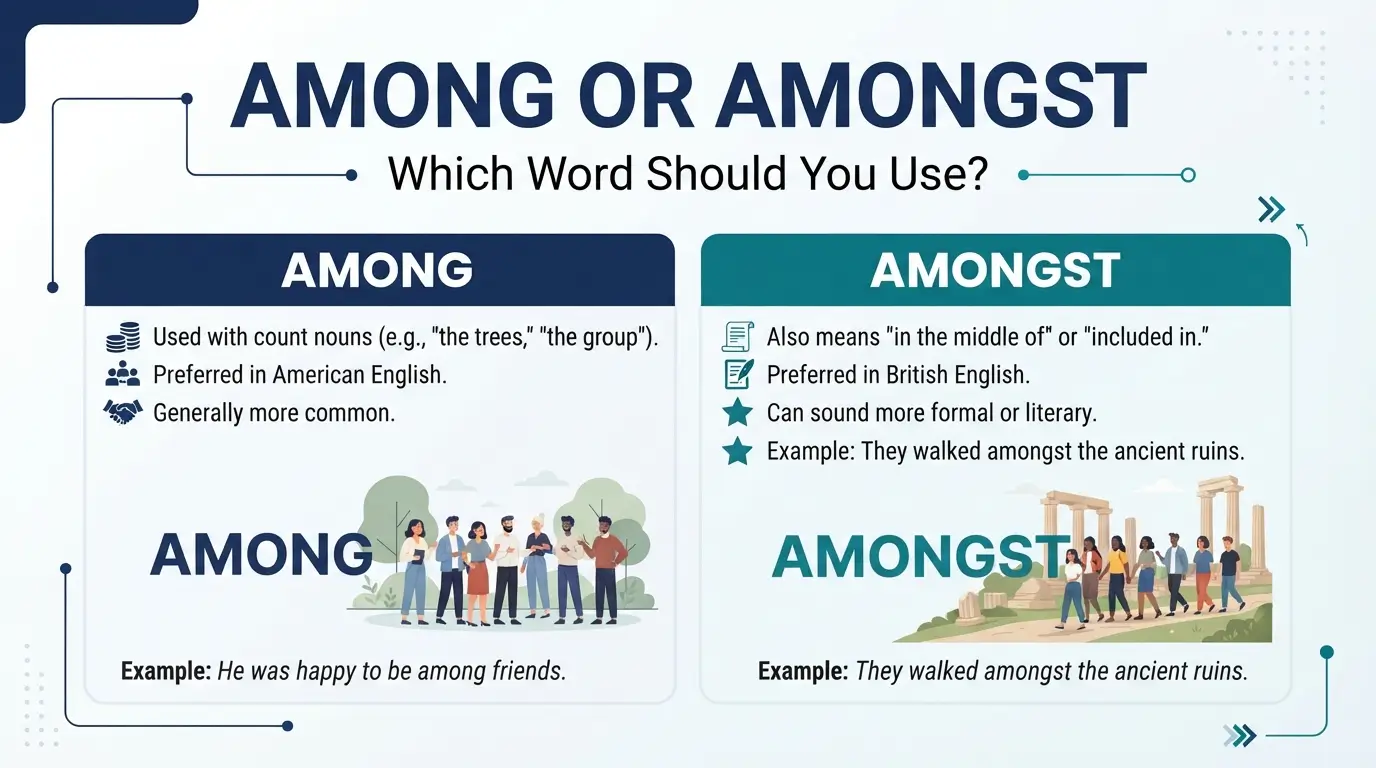
If you have ever wondered whether to write “among” or “amongst,” you are not alone. Both words are correct, and both have the same basic meaning. The confusion comes from their different styles and levels of use.
Among is much more common in modern English, especially in American English. Amongst is also correct, but it is more common in British English and can sound slightly more formal or traditional.
For example, you can say, “She was sitting among her friends” or “She was sitting amongst her friends.” The meaning does not change.
People often search for “among or amongst” because they want to know which word is grammatically correct, which one sounds more natural, and which form they should use in formal or professional writing.
This guide explains the difference between among and amongst, their history, regional preferences, common mistakes, and real-world examples. By the end, you will know exactly when to use each word.
Among or Amongst – Quick Answer
Among and amongst are both grammatically correct. They usually mean the same thing: in the middle of, surrounded by, or included with several people or things.
Examples
- She was among her classmates.
- She was amongst her classmates.
- The house stood among the trees.
- The house stood amongst the trees.
There is usually no major difference in meaning.
However, there is a difference in usage and style:
- Among → more common and more natural in modern English.
- Amongst → less common, often associated with British English and a more formal or traditional style.
Simple Rule
If you are unsure, choose among.
| Word | Correct? | Common Usage | Style |
| Among | Yes | Very common | Modern, neutral |
| Amongst | Yes | Less common | Formal, traditional, British |
For most websites, emails, school assignments, and everyday writing, among is the safest choice.
The Origin of Among or Amongst
The words among and amongst have a long history in English.
Among comes from Old English forms related to the idea of being in a group or surrounded by others. Over time, its spelling and pronunciation changed as the English language developed.
Amongst developed as a variation of among. The ending -st appeared in several English words and expressions over the centuries.
Similar variations can be found in words such as:
- among → amongst
- while → whilst
- amid → amidst
- toward → towards
The extra -st does not normally create a different meaning. It is mainly a historical and stylistic variation.
Why Do Both Forms Exist?
English has developed through many centuries and has borrowed or changed words from different sources. Regional speech and writing styles also influenced vocabulary.
Over time, among became the more common form in many varieties of modern English, especially American English.
Amongst remained more common in British English, although British speakers also use among very often.
So, the difference is not about one spelling being right and the other being wrong. It is mainly about frequency, region, and style.
British English vs American English Spelling
The biggest difference between among and amongst is not spelling rules. Both forms are spelled correctly.
The difference is mainly usage preference.
American English strongly favors among. British English also uses among, but amongst appears more often than it does in American English.
American English
In American English, among is the normal choice.
Examples:
- He felt comfortable among his friends.
- The teacher walked among the students.
- The answer was hidden among the documents.
Amongst is understandable to American readers, but it can sound somewhat formal, old-fashioned, or literary.
British English
British English accepts both forms.
Examples:
- She was standing among the crowd.
- She was standing amongst the crowd.
Neither sentence is grammatically wrong.
Amongst may sometimes be chosen when the writer wants a more formal or traditional tone.
Comparison Table
| Feature | Among | Amongst |
| Grammar | Correct | Correct |
| Meaning | Same | Same |
| American English | Very common | Less common |
| British English | Very common | More common than in US English |
| Formal writing | Recommended | Acceptable |
| Everyday speech | Very common | Less common |
| Modern style | Natural | Slightly traditional |
| Spelling | Standard | Standard |
Among or Amongst Variations
| Situation | Better Choice | Example |
| American website | Among | The product is popular among users. |
| Business email | Among | The news spread among employees. |
| School writing | Among | She was among the top students. |
| British formal writing | Among / Amongst | He was among the leaders. |
| Literary writing | Amongst can work | Flowers grew amongst the grass. |
| Everyday conversation | Among | He sat among his friends. |
Which Spelling Should You Use?
The best choice depends on your audience.
If You Write for a US Audience
Use among.
It is the most natural and familiar choice in American English.
For example:
The decision created concern among employees.
This sounds clear and normal to an American reader.
If You Write for a UK or Commonwealth Audience
You can use either among or amongst.
Among is still widely used and is never considered incorrect simply because you are writing British English.
Amongst may fit better when you want a more traditional or formal British tone.
If You Write for a Global Audience
Choose among.
For international websites, blogs, businesses, and educational content, among is usually the clearest option.
It is short, familiar, and widely understood.
Best SEO Writing Choice
For most online content, among is the better default.
It is more common, easier to read, and natural across different forms of English.
That does not mean you should never use amongst. If the tone or regional style calls for it, amongst is perfectly acceptable.
Common Mistakes with Among or Amongst
Although both words are correct, writers often make mistakes when using them.
Mistake 1: Thinking Amongst Is Incorrect
Incorrect belief:
Amongst is grammatically wrong.
This is false.
Amongst is a correct English word.
Better understanding:
Among and amongst are both correct.
Mistake 2: Thinking They Have Completely Different Meanings
Some learners believe that among and amongst describe different situations.
Usually, they do not.
Compare:
She walked among the trees.
She walked amongst the trees.
The basic meaning is the same.
Mistake 3: Using Among When Referring to Only Two Things
Among generally refers to a group or more than two people or things.
For two things, between is usually the better choice.
Example:
The agreement was made between John and Mary.
For a group:
The decision was discussed among the team members.
The traditional rule is simple: between for two, among for a group. Modern English can be more flexible in some contexts, but this rule is useful for learners.
Mistake 4: Changing Amongst to Amongsts
The correct word is:
amongst
Not:
amongsts
There is no plural form.
Mistake 5: Using Both Together
Do not write:
among amongst the students
Choose one:
among the students
or
amongst the students
Among or Amongst in Everyday Examples
Understanding real examples makes the difference easier to remember.
In Emails
Among is usually the better choice for professional emails.
The new policy was discussed among the team members.
You could write:
The new policy was discussed amongst the team members.
This is grammatically correct, but among usually sounds more direct and modern.
In News Writing
News writing often prefers clear and simple language.
The decision caused concern among local residents.
This sounds natural and professional.
On Social Media
Short and natural language works best.
It was one of the most popular posts among our followers.
Using amongst is not wrong, but it may sound more formal than necessary.
In Formal Writing
Both forms can work.
The report identified several problems among government agencies.
Or:
The report identified several problems amongst government agencies.
The first version is generally more direct.
In Academic Writing
Among is usually a safe choice.
The study found differences among the three groups.
Academic writing values clarity, so the simpler form is often preferred.
In Literature
Amongst can sound natural in literary or poetic writing.
She disappeared amongst the trees.
The extra -st can give the sentence a slightly traditional or atmospheric feeling.
Among or Amongst – Google Trends & Usage Data
Search interest for “among or amongst” shows that people are interested in understanding the difference between these two forms. However, search popularity should not be confused with actual word usage.
In everyday English, among is much more widely used than amongst.
The difference becomes clearer when looking at regional English.
United States
American English strongly favors among.
You are more likely to see:
Among the reasons…
than:
Amongst the reasons…
United Kingdom
British English uses both forms.
Amongst has a stronger presence in British writing and speech than in American English, but among remains extremely common.
Global English
For international communication, among is usually the safest choice.
It is widely recognized in:
- Business writing
- Websites
- Education
- News
- Emails
- Social media
- Academic writing
Google Trends can help show search interest, but it does not measure every use of a word in books, conversations, websites, or professional documents. For actual usage frequency, large language corpora and published text databases provide better evidence.
The key practical point remains simple: among is the dominant modern choice, while amongst is a less common but fully correct alternative.
FAQs About Among or Amongst
Is Among or Amongst Correct?
Both are correct. Among is more common, while amongst is less common and is often associated with British or traditional English.
Is Amongst More British Than Among?
Yes, amongst is more strongly associated with British English. However, British speakers also use among very frequently.
Is Amongst Formal English?
It can sound more formal, traditional, or literary than among, but it is not automatically more formal or better.
Should Americans Use Amongst?
Americans can use amongst, and it is grammatically correct. However, among usually sounds more natural in American English.
Is Among Better for Formal Writing?
Usually, yes. Among is clear, neutral, and widely accepted in professional and academic writing.
What Is the Difference Between Among and Amongst?
There is usually no difference in basic meaning. The main difference is style, frequency, and regional preference.
Should I Use Among or Amongst for SEO Content?
For most SEO content aimed at a broad or American audience, among is the better default because it is more common and natural. Use amongst when it fits the intended regional or literary style.
Conclusion
The choice between among or amongst is easier than it first appears. Both words are correct, and both generally have the same meaning. The main difference is how often they are used and the style they suggest.
Among is the safest choice for most modern writing. It is especially common in American English and works well in websites, emails, academic writing, business communication, news, and everyday conversation.
Amongst is also correct. It appears more often in British English and can give writing a slightly formal, traditional, or literary tone. However, you do not need to use it simply because you are writing for a British audience.
If you are unsure which word to choose, use among. It is simple, natural, and widely understood.
The most important point is this: you are not choosing between a correct and incorrect word. You are choosing between two correct forms with different usage preferences.
Discover More post
- Independent vs Dependent Variable: What’s the Difference?
- There or Their: What Is the Difference
- Quite or Quiet: What Is the Difference and Which Word Is Correct?

Toni Morrison is a celebrated American novelist known for her powerful storytelling, rich characters, and lasting impact on literature. At GrammerNests.com, she shares insights that help readers appreciate language, writing, and literary expression.








1 thought on “Among or Amongst: Which One Should You Use?”