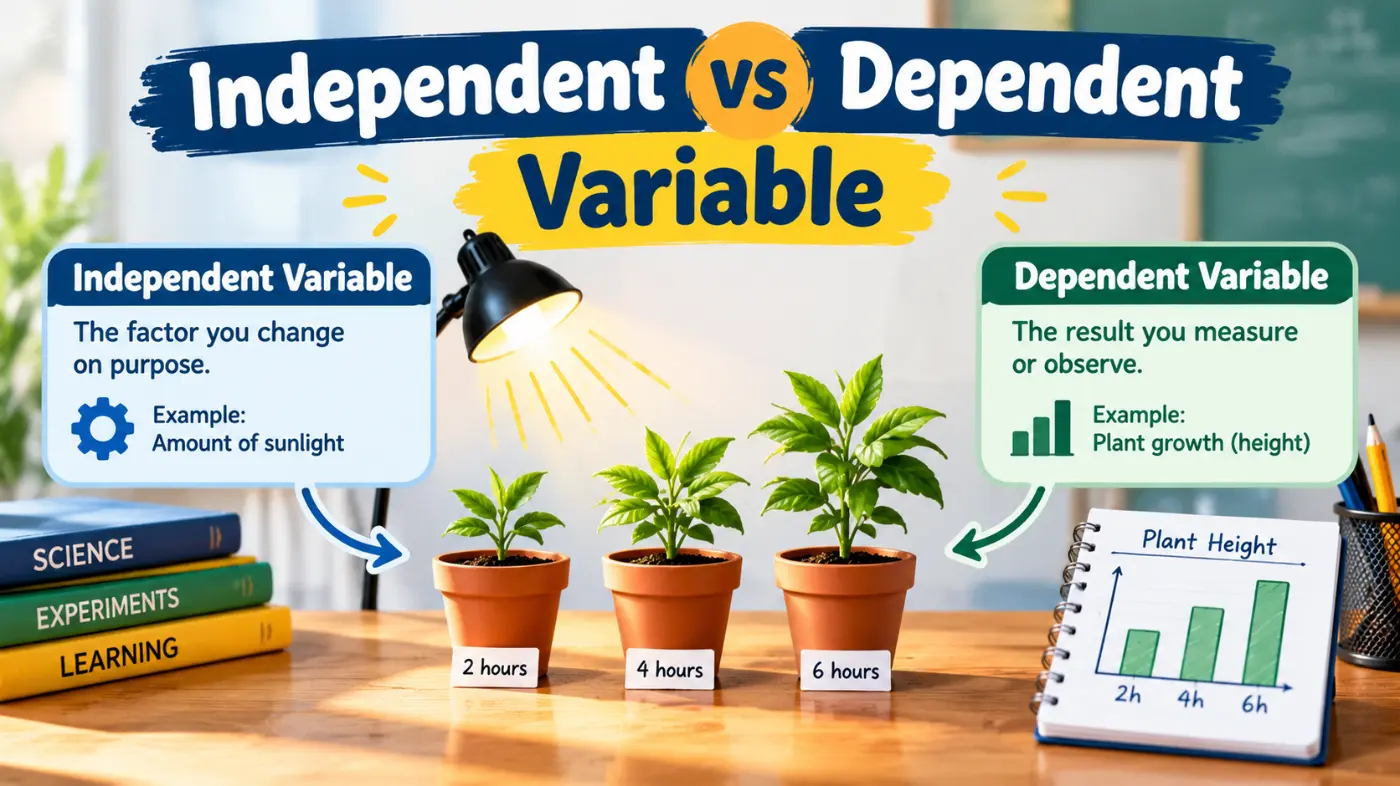
An independent variable is the factor a researcher changes, selects, or controls to study its effect. A dependent variable is the outcome that is measured.
In a simple experiment, the independent variable is the input or possible cause, while the dependent variable is the measured response or outcome.
Key Takeaways
The independent variable is what you change, control, or use to form comparison groups.
The dependent variable is what you measure or observe.
A simple memory trick is: independent = what I change; dependent = what I measure.
Controlled variables are factors kept the same so the experiment is fair.
In an experiment, these variables can help researchers investigate cause and effect. In observational research, the relationship may be associative rather than causal.
What Is an Independent Variable?
An independent variable is the factor that a researcher changes, controls, or varies to investigate what happens to another variable.
For example, imagine a student wants to find out whether the amount of sunlight affects plant growth.
The student gives different plants different amounts of sunlight:
- Plant A gets 4 hours of sunlight.
- Plant B gets 6 hours.
- Plant C gets 8 hours.
The amount of sunlight is the independent variable because it is the factor being changed.
In experimental research, the independent variable is often the treatment or condition that researchers manipulate. In some studies, however, researchers cannot directly manipulate it and instead compare existing groups or characteristics.
Easy way to remember it
Think:
Independent = I change it.
If you are designing an experiment, ask:
What factor am I changing or comparing?
That factor is often the independent variable.
What Is a Dependent Variable?
A dependent variable is the outcome that researchers measure or observe after changing or comparing the independent variable.
Using the plant example, the researcher might measure the height of each plant after two weeks.
The plant height is the dependent variable.
Why?
Because the researcher wants to know whether plant growth changes when the amount of sunlight changes.
The dependent variable is sometimes called the response variable or outcome variable because it represents the result being studied.
Easy way to remember it
Think:
Dependent = it depends on the factor being studied.
Ask:
What am I measuring or observing?
That is usually the dependent variable.
Independent vs Dependent Variable: Key Differences
The easiest way to understand independent vs dependent variable is to compare their roles.
| Feature | Independent Variable | Dependent Variable |
|---|---|---|
| Main role | Factor being changed or compared | Outcome being measured |
| Also called | Predictor or explanatory variable | Response or outcome variable |
| Researcher | Often manipulates or selects it | Measures it |
| Simple question | What am I changing? | What am I measuring? |
| Example | Amount of sunlight | Plant height |
| Graph convention | Usually x-axis | Usually y-axis |
In a basic experiment, the independent variable comes first in the question, while the dependent variable is the result you want to observe.
For example:
Does the amount of study time affect test scores?
- Independent variable: study time
- Dependent variable: test scores
This basic structure appears throughout science, psychology, education, and other research fields.
How to Identify the Independent and Dependent Variables
If you are given a science question and need to identify the variables, use two simple questions.
Ask “What Am I Changing?”
Look for the factor that is being changed, controlled, assigned, or compared.
Example:
Does water temperature affect how quickly sugar dissolves?
The water temperature is changed.
Independent variable: water temperature
Ask “What Am I Measuring?”
Next, find the result that is being measured.
In the same example, the researcher measures how long the sugar takes to dissolve.
Dependent variable: time required for the sugar to dissolve
This two-question method works well for many classroom experiments.
Quick tip: If the question contains “Does X affect Y?”, X is often the independent variable and Y is often the dependent variable.
Independent vs Dependent Variable Examples
Examples make the difference much easier to understand.
1. Plant Growth and Sunlight
Question: Does the amount of sunlight affect plant growth?
- Independent variable: amount of sunlight
- Dependent variable: plant growth or plant height
- Controlled variables: plant type, soil, water, pot size
Here, sunlight is changed while plant growth is measured.
2. Study Time and Test Scores
Question: Does studying longer affect test scores?
- Independent variable: amount of study time
- Dependent variable: test score
For example, a researcher could compare different study durations and then measure students’ scores.
3. Temperature and Ice Melting
Question: Does temperature affect how quickly ice melts?
- Independent variable: temperature
- Dependent variable: time taken for the ice to melt
The temperature is the factor being changed or compared, while melting time is the measured outcome.
4. Exercise and Heart Rate
Question: Does exercise intensity affect heart rate?
- Independent variable: exercise intensity
- Dependent variable: heart rate
A researcher could compare different exercise conditions and record participants’ heart rates.
5. Fertilizer and Plant Growth
Question: Does the amount of fertilizer affect plant growth?
- Independent variable: amount of fertilizer
- Dependent variable: plant growth
- Controlled variables: plant type, water, soil, sunlight, and growing conditions
The independent variable is the factor the experiment focuses on changing. The dependent variable is the result recorded by the researcher.
What Is a Controlled Variable?
A controlled variable is a factor that researchers keep the same during an experiment so it does not unfairly affect the results.
For example, suppose you are testing whether fertilizer affects plant growth.
You might change the amount of fertilizer, but keep these factors the same:
- Type of plant
- Amount of water
- Amount of sunlight
- Type of soil
- Size of pot
These are controlled variables.
This matters because changing several factors at once can make it difficult to determine what actually affected the outcome. Science education resources commonly describe experiments using the three-part distinction of what I change, what I observe, and what I keep the same.
Independent vs Dependent Variables on a Graph
Graphs can also help you understand the difference.
In many basic graphs:
- Independent variable → x-axis
- Dependent variable → y-axis
Suppose you are studying whether study time affects test scores.
You could place:
- Study time on the x-axis
- Test score on the y-axis
The x-axis represents the factor used to explain or predict changes, while the y-axis represents the response being measured.
This convention is useful, but the labels and study design matter more than simply memorizing “x equals independent” and “y equals dependent.”
Common Mistakes to Avoid
Mistake 1: Choosing the result as the independent variable
If you are measuring plant height, plant height is generally the dependent variable, not the independent variable.
Mistake 2: Confusing a controlled variable with the independent variable
If sunlight is kept the same for every plant, it is controlled. If sunlight is changed between groups, it can be the independent variable.
Mistake 3: Assuming “independent” means completely unrelated
The word does not mean that the variable has no relationship with anything else. It describes its role within a particular study or model.
Mistake 4: Assuming every relationship proves causation
An experiment designed to manipulate an independent variable can be used to investigate causal effects. But in an observational study, researchers may only observe variables without manipulating them. A relationship between variables does not automatically prove that one caused the other.
Mistake 5: Looking only at the names
Instead of trying to memorize hundreds of examples, focus on the role each variable plays.
Ask:
What changes? → Independent variable
What gets measured? → Dependent variable
Independent and Dependent Variables in Research
Independent and dependent variables are especially common in experimental and quasi-experimental research.
Researchers may manipulate an independent variable and then measure an outcome to determine whether the outcome changes. For example, a study might investigate whether different teaching methods affect test performance.
In that case:
- Teaching method = independent variable
- Test performance = dependent variable
However, not every research study involves a manipulated independent variable. In observational research, researchers may use terms such as predictor, explanatory variable, or outcome variable, depending on the research design and statistical model.
That distinction is important because the labels describe the role of variables in a particular study. They do not automatically establish a cause-and-effect relationship.
Frequently Asked Questions
Is the independent variable x or y?
In many basic graphs, the independent variable is placed on the x-axis, while the dependent variable is placed on the y-axis. This is a common convention for showing how an explanatory variable relates to a response variable.
Can a variable be both independent and dependent?
A variable can have different roles in different analyses or research questions, but within a specific simple experiment, the independent and dependent variables have different roles. One is the factor being manipulated or used as the predictor, while the other is the measured outcome.
What is the easiest way to remember the difference?
Use this sentence:
“I change the independent variable, and I measure the dependent variable.”
For example, if you change the amount of water and measure plant growth, water is independent and plant growth is dependent.
What are controlled variables?
Controlled variables are factors that are deliberately kept consistent during an experiment. They help researchers focus on the relationship between the independent and dependent variables instead of allowing other changing factors to influence the results.
What is an example of independent and dependent variables?
If you test whether the amount of sunlight affects plant height, the amount of sunlight is the independent variable, while plant height is the dependent variable. The type of plant, soil, water, and pot size could be controlled variables.
Conclusion
Understanding independent vs dependent variable becomes much easier when you focus on their roles.
The independent variable is the factor you change, control, assign, or compare. The dependent variable is the outcome you measure or observe. Controlled variables are kept consistent to make an experiment more reliable.
For a quick test, ask two questions:
What am I changing? → Independent variable.
What am I measuring? → Dependent variable.
Once you learn this simple pattern, you can identify variables in science experiments, research questions, graphs, and many real-world examples with much less confusion.









1 thought on “Independent vs Dependent Variable: What’s the Difference?”