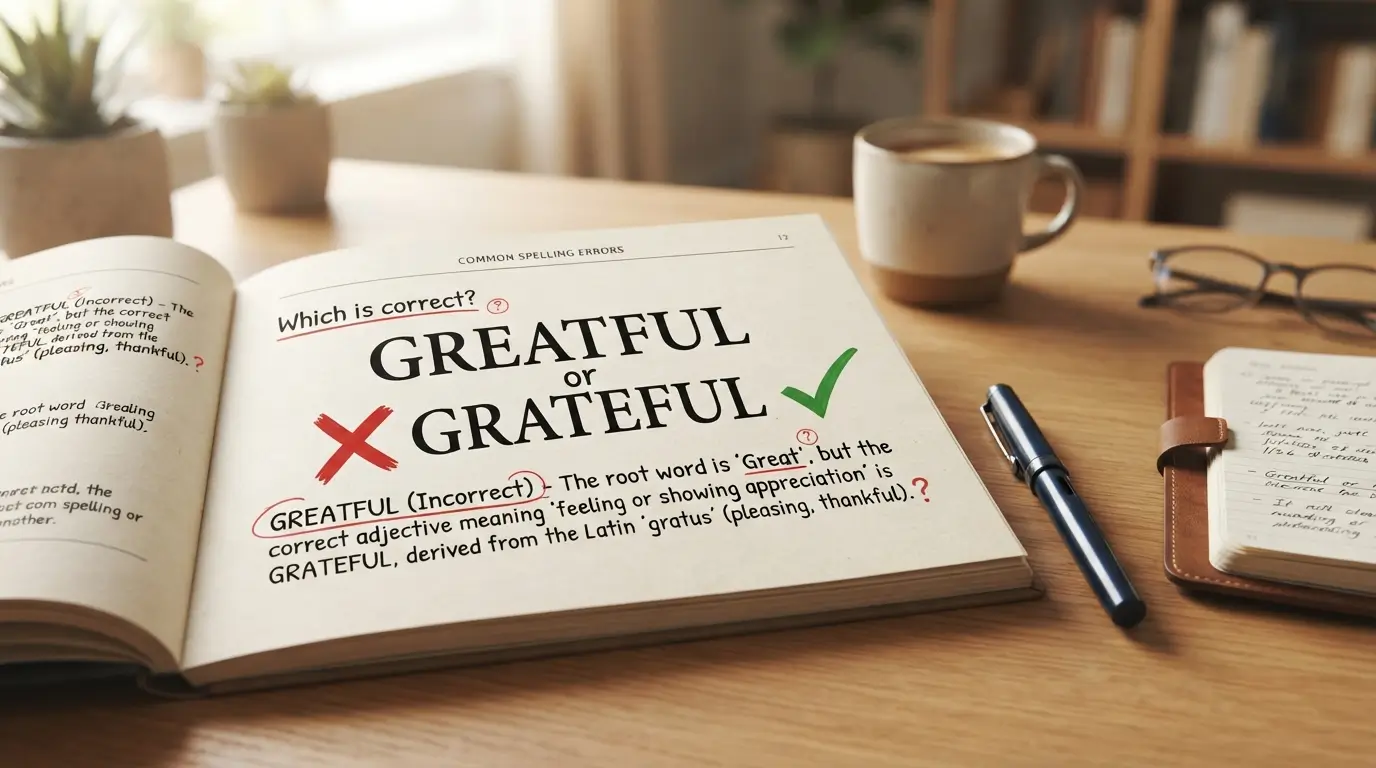
Have you ever typed greatful and wondered if it should actually be grateful ? You are not alone. This is a common English spelling question because both forms sound almost the same when spoken. The word also looks like it could come from great + ful, which makes greatful seem logical at first.
But English spelling does not always follow simple patterns.
If you want to express thanks, appreciation, or thankfulness, the correct spelling is grateful. The spelling greatful is a common mistake and should not be used in standard English.
People search for greatful or grateful when writing emails, school assignments, social media posts, thank-you messages, applications, and professional documents. They usually want a quick answer, but understanding the reason behind the spelling can help prevent the mistake in the future.
In this guide, you will learn which spelling is correct, where grateful comes from, whether British and American English use different spellings, common mistakes, everyday examples, and an easy way to remember the correct form.
Greatful or Grateful – Quick Answer
Grateful is the correct spelling.
Greatful is a common misspelling of grateful.
| Spelling | Correct? | Meaning |
| grateful | ✅ Yes | Thankful or appreciative |
| greatful | ❌ No | Common misspelling |
For example:
- ✅ I am grateful for your help.
- ❌ I am greatful for your help.
You can also use grateful when talking about a person:
- She is grateful to her parents.
- We are grateful to everyone who helped us.
Or when talking about something you appreciate:
- I am grateful for this opportunity.
- They were grateful for the support.
A simple memory trick is to connect grateful with gratitude.
Gratitude grateful
Both words begin with grat-, not great-.
The Origin of Greatful or Grateful
The spelling becomes easier to understand when you look at the history of grateful.
The word dates back to the mid-16th century. Oxford explains that it came from the older word grate, meaning pleasing or thankful, which is connected to the Latin word gratus. The suffix -ful was then added.
The Latin root gratus carried meanings related to being pleasing, acceptable, or thankful. Over time, the English word developed into the modern meaning of feeling or showing thanks.
Today, grateful means thankful or appreciative.
For example:
I am grateful for your kindness.
The important point is that grateful did not develop from the modern English word great.
This is why writing greatful is not an alternative spelling.
Why Does Greatful Look Correct?
The confusion is easy to understand.
English has many words where we add -ful:
- helpful
- useful
- careful
- hopeful
- thoughtful
- joyful
Because great is a common English word, someone may naturally think:
great + ful = greatful
But that is not how grateful developed.
The correct spelling comes from the grat- family, as seen in words such as:
- grateful
- gratitude
- gratify
- gratification
So, instead of thinking about great, think about gratitude.
Gratitude grateful
That connection is one of the easiest ways to remember the spelling.
British English vs American English Spelling
One important point is that grateful is not a British-versus-American spelling difference.
Both British English and American English use:
grateful
The incorrect form greatful is not a standard British alternative.
| English Variety | Correct Spelling | Incorrect Spelling |
| American English | grateful | greatful |
| British English | grateful | greatful |
| Canadian English | grateful | greatful |
| Australian English | grateful | greatful |
| New Zealand English | grateful | greatful |
| International English | grateful | greatful |
This is different from words such as:
- American color / British colour
- American favorite / British favourite
- American center / British centre
There is no similar standard variation for grateful.
Cambridge lists grateful in both its UK and US English entries and defines it as showing or expressing thanks.
Examples in British and American English
American English:
I am grateful for your support.
British English:
I am grateful for your support.
The spelling stays the same.
So if you are writing for readers in the United States, United Kingdom, Canada, Australia, or another English-speaking market, grateful is the safe standard form.
Which Spelling Should You Use?
The answer is simple:
Use grateful in every standard English variety.
If You Write for a US Audience
Use:
grateful
Example:
I am grateful for your quick response.
It is suitable for emails, school work, business communication, websites, and everyday writing.
If You Write for a UK or Commonwealth Audience
Use:
grateful
Example:
We are grateful for your continued support.
There is no need to change the spelling to greatful.
If You Write for a Global Audience
Use:
grateful.
This is especially important for international websites, blogs, academic content, business communication, and professional documents.
If You Are a Student
Always choose grateful when you mean thankful or appreciative.
For example:
I am grateful to my teacher for helping me prepare for the exam.
Using greatful may be treated as a spelling error.
If You Are Writing a Professional Email
Use:
I would be grateful if you could send me the information.
This is a common polite structure in formal English. Oxford also gives I would be grateful if… as a formal request pattern.
Common Mistakes with Greatful or Grateful
Several mistakes appear again and again.
1. Writing Greatful
Incorrect:
I am greatful for your help.
Correct:
I am grateful for your help.
The mistake happens because great is a familiar word and sounds similar to the beginning of grateful.
2. Writing Gratefull
Some people add an extra l because they connect -ful with the word full.
Incorrect:
I am gratefull for your support.
Correct:
I am grateful for your support.
The suffix -ful normally has one l.
Compare:
- helpful
- useful
- careful
- thankful
- grateful
3. Confusing Grateful and Gratitude
These words are related, but they have different jobs in a sentence.
Grateful is an adjective:
I am grateful for your help.
Gratitude is a noun:
I expressed my gratitude for your help.
4. Confusing Grateful and Thankful
These words are often close in meaning.
For example:
I am grateful for your kindness.
and
I am thankful for your kindness.
Both can express appreciation. Cambridge lists thankful as a synonym of grateful.
5. Using Greatful Because You See It Online
Seeing greatful on social media or in an online comment does not make it a correct spelling.
Online writing often contains typing mistakes and informal spelling errors.
For professional or academic writing, choose grateful.
Greatful or Grateful in Everyday Examples
The word grateful is useful in many types of writing.
In Emails
I am grateful for your quick response.
We are grateful for your continued support.
I would be grateful if you could send the document today.
These forms are natural in professional communication.
In News Writing
The family said they were grateful for the community’s support.
Local residents were grateful for the emergency assistance.
News writing normally uses the standard spelling grateful.
On Social Media
Feeling grateful for all the love and support today.
Forever grateful for these memories.
So grateful to have such wonderful friends.
Social media may contain informal spelling, but grateful remains the standard spelling.
In Formal Writing
The authors are grateful to the participants who contributed to the study.
We are grateful for your consideration.
The organization is grateful to its volunteers.
These examples work well in professional and formal contexts.
In Everyday Conversation
I am really grateful for your help.
She was grateful to be home.
We are grateful that everyone arrived safely.
Cambridge gives examples using grateful to, grateful for, and grateful to be, showing how the word commonly works in sentences.
Grateful or Greatful – Comparison Table
| Feature | Grateful | Greatful |
| Correct spelling | ✅ Yes | ❌ No |
| Meaning | Thankful or appreciative | No standard meaning |
| Used in standard English | Yes | No |
| American English | Yes | No |
| British English | Yes | No |
| Formal writing | Yes | No |
| Academic writing | Yes | No |
| Professional emails | Yes | No |
| Social media | Yes | Usually a spelling error |
| Related noun | Gratitude | — |
| Related adverb | Gratefully | — |
The standard dictionary form is grateful. Cambridge defines it as showing or expressing thanks, while Oxford traces its word origin to the mid-16th century and the Latin root gratus.
Greatful or Grateful – Google Trends & Usage Data
People often search greatful or grateful because they are unsure which spelling to use.
The search itself shows an important type of intent: users are usually looking for spelling correction, not two words with different meanings.
The established English word is grateful. The form greatful mainly appears when people make a spelling mistake or search for confirmation.
Search interest can also change with context. People may check the spelling before writing:
- thank-you messages
- emails
- school assignments
- social media captions
- professional letters
- holiday messages
- personal posts
It is important not to treat search volume as proof that a spelling is correct. A misspelled word can receive many searches precisely because people are unsure about it.
Current online articles about the query also describe grateful as the standard form and greatful as the common misspelling.
Google Trends can show relative search interest, but it does not change the spelling rule. If you are using this data for SEO research, remember that a high number of searches for greatful may represent people asking how to correct the mistake.
What Search Intent Does This Keyword Have?
The keyword greatful or grateful has mainly informational intent.
A searcher usually wants to know:
- Which spelling is correct?
- What does grateful mean?
- Why is greatful wrong?
- Is grateful British or American?
- How do I use grateful in a sentence?
- How can I remember the spelling?
That makes a clear spelling guide useful for this keyword.
Easy Memory Trick: Gratitude Grateful
Here is the easiest way to remember the correct spelling:
Gratitude grateful
Both begin with:
GRAT
Do not connect the word with:
GREAT
Instead, remember:
I feel grateful when I show gratitude.
This simple connection can help you avoid writing greatful.
You can also remember the ending:
grate + ful = grateful
Not:
great + ful = greatful
And not:
grate + full = gratefull
FAQs About Greatful or Grateful
Is grateful or greatful correct?
Grateful is correct. Greatful is a common misspelling.
Example:
I am grateful for your help.
Is greatful a real English word?
Greatful is not the standard spelling of the word meaning thankful or appreciative. In standard modern English, use grateful.
Is grateful British or American English?
Grateful is used in both British and American English. There is no standard UK/US spelling difference for this word.
Why do people spell grateful as greatful?
The mistake often happens because grateful sounds similar to greatful, and great is a familiar English word. People may naturally think the word comes from great + ful.
Historically, however, grateful is connected to grate and the Latin gratus, not the modern word great.
How do you spell grateful correctly?
The correct spelling is:
G-R-A-T-E-F-U-L
Remember:
gratitude grateful
What is the difference between grateful and thankful?
Both words can describe appreciation or thanks.
For example:
I am grateful for your help.
I am thankful for your help.
Both are natural English sentences. Cambridge lists thankful as a synonym of grateful.
What is the noun form of grateful?
The common noun is gratitude.
Example:
She expressed her gratitude to the volunteers.
You can also find gratefulness as a noun form, although gratitude is very common.
Can I use grateful in a formal email?
Yes. Grateful is appropriate in formal and professional writing.
For example:
I would be grateful if you could provide the requested information.
This is a polite and established way to make a formal request.
Conclusion
When choosing between greatful or grateful, the answer is simple: grateful is the correct spelling.
Use grateful when you mean thankful, appreciative, or pleased because of something helpful or kind. For example, you can say, I am grateful for your support or She is grateful to her parents.
The spelling does not change between British and American English. Both use grateful. The form greatful is a common spelling mistake, not a British alternative or a second correct form.
The best way to remember the spelling is to connect it with gratitude. Both words begin with grat-. This is more useful than connecting grateful with the word great.
Whether you are writing an email, school assignment, business document, social media post, or formal letter, choose grateful. Once you remember the link between gratitude and grateful, this common spelling problem becomes much easier to avoid.
Correct: grateful
Incorrect: greatful
Memory tip: gratitude grateful
Discover More Post
- Per Say or Per Se? Correct Spelling, Meaning, and Usage
- Hear Hear or Here Here? Meaning, Correct Spelling & Usage
- Noone or No One: Which Spelling Is Correct?

Toni Morrison is a celebrated American novelist known for her powerful storytelling, rich characters, and lasting impact on literature. At GrammerNests.com, she shares insights that help readers appreciate language, writing, and literary expression.








2 thoughts on “Greatful or Grateful: Which Spelling Is Correct?”