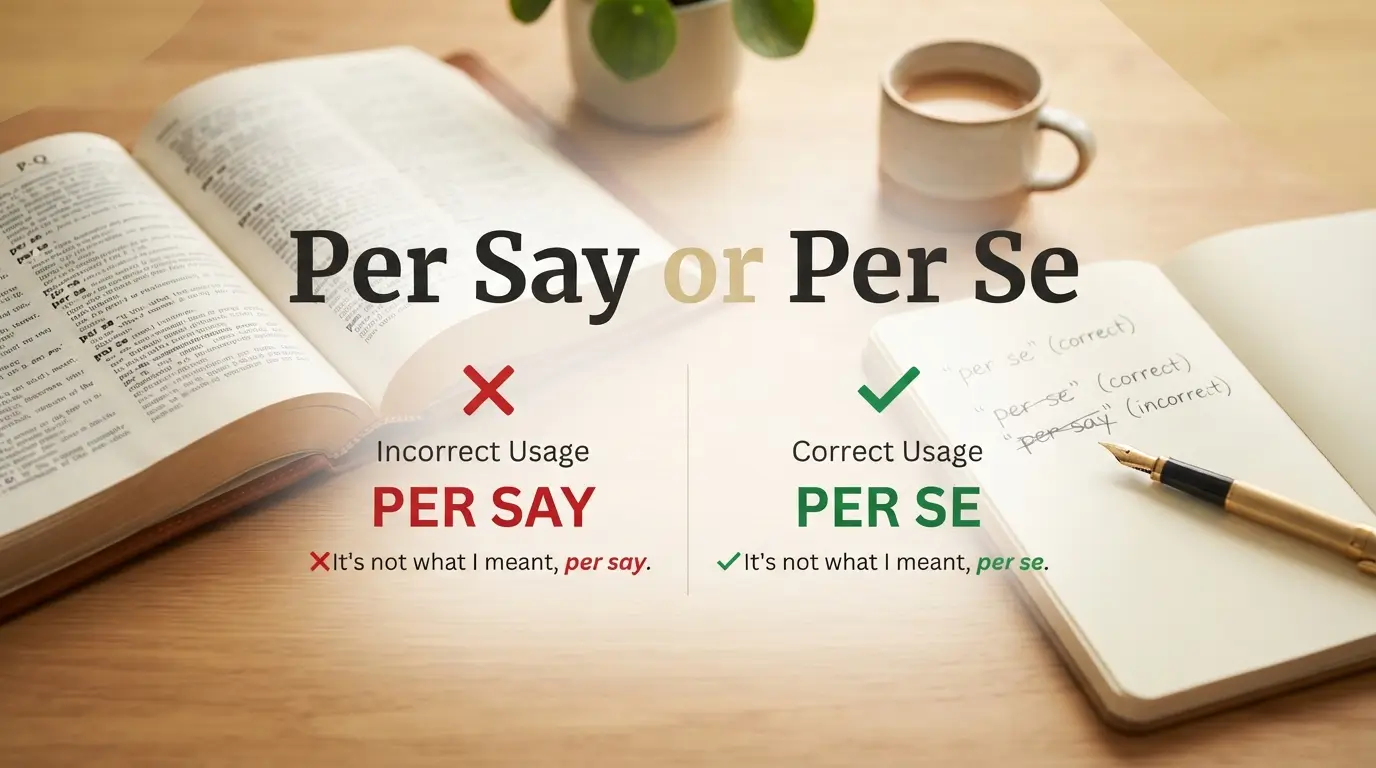
When people write “per say or per se,” the confusion usually comes from how the phrase sounds when spoken. Many people hear “per say” and naturally write it that way. However, the correct expression is “per se.”
Per se is a Latin phrase that means “by itself,” “in itself,” or “intrinsically.” It is common in everyday speech, emails, academic writing, journalism, and formal discussions.
For example, you might say, “The idea is not bad per se.” This means the idea is not bad in itself, although there may be other problems with it.
The phrase is often searched because “per say” sounds very similar to “per se.” This makes it an easy spelling mistake, especially for people who have heard the phrase many times but have rarely seen it written.
In this guide, you will learn the correct spelling, its Latin origin, how to use it, common mistakes, and real world examples. You will also see how per se is used in American and British English and which form you should use in professional writing.
Per Say or Per Se – Quick Answer
The correct spelling is per se.
Per say incorrect
Per se correct
Per se means “by itself,” “in itself,” or “considered alone.”
Examples
- The job is not difficult per se, but it takes a lot of time.
- I do not dislike social media per se; I dislike how people use it.
- The product is not expensive per se, but shipping costs are high.
- Being young is not a problem per se.
- The rule is not unfair per se, but its application can cause problems.
A simple way to remember it is:
Per se = in itself
The spelling “per say” is a common phonetic mistake. The phrase sounds somewhat like “per say” when spoken, but say is not part of the original expression.
Per Say vs Per Se
| Variation | Correct? | Meaning |
| per se | Yes | In itself; by itself |
| per say | No | Common spelling mistake |
| persee | No | Incorrect spelling |
| per say | No | Incorrect form |
The Origin of Per Say or Per Se
The correct phrase per se comes from Latin.
In Latin, per means “through,” “by,” or “by means of,” while se refers to “itself” or “himself/herself” depending on context.
Together, per se carries the idea of “by itself” or “in itself.”
English adopted many Latin expressions over hundreds of years. Some remained common in educated and formal writing, including:
- per se
- vice versa
- ad hoc
- status quo
- et cetera
- bona fide
- versus
Because per se comes from Latin, its spelling does not follow normal English spelling patterns.
Why Do People Write “Per Say”?
The main reason is pronunciation.
When people hear:
per se
it can sound like:
“per say”
Someone who learns the phrase through conversation may naturally assume that say is the second word.
This is called a phonetic spelling mistake. The writer spells a word based on how it sounds rather than how it is traditionally written.
The mistake is especially common because say is a normal English word, while se is not normally used as an independent English word.
So, if you are unsure, remember:
Per se = Latin expression
Per say = sound based mistake
British English vs American English Spelling
There is an important point here: British English and American English use the same spelling: “per se.”
Unlike words such as:
- colour / color
- organise / organize
- centre / center
there is no standard British American spelling difference for per se.
Comparison Table
| English Variety | Correct Spelling | Example |
| American English | per se | The plan is not bad per se. |
| British English | per se | The plan is not bad per se. |
| Canadian English | per se | The rule is not wrong per se. |
| Australian English | per se | The idea is not unusual per se. |
| International English | per se | The product is not expensive per se. |
Therefore, you do not need to choose between an American and British spelling.
Per se is the standard form in both varieties.
Does “Per Se” Need Italics?
You may sometimes see per se written in italics because it is a Latin expression.
For example:
The decision was not wrong per se.
However, modern English writing often uses per se without italics:
The decision was not wrong per se.
Both styles can appear in professional writing. Follow the style guide required by your school, employer, publication, or organization.
Which Spelling Should You Use?
Use per se regardless of whether your audience uses American English, British English, or another variety of English.
If You Write for an American Audience
Use:
per se
Example:
The proposal is not unreasonable per se.
If You Write for a British Audience
Use:
per se
Example:
The proposal is not unreasonable per se.
If You Write for a Global Audience
Again, use:
per se
The phrase is widely recognized in international English.
For Formal Writing
Per se is acceptable in many formal contexts, including:
- academic writing
- business writing
- journalism
- legal discussions
- essays
- professional emails
However, if your audience may not know the phrase, you can use a simpler alternative.
Instead of:
The policy is not harmful per se.
You could write:
The policy is not harmful in itself.
For very simple writing, “in itself” may be easier to understand.
Common Mistakes with Per Say or Per Se
1. Writing “Per Say”
The idea is not bad per say.
The idea is not bad per se.
This is the most common mistake.
2. Writing “Persee”
The rule is not unfair persee.
The rule is not unfair per se.
The phrase contains two separate words.
3. Writing “Per Say”
The product is not expensive per say.
The product is not expensive per se.
A hyphen is not needed.
4. Using It When You Mean “For Example”
Per se does not mean “for example.”
“I like many sports per se, such as football.”
If you want to introduce an example, use:
“For example, I like football.”
5. Confusing It with “Per Day”
Per se and per day have completely different meanings.
- per se = in itself
- per day = each day
Example:
The plan costs $10 per day.
Per Say or Per Se in Everyday Examples
The phrase per se appears in many types of writing. Here are examples from common situations.
In Emails
I do not have a problem with the proposal per se, but we need more time to review it.
This tells the reader that the proposal itself is not the problem.
In Business Writing
The product is not expensive per se, but its maintenance costs are high.
The product’s basic price is not necessarily the issue.
In News Writing
The policy is not controversial per se, but some groups disagree with how it is being applied.
The policy itself is not necessarily controversial. The disagreement concerns its application.
In Academic Writing
Technology is not harmful per se; its effects depend on how people use it.
This means technology itself is not automatically harmful.
In Social Media
I don’t hate online shopping per se. I just prefer visiting stores.
This is a casual way to clarify someone’s position.
In Conversation
I don’t dislike the movie per se. I just thought it was too long.
The speaker does not necessarily dislike the movie itself.
In Formal Writing
Competition is not harmful per se, but excessive competition can create problems.
Here, per se means “in itself.”
Per Say or Per Se – Google Trends & Usage Data
Searches for “per say or per se” usually come from people trying to confirm the correct spelling of a phrase they have heard.
The important pattern is that “per say” is generally a spelling error, while “per se” is the established expression.
Search interest can vary by:
- country
- education level
- writing context
- language background
- exposure to formal English
- interest in grammar and vocabulary
People may also search related questions such as:
- Is it per say or per se?
- What does per se mean?
- How do you spell per se?
- What is the meaning of per se?
- Is per se Latin?
- How do you use per se in a sentence?
Google Trends can show relative search interest by country and time period, but it should not be treated as a measure of the number of people who use the phrase in everyday writing. Search data measures searches, not total language usage.
For this keyword, the main user intent is clearly informational: people want to know which spelling is correct and how the phrase should be used.
Per Say vs Per Se: Comparison Table
| Phrase | Correct? | Meaning | Example |
| per se | ✅ | In itself | The idea is not bad per se. |
| per say | No standard meaning in this expression | Avoid this spelling. | |
| persee | Incorrect spelling | Do not use it. | |
| per say | Incorrect spelling | Do not hyphenate it. | |
| in itself | ✅ | Same basic meaning | The idea is not bad in itself. |
| by itself | ✅ | Similar meaning in many contexts | The machine can work by itself. |
FAQs About Per Say or Per Se
Is “per say” correct?
No. Per say is a common spelling mistake. The correct expression is per se.
What does “per se” mean?
Per se means “in itself,” “by itself,” or “considered alone.”
For example:
The idea is not wrong per se.
This means the idea is not wrong in itself.
Is “per se” Latin?
Yes. Per se is a Latin expression that entered English and is now commonly used in English writing and speech.
Is “per se” one word?
No. It is written as two words:
per se
Not:
persee
perse
per se
Do Americans and British people spell “per se” differently?
No. Both American English and British English normally use per se.
Can I use “per se” in formal writing?
Yes. Per se is widely used in formal, academic, professional, and journalistic writing. However, “in itself” can be clearer for readers who are unfamiliar with Latin expressions.
Why does “per se” sound like “per say”?
The pronunciation can make se sound similar to the English word say. This is why people sometimes write per say, even though the correct spelling is per se.
Conclusion
The correct expression is per se, not per say. Although both forms can sound similar when spoken, only per se is the established expression.
Per se comes from Latin and means “in itself,” “by itself,” or “considered alone.” It is used in American English, British English, and many other forms of international English, so you do not need to change its spelling for different audiences.
The most common mistake is writing “per say” because the phrase can sound that way in conversation. A simple memory trick is to connect per se with the phrase “in itself.”
For everyday and professional writing, use per se when you want to say that something is being considered on its own. If your audience prefers very simple English, “in itself” is a clear alternative.
So, whenever you are unsure, remember:
Per se = correct
Per say = incorrect
Discover More Post
- Carmel or Caramel: Which Spelling Is Correct?
- Lose or Loose: What’s the Difference?
- Spelt or Spelled: Which Is Correct? US vs UK English Guide

Emily Dickinson is one of America’s most influential poets, recognized for her unique style and thought-provoking poetry. Through GrammerNests.com, she contributes valuable perspectives on language, creativity, and the beauty of written expression.








1 thought on “Per Say or Per Se? Correct Spelling, Meaning, and Usage”