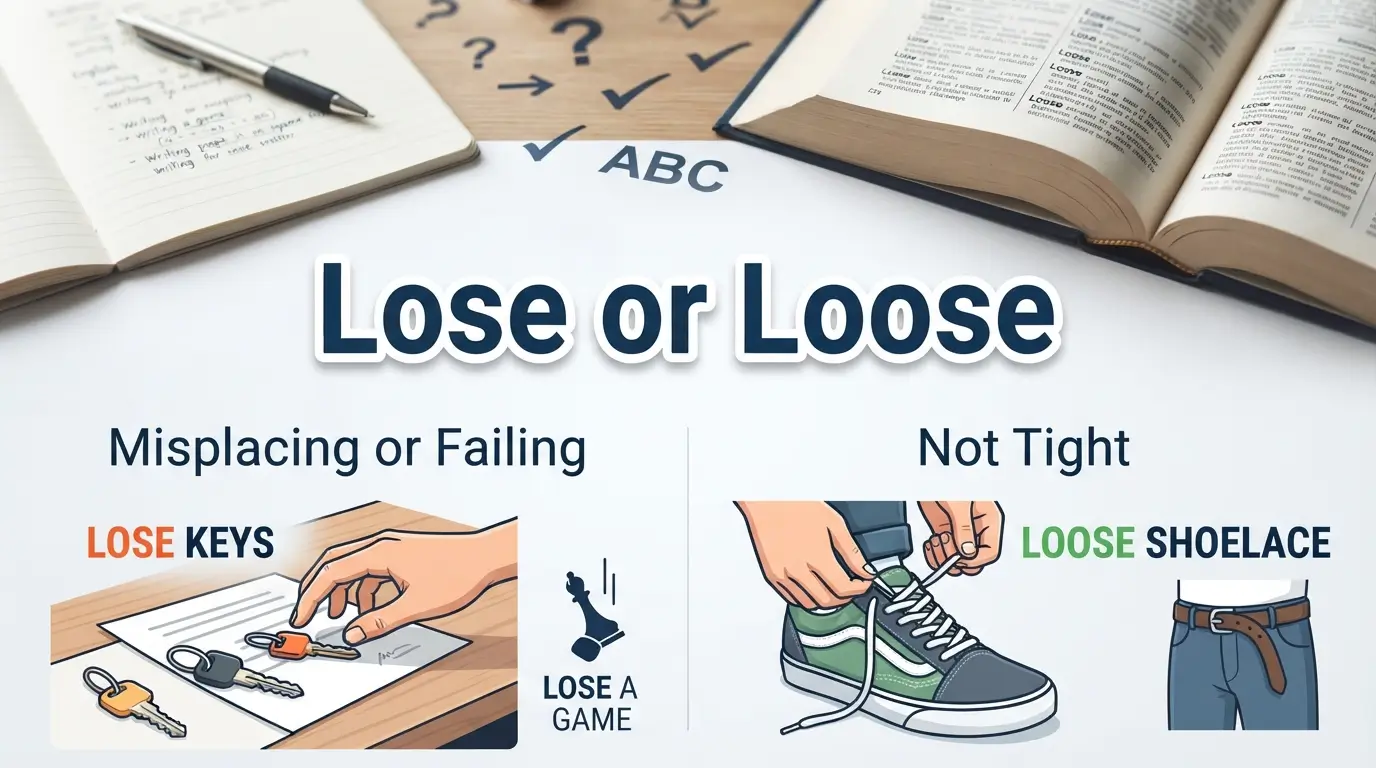
Lose or loose is one of the most common English spelling confusions. The two words look almost the same, but they have different meanings and different uses. If you have ever written I don’t want to loose my phone or wondered whether to say lose weight or loose weight, you are not alone.
The good news is that the difference is simple once you learn the basic rule. Lose is usually a verb. It means to no longer have something, fail to win, or reduce something. Loose is usually an adjective. It means not tight, not firmly fixed, or free.
This guide explains lose or loose with simple definitions, examples, spelling tips, common mistakes, and everyday sentences. It also looks at British and American English, so you can choose the correct word for your audience. By the end, you should be able to use lose and loose with confidence in emails, school writing, social media, and professional communication.
Lose or Loose – Quick Answer
The quick answer is:
- Lose = to misplace, fail to win, or reduce something.
- Loose = not tight or not firmly attached.
Examples of Lose
Use lose when something is no longer with you or when you fail to win.
- I do not want to lose my keys.
- Our team may lose the game.
- She wants to lose weight.
- Do not lose hope.
- He could lose his job.
Examples of Loose
Use loose when something is not tight or is free from something.
- My shirt is loose.
- This screw is loose.
- The dog got loose from the yard.
- She prefers loose clothing.
- One tooth feels loose.
Easy Memory Trick
Think:
Lose = loss
Loose = not tight
If you mean something is missing, gone, or not won, use lose.
If you mean something is not tight, use loose.
| Word | Main meaning | Example |
| Lose | Misplace, fail, or reduce | I may lose my phone. |
| Loose | Not tight or free | My shoes are loose. |
The Origin of Lose or Loose
The words lose and loose have different histories, even though their spellings are similar.
The Origin of Lose
Lose comes from Old English forms related to the idea of being deprived of something or suffering a loss. Over time, the word developed into the modern English verb lose.
Today, lose has several meanings. You can lose an object, lose a competition, lose money, lose time, or lose weight.
For example:
I do not want to lose my wallet.
Here, lose means to no longer know where your wallet is.
The Origin of Loose
Loose has roots connected with Old Norse and Old English words meaning free, unrestrained, or not bound.
The word later developed into the modern adjective loose, meaning something that is not tight or securely fixed.
For example:
The rope is loose.
The rope is not tight.
Why Do They Look So Similar?
The spelling can be confusing because both words contain the letters loo and sound somewhat similar. However, they developed from different word histories and have different meanings.
The extra o in loose can help you remember that something has more space and is not tight.
British English vs American English Spelling
There is no major spelling difference between lose and loose in British and American English.
Both forms are standard:
- British English: lose / loose
- American English: lose / loose
- Canadian English: lose / loose
- Australian English: lose / loose
The main difference is pronunciation.
Lose usually has a /z/ sound at the end:
lose → looz
Loose usually has an /s/ sound:
loose → looss
Comparison Table
| Feature | Lose | Loose |
| British English | Lose | Loose |
| American English | Lose | Loose |
| Main word type | Verb | Adjective |
| Meaning | Misplace, fail, reduce | Not tight, free |
| Example | Do not lose your keys. | These shoes are loose. |
| Pronunciation | Ends with /z/ sound | Ends with /s/ sound |
There is therefore no US-versus-UK spelling choice here. The important thing is choosing the correct word based on meaning.
Which Spelling Should You Use?
Your choice depends on what you want to say, not on whether you are writing for an American or British audience.
For US Audiences
Use lose when you mean to misplace, fail, or reduce something.
I do not want to lose my job.
Use loose when something is not tight.
The jacket is loose.
For UK and Commonwealth Audiences
The same rule applies.
She might lose the match.
His shirt is loose.
Countries such as the UK, Australia, Canada, and New Zealand use the same standard spellings for these two words.
For a Global Audience
Use the correct word based on meaning. There is no need to change lose to another spelling for international readers.
A simple rule works everywhere:
Lose = something goes away or is not won.
Loose = something is not tight.
Common Mistakes with Lose or Loose
Many mistakes happen because the two words look and sound similar.
Mistake 1: I Don’t Want to Loose My Phone
I do not want to loose my phone.
I do not want to lose my phone.
You mean that you do not want your phone to become lost.
Mistake 2: I Want to Loose Weight
I want to loose weight.
I want to lose weight.
Weight can be reduced, so the correct word is lose.
Mistake 3: My Shoes Are Lose
My shoes are lose.
My shoes are loose.
The shoes are not tight, so use loose.
Mistake 4: We Could Loose the Game
We could loose the game.
We could lose the game.
A team can lose a game, but it cannot loose a game.
Mistake 5: The Screw Is Lose
The screw is lose.
The screw is loose.
The screw is not firmly attached, so loose is correct.
Simple Correction Rule
Ask yourself:
Does it mean not tight ?
If yes, use loose.
Does it mean misplace, fail, or reduce ?
If yes, use lose.
Lose or Loose in Everyday Examples
Knowing the difference is useful because these words appear often in everyday English.
In Emails
Please do not lose the document.
The handle on the door is loose.
In News Writing
The team could lose the final match.
Police said the animal was loose in the area.
On Social Media
I do not want to lose my memories.
These jeans are too loose for me.
In Formal Writing
Businesses can lose customers because of poor service.
The connection became loose after repeated use.
At Work
We cannot afford to lose this client.
The cable appears to be loose.
In School Writing
Students may lose marks for spelling errors.
The paper was held by a loose clip.
Lose or Loose – Comparison Table
| Situation | Correct Word | Example |
| Misplacing something | Lose | I might lose my keys. |
| Failing to win | Lose | They may lose the game. |
| Reducing weight | Lose | She wants to lose weight. |
| No longer having something | Lose | He could lose his job. |
| Not tight | Loose | My shirt is loose. |
| Not firmly attached | Loose | The screw is loose. |
| Free or unrestrained | Loose | The dog is loose. |
| Clothing with extra space | Loose | She likes loose clothes. |
Lose or Loose – Google Trends & Usage Data
Search interest for lose and loose is influenced by the fact that both are common English words. People search for the phrase lose or loose when they are unsure which spelling is correct.
The confusion appears in many English-speaking countries, including the United States, United Kingdom, Canada, Australia, and other regions where English is widely used.
Searches also often come from people checking phrases such as:
- lose or loose weight
- lose or loose meaning
- lose or loose game
- lose or loose clothing
- lose or loose someone
- lose or loose connection
The context matters because lose is a very common verb, while loose is often used to describe physical objects, clothing, connections, or freedom.
Google Trends can change over time, and search interest can vary by country and season. For that reason, a single trend result should not be treated as a permanent measure of language use.
The most useful takeaway is simple: people search lose or loose mainly because the spellings are similar but their meanings are different.
FAQs About Lose or Loose
Is it lose or loose weight?
The correct phrase is lose weight.
Example:
I want to lose weight.
Is it lose or loose a game?
The correct phrase is lose a game.
Example:
Our team could lose the game.
Is loose the opposite of tight?
Yes. Loose can mean not tight.
Example:
This shirt is too loose.
Is lose the opposite of win?
In many situations, yes. When talking about a competition, lose is the opposite of win.
Example:
They could win or lose the match.
How do you remember lose vs loose?
Remember:
Lose = loss
Loose = not tight
This simple connection can help you choose the correct spelling.
Why do people confuse lose and loose?
They are confusing because their spellings are very similar and their pronunciation is close. However, their meanings and grammatical uses are different.
Is loose ever a verb?
Yes. Loose can also be used as a verb meaning to release or set free, although this use is less common in everyday English.
For example:
The action loosed the rope.
Conclusion: Lose or Loose
The difference between lose and loose is simple once you connect each word with its meaning. Lose is mainly a verb. It means to misplace something, fail to win, no longer have something, or reduce something. For example, you can lose your keys, lose a game, or lose weight.
Loose is mainly an adjective. It describes something that is not tight, firmly fixed, or restrained. For example, you can have loose clothing, a loose screw, or a loose connection.
The spelling does not change between standard British and American English. The key is meaning, not geography.
When you are unsure, ask one simple question: Does the sentence mean not tight ? If yes, use loose. If it means misplace, fail, or reduce something, use lose. With this quick rule, you can avoid one of the most common English spelling mistakes in everyday and professional writing.
Discover More Post
- Lets or Let’s: Which Spelling Is Correct?
- Past or Passed: Which One Should You Use?
- Carmel or Caramel: Which Spelling Is Correct?

Emily Dickinson is one of America’s most influential poets, recognized for her unique style and thought-provoking poetry. Through GrammerNests.com, she contributes valuable perspectives on language, creativity, and the beauty of written expression.








2 thoughts on “Lose or Loose: What’s the Difference?”