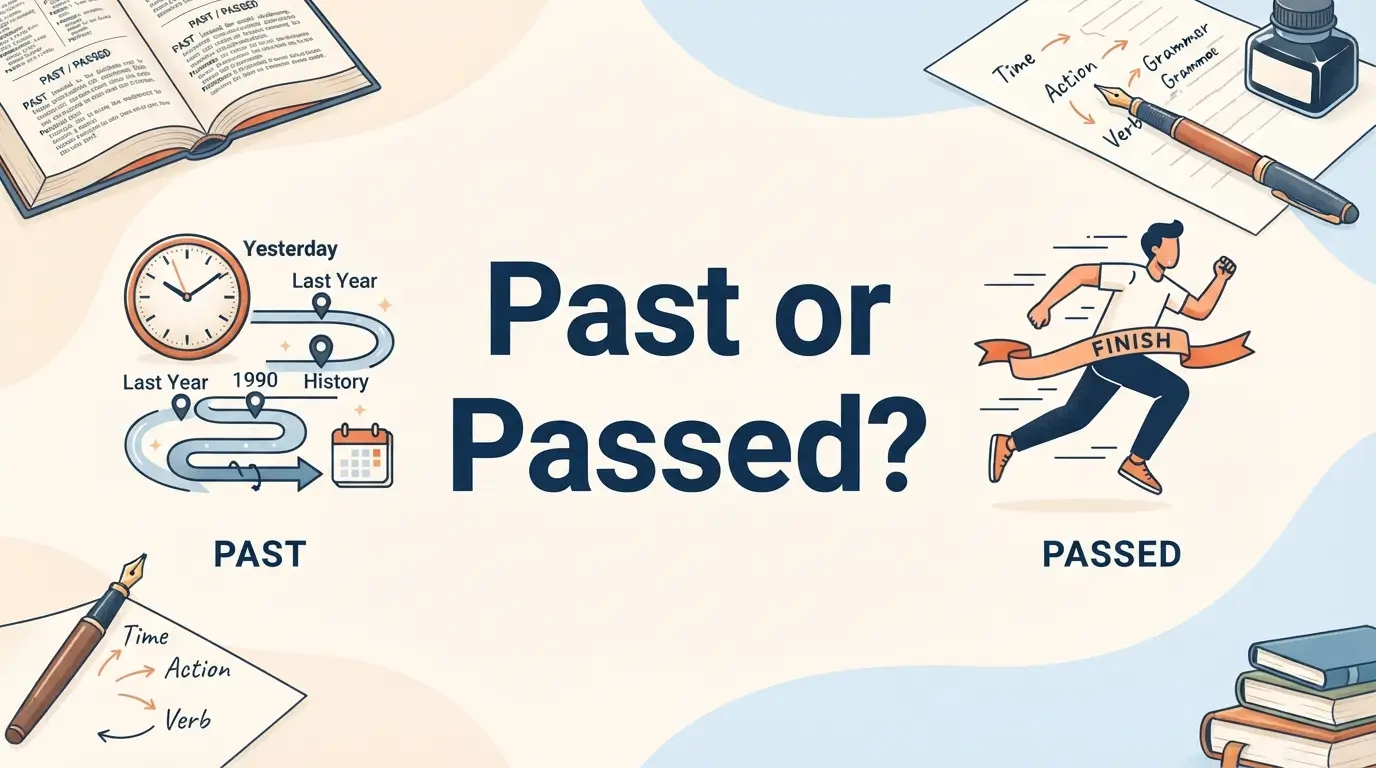
Past or passed is a common English confusion. The two words sound almost the same, but they have different meanings and grammar rules. Many people search for “past or passed” because they are unsure which word to use in a sentence.
For example, should you write, “She passed the store,” or “She walked past the store”? The answer depends on what you want to say.
The word past can describe time, location, or movement. The word passed is usually the past tense or past participle of the verb pass. Understanding this difference can help you write better emails, messages, school assignments, articles, and professional documents.
The good news is that the difference is easier than it first seems. You do not need to memorize many complicated rules. You only need to understand what each word means and how it works in a sentence.
In this guide, you will learn the difference between past or passed, see simple examples, learn common mistakes, and find out which form to use in different situations.
Past or Passed – Quick Answer
The easiest rule is:
- Past usually refers to time, place, or movement beyond something.
- Passed is usually the past tense of the verb “pass.”
Examples with “past”
- I walked past the school.
- We talked about the past.
- It happened in the past.
- She drove past my house.
Examples with “passed”
- She passed her exam.
- He passed me the book.
- The car passed us.
- Time passed quickly.
A useful trick is to ask yourself whether you need a verb.
If you need a verb showing an action, passed may be correct.
He passed the ball.
If you are talking about a time or position beyond something, past is usually correct.
He walked past the ball.
Past vs. Passed: Quick Comparison
| Word | Main use | Example |
| Past | Earlier time | I lived there in the past. |
| Past | Beyond a place | She walked past the store. |
| Past | Beyond a point | It is past midnight. |
| Passed | Past tense of “pass” | He passed the test. |
| Passed | Moving by something | The train passed the station. |
| Passed | Giving something | She passed me the phone. |
The Origin of Past or Passed
The words past and passed are closely connected to the idea of movement and time, but they developed through different grammatical paths.
Past comes from the idea of something that has gone by. It is related to the verb pass and became established as a word for earlier time or a position beyond something.
For example:
The past year was difficult.
Here, past describes a period of time that has already gone by.
Passed, on the other hand, is the past form of the verb pass.
She passed the door.
The spelling difference exists because the words have different grammatical jobs. Passed contains -ed, showing that it is a past-tense form of a verb. Past can work as a noun, adjective, adverb, or preposition.
This is why replacing one word with the other can change the meaning of a sentence.
Compare:
We walked past the house.
and:
We passed the house.
Both can describe movement, but their grammar is different. In the first sentence, past is a preposition. In the second, passed is the verb.
British English vs American English Spelling
There is an important point here: past and passed are not mainly a British-versus-American spelling difference.
Both British English and American English use past and passed in the same basic ways.
| Meaning | British English | American English |
| Earlier time | past | past |
| Beyond a place | past | past |
| Past tense of “pass” | passed | passed |
| Passed an exam | passed | passed |
| Passed someone | passed | passed |
For example, both varieties use:
She walked past the library.
And:
She passed her driving test.
However, British and American English can differ in some other spelling rules, such as colour/color, centre/center, and travelling/traveling. Those differences should not be confused with past/passed.
Why Do People Confuse Them?
One major reason is pronunciation.
In many accents, past and passed sound very similar or even identical. When people hear the sentence instead of seeing it written, it can be difficult to know which spelling is correct.
For example:
He walked past me.
and:
He passed me.
The words have different grammatical roles, even though their pronunciation is similar.
Which Spelling Should You Use?
The answer depends on the meaning of your sentence, not mainly on whether you use British or American English.
If You Mean Earlier Time
Use past.
I learned this lesson in the past.
She has changed a lot since the past few years.
A more natural version of the second sentence would be:
She has changed a lot over the past few years.
If You Mean Moving Beyond Something
Use past when it functions as a preposition or describes position.
We drove past the hospital.
He walked past me.
If You Mean the Action “Pass”
Use passed.
She passed the exam.
The bus passed us.
He passed the message to Sarah.
For US Readers
Use the same basic rules. American English does not replace past with passed.
For UK and Commonwealth Readers
The same basic distinction applies.
I walked past the shop.
I passed my driving test.
For Global English
If you write for an international audience, focus on meaning rather than regional spelling. The distinction between past and passed is understood in both major varieties of English.
Common Mistakes with Past or Passed
Mistake 1: “I walked passed the store.”
Incorrect:
I walked passed the store.
Correct:
I walked past the store.
Why? Past describes the position or movement beyond the store.
Mistake 2: “I past the exam.”
Incorrect:
I past the exam.
Correct:
I passed the exam.
Why? You need the verb passed, which is the past tense of pass.
Mistake 3: “In the passed”
Incorrect:
In the passed, people communicated differently.
Correct:
In the past, people communicated differently.
Here, past means an earlier period.
Mistake 4: “The car past me.”
Incorrect:
The car past me.
Correct:
The car passed me.
The sentence needs a verb. Passed is the past tense of pass.
Mistake 5: “For the passed three years”
Incorrect:
I have worked here for the passed three years.
Correct:
I have worked here for the past three years.
Here, past describes the period of time leading up to now.
A Simple Memory Trick
Remember:
Passed = an action.
Past = a time or position.
For example:
She passed the test.
Action → passed
She studied hard in the past.
Time → past
This simple trick will solve many past or passed questions.
Past or Passed in Everyday Examples
Knowing the rule is useful, but seeing these words in real situations makes the difference easier to remember.
In Emails
Correct:
I have attached the documents from the past meeting.
Correct:
Thank you for helping me pass the information to the team.
Correct:
The deadline has passed.
Here, passed is the verb describing an action or event that has gone by.
In News Writing
News articles often use both words.
The storm passed through the region overnight.
Here, passed is the verb.
Officials discussed problems from the past year.
Here, past refers to an earlier period.
On Social Media
You may see sentences such as:
Sometimes, you have to leave the past behind.
Or:
Another year has passed so quickly.
Both are correct because they have different meanings.
In Formal Writing
Formal writing also uses both words.
The company has changed significantly over the past decade.
The proposal passed the committee vote.
In Everyday Conversation
You might say:
I saw him walking past the house.
Or:
He passed me while I was walking.
The first sentence focuses on the position or direction. The second focuses on the action of passing.
Past or Passed – Google Trends & Usage Data
People frequently search for “past or passed” because the words are homophones in many English accents. That means they can sound the same even though they have different meanings and grammatical functions.
Search interest can vary by country, education level, writing context, and language-learning needs. Searches for this pair are often connected with grammar questions, proofreading, school writing, and English-learning content.
It is also important to understand that Google Trends measures relative search interest, not the total number of people who use a word. A high Trends value means a search term had relatively strong interest within the selected comparison and period. It does not mean that the word is objectively more common in everyday language.
The broader usage pattern is clear: past and passed are both standard English words in British and American English. The main issue is choosing the correct word for the sentence.
For writers, the most useful approach is therefore not to focus on which word is “more popular.” Instead, identify whether your sentence needs the verb passed or the time/place word past.
Past or Passed Variations: Side-by-Side Comparison
| Expression | Correct? | Meaning | Example |
| past | Yes | Earlier time | The past year was busy. |
| passed | Yes | Completed an action | She passed the exam. |
| walk past | Yes | Move beyond | Walk past the building. |
| walked past | Yes | Moved beyond | He walked past me. |
| passed by | Yes | Moved by | The bus passed by. |
| past few days | Yes | Recent time | I was busy for the past few days. |
| passed few days | Usually incorrect | — | Use past instead. |
| past the store | Yes | Beyond the store | Go past the store. |
| passed the store | Yes | Moved beyond the store | The car passed the store. |
Notice that past the store and passed the store can both be correct.
The grammar is what changes:
We walked past the store.
We passed the store.
FAQs About Past or Passed
Is it “past or passed”?
Both words are correct, but they have different meanings. Past usually refers to earlier time or a position beyond something. Passed is usually the past tense of the verb pass.
Is it “walk past” or “walk passed”?
The correct phrase is walk past.
We walked past the restaurant.
Here, past shows movement beyond the restaurant.
Is it “passed away” or “past away”?
The correct phrase is passed away.
Her grandfather passed away peacefully.
Passed is the verb in this expression.
Is it “past few days” or “passed few days”?
The correct phrase is past few days.
I have been busy for the past few days.
Is “past” a verb?
Usually, past is not used as the standard verb in modern English. It can function as a noun, adjective, adverb, or preposition.
For example:
We walked past the school.
Is “passed” always a verb?
Passed is normally the past tense or past participle of the verb pass.
She passed the exam.
The train has passed the station.
Do British and American English use different forms?
No. Both British English and American English use past and passed with the same basic meanings. The difference is based on grammar and meaning, not regional spelling.
Conclusion
The difference between past or passed becomes simple once you focus on meaning.
Use past when you are talking about an earlier time, a period that has gone by, or movement beyond a place. For example, “I lived there in the past” and “She walked past the store.”
Use passed when you need the past form of the verb pass. For example, “He passed the exam,” “The car passed us,” and “She passed the message to me.”
British English and American English follow the same basic rules for these two words. The main confusion comes from their similar pronunciation, not from regional spelling differences.
When you are unsure, ask yourself one simple question: Am I describing time or position, or am I describing an action? If it is time or position, past is often correct. If it is the action of passing, passed is usually correct.
With this simple rule, you can use both words confidently in everyday, academic, and professional writing.
Discover More Post
- Apart or a Part: What Is the Difference?
- Choose or Chose: What Is the Difference? Complete Guide
- Lets or Let’s: Which Spelling Is Correct?









2 thoughts on “Past or Passed: Which One Should You Use?”