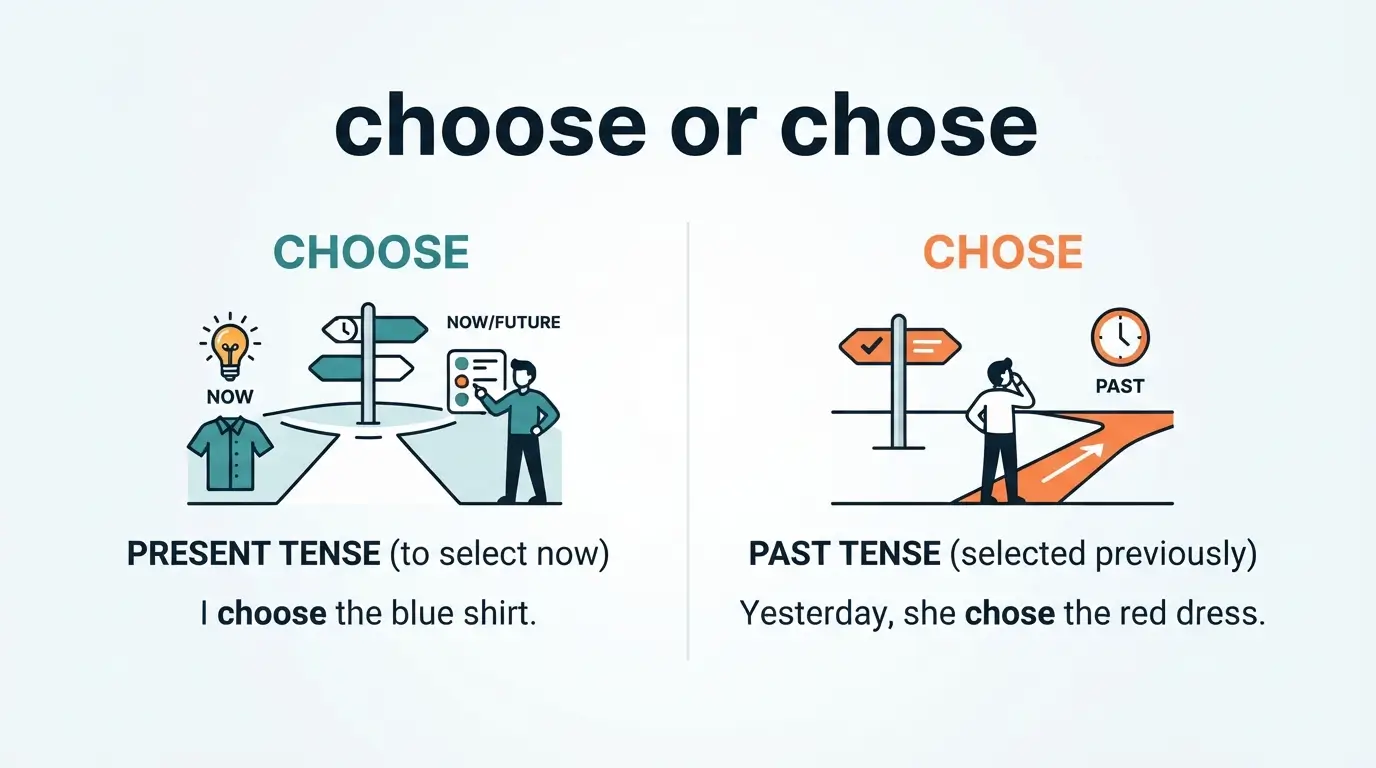
Have you ever stopped while writing a sentence and wondered, “Should I use choose or chose?” You are not alone. These two words look almost the same, but they are used at different times.
The main difference is simple: choose is the present tense, while chose is the past tense. For example, you can say, “I choose tea every morning,” but you should say, “I chose tea yesterday.”
This small spelling difference can cause mistakes in emails, schoolwork, social media posts, and professional writing. It can also be confusing because choose and chose have different pronunciations.
In this guide, you will learn the difference between choose or chose, where these words come from, how British and American English use them, and how to avoid common mistakes. You will also see simple examples from everyday writing.
Choose or Chose – Quick Answer
The quick answer is:
- Choose = present tense
- Chose = past tense
- Chosen = past participle, normally used with have, has, or had
Examples
Choose:
I usually choose coffee.
This means you make the choice now or regularly.
Chose:
I chose coffee yesterday.
This means the choice happened in the past.
Chosen:
I have chosen coffee for my breakfast.
Here, chosen works with “have.”
Quick Comparison
| Word | Tense | Example |
| Choose | Present | I choose the blue shirt. |
| Chose | Past | I chose the blue shirt yesterday. |
| Chosen | Past participle | I have chosen the blue shirt. |
A simple trick can help:
Today → choose
Yesterday → chose
The Origin of Choose or Chose
The words choose and chose come from the same English verb. Their history goes back to Old English and earlier Germanic languages.
The modern English verb choose developed from older forms that meant to select, pick, or decide between options.
Over time, English changed its spelling and pronunciation. The present form became choose, while the past form developed into chose.
This is why the two words look similar but are not spelled the same.
English has many verbs like this. They are called irregular verbs because they do not form their past tense by simply adding -ed.
For example:
- choose → chose
- speak → spoke
- write → wrote
- drive → drove
- break → broke
So you should not write “choosed.” The correct past form is chose.
British English vs American English Spelling
There is an important point about choose or chose: British English and American English use the same spelling for these two forms.
Unlike words such as colour/color or centre/center, there is no British-versus-American spelling difference for choose and chose.
Both varieties use:
- choose for the present
- chose for the past
- chosen as the past participle
Comparison Table
| Meaning | British English | American English |
| Present | choose | choose |
| Past | chose | chose |
| Past participle | chosen | chosen |
| Example | I choose this one. | I choose this one. |
| Past example | I chose this one. | I chose this one. |
The main difference you may notice is pronunciation, not spelling.
Choose sounds like “chews.”
Chose sounds like “chohz.”
For example:
Please choose one.
She chose the red dress.
So whether you write for a British or American audience, the spelling stays the same.
Which Spelling Should You Use?
Your choice depends on the time of the action, not your country.
Use “choose” for the present
Use choose when someone is making a choice now or when talking about a regular choice.
I choose healthy food.
We choose a new topic every week.
You can choose any color.
Use “chose” for the past
Use chose when the choice happened before now.
I chose this university last year.
She chose the blue dress yesterday.
They chose a different hotel.
Use “chosen” with perfect tenses
Use chosen after words such as have, has, and had.
I have chosen my course.
She has chosen a new job.
They had chosen the restaurant before we arrived.
The key is to focus on when the choice happened, rather than whether you are writing American or British English.
Common Mistakes with Choose or Chose
Many mistakes happen because the words look and sound similar.
Mistake 1: Using “chose” for the present
Incorrect:
I chose this option every day.
If you mean this is your regular choice, use choose.
Correct:
I choose this option every day.
Mistake 2: Using “choose” for the past
Incorrect:
Yesterday, I choose the red shirt.
Correct:
Yesterday, I chose the red shirt.
The word “yesterday” clearly shows that the action happened in the past.
Mistake 3: Writing “choosed”
Incorrect:
She choosed the best option.
Correct:
She chose the best option.
Choosed is not the standard past tense of choose.
Mistake 4: Confusing “chose” and “chosen”
Incorrect:
I have chose this one.
Correct:
I have chosen this one.
Remember:
choose → chose → chosen
Mistake 5: Confusing pronunciation
Choose and chose are not pronounced the same way.
- choose → sounds like “chews”
- chose → sounds like “chohz”
This pronunciation difference can help you remember the spelling.
Choose or Chose in Everyday Examples
Understanding real examples makes the difference much easier.
In Emails
Present:
Please choose your preferred meeting time.
Past:
We chose Tuesday for the meeting.
Formal writing:
The committee has chosen a new date.
In News Writing
Present:
Voters choose their representatives through elections.
Past:
The committee chose a new chairperson.
The tense depends on when the action happened.
On Social Media
Present:
I always choose coffee over tea.
Past:
I chose this outfit for today’s event.
You can also see the word in questions:
Which one would you choose?
Which one did you choose?
In Formal Writing
Present:
Students can choose from several courses.
Past:
The student chose the science program.
Perfect tense:
The student has chosen the science program.
These examples show why checking the tense is more useful than simply trying to remember the spelling.
Choose or Chose – Google Trends & Usage Data
People often search for “choose or chose” because the words are closely related and easy to confuse.
Search interest can vary by country, language background, education level, and writing context. English learners may search for the phrase when they are writing essays, emails, applications, or social media posts.
Google Trends can also show that search interest changes over time. However, Trends data is based on relative search interest, not the total number of searches. It should therefore be used to understand search patterns rather than as an exact measure of word usage.
The practical difference remains the same across major English-speaking varieties:
choose = present
chose = past
For people learning English, grammar context is more useful than country-specific spelling rules because choose and chose are spelled the same in both British and American English.
Choose or Chose: Comparison Table
| Word | Grammar | When to Use | Example |
| Choose | Present | Now or regularly | I choose tea. |
| Chose | Past | A completed past action | I chose tea yesterday. |
| Chosen | Past participle | With have/has/had | I have chosen tea. |
Easy Memory Rule
Think of the three forms as:
Choose → Chose → Chosen
You can also connect them with time:
Now → choose
Before → chose
Have/has/had → chosen
FAQs About Choose or Chose
Is “chose” the past tense of “choose”?
Yes. Chose is the simple past tense of choose.
I choose this book today.
I chose this book yesterday.
Is “choosed” a correct word?
No. The standard past tense is chose, not “choosed.”
❌ I choosed the red one.
✅ I chose the red one.
What is the past participle of choose?
The past participle is chosen.
I have chosen this option.
The three main forms are:
choose → chose → chosen
Should I say “I choose” or “I chose”?
It depends on the time.
Use I choose for the present or a regular action.
Use I chose for a completed past action.
Is “choose” American or British English?
Choose is used in both American and British English. There is no spelling difference between the two varieties.
Is “chose” pronounced like “choose”?
No. They have different pronunciations.
Choose rhymes with words such as “shoes.”
Chose has a sound similar to “shows.”
Can “choose” be used for the future?
Yes. Choose can appear when talking about a future choice.
You can choose your seat tomorrow.
The surrounding words show that the action is in the future.
Conclusion
The difference between choose or chose is simple once you focus on time. Choose is the present form, while chose is the simple past form. The past participle is chosen.
For example, say:
I choose tea every morning.
But say:
I chose tea yesterday.
And with a perfect tense:
I have chosen tea.
British and American English use the same spellings, so you do not need to worry about choosing a different form based on your audience. The most important thing is to identify when the action happened.
Remember the basic pattern: choose → chose → chosen. If the action is happening now or happens regularly, use choose. If it happened in the past, use chose. With have, has, or had, use chosen.
Discover More Post
- It’s or Its? Simple Rules, Examples, and Common Mistakes
- Lieing or Lying: Which Spelling Is Correct?
- Apart or a Part: What Is the Difference?

Emily Dickinson is one of America’s most influential poets, recognized for her unique style and thought-provoking poetry. Through GrammerNests.com, she contributes valuable perspectives on language, creativity, and the beauty of written expression.








2 thoughts on “Choose or Chose: What Is the Difference? Complete Guide”