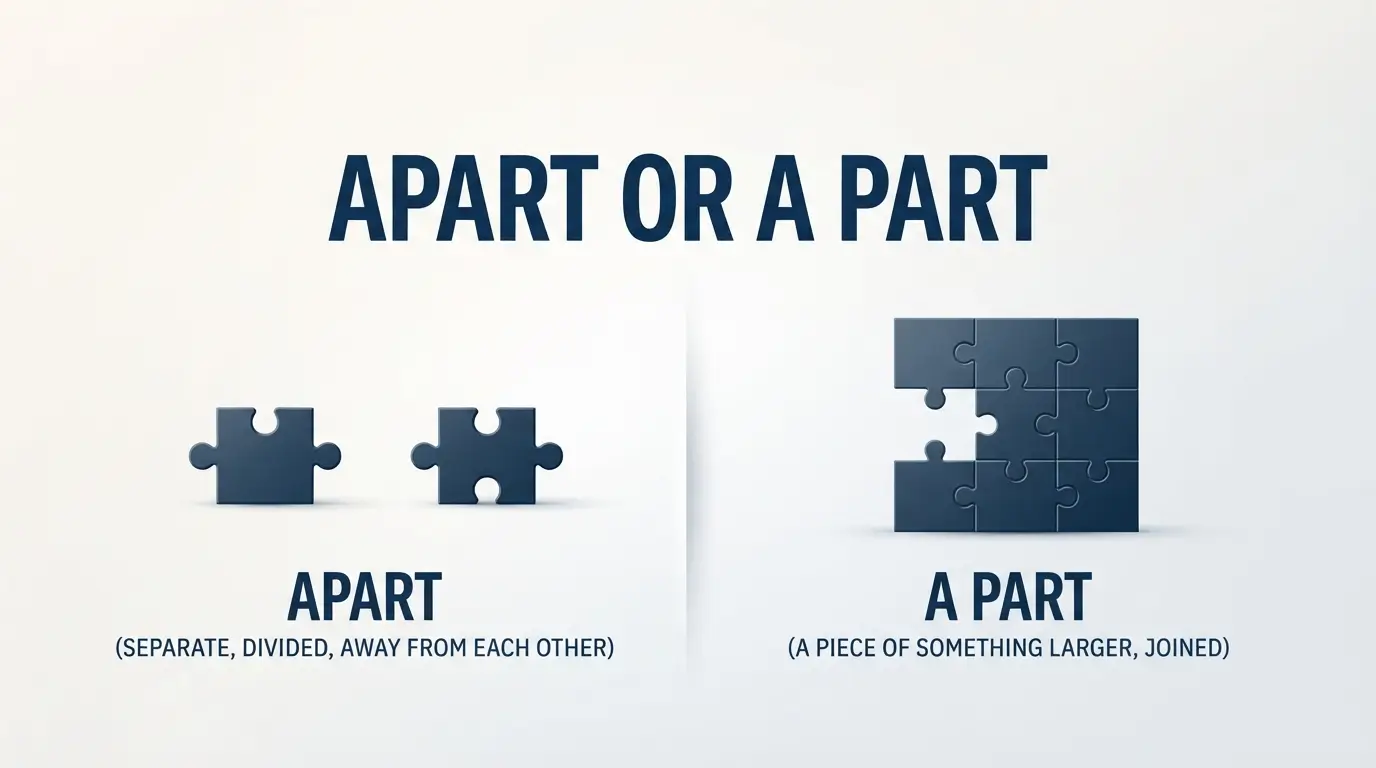
Have you ever stopped while writing and wondered if the correct phrase is “apart” or “a part”? You are not alone. These two forms sound almost the same, but they have different meanings and uses. Choosing the wrong one can change the meaning of your sentence.
The word “apart” usually means separated, away from each other, or into pieces. For example, “The two houses are far apart.” On the other hand, “a part” means one piece, member, or section of something. For example, “I want to be a part of the team.”
This small spelling difference often causes confusion in emails, school assignments, social media posts, and professional writing. The good news is that the rule is simple once you understand what each form means.
In this guide, you will learn the difference between apart and a part, see easy examples, learn common mistakes, and find out which form to use in different situations.
Apart or a Part – Quick Answer
“Apart” and “a part” are both correct, but they do not mean the same thing.
- Apart = separated, away from, or into pieces.
- A part = one piece, section, member, or element of something.
Examples with “apart”
- The two friends live miles apart.
- Please keep the books apart.
- The old machine came apart.
- They decided to stay apart for a while.
Examples with “a part”
- I want to be a part of this project.
- She is a part of our team.
- Everyone played a part in the success.
- This chapter is a part of the book.
Easy memory trick
If you mean “separate” or “away,” use apart.
If you mean “one piece of something,” use a part.
For example:
The children sat apart.
They sat separately.
The children are a part of the school team.
They belong to the team.
The Origin of Apart or A Part
The difference between apart and a part comes from both language history and grammar.
The word “apart” developed from older forms of English and French-related language. It has long been used to describe separation or distance. Today, it functions mainly as an adverb and adjective in English.
The phrase “a part” is different. It contains the article “a” and the noun “part.” The word “part” comes through Old French and Latin roots connected with the idea of a portion or share.
This explains why the two forms look so similar. They contain the same basic word, part, but they work differently in a sentence.
Compare:
The two buildings are apart.
Here, “apart” describes their separation.
This building is a part of the university.
Here, “a part” means one section or member of a larger whole.
The spelling difference is therefore not mainly about British or American English. It is about meaning and grammar.
British English vs American English Spelling
There is no major British-versus-American spelling difference between apart and a part.
Both British English and American English normally use:
- apart
- a part
The important difference is how the words are used in a sentence.
| Meaning | British English | American English |
| Separate or away | apart | apart |
| One piece of something | a part | a part |
| Belonging to a group | a part of | a part of |
| Physically separated | apart | apart |
| Into separate pieces | apart | apart |
For example, both forms are correct in the United Kingdom and the United States:
We live apart.
I am a part of the team.
Important point
You should not choose “apart” simply because you are writing for an American audience or “a part” because you are writing for a British audience.
The correct choice depends on the meaning of your sentence.
Which Spelling Should You Use?
The answer depends on what you want to say.
Use “apart” when you mean separate
Use apart when people or things are separated by distance, position, or condition.
Examples:
- The houses are far apart.
- Keep the two wires apart.
- The couple decided to live apart.
- The pieces fell apart.
Use “a part” when you mean one piece or member
Use a part when something belongs to a larger whole.
Examples:
- I am a part of the community.
- She became a part of the team.
- This is a part of our plan.
- Everyone has a part to play.
For US readers
Use the same rules. American English does not normally change apart into a part or vice versa.
For UK and Commonwealth readers
The same basic rule applies. British English, Australian English, and other varieties generally distinguish the two forms by meaning rather than by national spelling rules.
For global writing
If your website has an international audience, use the form that matches your intended meaning. Do not treat apart and a part as interchangeable.
Common Mistakes with Apart or A Part
Many mistakes happen because the two forms sound similar.
Mistake 1: “I want to be apart of the team.”
Incorrect:
I want to be apart of the team.
Correct:
I want to be a part of the team.
Here, the writer means to belong to the team. Therefore, a part is correct.
Mistake 2: “The houses are a part.”
If you mean the houses are separated, this is incorrect.
Better:
The houses are apart.
Mistake 3: “They live a part.”
Incorrect:
They live a part.
Correct:
They live apart.
The intended meaning is that they live separately.
Mistake 4: “Everyone played apart in the project.”
If you mean everyone contributed, use:
Everyone played a part in the project.
Here, “a part” means a role or contribution.
Mistake 5: Confusing “apart from”
The phrase “apart from” has its own uses.
For example:
Apart from John, everyone attended the meeting.
Depending on context, “apart from” can mean except for or in addition to.
It is not the same as the phrase “a part of.”
Apart or A Part – Comparison Table
| Form | Meaning | Example |
| apart | separated | The two houses are far apart. |
| apart | away from each other | The children sat apart. |
| apart | into pieces | The old chair came apart. |
| a part | one piece of a whole | This is a part of the machine. |
| a part | member of a group | She is a part of our team. |
| a part | role or contribution | He played a part in the project. |
| apart from | except for / besides | Apart from Sarah, everyone came. |
A quick test can help:
Can you replace the phrase with “separate” or “separately”?
If yes, apart is probably correct.
Can you replace it with “one piece,” “one member,” or “one section”?
If yes, a part is probably correct.
Apart or A Part in Everyday Examples
These words appear in many types of writing.
In emails
Please keep the documents apart until we finish checking them.
I am happy to be a part of this project.
The first sentence describes separation. The second describes membership.
In news writing
The two groups have remained apart since the disagreement.
Local volunteers played a part in the recovery effort.
News writing often uses both forms because journalists describe both separation and participation.
On social media
People often write:
Proud to be a part of this amazing community!
Another common sentence is:
We may be miles apart, but we are still connected.
Both forms are correct because their meanings are different.
In formal writing
Several factors played a part in the final decision.
The two sections should remain apart for safety reasons.
In formal writing, choosing the correct form helps make your meaning clear.
In school writing
Students often use a part when discussing membership or contribution:
Education is a part of personal development.
They may use apart when describing separation:
The two characters are kept apart by distance.
Apart or A Part – Google Trends & Usage Data
Searches for “apart or a part” usually come from people who are unsure about grammar and spelling. The search intent is mainly informational.
Search interest can vary by country, language background, education level, and writing context. English learners may search the phrase because apart and a part sound very similar when spoken.
The exact popularity of the search term can also change over time. Google Trends is useful for comparing relative search interest, but it does not provide a simple count of all searches.
Usage also depends on the phrase being searched.
For example:
- “a part of the team” is a common phrase about membership.
- “far apart” is a common phrase about distance.
- “fall apart” is a common phrase about breaking into pieces or losing strength.
- “apart from” is a common phrase with meanings such as “except for” or “besides.”
This means that looking only at the popularity of “apart” versus “a part” can be misleading. The words often appear in completely different sentence structures.
For professional writing, meaning should always come before searching for popularity.
Simple Rules to Remember
Here is the easiest way to remember the difference:
Apart = separate
The chairs are apart.
A part = one piece or member
She is a part of the group.
You can also use these questions:
Question 1: Do I mean “separate”?
Use apart.
Question 2: Do I mean “one piece of a larger thing”?
Use a part.
Question 3: Do I mean “a member of a group”?
Usually use a part.
More examples
The twins live apart.
Both twins are a part of the school team.
The machine broke apart.
This small component is a part of the machine.
These examples show why the two forms cannot always replace each other.
Frequently Asked Questions
Is “apart” one word?
Yes. Apart is normally written as one word when it means separated, away, or into pieces.
Example:
The two offices are far apart.
Is “a part” two words?
Yes. A part consists of the article “a” and the noun “part.”
Example:
She is a part of the team.
Is “apart of” correct?
Usually, no, when you mean membership or belonging.
Write:
I am a part of the team.
Not:
I am apart of the team.
What is the difference between “apart” and “a part”?
Apart means separated or away from something. A part means one piece, section, member, or element of something larger.
Is “a part of” grammatically correct?
Yes. A part of is correct when you mean one portion or member of something.
Example:
He is a part of our community.
Is “apart from” the same as “a part of”?
No. They have different meanings.
Apart from can mean “except for” or “besides.”
A part means one piece or member of something.
Which is correct: “I want to be apart of it” or “I want to be a part of it”?
“I want to be a part of it” is correct when you mean that you want to participate or belong.
Can “apart” and “a part” be used interchangeably?
No. They have different meanings and grammatical functions. Choose the form based on what you want to say.
Conclusion
The difference between apart and a part is simple once you focus on meaning. Apart is used when something is separated, distant, or broken into pieces. A part is used when something is one piece, section, member, or contribution within a larger whole.
For example, “The two buildings are far apart” describes distance. In contrast, “This building is a part of the university” describes membership in a larger organization.
There is no major British-versus-American spelling difference between these forms. Writers in both varieties of English use apart and a part according to their meaning.
When you are unsure, ask yourself what you mean. If you mean separate, choose apart. If you mean one piece or member, choose a part.
This small rule can help you avoid one of the most common spelling and grammar mistakes in everyday English.
Discover More Post
- Canceling or Cancelling: Which Spelling Is Correct?
- It’s or Its? Simple Rules, Examples, and Common Mistakes
- Lieing or Lying: Which Spelling Is Correct?

Emily Dickinson is one of America’s most influential poets, recognized for her unique style and thought-provoking poetry. Through GrammerNests.com, she contributes valuable perspectives on language, creativity, and the beauty of written expression.








1 thought on “Apart or a Part: What Is the Difference?”