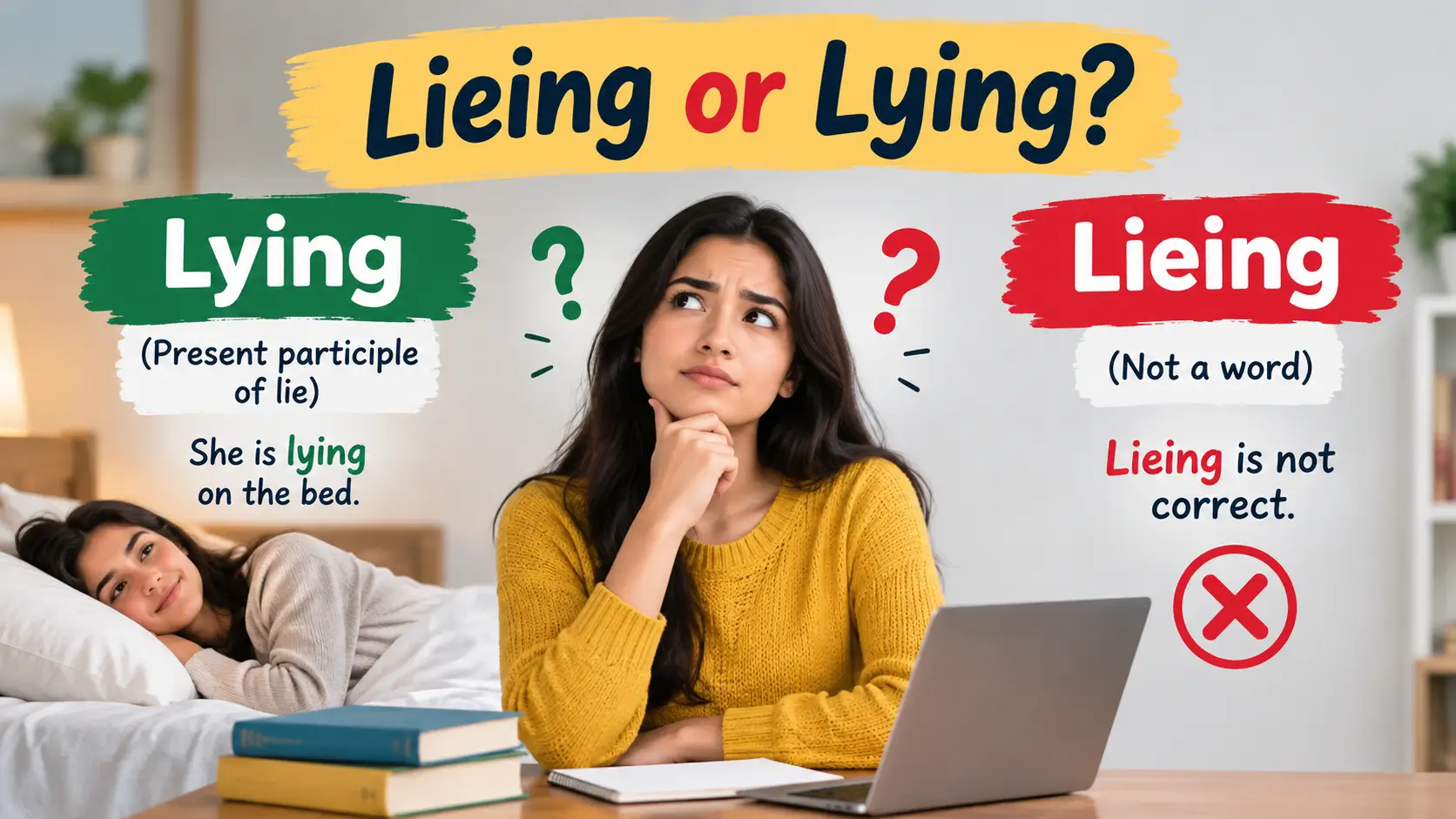
Have you ever typed “lieing” and then stopped to wonder if it should actually be “lying”? This small spelling question causes confusion because the word lie does not form its ing version in the way many learners expect. If you know that most verbs simply take ing, “lieing” can look perfectly reasonable at first.
People search for “lieing or lying” when writing school assignments, emails, social media posts, articles, or professional documents. They want a quick answer, but they also want to know why one spelling is correct and the other is not.
The good news is that the rule is simple. Lying is the correct spelling in standard English. Lieing is a misspelling. The same spelling pattern can be seen in words such as die → dying and tie → tying.
This guide explains the spelling rule, word history, British and American English usage, common mistakes, everyday examples, and practical advice for writers.
Lieing or Lying – Quick Answer
The correct spelling is lying.
- ✅ Lying — correct
- ❌ Lieing — incorrect in standard English
The word lying is the present participle and gerund form of lie. It can describe two different meanings.
First, lying can mean being in a flat or resting position:
She is lying on the sofa.
Second, lying can mean saying something that is not true:
He is lying about what happened.
Both meanings use exactly the same spelling: lying. Cambridge Dictionary and Oxford Learner’s Dictionaries both give lying as the ing form of lie.
Why Not “Lieing”?
The confusion happens because people often learn a simple rule:
verb + ing
For example:
- play → playing
- read → reading
- work → working
But verbs ending in ie follow a special spelling pattern.
The ie changes to y before ing:
- lie → lying
- die → dying
- tie → tying
- vie → vying
So:
lie + ing → lying
not:
lie + ing → lieing
This is why lieing is considered a spelling mistake.
The Origin of Lieing or Lying
The history of lying becomes easier to understand when we look at the history of lie.
The modern English verb lie, meaning “to be in a flat or resting position,” has very old Germanic roots. Oxford lists its modern forms as lie, lay, lain, lying.
The English language developed over many centuries. Its spelling was influenced by Old English, Middle English, pronunciation changes, and later standardization. As a result, modern English spelling does not always work like a simple mathematical formula.
The important point for modern writers is the spelling pattern:
ie → y + ing
This gives us:
| Base verb | Correct ing form |
| lie | lying |
| die | dying |
| tie | tying |
| vie | vying |
If we simply added ing to lie, we would get lieing. However, standard English uses lying.
Two Different Meanings of “Lie”
There are actually two common verbs spelled lie.
One means to rest or be in a horizontal position:
The cat is lying under the table.
The other means to say something that is not true:
She is lying to her parents.
These verbs have different histories, but their present participle is spelled lying in modern English.
Cambridge Dictionary also distinguishes these meanings and lists lying as the ing form for the physical position verb. For the “not tell the truth” meaning, the past form is lied.
Why “Lieing” Looks Reasonable
English learners often make this mistake because several common spelling rules seem to point toward lieing.
For example:
- make → making
- write → writing
- hope → hoping
These verbs drop the final e before adding ing.
But lie is different because it ends in ie, not simply a silent e.
Compare:
- make → making
- write → writing
- lie → lying
Learning the pattern as a complete word family is often easier than trying to create the spelling from scratch each time.
British English vs American English Spelling
One useful fact about this keyword is that British English and American English do not have different spellings for this word.
Both use:
lying
Neither standard British English nor standard American English uses lieing as the normal spelling.
This is different from words such as colour/color, centre/center, or travelled/traveled, where regional spelling differences exist.
Comparison Table
| Feature | British English | American English |
| Correct spelling | lying | lying |
| Incorrect form | lieing | lieing |
| Meaning: resting | lying | lying |
| Meaning: not telling the truth | lying | lying |
| Past tense: dishonesty | lied | lied |
| Past tense: resting | lay | lay |
| Past participle: resting | lain | lain |
| Standard formal writing | lying | lying |
The spelling is therefore straightforward for international English users. You do not need to change lying to another regional form.
An Important Difference: Lying vs Laying
Some confusion comes from another pair:
lying and laying.
They are not interchangeable.
Lying comes from lie, meaning to be in a resting or horizontal position:
The dog is lying on the floor.
Laying comes from lay, meaning to put or place something somewhere:
She is laying the book on the table.
Cambridge explains that lay normally takes an object, while lie does not.
A simple comparison is:
- I am lying on the bed.
- I am laying the blanket on the bed.
The first describes your position. The second describes an action involving an object.
Which Spelling Should You Use?
For almost every normal English situation, use lying.
If Your Audience Uses American English
Use:
lying
For example:
He is lying about the results.
American English does not use lieing as the standard spelling.
If Your Audience Uses British English
Use:
lying
For example:
She was lying on the grass.
The spelling is the same in British English.
If You Write for a Global Audience
Use lying.
This is especially important for:
- websites
- blogs
- academic writing
- business documents
- emails
- social media
- educational material
- international communication
There is no need to create separate US and UK versions of lying.
For Students and English Learners
The easiest rule to remember is:
Lie changes to lying.
You can remember it with two other words:
die → dying
tie → tying
So:
lie → lying
Once you learn these three together, the spelling becomes much easier to remember.
Common Mistakes with Lieing or Lying
The most common mistake is simply writing lieing instead of lying.
Mistake 1: Lieing
❌ She is lieing on the bed.
✅ She is lying on the bed.
Mistake 2: Lieing About Something
❌ He is lieing about his age.
✅ He is lying about his age.
The meaning does not change the spelling.
Mistake 3: Confusing Lying and Laying
❌ The baby is laying on the bed.
✅ The baby is lying on the bed.
But:
✅ She is laying the baby on the bed.
The difference is whether the verb describes a person or thing being in a position or someone placing an object.
Mistake 4: Using “Lied” for Resting
This is another important error.
❌ I lied on the sofa yesterday.
If you mean that you rested on the sofa, the correct past tense is:
✅ I lay on the sofa yesterday.
Cambridge gives lay as the past simple of lie when lie means to be in a horizontal position.
But if you mean that you were dishonest:
✅ I lied to my friend yesterday.
Mistake 5: Confusing Lying With Laying
Remember:
lie → lying → lay → lain
for the physical position meaning.
And:
lay → laying → laid
for placing something somewhere.
The CDC also highlights this common lay/lie/lain/laid confusion in its writing guidance.
Lieing or Lying in Everyday Examples
The word lying appears in many types of writing. The spelling does not change based on whether the writing is casual or formal.
In Emails
I found the documents lying on my desk.
Or:
I believe he was lying about the reason for the delay.
In News Writing
The witness said that the information was false and accused the speaker of lying.
News writing may use lying when reporting statements or describing someone’s actions. The spelling remains the same.
On Social Media
Just lying in bed and watching movies.
Or:
Stop lying about what happened!
Social media is often informal, but lying is still the correct spelling.
In School Assignments
The character was lying about his identity.
Students should use lying in essays, reports, and examinations.
In Formal Writing
The evidence suggested that the witness had been lying.
Or:
The documents were lying on the table before the meeting began.
In Everyday Conversation
You may hear:
Are you lying to me?
Or:
I’m just lying here and relaxing.
The pronunciation is approximately LYE ing.
Lieing or Lying – Google Trends & Usage Data
Search interest around “lieing or lying” is mainly driven by spelling confusion. People who type this query are usually trying to determine which form is correct.
Search behavior should not be confused with correct language usage. A misspelling can receive searches precisely because people want to check whether it is correct.
Available online discussions about this keyword commonly describe searches from students, English learners, bloggers, and professional writers who want to confirm the spelling.
What About Different Countries?
The spelling rule itself does not change across major English varieties.
English learners in countries such as:
- United States
- United Kingdom
- Canada
- Australia
- India
- Pakistan
- other English learning countries
may search for the spelling for different reasons, but the standard answer remains lying.
Some websites discussing search behavior report strong interest in English learning markets, but exact Google Trends numbers can change over time and depend on the selected date range, country, search type, and comparison terms.
For this reason, it is better not to treat a search trend as proof of grammar.
Search Intent Behind “Lieing or Lying”
Most searches fit into a few simple categories:
| Search intent | Example query |
| Spelling check | Is it lieing or lying? |
| Grammar | Why is lying spelled this way? |
| Meaning | What does lying mean? |
| Usage | Is “lying” correct in this sentence? |
| Education | What is the ing form of lie? |
| Comparison | Lying vs laying |
This shows why a good answer should give the quick spelling first and then explain the rule.
Usage Is More Important Than Search Volume
The key fact is not which spelling someone searches more often. The key fact is which spelling is accepted in standard English.
Major dictionaries list lying as the correct ing form of lie.
Lieing vs Lying: Comparison Table
Here is the complete comparison at a glance:
| Variation | Correct? | Meaning | Example |
| lying | ✅ Yes | Present participle of lie | She is lying on the bed. |
| lieing | ❌ No | Common misspelling | She is lieing on the bed. |
| laying | ✅ Yes | Present participle of lay | She is laying the book down. |
| lay | ✅ Yes | Past tense of lie / base form of lay | He lay on the sofa. |
| lied | ✅ Yes | Past tense of lie = not telling truth | He lied to me. |
| lain | ✅ Yes | Past participle of lie | She had lain there for hours. |
The most important comparison is:
lying ✅
lieing ❌
If you are writing the ing form of lie, choose lying.
A Simple Memory Trick for Lying
If you regularly forget the spelling, use this pattern:
IE → Y before ING
Examples:
- lie → lying
- die → dying
- tie → tying
- vie → vying
You can remember the phrase:
IE changes to Y before ING.
This helps you avoid the tempting spelling lieing.
Another easy trick is to remember:
Lie, die, tie → lying, dying, tying.
The three words follow the same pattern.
FAQs About Lieing or Lying
Is it lieing or lying?
Lying is correct. Lieing is a misspelling in standard English.
Example:
She is lying on the sofa.
Is “lieing” ever correct?
In normal modern English, lieing is not the standard spelling. It may appear as a typo or misspelling, but writers should use lying.
Why is it lying instead of lieing?
The letters ie change to y before ing in this word pattern.
So:
lie → lying
The same pattern occurs in:
die → dying
tie → tying
Does lying mean telling a lie?
It can. Lying can mean saying something that is not true.
He is lying about his age.
But lying can also mean being in a flat or resting position:
The cat is lying on the floor.
Context tells you which meaning is intended.
What is the difference between lying and laying?
Lying comes from lie and usually describes being in a position.
I am lying on the bed.
Laying comes from lay and means putting or placing something somewhere.
I am laying the book on the bed.
Cambridge specifically distinguishes these two verbs by whether there is an object.
Is “lying” correct in American English?
Yes. Lying is the standard spelling in American English.
Is “lying” correct in British English?
Yes. Lying is also the standard spelling in British English.
There is no British American spelling difference for this word.
What is the past tense of “lie”?
It depends on the meaning.
For lie = rest or be in a position:
lie → lay → lain
For lie = tell an untruth:
lie → lied → lied
This difference is one reason learners often find lie confusing.
How do you spell “lying down”?
The correct spelling is:
lying down
Example:
I am lying down on the sofa.
Not:
❌ lieing down
Can I use “lying” in formal writing?
Yes. Lying is the standard form and is appropriate in academic, professional, business, news, and everyday writing.
Conclusion
When you are choosing between lieing or lying, the answer is clear: lying is the correct spelling in standard English. Lieing is a common misspelling and should be avoided in schoolwork, professional writing, websites, emails, and other formal communication.
The reason for the unusual spelling is the ie → y pattern used before ing. This gives us lie → lying, just as we get die → dying and tie → tying. Once you remember these words together, the spelling becomes much easier.
There is also no British American spelling difference here. Writers in both varieties use lying. The bigger grammar issue is knowing when to use lying, laying, lay, lied, and lain. For example, you can say “She is lying on the bed,” but “She is laying the book on the table.”
So, if you ever pause and ask, “Lieing or lying?”, choose lying. It is the standard spelling for both major meanings of lie, and it works in casual, academic, professional, and online writing.
Discover More Post
- Is Chopped an Insult or Just a Joke? Explanation Guide 2026
- Canceling or Cancelling: Which Spelling Is Correct?
- It’s or Its? Simple Rules, Examples, and Common Mistakes









2 thoughts on “Lieing or Lying: Which Spelling Is Correct?”