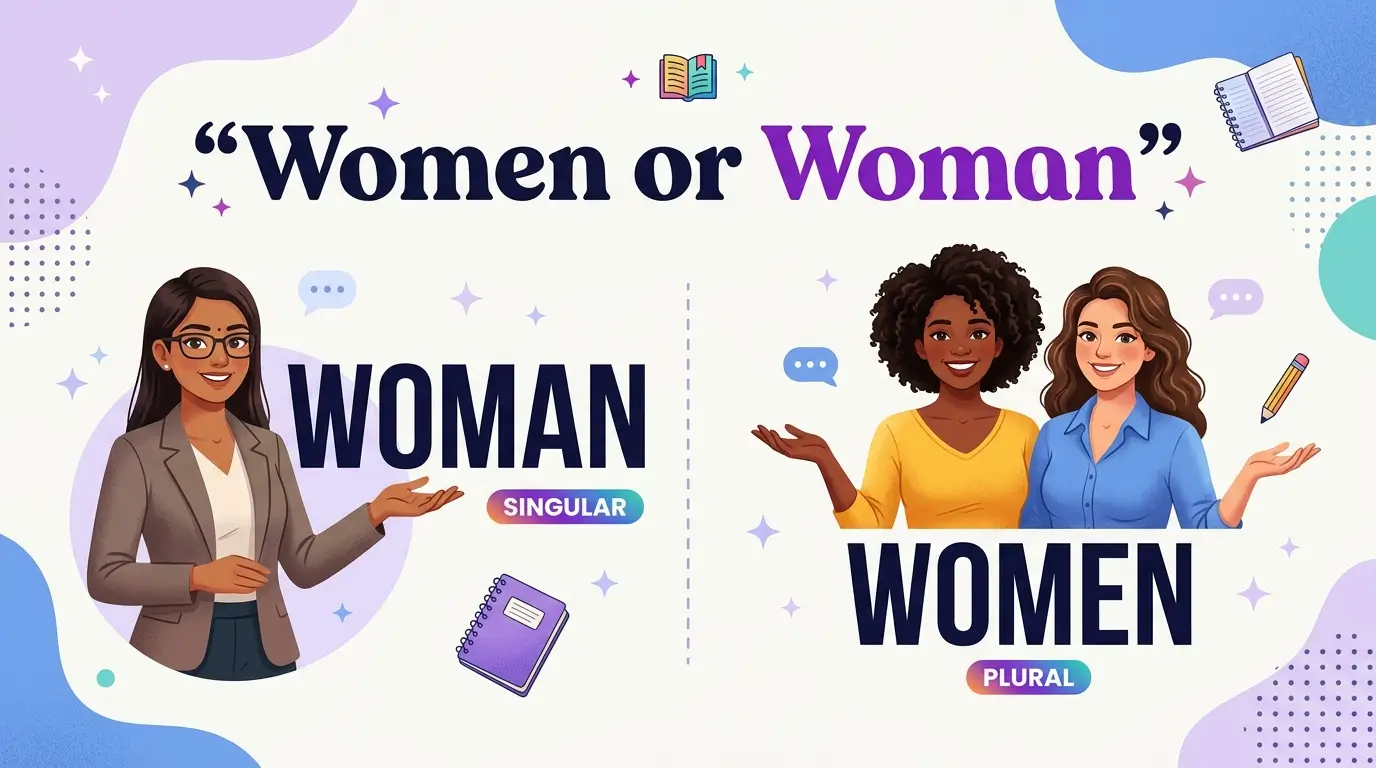
Have you ever wondered to write women or woman? These two words look very similar, but they have different meanings. Choosing the wrong one can make a sentence sound incorrect or confuse your reader.
The main difference is simple: woman means one adult female, while women means more than one adult female. The words are related, but they are not used in the same way. They also have different pronunciations, which can make them harder to learn.
English learners often search for women or woman because they want to improve their grammar, spelling, and everyday communication. The difference matters when writing emails, school assignments, social media posts, reports, and articles.
In this guide, you will learn the meaning of both words, how they are formed, how to use them in sentences, and which common mistakes to avoid. You will also find a comparison table, everyday examples, and answers to common questions.
By the end, you will know when to use woman and when to use women with confidence.
Women or Woman – Quick Answer
Woman is singular, which means one adult female. Women is plural, which means two or more adult females.
Examples:
- One woman is waiting outside.
- Two women are waiting outside.
- The woman is my teacher.
- The women are my teachers.
Use woman when you mean one person. Use women when you mean more than one person.
Woman: Singular Form
The word woman refers to one adult female.
Examples:
- She is a kind woman.
- A woman called the office.
- That woman works at a school.
- Every woman deserves respect.
Women: Plural Form
The word women refers to two or more adult females.
Examples:
- The women are talking.
- Many women work in this field.
- Three women joined the meeting.
- These women are excellent teachers.
Easy Rule to Remember
| Number | Correct Word | Example |
| One | Woman | One woman is here. |
| Two | Women | Two women are here. |
| Three | Women | Three women are here. |
| Many | Women | Many women are here. |
Remember: one woman, two women. The word changes from woman to women when it becomes plural.
The Origin of Women or Woman
The words woman and women have a long history in the English language. Their spelling and pronunciation have changed over time, but their basic meaning has remained connected to adult females.
Where Does the Word Woman Come From?
The word woman developed from an older English word, wīfmann. In Old English, wīf referred to a woman or female person, while mann referred to a person or human being.
Over time, the word changed in spelling and pronunciation until it became the modern English word woman.
Today, woman is used as the singular form.
Example: “The woman is reading a book.”
How Did Women Become the Plural Form?
The word women developed as the plural form of woman. English has many nouns that change their spelling when they become plural.
For example:
- Man becomes men.
- Woman becomes women.
- Foot becomes feet.
- Tooth becomes teeth.
These are called irregular plurals because they do not follow the usual rule of adding s or es.
Why Are Woman and Women Spelled Differently?
The difference comes from the history of English. These words follow an older spelling pattern rather than the regular plural rule.
For most nouns, adding s creates the plural form.
Examples:
- Book becomes books.
- Chair becomes chairs.
- Teacher becomes teachers.
But woman does not become womans. Its correct plural form is women.
Why Do Woman and Women Sound Different?
The two words also have different pronunciations.
- Woman: Usually pronounced “WUUM uhn.”
- Women: Usually pronounced “WIM in.”
The first vowel sound changes in the plural form. This is one reason English learners may find these words confusing.
Learning both the spelling and pronunciation can help you use them correctly in speaking and writing.
British English vs American English Spelling
The words woman and women are spelled the same way in British English and American English. There is no regional spelling difference between these two forms.
The main difference is grammatical: woman is singular, and women is plural.
Woman in American English
American English uses woman to refer to one adult female.
Examples:
- A woman is standing near the door.
- The woman works in an office.
- She is a strong woman.
For more than one person, American English uses women.
Examples:
- Two women are standing near the door.
- The women work in an office.
- These women are strong.
Woman in British English
British English follows the same rule.
Examples:
- A woman is waiting at the bus stop.
- The woman lives nearby.
- She is a talented woman.
For multiple people:
- Two women are waiting at the bus stop.
- The women live nearby.
- They are talented women.
American vs British English Comparison Table
| Feature | American English | British English |
| Singular form | Woman | Woman |
| Plural form | Women | Women |
| One person | One woman | One woman |
| More than one | Two women | Two women |
| Spelling difference | None | None |
| Grammar rule | Same | Same |
| Pronunciation | May vary by accent | May vary by accent |
Both varieties use the same spelling and grammar rules for these words. You do not need to choose a different form based on your audience.
Which Spelling Should You Use?
Choosing between woman and women depends on how many people you are talking about. Your location does not change the rule.
When to Use Woman
Use woman when you mean one adult female.
Examples:
- The woman is my friend.
- A woman called me yesterday.
- Every woman should be treated with respect.
- She is a successful woman.
Remember that singular countable nouns often need a word such as a, the, or this.
For example, “I saw woman” is usually incorrect in standard English. Write “I saw a woman” instead.
When to Use Women
Use women when you mean two or more adult females.
Examples:
- The women are waiting.
- Many women enjoy reading.
- These women are doctors.
- Three women attended the event.
Do not add a before women, because it is plural.
Incorrect: “A women is here.”
Correct: “A woman is here.”
Also correct: “Women are here.”
For School and College Writing
Use woman for one person and women for more than one. Check your sentence to make sure the verb agrees with the subject.
Examples:
- The woman is ready.
- The women are ready.
For Emails and Professional Writing
The same rules apply in emails, reports, and business documents.
Examples:
- “The woman who called earlier has returned.”
- “The women who called earlier have returned.”
For SEO Articles and Websites
Use the word that matches the meaning of your sentence and target keyword. Do not use women when you mean one person or woman when you mean several people.
Correct grammar makes your content easier to read and understand.
Common Mistakes with Women or Woman
Many English learners confuse woman and women because their spellings are similar. Here are the most common mistakes and how to correct them.
Mistake 1: Using Woman for More Than One Person
Incorrect: “Three woman are waiting outside.”
Correct: “Three women are waiting outside.”
Use women when you mean more than one person.
Mistake 2: Using Women for One Person
Incorrect: “A women is standing near the window.”
Correct: “A woman is standing near the window.”
Use woman when you mean one person.
Mistake 3: Writing Womans Instead of Women
Incorrect: “Many womans work here.”
Correct: “Many women work here.”
The plural form of woman is irregular. You must use women, not womans.
Mistake 4: Using the Wrong Verb
The word you choose can affect the verb in your sentence.
Incorrect: “The woman are happy.”
Correct: “The woman is happy.”
Also correct: “The women are happy.”
Use is with a singular subject and are with a plural subject.
Mistake 5: Confusing Woman’s and Women’s
Both forms are correct, but they show different things.
- Woman’s: Something belongs to one woman.
- Women’s: Something belongs to multiple women.
Examples:
- The woman’s bag is black.
- The women’s bags are black.
The apostrophe helps show ownership.
Mistake 6: Mispronouncing the Words
Woman and women have different vowel sounds.
- Woman sounds like “WUUM uhn.”
- Women sounds like “WIM in.”
Practicing these sounds can help you recognize the difference when speaking English.
Mistake 7: Forgetting Articles Before Singular Nouns
In standard English, a singular countable noun often needs an article or another determiner.
Incorrect: “Woman is waiting for the bus.”
Correct: “A woman is waiting for the bus.”
You can also say, “The woman is waiting for the bus.”
Women or Woman in Everyday Examples
The best way to understand these words is to see how they work in real sentences.
1. In Emails
Use woman when writing about one person.
Example: “The woman who contacted us will receive a reply today.”
Use women when writing about multiple people.
Example: “The women who contacted us will receive replies today.”
2. In News Articles
Examples:
- A woman was seen helping an older person.
- Several women took part in the event.
- The woman spoke about her experience.
- The women shared their views during the meeting.
The singular or plural form depends on the number of people involved.
3. On Social Media
Examples:
- “Every woman deserves respect.”
- “These women inspire me.”
- “A woman can achieve great things.”
- “Many women are learning new skills.”
Both words are common in posts, captions, and comments.
4. In Formal Writing
Examples:
- The woman completed the survey.
- The women completed the survey.
- Each woman received a certificate.
- All women were invited to attend.
Notice that each woman refers to individuals one at a time, so the singular form is used.
5. In Everyday Conversations
| Situation | Example |
| Talking about one person | That woman is my neighbor. |
| Talking about two people | Those women are my neighbors. |
| Asking a question | Who is that woman? |
| Asking about a group | Who are those women? |
| Giving an opinion | She is a confident woman. |
| Describing a group | They are confident women. |
6. In Questions
Use woman for one person and women for more than one.
Examples:
- Is that woman your teacher?
- Are those women your teachers?
- Which woman called you?
- Which women called you?
The verb and the noun should agree in number.
Women or Woman – Google Trends and Usage Data
People search for women or woman because they want to understand the difference between the two words. The topic is useful for English learners, students, writers, and anyone who wants to improve grammar.
Which Word Is More Common?
Both words are common, but they serve different purposes.
- Woman refers to one adult female.
- Women refers to two or more adult females.
The plural form may appear more often in some topics, such as discussions about women’s rights, health, education, and work. The singular form may be more common when a sentence describes one person.
Actual usage depends on the subject, sentence, and context.
What Can Google Trends Tell You?
Google Trends can help compare search interest for woman and women across countries and periods. However, search interest does not show the total number of times people use these words in everyday language.
No exact search volumes, percentages, or country rankings are included here because current data has not been verified.
When comparing these terms, remember that they have different meanings. Search interest may reflect different topics and questions, so a higher score does not mean that one word is more grammatically correct.
Why Do People Search for This Keyword?
Common reasons include:
- Learning the singular and plural forms.
- Improving English grammar.
- Understanding pronunciation.
- Writing correct sentences.
- Preparing school assignments or articles.
- Learning when to use woman’s and women’s.
The most important lesson is that these words are not interchangeable. Choose the form that matches the number of people in your sentence.
Women vs Woman: Comparison Table
Use this table to review the main differences.
| Feature | Woman | Women |
| Number | Singular | Plural |
| Meaning | One adult female | Two or more adult females |
| Example | A woman is here. | Two women are here. |
| Common verb | Is | Are |
| Another example | This woman is kind. | These women are kind. |
| Possessive form | Woman’s | Women’s |
| American spelling | Woman | Women |
| British spelling | Woman | Women |
Woman, Women, Woman’s, and Women’s
These four forms have different uses.
- Woman: One person.
- Women: More than one person.
- Woman’s: Belonging to one woman.
- Women’s: Belonging to multiple women.
Examples:
“The woman’s coat is blue.”
“The women’s coats are blue.”
Learning these forms will help you avoid common grammar mistakes.
Frequently Asked Questions
1. Is it woman or women?
Both words are correct, but they have different meanings. Woman means one adult female, while women means two or more adult females.
2. What is the plural of woman?
The plural of woman is women. Do not write womans.
Example: “One woman is here. Three women are here.”
3. Is women singular or plural?
Women is plural. Use it when talking about two or more people.
Example: “The women are working together.”
4. How do you pronounce woman and women?
Woman is usually pronounced “WUUM uhn.” Women is usually pronounced “WIM in.” The first vowel sound changes between the two words.
5. Should I use is or are with woman and women?
Use is with the singular word woman and are with the plural word women.
Examples:
- The woman is happy.
- The women are happy.
6. What is the difference between woman’s and women’s?
Woman’s shows ownership by one woman. Women’s shows ownership by multiple women.
Examples:
- The woman’s phone is ringing.
- The women’s phones are ringing.
7. Is women correct in American and British English?
Yes. Both American and British English use woman for the singular and women for the plural. The spelling rule is the same in both varieties.
8. Can I use women for one person?
No. In standard English, use woman for one person and women for two or more people.
Incorrect: “One women is waiting.”
Correct: “One woman is waiting.”
Conclusion
The difference between women and women is simple once you remember the singular and plural forms. Woman means one adult female, while women means two or more adult females. Both words are used in American and British English, and their spelling does not change between these varieties.
Use “woman when talking about one person, such as “The woman is waiting.” Use women when talking about a group, such as “The women are waiting.” Also, remember to use the correct verb. A woman is ready, while women are ready.
Pay attention to related forms, too. Women show ownership by one woman, while women show ownership by multiple women. These small differences can make your writing clearer and more accurate.
you are writing an email, completing a school assignment, or creating an article, choose the word that matches the number of people you mean. Practice these examples, and the difference will become easier to remember. With regular use, you can avoid common mistakes and write more confidently.
Discover More Post
- Traveled or Travelled: Which Spelling Is Correct?
- Ect or Etc: Which Spelling Is Correct?
- Nosey or Nosy: Which Spelling Is Correct?

Emily Dickinson is one of America’s most influential poets, recognized for her unique style and thought-provoking poetry. Through GrammerNests.com, she contributes valuable perspectives on language, creativity, and the beauty of written expression.







