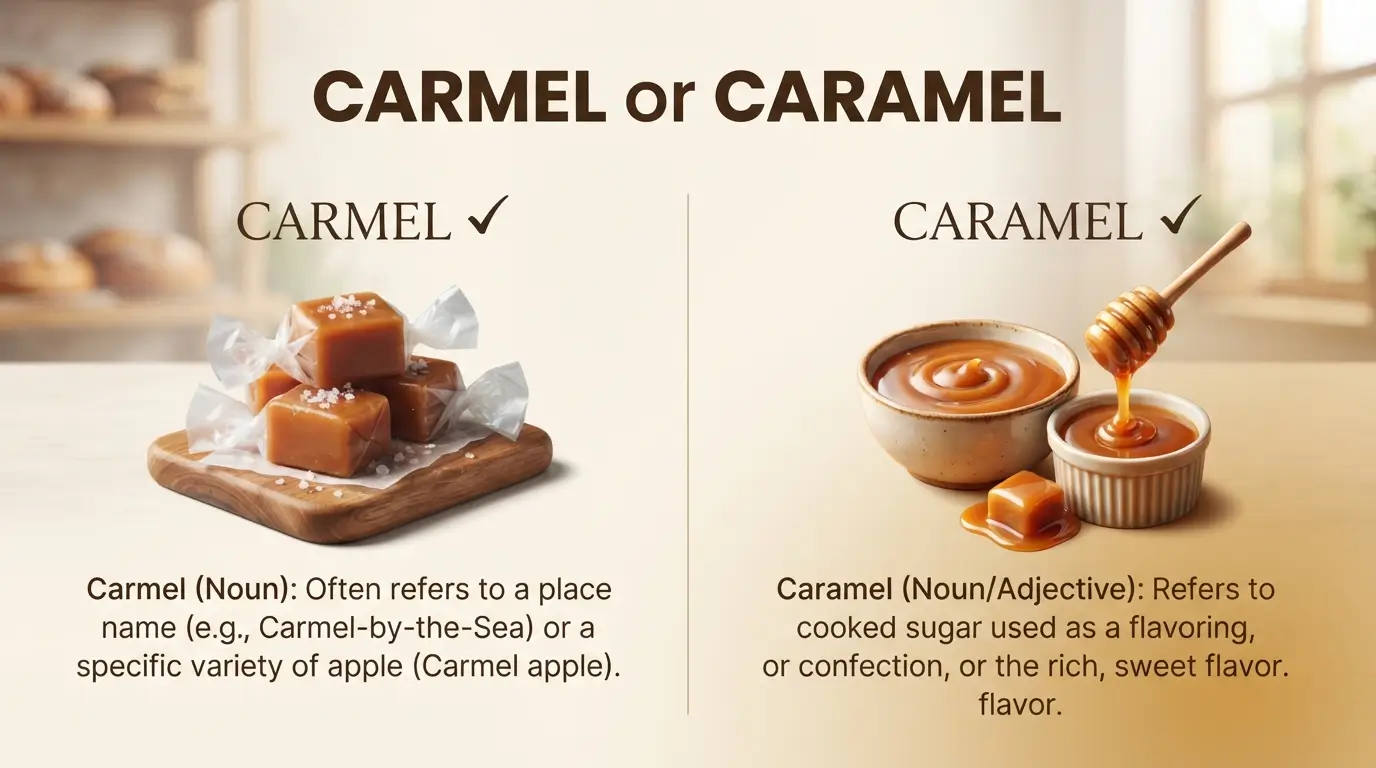
If you have ever typed “carmel or caramel” into Google, you are not alone. These two words look very similar, and they can sound similar in some accents. But they do not normally mean the same thing.
The correct spelling for the sweet food, sauce, flavor, or color is caramel. For example, you would write “caramel sauce,” “caramel candy,” and “caramel popcorn.” Dictionaries list caramel as the word for sugar heated until it becomes brown and is used for flavoring, coloring, or making candy.
Carmel, without the second a, is usually a proper name. You may see it in names of people, places, or organizations. It is not the standard spelling of the sweet food.
The confusion becomes stronger because caramel has more than one common pronunciation, especially in American English. Cambridge lists both shorter and longer American pronunciations.
This guide explains the difference, pronunciation, history, regional usage, common mistakes, and practical examples.
Carmel or Caramel – Quick Answer
The quick answer is:
Use “caramel” when you mean the sweet food, cooked sugar, flavor, sauce, or color.
Examples:
- I love caramel ice cream.
- She made caramel sauce.
- He ordered a caramel latte.
- The recipe needs two tablespoons of caramel.
- The cake has a rich caramel flavor.
Carmel is generally used as a proper name rather than as the food word.
For example:
- Carmel can appear in a place name.
- Carmel can be part of a person’s name.
- Carmel can appear in the name of an organization or institution.
So, if you are talking about something sweet and made from heated sugar, choose caramel.
Carmel vs. Caramel at a glance
| Word | Main use | Example |
| caramel | Sweet food, cooked sugar, flavor, color | Caramel sauce |
| Carmel | Proper name or place name | Carmel, a place name |
| caramelize | To turn something into caramel or brown it with heat | Caramelize the onions |
| caramelise | British variant of caramelize | Caramelise the onions |
Cambridge and Collins both define caramel as heated/burnt sugar and also as a chewy sweet made with ingredients such as sugar, butter, and milk.
The Origin of Carmel or Caramel
The history of caramel is more complicated than its spelling suggests.
Collins traces caramel through French and Spanish and notes that its deeper origin is uncertain. Its historical forms are connected with words associated with sugar cane and, further back, Latin terms involving canna (“cane”) and mel (“honey”).
The word entered English several centuries ago. Collins gives an English word origin in the 18th century and also records an American English etymological history reaching through French, Spanish, and earlier forms.
Why does “Carmel” appear?
One reason people search “carmel or caramel” is pronunciation.
In some varieties of English, caramel may be pronounced with two syllables, sounding roughly like:
CAR mel
In other varieties, it may be pronounced with three syllables:
CAR uh mel
Cambridge gives a UK pronunciation with three syllables and lists a shorter US pronunciation as well as another longer US pronunciation.
This means a person may hear something close to “carmel” and assume that the shorter sound represents a different spelling.
It usually does not.
The spelling of the food remains:
caramel
British English vs American English Spelling
There is an important point here: “caramel” is not normally a British versus American spelling difference.
British and American speakers can both write caramel.
The bigger difference is often pronunciation.
Cambridge lists:
- UK: /ˈkær.ə.məl/
- US: /ˈkɑːr.məl/
It also records another common American pronunciation with the longer middle sound.
Collins similarly lists several American pronunciations while giving a British pronunciation that includes the middle vowel.
Comparison table
| Feature | British English | American English |
| Standard spelling | caramel | caramel |
| Common pronunciation | Often 3 syllables | Often 2 or 3 syllables |
| Example | caramel sauce | caramel sauce |
| Verb | caramelise / caramelize | caramelize |
| Main spelling difference | Usually pronunciation, not caramel itself | Usually pronunciation, not caramel itself |
British and American English do have many genuine spelling differences, such as colour/color and organise/organize. Collins explains that these differences developed through the history and standardization of English on both sides of the Atlantic.
But carmel vs caramel is not one of those standard UK US spelling pairs.
Caramelize vs caramelise
There is a real regional spelling difference in the related verb.
American English:
Caramelize the onions.
British English:
Caramelise the onions.
Collins lists caramelize as the American form and notes caramelise as a British alternative.
Which Spelling Should You Use?
For most writers, the choice is simple.
If you mean the food
Use:
caramel
This is correct in American English, British English, and general international English.
If you write for an American audience
Use caramel.
For the related verb, caramelize is the usual American spelling.
Example:
Add the sugar and caramelize the apples.
If you write for a British audience
Still use caramel for the noun.
For the related verb, caramelise is common in British English.
Example:
Add the sugar and caramelise the apples.
If you write for an international audience
Caramel is the safest spelling for the food.
Do not change it to carmel simply because some speakers pronounce it that way.
For websites, blogs, recipes, school assignments, emails, and professional writing, consistency matters more than trying to copy a particular pronunciation.
Common Mistakes with Carmel or Caramel
The biggest mistake is treating carmel as an alternative spelling of the food.
Mistake 1: Carmel sauce
Incorrect:
I made carmel sauce.
Correct:
I made caramel sauce.
Mistake 2: Carmel candy
Incorrect:
She bought a box of carmel candy.
Correct:
She bought a box of caramel candy.
Mistake 3: Carmel popcorn
Incorrect:
We ate carmel popcorn.
Correct:
We ate caramel popcorn.
Mistake 4: Confusing pronunciation with spelling
Someone may pronounce caramel in a way that sounds like “carmel.”
That does not automatically make carmel the correct spelling.
Think of it this way:
Sound can change. Standard spelling does not have to change with it.
Mistake 5: Mixing up caramel and caramelize
These words are related but have different grammatical roles.
- caramel = noun/adjective use
- caramelize = verb
- caramelized = past participle/adjective
- caramelization = noun
Examples:
The dessert contains caramel.
The chef will caramelize the bananas.
We served caramelized apples.
The caramelization gave the onions a deeper flavor.
Collins confirms caramelize means to turn something into caramel or brown it through heat and also records the British spelling caramelise.
Carmel or Caramel in Everyday Examples
Knowing the correct spelling is easier when you see it in real situations.
In an email
Hi Sarah,
I ordered the caramel cake for Friday’s meeting.
Thanks!
Here, caramel is correct because the message refers to a food.
In a recipe
Heat the sugar until it turns a deep golden caramel color.
Or:
Pour the warm caramel over the dessert.
In a news article
The company introduced a new caramel flavored snack.
News and professional writing normally use the standard dictionary spelling caramel.
On social media
This caramel latte is amazing!
A casual social media post may use informal language, but the standard spelling remains caramel.
In formal writing
The dessert is served with a warm caramel sauce.
This is appropriate for menus, reports, articles, and academic or professional writing when discussing the food.
In a product description
A creamy vanilla dessert topped with rich caramel sauce.
Again, caramel is the correct food spelling.
Carmel or Caramel – Google Trends & Usage Data
Search interest around “carmel or caramel” is closely connected to a real language question: people often hear different pronunciations and want to know whether the spelling changes too.
Google Trends measures relative search interest, rather than giving a simple count of all searches. That means a higher Trends value in one location or period does not automatically mean that word is used more often in every type of writing.
For this keyword, it is also important to separate search behavior from dictionary usage.
The dictionaries consistently recognize caramel as the standard word for the cooked sugar food. Cambridge provides both UK and US pronunciations, while Collins also lists multiple American pronunciations.
This helps explain why people may search for “carmel or caramel” even when they already know what they mean.
Search context matters
Someone searching:
carmel or caramel
is probably trying to solve a spelling question.
Someone searching:
Carmel California
is looking for a proper name or place.
Someone searching:
caramel sauce recipe
is looking for food information.
So search volume for Carmel by itself can include completely different intent from searches about the sweet food.
For SEO writers, this distinction is important. A page targeting “carmel or caramel” should clearly explain the spelling difference instead of assuming that every search for Carmel refers to food.
Carmel vs Caramel: Comparison Table
| Variation | Correct for the sweet food? | Typical meaning/use | Example |
| caramel | Yes | Cooked sugar, candy, flavor, color | Caramel pudding |
| Carmel | No | Proper name/place/name element | Carmel |
| caramelize | Yes | Verb | Caramelize the sugar |
| caramelise | Yes | British spelling of the verb | Caramelise the onions |
| caramelized | Yes | Past form/adjective | Caramelized fruit |
| caramelized | Yes | Same spelling in UK/US | Caramelized onions |
The key point is that Carmel is not simply the American spelling of caramel.
The noun referring to the sweet food is caramel.
How Do You Pronounce Caramel?
There is no single pronunciation used by every English speaker.
Cambridge gives a UK pronunciation that includes three syllables and a US pronunciation that can be shorter. It also lists another longer US pronunciation.
You may hear:
CAR uh mel
or
CAR mel
Both can occur in English speech, depending on accent and speaker.
This is one reason the spelling question can be confusing.
If you hear someone say something that sounds like “carmel,” remember that they may simply be using a pronunciation of caramel.
Is Carmel Ever Correct?
Yes.
Carmel can be completely correct when it is a proper name.
For example, Carmel can appear in the names of places, people, institutions, or other named entities.
In those situations, do not change the spelling to caramel.
This gives you a simple rule:
Food = caramel. Proper name = check the official name.
Capitalization can also help. Carmel is often capitalized when it is a proper name, while caramel is normally lowercase when referring to the food.
FAQs About Carmel or Caramel
Is “carmel” or “caramel” correct?
Caramel is correct when you mean the sweet food, cooked sugar, sauce, flavor, or color. Carmel is generally used as a proper name.
Is caramel spelled with one or two “a” sounds?
The spelling is caramel: C A R A M E L.
The pronunciation can vary. Some speakers use two syllables, while others use three.
Why do people spell caramel as carmel?
Pronunciation is a major reason. In some accents, caramel is pronounced with fewer clearly heard syllables, which can make it sound like carmel.
Is Carmel an alternative spelling of caramel?
No. Carmel is not the standard alternative spelling of the food word. Use caramel for the sweet food.
Is caramel British or American?
Caramel is used in both British and American English. The main difference is often pronunciation rather than the spelling of the noun.
Is “caramelize” American and “caramelise” British?
Yes, generally. Caramelize is the usual American spelling, while caramelise is used in British English. Collins lists both forms and identifies caramelise as a British variant.
Which spelling should I use in an article?
Use caramel when discussing the food, sauce, flavor, candy, or color. If you are writing for a particular regional audience, follow that audience’s preferred style for related words such as caramelize/caramilise.
Conclusion
The answer to “carmel or caramel” is simple when you know what the word means. If you are talking about cooked sugar, a sweet candy, a dessert topping, a flavor, or the brown color associated with caramel, the correct spelling is caramel.
Carmel is different. It is generally found as a proper name rather than as a spelling variation of the food. The confusion mainly comes from pronunciation. English speakers do not all pronounce caramel in exactly the same way. Some use a two syllable pronunciation, while others use a three syllable pronunciation.
British and American English both use caramel as the noun. A clearer regional difference appears with the verb: American English commonly uses caramelize, while British English also uses caramelise.
So, for everyday writing, recipes, emails, websites, and professional content, remember one easy rule: if you mean the sweet food, spell it caramel.
Discover More Post
- Choose or Chose: What Is the Difference? Complete Guide
- Lets or Let’s: Which Spelling Is Correct?
- Past or Passed: Which One Should You Use?

Toni Morrison is a celebrated American novelist known for her powerful storytelling, rich characters, and lasting impact on literature. At GrammerNests.com, she shares insights that help readers appreciate language, writing, and literary expression.








1 thought on “Carmel or Caramel: Which Spelling Is Correct?”