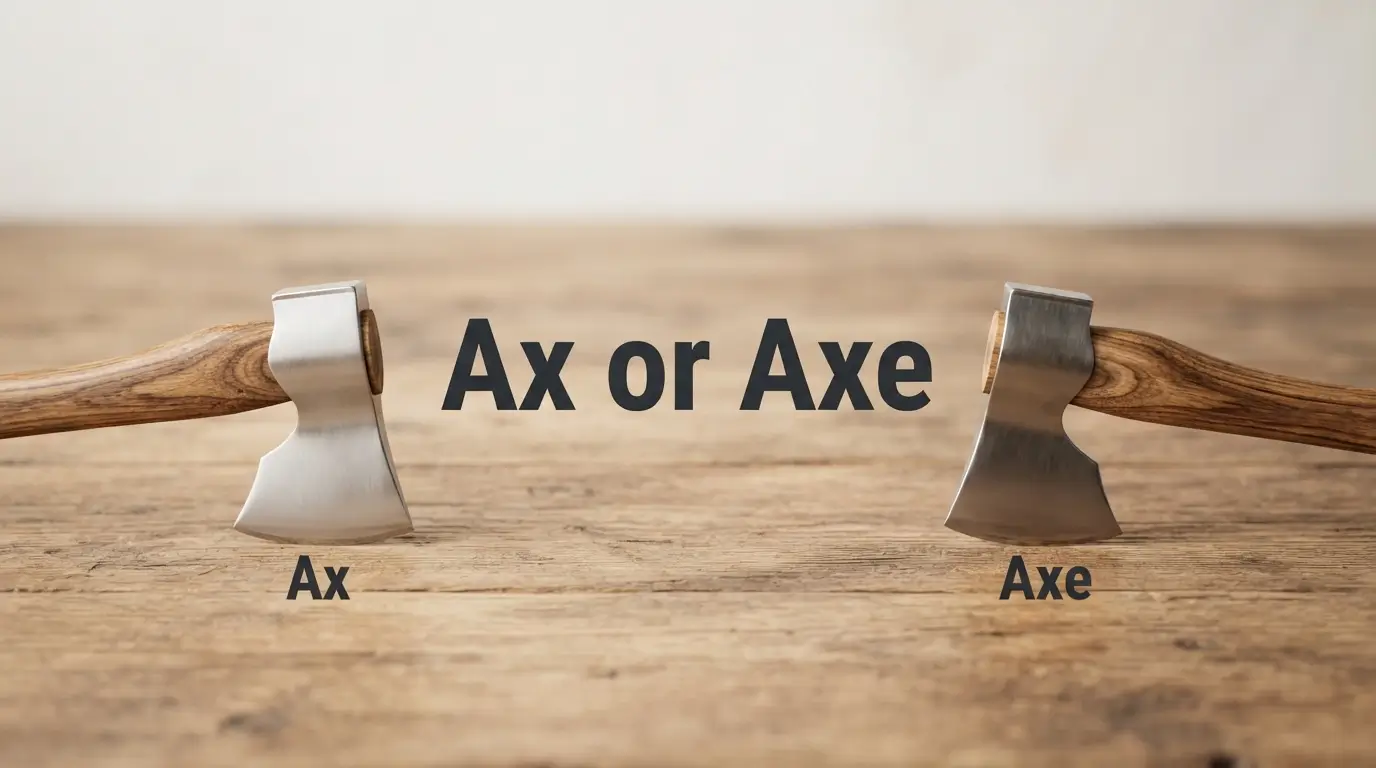
The words ax and axe have the same meaning, but their spelling often confuses English learners, writers, and even native speakers. If you have ever wondered whether to write ax or axe in an article, email, school assignment, or professional document, you are not alone.
Both spellings are correct. They refer to the same tool, which has a sharp metal blade attached to a handle. People use it to cut wood, chop trees, and perform other tasks.
The main difference is regional spelling. Ax is more common in American English, while axe is widely used in British English and many other English speaking countries. However, American English also accepts axe, so the choice is not always strict.
Understanding the difference can help you write clearly and avoid spelling mistakes. It is especially useful for students, bloggers, content writers, and anyone who wants to follow consistent English spelling rules.
In this guide, you will learn the meaning, origin, regional differences, everyday examples, and common mistakes involving ax or axe. You will also discover which spelling to use for your audience in 2026.
Ax or Axe – Quick Answer
Both ax and axe are correct spellings. They have the same meaning, pronunciation, and grammatical use. The difference is mainly a matter of regional preference.
- Ax: More common in American English, particularly in US dictionaries and some formal writing.
- Axe: More common in British English, Australian English, Canadian English, and other varieties of English.
Examples:
- He used an ax to cut the wood. (American English)
- He used an axe to cut the wood. (British English)
Both sentences are grammatically correct. Neither spelling changes the meaning of the sentence.
Quick rule
Use ax if you follow American spelling conventions and axe if you follow British spelling conventions. Keep the same spelling throughout your writing.
The Origin of Ax or Axe
The word ax has a long history. It comes from Old English æx or eax, which referred to a cutting tool used for chopping wood and other materials.
The word is also related to older Germanic words, including Old High German ackus. Similar words appear in other European languages, showing that the tool’s name has ancient roots.
Over time, English spelling changed. Different writers and dictionaries used different forms, including ax and axe.
The shorter spelling, ax, became established in American English. Noah Webster, an American lexicographer, supported simpler spellings in his dictionaries. His approach helped promote shorter forms in American writing.
However, axe remained common in British English and continued to be used in the United States as well.
Today, both forms are accepted in standard English. The difference is not a difference in meaning or pronunciation. It is simply a spelling preference that developed through the history of English.
British English vs American English Spelling
British and American English often use different spellings for the same words. Examples include colour and color, centre and center, and travelling and traveling.
The words ax and axe follow a similar regional pattern, although both spellings are accepted in American English.
| Feature | American English | British English |
| Preferred spelling | Ax | Axe |
| Alternative spelling | Axe | Ax (less common) |
| Meaning | Cutting tool | Cutting tool |
| Pronunciation | /æks/ | /æks/ |
| Verb form | Axed | Axed |
| Plural form | Axes | Axes |
| Usage | US writing | UK writing |
American English
In American English, ax is a recognized spelling and is often preferred in dictionaries and editorial style guides.
Examples:
- The worker picked up an ax.
- He bought a new ax for camping.
- The company decided to ax several positions.
Although axe is also correct in the United States, ax is a common choice, especially in some formal and editorial contexts.
British English
In British English, axe is the standard and more familiar spelling.
Examples:
- She used an axe to chop firewood.
- The farmer sharpened his axe.
- The government decided to axe the project.
British writers generally use axe in everyday communication, books, newspapers, and professional documents.
The important point is that regional preference does not make the alternative spelling incorrect.
Which Spelling Should You Use?
Choosing between ax and axe depends on your audience, location, and writing style. Both spellings are correct, but using the form familiar to your readers makes your writing more consistent.
For American Readers
Use ax if you are writing for an American audience. It is a recognized American spelling and appears in US dictionaries.
For example:
- The lumberjack carried an ax.
- He bought a new ax from the hardware store.
If your company follows a particular style guide, follow that guide even if it prefers axe.
For British and Commonwealth Readers
Use axe if you are writing for readers in the United Kingdom. It is also widely used in Australia and other countries that follow British spelling conventions.
For example:
- The woodsman carried an axe.
- She used an axe to cut the branches.
Canadian English can use both forms, although axe is common in Canadian writing.
For Global Content and SEO
If you run a blog, website, or online business with an international audience, consider your main target country.
- US audience: Prefer ax.
- UK audience: Prefer axe.
- Australian audience: Prefer axe.
- Canadian audience: Either is acceptable; use a consistent style.
- International audience: Choose one spelling and use it consistently.
For SEO, both spellings can be relevant search terms. You can naturally mention the alternative in your article without repeating the keyword unnecessarily.
Common Mistakes with Ax or Axe
Although both words are correct, writers sometimes make mistakes when using them in sentences.
Using Both Spellings Without a Reason
One common mistake is switching between ax and axe in the same article.
Incorrect:
He picked up an ax and sharpened his axe.
Correct:
He picked up an ax and sharpened it.
The first sentence is not grammatically wrong, but switching spellings without a clear reason can make your writing look inconsistent.
Thinking Ax Is Always Incorrect
Some learners believe ax is a shortened or informal version of axe. This is not true.
Both are standard English spellings. Ax is particularly well established in American English.
Correct:
- The ax was made of steel.
- The axe was made of steel.
Confusing Axes With Axis
The plural of both ax and axe is axes. However, axis is a different word.
Examples:
- The worker owns two axes.
- The Earth rotates on its axis.
Remember that axes can also be the plural of axis, depending on the context.
Using the Wrong Verb Form
Both spellings use the same verb forms when referring to removing something or cutting something out.
Examples:
- The company axed several jobs.
- The company decided to axe several jobs.
The past tense is axed, not axeed or axsed.
Ax or Axe in Everyday Examples
Both spellings appear in everyday communication. Your choice usually depends on your location or the spelling style you follow.
In Emails
American English:
“Please bring an ax to the camping trip. We need to cut some firewood.”
British English:
“Please bring an axe to the camping trip. We need to cut some firewood.”
Both examples are suitable for ordinary emails. The important thing is to match the spelling to your audience.
In News Articles
American English:
“The local worker used an ax to remove the fallen tree.”
British English:
“The local worker used an axe to remove the fallen tree.”
News publications generally follow their own editorial guidelines, so you may see either spelling in international news coverage.
On Social Media
People often use both spellings on social media.
Examples:
- “I bought a new ax for my outdoor adventures.”
- “This axe is perfect for chopping firewood.”
Social media posts tend to be less formal, but correct spelling still helps readers understand the message.
In Formal Writing
In academic papers, business reports, and professional documents, consistency is important.
Examples:
- “The study examined the effectiveness of a traditional ax.”
- “The research explored the historical development of the axe.”
Follow the preferred spelling of your institution, publisher, or organization.
As a Verb
Both words can also be used as verbs. In this context, they often mean to remove something, cancel a plan, or eliminate a position.
Examples:
- The company decided to ax the project.
- The government plans to axe the proposal.
This use is especially common in headlines and business news.
Ax or Axe – Google Trends & Usage Data
People search for ax or axe because they want to know which spelling is correct, especially when writing for a particular English speaking audience.
The two spellings have different regional patterns, but exact search popularity can change over time.
Regional Usage
| Country | Common spelling | General usage |
| United States | Ax | American spelling |
| United Kingdom | Axe | British spelling |
| Australia | Axe | British influenced spelling |
| Canada | Axe / Ax | Both accepted |
| New Zealand | Axe | British influenced spelling |
| Pakistan | Axe / Ax | Both understood |
These are general spelling preferences, not measured percentages of searches or writing.
Search Intent
People searching for this keyword usually have informational intent. They want to know:
- Which spelling is correct?
- Is ax an American word?
- Is axe British English?
- Do both words mean the same thing?
- Which spelling should they use in formal writing?
For content creators, the search intent is straightforward: readers need a quick answer followed by examples and regional guidance.
Google Trends
Google Trends can help compare search interest for ax and axe by country and over a selected period.
However, the word ax has other meanings in some contexts, including its use as a verb meaning to remove or cancel something. Search interest may therefore include queries unrelated to the physical tool.
It is important to distinguish between search interest and actual spelling frequency. Google Trends uses normalized relative interest, not exact search counts. Without a live, specified comparison, it would be misleading to give precise popularity percentages or claim one spelling is universally more searched.
You can explore the regional comparison directly through Google Trends: Ax vs Axe .
Ax vs Axe – Comparison Table
The following table summarizes the key differences between the two spellings.
| Word feature | Ax | Axe |
| Correct spelling | Yes | Yes |
| Meaning | Cutting tool | Cutting tool |
| Pronunciation | Same | Same |
| American usage | Common | Accepted |
| British usage | Less common | Standard |
| Plural | Axes | Axes |
| Past tense | Axed | Axed |
| Formal writing | Accepted | Accepted |
| SEO keyword | Valid | Valid |
The biggest difference is regional preference. Neither word is grammatically superior, and both are suitable for formal and informal writing.
Frequently Asked Questions
Is ax or axe correct?
Both ax and axe are correct English spellings. Ax is more common in American English, while axe is preferred in British English. Both have the same meaning.
Is ax American or British English?
Ax is mainly associated with American English. It is a standard spelling in the United States, although American writers also use axe.
Why do British people spell it axe?
British English traditionally uses axe. The spelling developed from older English forms and remained established in British dictionaries and everyday writing.
Is axe more correct than ax?
No. Neither spelling is more correct than the other. Both are recognized in standard English. The appropriate choice depends on your preferred spelling convention and audience.
What is the plural of ax or axe?
The plural form of both words is axes.
Examples:
- The workers carried two axes.
- He collected several old axes.
Is axed or axeed correct?
Axed is correct. Both ax and axe form their past tense with ed.
Examples:
- The company axed the proposal.
- The company axed several positions.
The spelling axeed is incorrect.
Which spelling is better for SEO: ax or axe?
Neither spelling is automatically better for SEO. Choose the version that matches your target audience and use it consistently. If your article targets both American and British readers, you can naturally include the alternative spelling to address both search queries.
Conclusion
Both ax and axe are correct English spellings. They refer to the same cutting tool, have the same pronunciation, and follow the same grammatical rules. The main difference is their regional use.
American English commonly prefers ax, while British English, Australian English, and many other English speaking regions generally prefer axe. However, both forms are accepted in standard English, including American dictionaries.
If you are writing a school assignment, professional email, news article, or blog post, the best approach is to consider your audience. Choose the spelling that matches your regional style guide and maintain consistency throughout your writing.
For international websites, using one spelling consistently while explaining the alternative can help readers understand the difference. From an SEO perspective, both forms are useful keywords, but clear and natural content matters more than repeating either spelling.
Discover More Post
- Greatful or Grateful: Which Spelling Is Correct?
- Independent vs Dependent Variable: What’s the Difference?
- There or Their: What Is the Difference

Toni Morrison is a celebrated American novelist known for her powerful storytelling, rich characters, and lasting impact on literature. At GrammerNests.com, she shares insights that help readers appreciate language, writing, and literary expression.








1 thought on “Ax or Axe: Which Spelling Is Correct in American & British English? ”