English has many words that look slightly different but mean the same thing. Toward and towards are a good example. If you have ever stopped while writing an email, essay, or social media post and wondered, “Should I use toward or towards?” you are not alone.
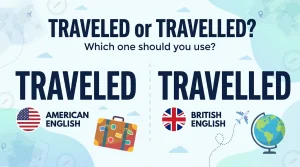
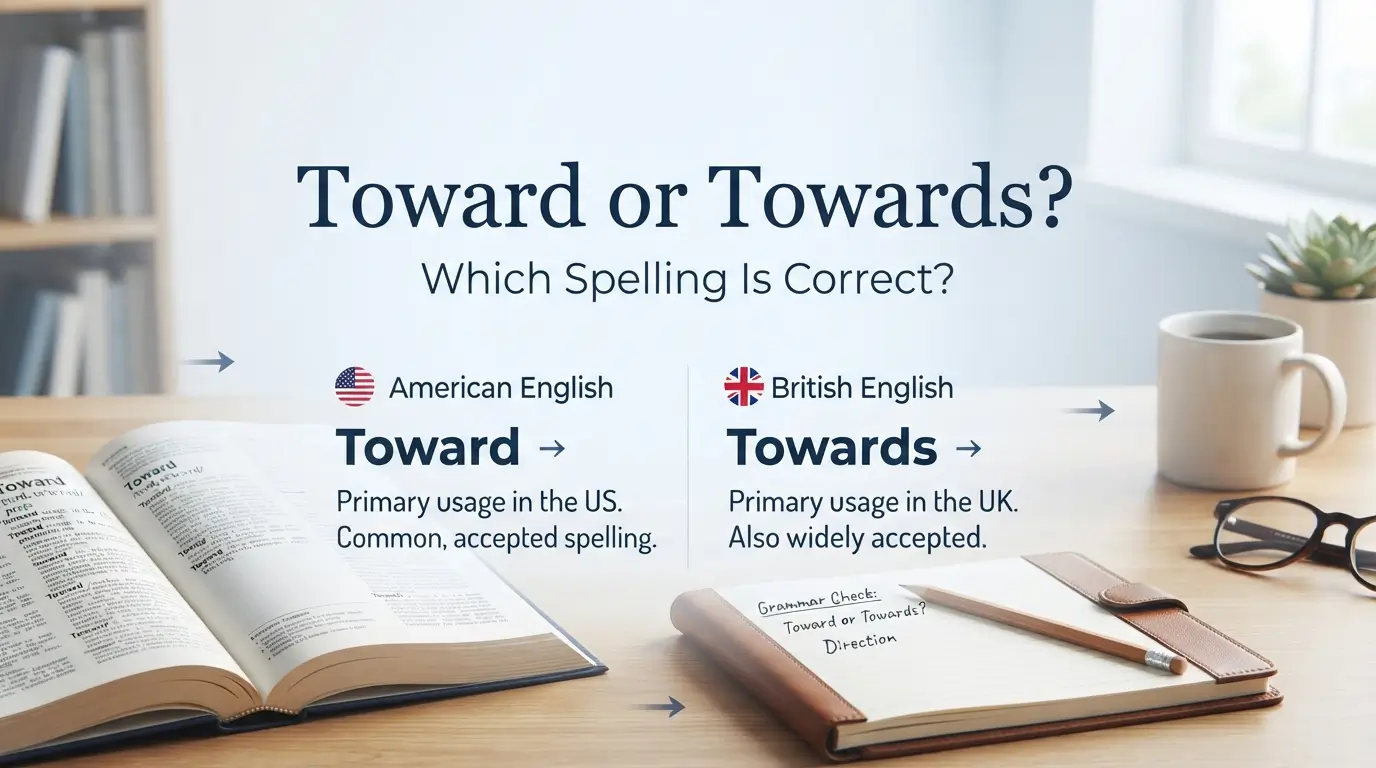
Both forms are correct. They have the same basic meaning and can usually be used in the same sentences. The main difference is regional preference. American English tends to prefer toward, while British English and many other varieties of English tend to prefer towards.
This small spelling difference can confuse because some writers think one form is grammatically correct and the other is wrong. That is not the case. The choice often depends on your audience, location, and writing style.
In this guide, you will learn the meaning of toward or towards, their history, British and American usage, common mistakes, everyday examples, and how search interest varies by region. By the end, you will know which form to choose with confidence.
Toward or Towards – Quick Answer
Toward and towards are both correct spellings. They have the same meaning and are normally interchangeable.
Both words can mean “in the direction of,” “closer to,” or “in relation to.”
Examples
- She walked toward the door.
- She walked towards the door.
- We are moving toward a better future.
- We are moving towards a better future.
- His attitude toward his coworkers was friendly.
- His attitude towards his coworkers was friendly.
All of these sentences are grammatically correct.
The main difference is regional:
| Form | Common Preference | Example |
| Toward | American English | She walked toward the station. |
| Towards | British English and many other varieties | She walked towards the station. |
Merriam-Webster notes that toward is more common in the United States and Canada, while towards is generally preferred elsewhere.
So, the simple rule is:
Use “toward” for an American audience and “towards” for a British audience if you want to follow the usual regional preference.
The Origin of Toward or Towards
The difference between toward and towards is not a modern spelling invention.
The word dates back to Old English, with forms appearing as early as the ninth century. It developed from the idea of moving or pointing in a particular direction. Merriam-Webster explains that it came from a combination related to to and the Old English suffix -weard, meaning direction.
Interestingly, both forms have a long history. The spelling with -s, towards, was not created recently in British English.
English has several similar pairs:
- forward / forwards
- backward / backwards
- upward / upwards
- downward / downwards
- inward / inwards
- outward / outwards
These forms often have the same basic meaning.
Over time, different English-speaking regions developed different preferences. American English generally became more comfortable with the shorter toward, while British English developed a stronger preference for towards.
This is why the difference is mainly about dialect and style, not grammar.
British English vs American English Spelling
The biggest difference is frequency.
American English usually favors “toward.”
British English usually favors “towards.”
Cambridge Dictionary labels toward as mainly US and notes that towards is mainly UK. It also treats the two forms as having the same basic meaning.
Comparison Table
| Feature | American English | British English |
| Preferred form | toward | towards |
| Alternative | towards | toward |
| Meaning | Same | Same |
| Grammar | Correct | Correct |
| Example | Walk toward me. | Walk towards me. |
| Formal writing | Toward is common | Towards is common |
| Main difference | Regional preference | Regional preference |
For example:
American English:
The company is moving toward a new strategy.
British English:
The company is moving towards a new strategy.
Neither sentence is wrong.
The same rule applies when the word describes movement:
- The child ran toward his mother.
- The child ran towards his mother.
It also applies to ideas, goals, and attitudes:
- We are working toward peace.
- We are working towards peace.
- She has a positive attitude toward change.
- She has a positive attitude towards change.
Which Spelling Should You Use?
Your audience should guide your choice.
If You Write for Americans
Choose toward as your default.
For example:
The team is working toward its goal.
This form is especially natural in American websites, newspapers, business writing, and academic writing.
If You Write for British Readers
Choose towards.
For example:
The team is working towards its goal.
This matches the common British preference.
If You Write for Commonwealth Audiences
Towards is often a natural choice in British-influenced varieties of English, including many Commonwealth contexts.
However, local style guides can differ, so follow the style used by your organization when one exists.
If You Write for a Global Audience
Either spelling is acceptable.
The most important thing is consistency. If your website uses American English, use toward throughout. If it follows British English, use towards throughout.
For an SEO website with an international audience, you do not need separate articles just because both spellings exist. Both forms communicate the same meaning.
Common Mistakes with Toward or Towards
Because the two words are so similar, writers sometimes make unnecessary grammar rules.
Mistake 1st: Thinking “towards” Is Wrong
Incorrect belief:
“Toward is the only correct spelling.”
Correction:
Both toward and towards are standard English forms.
Mistake 2nd: Thinking “Towards” Is Only British
Although towards is strongly associated with British English, it is not grammatically forbidden in American English.
Better approach:
Use the form that matches your preferred variety of English.
Mistake 3rd: Changing Between Forms Without Reason
For example:
We walked toward the park and then moved towards the river.
There is nothing grammatically wrong with this sentence, but switching forms may make your writing look inconsistent.
A smoother style is:
We walked toward the park and then moved toward the river.
Or, in British English:
We walked towards the park and then moved towards the river.
Mistake 4th: Assuming the Meaning Changes
The final -s does not normally change the meaning.
- toward the house
- towards the house
Both mean movement in the direction of the house.
Mistake 5th: Confusing “Toward” With “To”
Toward often describes direction, while to can identify a destination.
Compare:
We walked toward the station.
This focuses on direction.
We walked to the station.
This normally identifies the destination.
Toward or Towards in Everyday Examples
Both forms appear in everyday writing and speech.
In Emails
American style:
We are working toward completing the project by Friday.
British style:
We are working towards completing the project by Friday.
Both are correct.
In News Writing
American news writing may use:
The country is moving toward economic recovery.
British news writing may use:
The country is moving towards economic recovery.
The choice usually follows the publication’s regional style.
In Social Media
You can use either:
Taking one step toward my goals every day.
Or:
Taking one step towards my goals every day.
Social media does not create a special grammar rule for either form.
In Formal Writing
Both forms work in essays, reports, and professional documents.
American English:
The research points toward a possible solution.
British English:
The research points towards a possible solution.
For formal writing, consistency matters more than choosing one form over the other.
More Everyday Examples
| Meaning | Toward | Towards |
| Direction | Walk toward the beach. | Walk towards the beach. |
| Goal | Work toward success. | Work towards success. |
| Time | Toward evening, it became colder. | Towards evening, it became colder. |
| Attitude | Her attitude toward him changed. | Her attitude towards him changed. |
| Contribution | Put money toward the project. | Put money towards the project. |
| Movement | He leaned toward me. | He leaned towards me. |
Toward or Towards – Comparison at a Glance
| Toward | Towards |
| Shorter spelling | Longer spelling |
| More common in American English | More common in British English |
| Standard English | Standard English |
| Means “in the direction of” | Means “in the direction of” |
| Used as a preposition | Used as a preposition |
| Correct in formal writing | Correct in formal writing |
| Preferred by many US writers | Preferred by many UK writers |
The key point is simple: there is no difference in core meaning.
Toward or Towards – Google Trends & Usage Data
People often search “toward or towards” because they want to know which spelling is correct. Search interest is therefore closely linked to English grammar, spelling, regional differences, and writing advice.
Google Trends can help show how interest in a search term changes over time and across locations. However, Google Trends data should be treated as relative search interest, not as an exact count of searches.
Research on Google Trends also warns that search data can be sensitive to the terms and benchmarks being compared.
For toward vs. towards, the clearest usage pattern comes from major English dictionaries:
- United States: “toward” is generally more common.
- Canada: “toward” is also commonly preferred.
- United Kingdom: “towards” is generally preferred.
- Other English-speaking regions: “towards” is often common, especially where British English has strong influence.
This means searchers in different countries may expect different forms, even though both are correct.
For SEO writers, this is useful. If your website targets the United States, toward may fit your main keyword and editorial style better. If you target the UK, towards may sound more natural.
Google also introduced an experimental Trends API in 2025, showing continued development of tools for analyzing search interest.
Important: Do not claim that one spelling is “more correct” simply because it has higher search interest. Search volume and grammatical correctness are different things.
Toward or Towards: Which One Is More Common?
The answer depends on the variety of English.
Toward is more common in American English.
Towards is more common in British English and is also widely used in other English varieties.
This is similar to other regional differences, such as:
- color/colour
- organize/organise
- center/centre
These differences do not automatically make one spelling right and the other wrong.
FAQs:
Is “toward” or “towards” correct?
Both toward and towards are correct. They have the same basic meaning and are generally interchangeable.
Is “towards” British or American?
Towards is more strongly associated with British English, while American English generally prefers toward. However, both forms can occur in American English.
Do “toward” and “towards” mean the same thing?
Yes. Both normally mean in the direction of, closer to, or in relation to something.
Which is more common in American English?
Toward is generally more common in American English.
Which is more common in British English?
Towards is generally more common in British English.
Is “towards” more formal than “toward”?
No. Neither form is inherently more formal. The difference is mainly regional preference.
Should I use “toward” or “towards” in an essay?
Use the form that matches your chosen variety of English. For American English, toward is usually the natural choice. For British English, towards is usually preferred. Most importantly, stay consistent.
Conclusion:
The toward or towards question has a simple answer: both spellings are correct. They are two forms of the same word, and their basic meaning does not change. Both can describe movement, direction, goals, attitudes, time, and relationships.
The main difference is regional style. Toward is more common in American English, while towards is generally preferred in British English and many other English-speaking varieties.
If you write for an American audience, toward is the safest default. If your audience uses British English, towards will usually sound more natural. For international readers, either form is acceptable.
The most important rule is consistency. Do not switch between toward and towards without a reason. Choose the spelling that fits your audience and use it consistently across your article, website, email, or professional document.
So, If you write “walk toward the door” or “walk towards the door,” your sentence is correct. The choice is mainly about English variety, not grammar.
Read More Posts:
- HY Meaning in Text From a Guy or Girl Explained 2026
- O7 Meaning in Text: What Does This Symbol Mean?
- Cancelled or Canceled: American vs British English Explained

Emily Dickinson is one of America’s most influential poets, recognized for her unique style and thought-provoking poetry. Through GrammerNests.com, she contributes valuable perspectives on language, creativity, and the beauty of written expression.