Few English words cause as much confusion as its or it’s. They sound the same when spoken, but they have different meanings and jobs in a sentence. One shows possession, while the other is a contraction. That small apostrophe can completely change the meaning of a sentence.
For example, compare “The dog wagged its tail” with “It’s raining outside.” In the first sentence, its shows that the tail belongs to the dog. In the second, it’s means “it is.”
People often search for its or it’s when writing emails, school assignments, websites, social media posts, business documents, or formal papers. The confusion is common because apostrophes often show possession in English, such as Sarah’s book. However, its is different because possessive pronouns do not normally use apostrophes.
The good news is that the rule is simple. This guide explains its, or it’s, where the two forms came from, common mistakes, everyday examples, and the best way to remember the difference.
Its or It’s – Quick Answer
The easiest rule is:
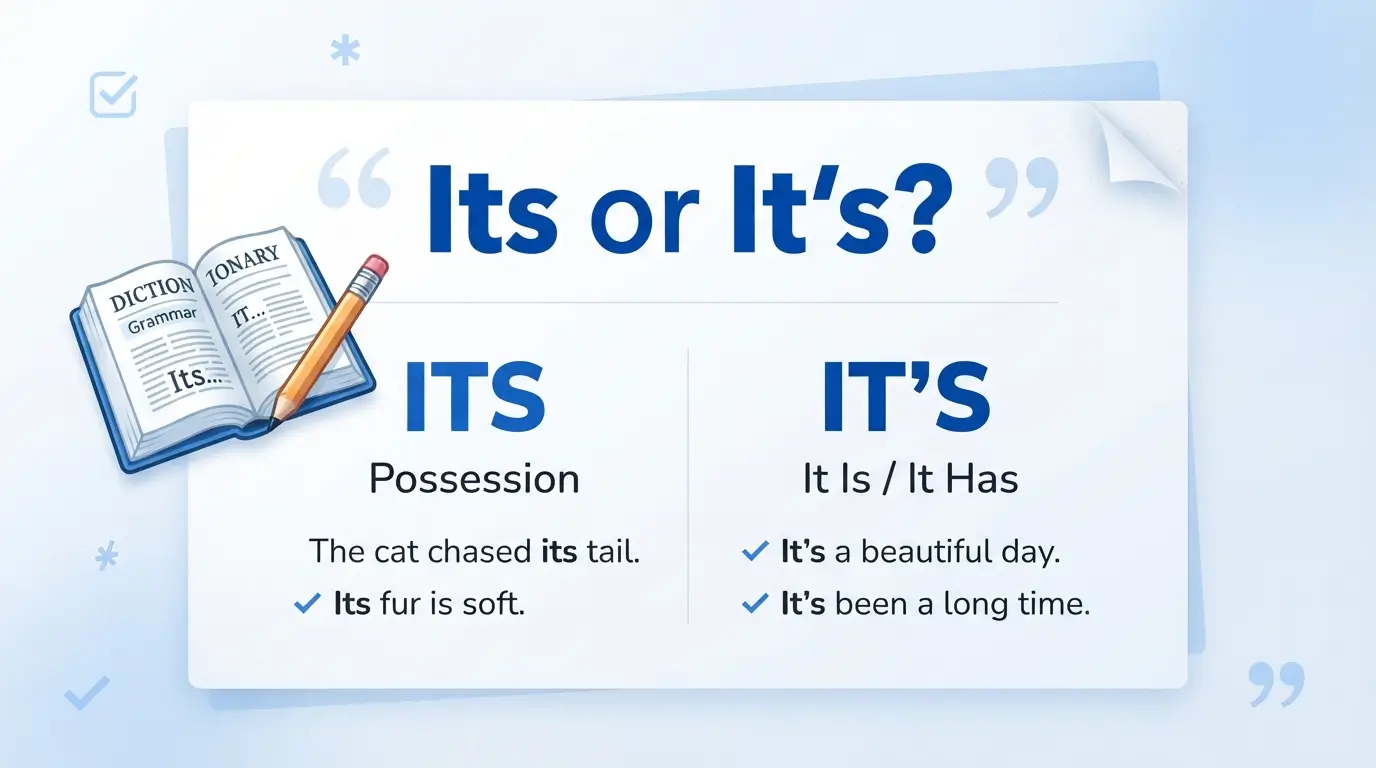
- Its = shows possession or belonging.
- It’s = means “it is” or “it has.”
Examples with “its”
Use its when something belongs to or is connected with something else.
- The cat cleaned its paws.
- The company changed its policy.
- Tree lost its leaves.
- The phone has its own charger.
You can often replace its with his, her, or their:
The dog wagged its tail.
The boy moved his chair.
Examples with “it’s”
Use it’s when you mean it is or it has.
- It’s cold today. = It is cold today.
- It’s a beautiful morning. = It is a beautiful morning.
- It’s been a long day. = It has been a long day.
- It’s already started. = It has already started.
The fastest test
Replace it’s with it is, or it has.
If the sentence still makes sense, use it’s.
It’s raining.
It is raining. ✓
The company increased its prices.
The company increased it is prices. ✗
So the correct sentence is:
The company increased its prices.
Merriam-Webster gives the same basic rule: it’s is a contraction of it is, or it has, while its is the possessive form of it.
The Origin of Its or It’s
The difference between its and it’s has a surprisingly long history.
The word it comes from Old English and developed as a pronoun for referring to things, animals, and ideas. Older English did not always use its in the way modern English does. The possessive form of it changed over time as English grammar developed.
Merriam-Webster notes that its first appeared in its modern possessive sense in the late 16th century. It’s also has a long history, but its apostrophe has served different purposes over the centuries.
In earlier English, writers sometimes used an apostrophe in the possessive it’s. This may look strange to modern readers, but it was once common. During the 17th century, forms such as it’s could be used to show possession.
Over time, English writers increasingly used it’s as a contraction of it is, while its became the standard possessive form. By the 18th century, the modern distinction had become much more established.
This history explains why the rule can seem unusual. English often uses apostrophes to show possession:
- the girl’s book
- the dog’s collar
- the company’s website
But possessive pronouns work differently:
- his
- hers
- yours
- ours
- theirs
- its
So its does not need an apostrophe when it shows possession.
British English vs American English Spelling
There is no major British-versus-American spelling difference between its and it’s.
Both British English and American English use:
- its for possession
- it’s for it is or it has
For example:
| Meaning | British English | American English |
| Possession | The company changed its name. | The company changed its name. |
| It is | It’s a good idea. | It’s a good idea. |
| It has | It’s been a busy week. | It’s been a busy week. |
| Possession | The dog hurt its paw. | The dog hurt its paw. |
Unlike words such as colour/color, centre/center, and organise/organize, its/it’s does not normally change based on If you are using British or American English.
The same distinction is recognized in both varieties. Collins, for example, lists its as the possessive form and it’s as the contraction of it is or it has in both British and American English.
Its or It’s Comparison Table
| Word | Meaning | Grammar role | Example |
| its | belonging to it | Possessive determiner | The bird spread its wings. |
| it’s | it is | Contraction | It’s very cold. |
| it’s | it has | Contraction | It’s been a long time. |
| its’ | Not standard | Incorrect form | Its’ color is unusual. ✗ |
The most important point is that British and American writers follow the same rule.
Which Spelling Should You Use?
The answer depends less on your country and more on what you mean.
If you write for a US audience
Use its for possession, and it’s for it is or it has.
The business updated its website.
It’s ready for customers.
If you write for a UK or Commonwealth audience
Use the same rule.
The school changed its timetable.
It’s ready for the new term.
If you write for a global audience
The same rule is still the safest choice.
If your readers are in the United States, United Kingdom, Canada, Australia, New Zealand, or another English-speaking country, the distinction between its and it’s is widely accepted.
For professional writing, academic work, websites, and business communication, always use the standard forms. This makes your writing clearer and avoids an error that readers notice quickly.
A simple professional rule
Remember:
Its = belonging to it
It’s = it is / it has
If you follow that rule consistently, you will almost always choose the correct form.
Common Mistakes with Its or It’s
Mistake 1st: Using “it’s” to show possession
Incorrect:
The company changed it’s logo.
Correct:
The company changed its logo.
Why? The logo belongs to the company. You cannot replace its with it is.
Mistake 2nd: Using “its” instead of “it’s”
Incorrect:
Its raining outside.
Correct:
It’s raining outside.
Here, it’s means it is.
Mistake 3rd: Writing “its’”
Incorrect:
The dog hurt its’ leg.
Correct:
The dog hurt its leg.
Its’ is not the standard possessive form of it.
Mistake 4th: Assuming every apostrophe shows possession
This is one of the main reasons people make this error.
An apostrophe can show possession with many nouns:
Maria’s car
the teacher’s desk
But it’s is not the possessive form of it. It is a contraction.
The possessive form is:
its
Mistake 5th: Forgetting that “it’s” can mean “it has”
Many learners remember only:
It’s = it is
But it’s can also mean it has when has works as a helping verb.
It’s been raining.
= It has been raining.
It’s already finished.
= It has already finished.
Merriam-Webster specifically identifies both it is and it has as meanings of it’s.
Its or It’s in Everyday Examples
Knowing the rule is useful, but seeing these words in real writing makes the difference easier to remember.
In emails
Professional email:
The company has updated its policy.
All employees must read the update.
Here, its shows possession, while it’s means it is.
In news writing
News articles often use both forms:
The city announced its new transport plan.
It’s expected to begin next month.
The first example shows ownership or connection. The second means it is expected.
In social media
Informal posts may use contractions often:
It’s finally Friday!
The restaurant changed its menu.
Even though social media is informal, the standard distinction still applies.
In formal writing
Academic and professional writing should be especially careful:
The study examines the company and its effect on local employment.
Not:
The study examines the company, and it’s effect on local employment. ✗
Another example:
The results need further study.
Here, it’s correctly means it is.
In websites and blogs
Correct usage improves the quality of online content:
Learn how the software works and how to use its main features.
It’s easy to get started.
A simple grammar error can make otherwise strong content look less professional.
Its or It’s – Google Trends & Usage Data
The search phrase “its or it’s” reflects a common grammar question rather than a regional spelling difference. People search for it because the two forms sound the same but perform different grammatical jobs.
Google Trends can be useful for studying this type of search behavior because it allows comparisons by country, time period, and related search terms. However, Trends data should be treated as relative search interest, not as an exact count of how many people use or search for a word.
Interest in its or it’s can appear across countries where English is widely used, including the United States, United Kingdom, Canada, Australia, and other regions.
The exact level of interest can change over time and may also vary with education, ESL learning, school assignments, grammar questions, and general writing needs.
The important point is that its and it’s are not competing regional spellings. Their meanings are different everywhere standard English is used.
For content creators, this makes “its, or it’s” a useful educational keyword. Someone searching the phrase usually wants a fast answer, examples, a grammar rule, or help deciding which form belongs in a sentence.
What Searchers Usually Want
| Search need | What the user wants |
| Quick answer | The difference between its and it’s |
| Grammar help | Rules and examples |
| Writing correction | Which form belongs in a sentence |
| ESL learning | Easy explanation |
| Professional writing | Correct usage |
| School work | Examples and practice |
| SEO/content writing | Clear grammar guidance |
For the most accurate current search-interest numbers, check Google Trends directly for your target country and date range. Trends values are indexed rather than raw search volumes, so they are best used to understand relative popularity and patterns, not exact traffic.
Its or It’s – Comparison Table
| Feature | Its | It’s |
| Apostrophe | No | Yes |
| Main meaning | Belonging to it | It is / it has |
| Grammar | Possessive form | Contraction |
| Example | The dog wagged its tail. | It’s very happy. |
| Can replace with “it is”? | No | Yes |
| Can replace with “it has”? | No | Yes |
| Used in British English? | Yes | Yes |
| Used in American English? | Yes | Yes |
| Common mistake | Adding apostrophe | Using it for possession |
How to Remember Its or It’s Easily
Try this three-step method.
Step 1: Look at “it’s”
Ask:
Does it’s mean it is or it has?
If yes, keep the apostrophe.
It’s late.
It is late. ✓
It’s been fun.
It has been fun. ✓
Step 2: Look for possession
Ask:
Does something belong to “it”?
If yes, use its.
The phone lost its signal.
The signal belongs to the phone.
Step 3: Use the “his or her” test
If you could replace its with his, her, or their, you probably need its.
The company changed its name.
Compare:
The company changed her name.
The structure shows possession.
FAQs:
What is the difference between its and it’s?
Its shows possession or belonging. It’s is a contraction meaning it is or it has.
The dog loves its owner.
It’s sleeping.
Is “its” possessive?
Yes. Its is the possessive form used for it.
The car lost its wheel.
Is “it’s” always a contraction?
In standard modern English, it’s is used as a contraction of it is or it has.
It’s cold. = It is cold.
It’s been a great day. = It has been a great day.
Is “its’” correct?
No. Its’ is not the standard form. Use its for possession.
Correct:
The company improved its service.
Is “it’s” ever possessive?
In modern standard English, no. Use its for possession.
The bird opened its wings. ✓
The bird opened it’s wings. ✗
Historical English sometimes used it’s as a possessive, but that is not the modern standard rule.
Which is correct: “The company changed its policy” or “The company changed it’s policy”?
The correct sentence is:
The company changed its policy.
The policy belongs to or is associated with the company.
Which is correct: “Its a good idea” or “It’s a good idea”?
The correct sentence is:
It’s a good idea.
Here, it’s means it is.
Conclusion:
Understanding its or it’s is much easier once you separate possession from contraction. Its means that something belongs to, relates to, or is associated with “it.” It’s is a shortened form of it is, or it has.
The quickest test is to replace it’s with it is, or it has. If the sentence still makes sense, it’s is correct. If it does not, you probably need its.
For example, “It’s raining” means “It is raining,” while “The dog wagged its tail” shows that the tail belongs to the dog.
There is no meaningful British-versus-American spelling difference here. Both varieties use the same standard rule. The difference comes from grammar, not geography.
When writing emails, articles, school papers, business documents, or social media posts, use its for possession, and it’s for it is/it has. Once this simple rule becomes familiar, one of English’s most common grammar problems becomes easy to avoid.
Read More Posts:
- Cancelled or Canceled: American vs British English Explained
- How to Use “Whether or Not” in Formal and Casual English
- Effect or Affect: Understand Difference as a Verb and Noun