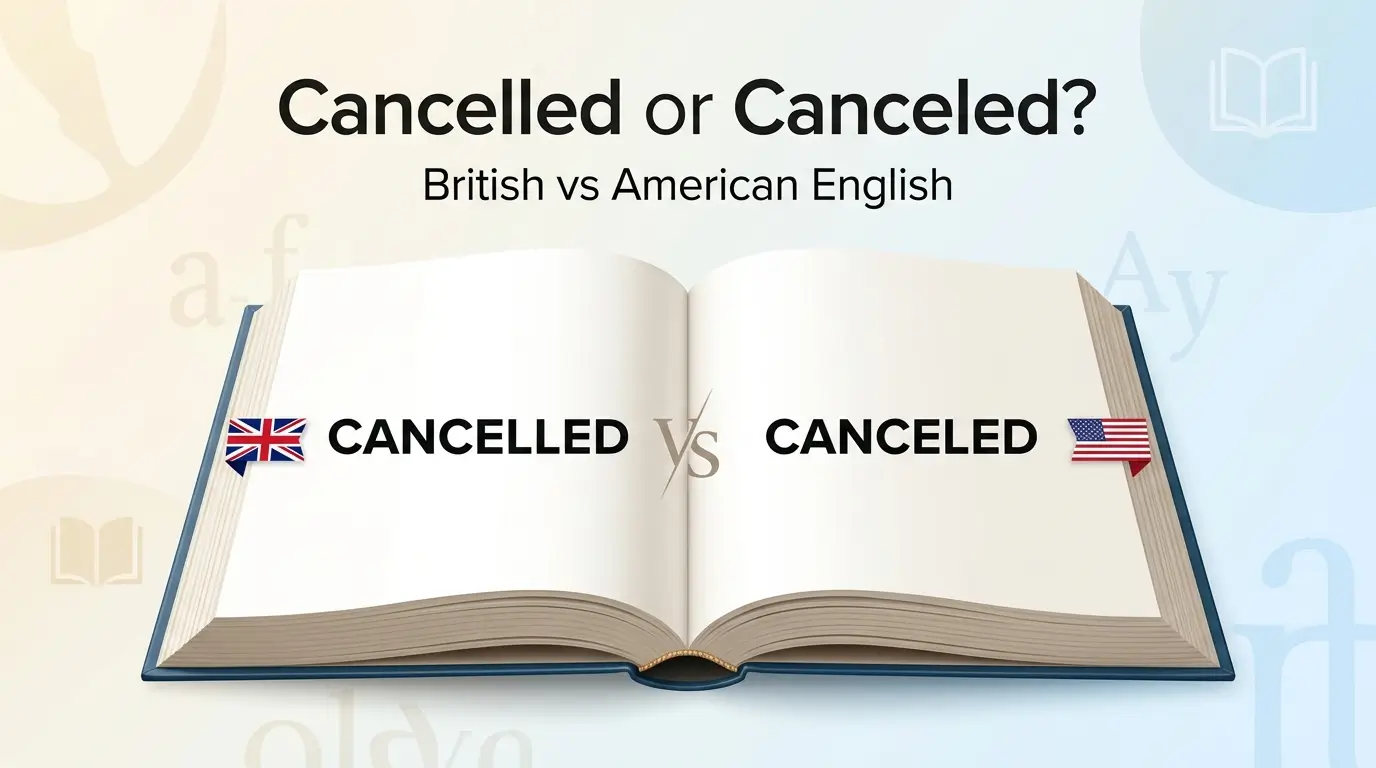
Cancelled or canceled is a common spelling question in English. Both forms are correct, but the preferred spelling depends on where you use English. The difference is small: cancelled has two ls, while canceled has one.
If you write for a British audience, you will usually see cancelled. American English normally uses canceled. This difference can appear in emails, school assignments, business documents, news articles, websites, and social media posts.
The confusion becomes greater because both spellings appear in dictionaries and online searches. Someone may see “event canceled” in an American article and “event cancelled” in a British article and wonder which one is actually correct.
The simple answer is that both spellings are correct. The main difference is regional spelling style. British English and many other varieties influenced by British English usually keep the double l, while American English often uses one l.
Next deeply explains the difference between cancelled or canceled, their origins, spelling rules, common mistakes, and when to use each form.
Cancelled or Canceled
Cancelled and canceled are both correct spellings of the past tense and past participle of cancel.
- Cancelled = preferred in British English.
- Canceled = preferred in American English.
Examples
British English:
The flight was cancelled due to bad weather.
American English:
The flight was canceled due to bad weather.
The meaning does not change. Both sentences say that the flight will not take place.
The same difference appears with the present participle:
- British English: cancelling
- American English: canceling
Quick comparison
| Form | British English | American English |
| Base word | cancel | cancel |
| Past tense | cancelled | canceled |
| Present participle | cancelling | canceling |
| Meaning | Stop or call off something | Stop or call off something |
So, if you are wondering “Is cancelled or canceled correct?”, the answer is both. Your choice should match your preferred variety of English.
The Origin of Cancelled or Canceled
The spelling difference comes from the history of the word cancel.
The English word can be traced to the Latin cancellare, meaning to make something invalid or cross something out. It was related to cancellus, meaning a lattice or grating. Over time, the word entered French and then English.
The basic word became cancel in English. When adding endings such as -ed and -ing, English developed different spelling conventions.
British English generally retained the double l in forms such as:
- cancelled
- cancelling
American English developed a preference for keeping one l:
- canceled
- canceling
This is part of a wider pattern in English spelling. American English often favors shorter spellings in certain words, while British English retains forms that became traditional in Britain.
For example:
| British English | American English |
| cancelled | canceled |
| travelling | traveling |
| labelled | labeled |
| modelling | modeling |
| signalling | signaling |
The differences do not usually affect pronunciation or meaning. They mainly reflect spelling conventions.
It is also important to understand that American spelling did not simply “remove” letters randomly. American English developed its own standardized spelling traditions, influenced by dictionary writers and broader language changes.
British English vs American English Spelling
The biggest difference between cancelled and canceled is regional preference.
British English usually doubles the final l before adding -ed or -ing:
- cancel → cancelled
- cancel → cancelling
American English generally does not double the l:
- cancel → canceled
- cancel → canceling
Comparison table
| Feature | British English | American English |
| Past tense | cancelled | canceled |
| Present participle | cancelling | canceling |
| Preferred spelling | Cancelled | Canceled |
| Pronunciation | Same | Same |
| Meaning | Same | Same |
| Common in | UK and many Commonwealth contexts | United States |
Why does this happen?
English spelling is not completely uniform. Different English-speaking regions have developed different conventions over time.
In British English, words ending in l often double the letter when certain suffixes are added.
American English commonly follows a different pattern with words such as cancel.
However, not every word follows the same rule. That is why it is better to learn common spelling patterns rather than assume that every word ending in l behaves identically.
Related examples
Consider these pairs:
- travelled / traveled
- travelling / traveling
- labelled / labeled
- labelling / labeling
- cancelled / canceled
- cancelling / canceling
If your website, school, workplace, or publication follows American English, use the American forms consistently. If it follows British English, use the British forms.
Which Spelling Should You Use?
The best spelling depends on your audience.
For American readers
Use canceled and canceling.
For example:
The meeting was canceled yesterday.
This is the standard choice in American English.
For British readers
Use cancelled and cancelling.
For example:
The meeting was cancelled yesterday.
This is the normal British English spelling.
For UK and Commonwealth audiences
British-style spelling is common in many countries and institutions that use British English conventions. Depending on the country and organization, cancelled may be the preferred form.
Always check the style guide of your school, employer, publisher, or website if one is provided.
For a global audience
If you publish online for readers around the world, either spelling can work. The most important thing is consistency.
Do not switch randomly between:
The event was cancelled.
and:
The event was canceled.
Choose one spelling system and use it throughout the same piece of content.
For SEO content
Search engines can understand both forms. The key is to create useful content for the reader rather than force one spelling repeatedly.
If your target audience is mainly American, use canceled naturally. If your audience is mainly British, use cancelled.
You can also mention both forms when the article is specifically about the spelling difference.
Common Mistakes with Cancelled or Canceled
Because both spellings are correct, the biggest mistakes usually involve inconsistency or incorrect forms.
Mistake 1st: Mixing spelling styles
Incorrect for a consistent British-style article:
The flight was canceled, but the next flight was cancelled.
This mixes American and British spelling.
Better:
The flight was cancelled, but the next flight was cancelled too.
Or, in American English:
The flight was canceled, but the next flight was canceled too.
Mistake 2nd: Writing “cancelld”
The correct spelling is:
cancelled
Not:
cancelld
The word keeps the e before d.
Mistake 3rd: Writing “canceld”
Another common typo is:
canceld
The correct American form is:
canceled
The e remains before the d.
Mistake 4th: Using “cancelled” as the only correct spelling
It is incorrect to say that canceled is always wrong.
Canceled is the standard American English form.
Mistake 5th: Using “canceled” as the only correct spelling
The opposite is also true.
Cancelled is a standard and correct British English spelling.
Mistake 6th: Forgetting the spelling difference in “-ing”
The difference also appears in the present participle:
- British: cancelling
- American: canceling
For example:
The company is cancelling the event.
British English
The company is canceling the event.
American English
Cancelled or Canceled in Everyday Examples
The word appears frequently in everyday communication.
In emails
British English:
Please note that tomorrow’s meeting has been cancelled.
American English:
Please note that tomorrow’s meeting has been canceled.
Both are professional and correct.
In news writing
A British news report may say:
The match was cancelled because of heavy rain.
An American news report may say:
The game was canceled because of heavy rain.
The spelling reflects the publication’s regional style.
On social media
British-style:
Tonight’s event has been cancelled. Sorry for the inconvenience!
American-style:
Tonight’s event has been canceled. Sorry for the inconvenience!
Social media does not change the spelling rule. Your regional English style still determines the preferred form.
In formal writing
British English:
The conference was cancelled because the venue was unavailable.
American English:
The conference was canceled because the venue was unavailable.
In customer service
British:
Your appointment has been cancelled.
American:
Your appointment has been canceled.
In everyday conversation
You might write:
My plans were cancelled.
Or:
My plans were canceled.
Again, the meaning is the same.
Cancelled or Canceled – Search Trends & Usage Data
Search interest for cancelled and canceled varies by country because English spelling preferences vary by region.
In general, canceled is strongly associated with the United States, while cancelled is more common in the United Kingdom and other regions where British spelling is widely used.
Search behavior can also depend on context. People may search:
- cancelled or canceled
- canceled vs cancelled
- is cancelled correct
- is canceled correct
- cancelled meaning
- canceled meaning
- canceling or cancelling
The exact popularity of each spelling can change over time, and Google Trends results depend on the selected country, date range, and search category.
For SEO, this means you should not assume that one spelling is universally better. Instead, identify your target audience.
If your website targets the United States, canceled is usually the natural primary spelling.
If your website targets the United Kingdom, cancelled is usually more appropriate.
For global English content, mentioning both forms can help answer users who are searching for the spelling difference.
Usage by region
| Region | Common preference |
| United States | canceled |
| United Kingdom | cancelled |
| Canada | Often cancelled, but usage can vary |
| Australia | cancelled |
| New Zealand | cancelled |
| International audience | Either, depending on style |
These are broad language tendencies, not absolute rules. Individual organizations may use their own style guides.
Cancelled vs Canceled: Side-by-Side Comparison
| Word or form | British English | American English |
| Base verb | cancel | cancel |
| Past tense | cancelled | canceled |
| Past participle | cancelled | canceled |
| Present participle | cancelling | canceling |
| Meaning | Call off or stop | Call off or stop |
| Pronunciation | Same | Same |
| Correct? | Yes | Yes |
| Main difference | Double l | Single l |
The most important point is simple: there is no difference in meaning.
The difference is mainly spelling style.
FAQs:
Is cancelled or canceled correct?
Both are correct. Cancelled is preferred in British English, while canceled is preferred in American English.
Is “cancelled” British or American?
Cancelled is primarily the British English spelling. It is also common in several countries and organizations that follow British English conventions.
Is “canceled” American English?
Yes. Canceled is the standard American English spelling.
Which is correct: canceling or cancelling?
Both are correct. Canceling is preferred in American English, while cancelling is preferred in British English.
Does cancelled mean something different from canceled?
No. They have the same meaning. Both mean that something was stopped, called off, or made no longer valid.
Should I use cancelled or canceled in an essay?
Follow the English style required by your school, university, teacher, publisher, or employer. For American English, use canceled. For British English, use cancelled.
Which spelling is better for SEO?
Neither spelling is universally better. Choose the form that matches your target audience. If you target American readers, canceled is usually the better choice. For British readers, use cancelled.
Conclusion:
The answer to “cancelled or canceled?” is simple: both spellings are correct. The difference comes from regional English spelling conventions rather than meaning.
Cancelled is the preferred form in British English and is common in many Commonwealth varieties of English. Canceled is the standard American English spelling. The same pattern appears with cancelling and canceling.
When choosing between them, think about your audience first. Use canceled for American English and cancelled for British English. If you are writing for an international audience, either can work, but consistency is important.
Neither spelling should be treated as a spelling mistake when used in the appropriate variety of English. The goal is to match the style of your readers and keep your writing consistent.
So, if you write “The meeting was cancelled” or “The meeting was canceled,” your sentence is correct. The only real question is which English spelling style you are following.
Read More Posts:
- Examples of OFC in Text Messages
- ING Meaning Across Social Media 2026
- What Does OTR Mean From a Guy or Girl In Texting 2026

Toni Morrison is a celebrated American novelist known for her powerful storytelling, rich characters, and lasting impact on literature. At GrammerNests.com, she shares insights that help readers appreciate language, writing, and literary expression.