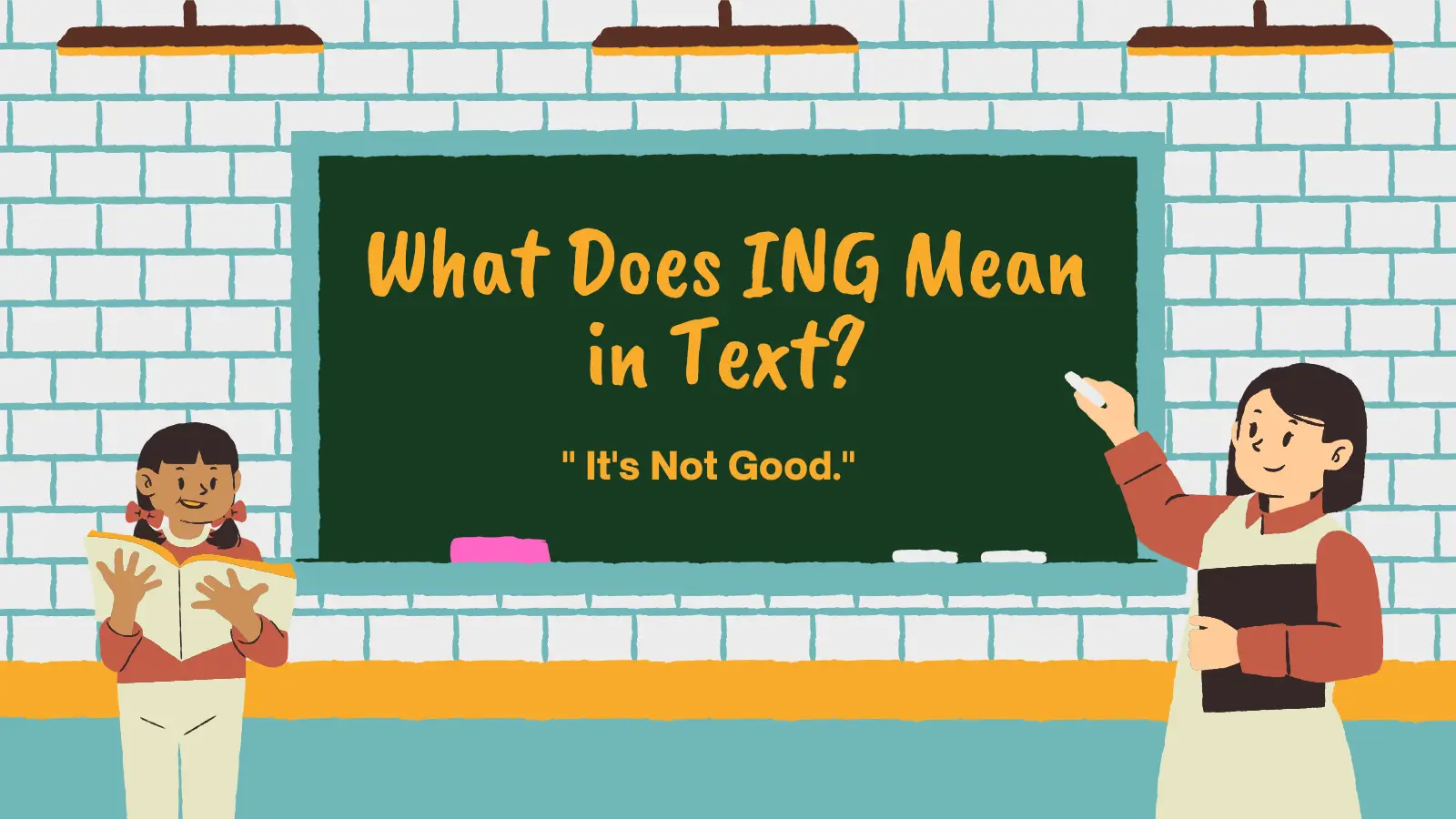
Text abbreviations often have multiple meanings depending on the conversation, platform, or industry.
While some people recognize ING as part of common English grammar, others encounter it as a shortcut in texting, social media, gaming, or even technical fields such as medicine and physics.
People search for what does ING mean in text because the abbreviation appears in many different places.
A friend might use it casually in a chat, someone may include it in a social media caption, or you might see it in professional or academic discussions with an entirely different meaning. Understanding the context is the key to interpreting it correctly.
Next, Explains the most common meanings of ING in text messages, WhatsApp, Instagram, TikTok, dating apps, and specialized fields. You’ll also learn how to respond when someone uses it, how it differs from similar abbreviations, and why context always matters.
Meaning & Definition
The meaning of ING depends on where and how it appears. In most everyday conversations, ING is not a standalone slang term.
Instead, people usually see it as the familiar English suffix added to verbs, creating words such as running, talking, swimming, working, or playing.
However, in texting and online communication, some users type ING by itself as a shortened way to refer to an ongoing activity. Although this usage is less common than other internet abbreviations, it occasionally appears in casual conversations among friends.
Here are the most common meanings:
- Refers to an action currently happening.
- Represents the “-ing” ending of English verbs.
- Indicates that someone is busy doing something.
- Can appear as part of usernames, hashtags, or online trends.
- May represent completely different terms in technical or professional settings.
For example:
- “Still workING.” (Emphasizes the ongoing action.)
- “I’m gaming.”
- “Currently studying.”
In these situations, ING relates to continuous actions rather than a separate word with its own definition.
Because language on the internet evolves quickly, users sometimes create playful abbreviations using ING, but no universally accepted slang definition applies to every conversation.
Background
The letters ING have existed in the English language for centuries because they form one of the most common grammatical endings. The suffix transforms verbs into present participles or gerunds, allowing speakers to describe actions that are happening now or activities in general.
As digital communication became faster, people started shortening words, removing punctuation, and inventing abbreviations.
While acronyms such as LOL, BRB, and IMO became widely recognized, ING remained closely connected to grammar rather than becoming a mainstream internet acronym.
Social media also influenced how people interpret ING. Short captions, hashtags, and usernames frequently include words ending in “-ing,” making the suffix highly visible online. Over time, some users began referring to the ending itself simply as “ING.”
Outside everyday language, ING also appears as initials for organizations, companies, technical terms, and scientific abbreviations. This explains why its meaning changes dramatically depending on the topic.
Whenever you encounter ING, ask yourself:
- Is this a casual text message?
- Is it part of a complete English word?
- The conversation about science, medicine, aviation, or finance?
Answering these questions usually reveals the intended meaning.
Usage in Different Contexts
Context determines the meaning of ING more than the letters themselves.
Casual Texting
Friends often use words ending in “-ing” to describe current activities.
Examples:
- “Watching TV.”
- “Cooking dinner.”
- “Working late.”
Here, ING simply signals an action in progress.
Social Media
On social platforms, users include ING words in:
- Hashtags
- Captions
- Comments
- Short status updates
Examples include:
- #Traveling
- #Learning
- #Growing
- #Winning
These words help describe experiences, hobbies, and personal updates.
Gaming
Gamers frequently write:
- Grinding
- Farming
- Camping
- Healing
Although ING is not the abbreviation itself, many gaming terms naturally end with “-ing.”
Business
Professionals use ING words regularly:
- Meeting
- Planning
- Marketing
- Training
- Hiring
These describe ongoing workplace activities rather than internet slang.
Academic Writing
Students and teachers encounter ING constantly because English grammar relies heavily on present participles and gerunds.
Overall, ING appears across almost every type of communication because continuous actions are common in both spoken and written English.
Meaning in Chat, WhatsApp, Instagram, and TikTok
Social platforms often give abbreviations new meanings, but ING usually stays connected to ongoing actions.
In Chat
Someone may write:
- “Working.”
- “Driving.”
- “Studying.”
The ING ending tells you the activity is happening right now.
On WhatsApp
WhatsApp conversations are informal, so people frequently use short replies such as:
- Sleeping
- Eating
- Waiting
- Traveling
Instead of writing a full sentence, they simply mention the activity.
On Instagram
Instagram captions commonly feature action words ending in ING.
Examples:
- Loving this view.
- Exploring new places.
- Living my best life.
- Creating memories.
These captions sound active and engaging.
On TikTok
TikTok creators often use ING words to introduce videos:
- Trying this trend.
- Testing viral hacks.
- Reacting to comments.
- Dancing challenge.
The suffix helps emphasize movement, action, and participation.
Because social media favors short, energetic language, ING appears naturally in captions without serving as a unique abbreviation.
Meaning in Physics, Medical, and Aircraft Terminology
Outside texting, ING may appear in specialized industries.
Physics
ING has no universally recognized meaning in physics. When it appears, it is usually an abbreviation created specifically for a research paper, laboratory, or institution. Always check the surrounding context.
Medical Field
Healthcare professionals occasionally use ING within hospital documentation, organization names, or internal shorthand. Unlike common medical abbreviations such as BP or ECG, ING does not have one standard medical definition accepted everywhere.
Aircraft and Aviation
In aviation, ING may appear in company names, maintenance documents, engineering references, or internal abbreviations. It is not a globally standardized aviation acronym.
Because technical industries often develop their own abbreviations, readers should avoid assuming ING carries the same meaning in every document.
When reading scientific or professional material, rely on the document’s glossary or explanation instead of guessing.
Common Misconceptions
Several misunderstandings surround ING.
Misconception 1st: ING always means one thing.
False. Its meaning changes depending on context.
Misconception 2nd: ING is a popular internet acronym.
Not exactly. Most people recognize it as the English verb ending rather than a standalone slang abbreviation.
Misconception 3rd: Everyone uses ING in texting.
Most texters simply use complete words ending in “-ing” instead of writing ING by itself.
Misconception 4th: Technical meanings are universal.
Different industries assign different meanings to abbreviations, so one definition may not apply elsewhere.
Recognizing these misconceptions helps prevent confusion during conversations.
Similar Terms & Alternatives
Several abbreviations appear alongside ING in online conversations.
- LOL > Laughing out loud
- BRB > Be right back
- AFK > Away from keyboard
- IMO > In my opinion
- TBH > To be honest
- IDK > I don’t know
- BTW > By the way
- SMH > Shaking my head
- ICYMI > In case you missed it
- TTYL > Talk to you later
Unlike these abbreviations, ING usually functions as part of a word rather than replacing an entire phrase.
How to Respond to ING
Your response depends on the conversation.
If someone says:
- “Working.”
You could reply:
- “Good luck!”
- “Hope it goes well.”
- “Talk later.”
If they write:
- “Studying.”
You might answer:
- “You’ve got this.”
- “Good luck with your exam.”
If the meaning seems unclear, simply ask:
- “What do you mean by ING?”
- “Could you explain that?”
- “Which ING are you referring to?”
A quick question prevents misunderstandings.
Differences from Similar Words
ING differs from many internet abbreviations because it usually serves as a grammatical ending instead of representing a complete phrase.
| Term | Meaning |
| ING | Usually indicates an ongoing action through the “-ing” verb ending |
| LOL | Laughing out loud |
| BRB | Be right back |
| IDK | I don’t know |
| IMO | In my opinion |
| AFK | Away from keyboard |
While acronyms replace entire expressions, ING usually modifies verbs to show continuous action.
Relevance in Online Conversations & Dating Apps
Dating apps encourage short, engaging conversations, making action words extremely common.
Profiles often include phrases such as:
- Traveling the world.
- Learning new skills.
- Cooking every weekend.
- Exploring coffee shops.
- Hiking every chance I get.
These ING words make profiles sound active and interesting.
During chats, someone might say:
- “Watching a movie.”
- “Working now.”
- “Driving home.”
These responses naturally communicate what the person is doing at that moment.
Although some users treat ING as casual shorthand, most dating app conversations simply rely on regular English words ending in “-ing.” Understanding this makes conversations easier to follow and reduces confusion.
Conclusion:
Understanding what does ING mean in text becomes much easier once you consider the context. In most conversations, ING is simply the familiar English verb ending that describes actions happening now, such as working, studying, or traveling.
On social media, it helps create engaging captions and status updates, while in technical fields it may represent specialized abbreviations unique to a profession or organization.
Whenever you encounter ING, avoid assuming it has a single universal meaning. Look at the surrounding words, the platform, and the subject being discussed.
Doing so will help you interpret messages accurately, respond appropriately, and communicate more confidently across chats, social media, dating apps, and professional settings.
Read More Posts:
- TS Meaning in Chat: What It Means and When to Use It in 2026
- What Does DK Mean in Texting? Discover Its True Meaning
- JC Text Meaning: Definition and Real Usage in 2026

Emily Dickinson is one of America’s most influential poets, recognized for her unique style and thought-provoking poetry. Through GrammerNests.com, she contributes valuable perspectives on language, creativity, and the beauty of written expression.