If you have ever paused while writing a sentence and wondered If to use effect or affect, you are not alone.
These two words look and sound similar, but they usually play different roles in a sentence. Knowing the difference can make your emails, essays, reports, social media posts, and professional writing much clearer.
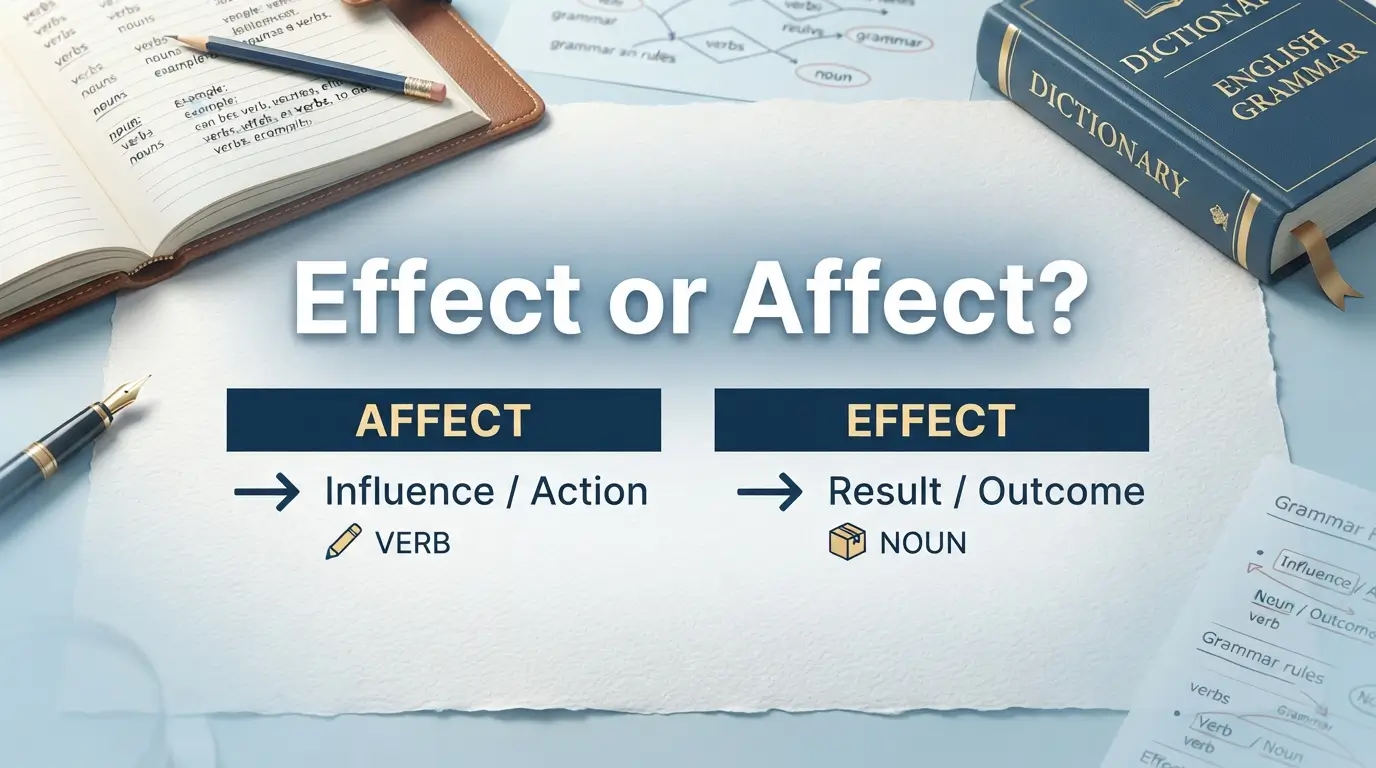
The main rule is simple: affect is usually a verb, while effect is usually a noun. For example, “The weather can affect your mood” uses affect as an action. “The weather had a strong effect on my mood” uses effect as a result.
People search for effect or affect because the words are closely related in meaning and pronunciation. There are also a few less common exceptions that can make the rule seem confusing.
In the next discussion, a quick answer first, then explain the history, common mistakes, everyday examples, usage patterns, and practical ways to remember which word to choose.
Effect or Affect – Quick Answer
The easiest rule is:
- Affect = usually a verb meaning to influence or change something.
- Effect = usually a noun meaning a result or consequence.
Compare these examples:
Affect as a verb:
- The rain affected our travel plans.
- Lack of sleep can affect your concentration.
- The new policy will affect many workers.
Effect as a noun:
- The rain had a major effect on our travel plans.
- Lack of sleep can have a negative effect on concentration.
- The new policy will have a major effect on workers.
A useful memory trick is A = Action for affect and E = End result for effect. This is not a perfect rule because both words have uncommon alternative uses, but it works in most everyday situations.
One sentence that shows both
The loud noise affected my sleep and had a negative effect on my health.
Here, affected describes the action, while effect describes the result.
The Origin of Effect or Affect
Effect and affect are not simply two spellings of the same word. They are separate words with related histories and meanings.
Both words entered English through Latin and French influences. Their histories are connected to ideas of doing, influencing, producing, and bringing about results. Over time, their meanings developed into the forms we commonly use today.
The modern distinction is especially useful in English grammar:
- Affect became strongly associated with influencing or changing something.
- Effect became strongly associated with the result or consequence of an action.
This is why the two words often appear together in discussions about cause and result.
For example:
The heat affected the plants.
The heat caused a change. Therefore, affected is the verb.
The heat had an effect on the plants.
The change caused by the heat is the result. Therefore, effect is the noun.
The distinction is not absolute. Effect can be used as a verb meaning to bring something about or accomplish something, while affect can be a noun in psychology, where it refers to an observable emotional state or expression. These uses are much less common in everyday English.
So, the words have different meanings and grammatical jobs even though they are closely related.
British English vs American English Spelling
One important point often missed in searches for effect or affect is that this is not mainly a British-versus-American spelling difference.
Unlike words such as colour/color or centre/center, effect and affect are spelled the same in standard British and American English.
The difference is about meaning and grammar, not regional spelling.
| Word | British English | American English | Main Use |
| affect | affect | affect | Usually a verb |
| effect | effect | effect | Usually a noun |
| affected | affected | affected | Past form of affect |
| affecting | affecting | affecting | Present participle of affect |
| effected | effected | effected | Past form of effect |
| effects | effects | effects | Plural noun |
Examples in both varieties
British English:
The new rules may affect local businesses.
American English:
The new rules may affect local businesses.
The spelling does not change.
Similarly:
British English:
The changes had a positive effect.
American English:
The changes had a positive effect.
Again, the spelling remains the same.
So if you are writing for a UK audience, US audience, Canadian audience, Australian audience, or another international English audience, you normally do not need to choose a different spelling of affect or effect.
Which Spelling Should You Use?
If you are deciding between effect or affect, do not ask, “Which spelling is British?” or “Which spelling is American?”
Instead, ask:
Am I describing an action or a result?
For US English
Use affect when you need the usual verb:
Stress can affect your performance.
Use effect when you need the usual noun:
Stress can have an effect on your performance.
For UK and Commonwealth English
The same basic rule applies.
The decision will affect employees.
The decision will have an effect on employees.
British and American English both use these words in essentially the same way. Cambridge Dictionary gives the same core distinction: affect means to influence or cause change, while effect refers to the result of that influence.
For global English
If you write for an international audience, use the standard distinction:
Affect > influence/change
Effect > result/consequence
This makes your writing easier for readers from different English-speaking backgrounds to understand.
Effect or Affect – Comparison Table
| Feature | Affect | Effect |
| Most common part of speech | Verb | Noun |
| Basic meaning | Influence or change | Result or consequence |
| Example | The news affected her mood. | The news had an effect on her mood. |
| Memory clue | A = Action | E = End result |
| Common phrase | affect someone | effect on something |
| Common form | affected | effect |
| British spelling | affect | effect |
| American spelling | affect | effect |
| Common mistake | Using effect as the verb | Using affect as the noun |
The biggest difference is therefore grammatical rather than geographical.
Common Mistakes with Effect or Affect
“The weather effected my plans.”
Usually, this is incorrect.
Correct:
The weather affected my plans.
Here, affected means influenced.
“The weather had a negative affect.”
Usually, this is incorrect.
Correct:
The weather had a negative effect.
Here, effect is a noun meaning result.
“This will effect the outcome.”
Usually, use:
This will affect the outcome.
The word follows will, so you need the usual verb affect.
“It had a strong affect on me.”
Use:
It had a strong effect on me.
The phrase “have an effect on” is one of the most useful patterns to remember.
“The medicine had no affect.”
Use:
The medicine had no effect.
Again, effect is the noun.
Confusing “affected” and “effected”
These are different.
The new law affected businesses.
This means the law influenced businesses.
The new law effected major changes.
This means the law brought the changes about.
The second use is more formal and less common. Merriam-Webster notes that effect as a verb can mean “to cause to come into being” or “accomplish.”
Effect or Affect in Everyday Examples
The difference becomes easier when you see the words in real writing.
In emails
Affect:
The schedule change may affect your meeting time.
Effect:
We expect the schedule change to have little effect on your work.
In news writing
Affect:
Higher prices could affect household spending.
Effect:
Analysts are studying the effect of higher prices on consumers.
News writing often discusses causes and results, so both words appear frequently.
In social media
Affect:
Too much screen time can affect your sleep.
Effect:
This small habit can have a big effect on your day.
In academic writing
Affect:
Economic conditions may affect student performance.
Effect:
The study examined the effect of economic conditions on student performance.
In formal writing
Affect:
The proposed changes could affect current employees.
Effect:
The proposed changes could have a significant effect on current employees.
In casual conversation
Does coffee affect your sleep?
Yes, it has a noticeable effect on me.
This simple question-and-answer format shows the difference very clearly.
Effect or Affect – Google Trends & Usage Data
Search interest for effect or affect is driven mainly by grammar confusion rather than regional spelling differences. People commonly search the phrase when they are writing an essay, email, report, application, or professional document and need to choose the correct word.
Google Trends can be useful for comparing search interest in affect, effect, and related searches such as affect vs effect.
However, Google Trends reports relative search interest, not a fixed number of searches. A Trends score of 100 represents the highest relative popularity for the selected comparison and time period, not 100 searches.
What usage patterns suggest
The two words have different everyday roles:
- Effect is widely used as a noun for a result, consequence, or outcome.
- Affect is widely used as a verb for influencing or changing something.
- Effect also appears as a verb in formal contexts such as “effect change.”
- Affect appears as a noun mainly in psychology and related technical contexts.
By country
Because effect and affect are standard English words, both are used across major English-speaking markets, including the United States, United Kingdom, Canada, Australia, and other countries where English is widely used.
The important point for SEO writers is that the country does not normally determine If you choose effect or affect. The sentence structure does.
For example, an American writer and a British writer would both normally write:
The change will affect the result.
And:
The change will have an effect on the result.
Search intent behind “effect or affect”
Someone searching effect or affect is usually looking for one or more of these answers:
- Which word is correct?
- What is the difference between affect and effect?
- Is affect a noun or verb?
- Is effect a noun or verb?
- How can I remember the difference?
- Which word should I use in a sentence?
- Are affect and effect different in British and American English?
That makes effect or affect an informational grammar keyword primarily.
For current search-volume figures, Google Trends or a keyword research platform should be checked for the exact country, date range, and search type because search interest changes over time.
A Simple Trick to Remember Effect or Affect
Try this:
A = Affect = Action
When something acts on or changes something, use affect.
Noise can affect your sleep.
E = Effect = End result
When you mean the end result, use effect.
Noise can have a negative effect on your sleep.
Another helpful pattern is:
Affect the effect.
For example:
Stress can affect your health and have a negative effect on your body.
This is not a rule for every rare use, but it is a strong memory aid for everyday writing. Merriam-Webster also recommends thinking of affect as the usual verb and effect as the usual noun.
When Effect Is a Verb
This is one of the main exceptions to the basic rule.
Effect can be a verb meaning to bring about, cause, or accomplish something.
For example:
The organization hopes to effect positive change.
This means the organization hopes to bring about positive change.
Another example:
The government introduced reforms to effect change.
This use is more formal than the common verb affect.
Compare:
The new law will affect businesses.
The law will influence businesses.
The new law will effect major reforms.
The law will bring the reforms into existence.
These meanings are close but not identical.
When Affect Is a Noun
Affect can also be a noun, but this use is much less common in ordinary writing.
In psychology and related fields, affect refers to an observable emotional expression or emotional state.
For example:
The patient showed a flat affect.
This is a specialized use.
In normal writing, if you mean a result or consequence, you almost certainly want effect:
The experience had a strong effect on her.
This is why the simple verb/noun rule works so well for most general writing.
Effect or Affect: Quick Decision Guide
When you are unsure, use these questions.
Step 1: Is the word describing an action or influence?
→ Use affect.
The heat affected the crops.
Step 2: Is the word naming a result?
→ Use effect.
The heat had an effect on the crops.
Step 3: Is effect being used to mean “bring about” or “accomplish”?
→ Effect may be correct.
The new policy could effect major change.
Step 4: Is affect being used as a technical psychology term?
→ Affect may be correct.
The doctor observed the patient’s affect.
For most everyday sentences, the first two steps are enough.
FAQs:
Is it affect or effect?
Usually, affect is the verb and effect is the noun.
The news affected me.
The news had an effect on me.
What is the easiest way to remember affect and effect?
Remember A = Action and E = End result. If you mean influence or change, choose affect. If you mean the result, choose effect.
Is affect a verb or a noun?
Affect is usually a verb, meaning to influence or change something. It can also be a noun in psychology and related technical contexts.
Is effect a verb or a noun?
Effect is usually a noun, meaning a result or consequence. It can also be a verb meaning to bring about or accomplish something.
Is affect or effect different in British English?
No major spelling difference exists. British and American English generally spell both words affect and effect.
Which is correct: “affect on” or “effect on”?
Usually, use effect on when you mean a result:
The change had an effect on sales.
With affect, you normally do not need “on”:
The change affected sales.
Is “effected change” correct?
Yes. Effected change is grammatically correct when effect means brought about or accomplished change.
The new manager effected several important changes.
However, this is a more formal use than the everyday verb affected.
Conclusion:
The difference between effect and affect is easier once you focus on grammar instead of spelling. In most everyday English, affect is a verb that means to influence or change something, while effect is a noun that means the result or consequence of something.
For example:
The weather affected our plans.
The weather had a major effect on our plans.
This rule works in American English, British English, and most international English writing. The words do not change spelling based on country. Instead, your choice depends on what the sentence means.
There are a few exceptions. Effect can be a verb meaning to bring about or accomplish something, while affect can be a noun in psychology. These uses are less common, so they should not make the basic rule feel harder than it is.
When in doubt, remember A = Action and E = End result.
Check: If you need a verb or noun, read the whole sentence and choose the word that matches its role. With a little practice, effect or affect becomes a much easier choice.
Read More Posts:
- How to Use “Whether or Not” in Formal and Casual English
- Cancelled or Canceled: American vs British English Explained
- O7 Meaning in Text: What Does This Symbol Mean?

Toni Morrison is a celebrated American novelist known for her powerful storytelling, rich characters, and lasting impact on literature. At GrammerNests.com, she shares insights that help readers appreciate language, writing, and literary expression.