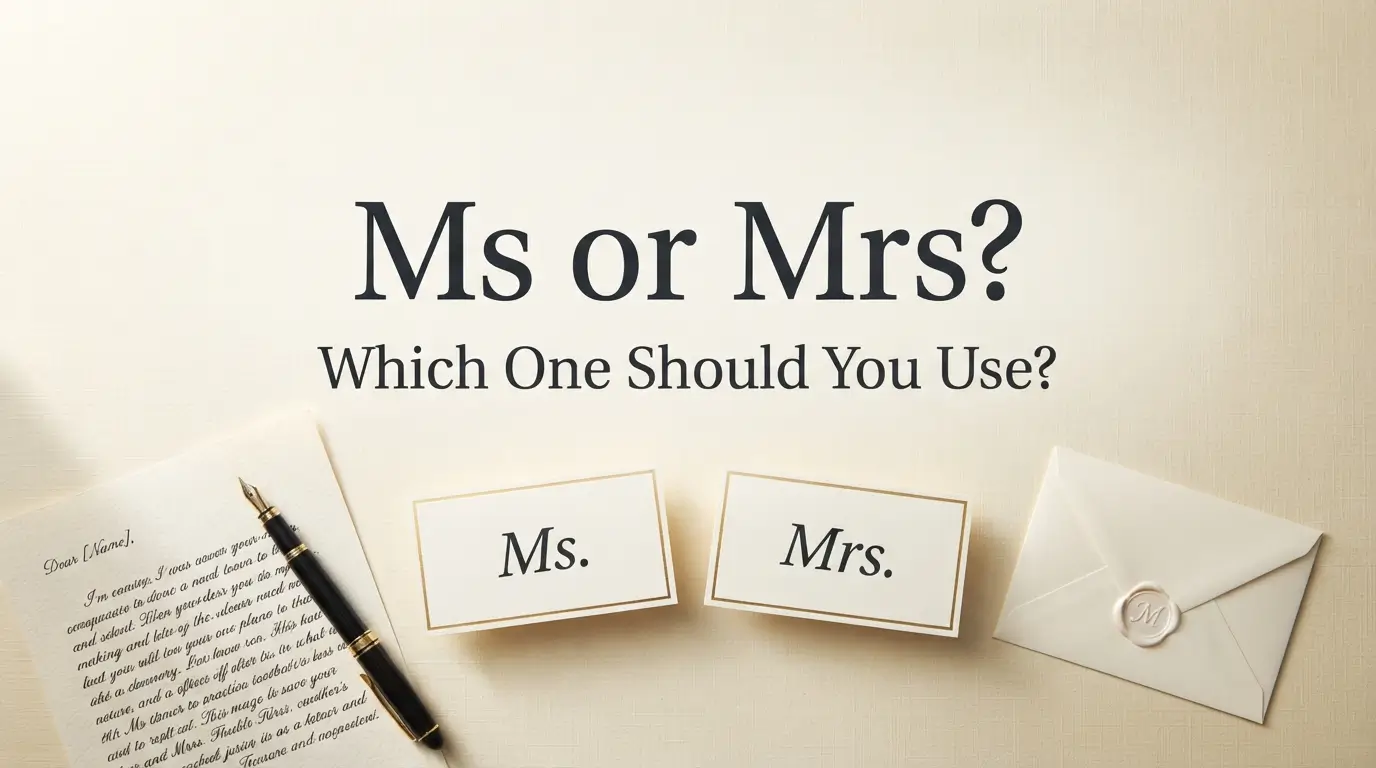
Choosing between Ms or Mrs can feel confusing, especially when you are writing an email, filling out a form, addressing a letter, or speaking to someone in a professional setting. Both are common titles for women, but they do not always mean the same thing.
Mrs traditionally refers to a married woman, while Ms does not reveal or depend on marital status. This simple difference makes Ms a useful choice when you do not know whether a woman is married or when her marital status is not relevant.
People often search for “Ms or Mrs” because they want to know which title is correct, whether Ms or Mrs is more polite, and whether British and American English use these titles differently. Another common question is whether the period matters: should you write Ms. or Ms and Mrs. or Mrs?
Next, this guide deeply explains the meaning, history, spelling, punctuation, and everyday use of Ms or Mrs. You will also learn which form works best in American English, British English, Commonwealth English, business writing, emails, and formal documents.
Ms or Mrs – Quick Answer
The quick answer is:
- Ms = a title for a woman without specifying whether she is married.
- Mrs = traditionally a title for a married woman.
- Ms. = the common American spelling with a period.
- Ms = the common British spelling without a period.
- Mrs. = the common American spelling with a period.
- Mrs = the common British spelling without a period.
For example:
- Ms. Taylor > marital status is unknown or not important.
- Mrs. Taylor > Taylor is traditionally identified as a married woman.
The pronunciation is also different. Ms is usually pronounced “miz,” while Mrs is generally pronounced “miss-iz.”
Ms or Mrs at a glance
| Form | Meaning | Typical use | American English | British English |
| Ms. / Ms | Woman, marital status not specified | Professional/general use | Ms. | Ms |
| Mrs. / Mrs | Traditionally married woman | When the woman uses this title | Mrs. | Mrs |
| Miss | Traditionally unmarried woman or girl | Some formal/social contexts | Miss | Miss |
The most important rule is simple: use the title the woman prefers whenever you know her preference. Canadian government writing guidance also notes that many women prefer Ms as a neutral alternative to Mrs and Miss.
The Evolution of Ms or Mrs
The history of Ms or Mrs is more interesting than it first appears.
Both titles developed from the older word mistress, which was historically the feminine counterpart of master. The word did not originally have the modern meaning associated with an illicit romantic relationship. It could refer to a woman of status, authority, or social position.
Researchers at the University of Cambridge explain that mistress is the root of both Mrs and Miss, just as Mr developed from Master.
How Mrs developed
Mrs began as an abbreviation of mistress in the 17th century. At first, the title did not always mean that a woman was married.
Over time, English usage changed. Miss increasingly became associated with unmarried women, while Mrs became associated with married women. This distinction became much stronger during the 18th and 19th centuries.
Collins Dictionary traces Mrs to the 17th century and identifies it as an abbreviation of mistress.
Interestingly, historical research shows that Mrs was not always a reliable marker of marital status. Cambridge research notes that the modern distinction developed gradually and was not firmly established until around the beginning of the 20th century.
How Ms developed
Ms has an equally interesting history.
Although many people think Ms was invented during the women’s movement of the 20th century, older examples exist. The Oxford University Press explains that forms similar to Ms appeared centuries ago as abbreviations connected with mistress and Miss.
The modern use of Ms became much more popular during the 20th century, especially in the 1960s and 1970s.
The title became attractive because it allowed women to be addressed without revealing marital status. The launch and popularity of Ms. magazine in the early 1970s helped make the title widely recognizable in American English.
Why spelling differences exist
The main difference is not really the letters in Ms or Mrs. The major difference is punctuation.
American English commonly uses periods after abbreviated titles:
- Ms.
- Mrs.
- Mr.
- Dr.
British English often leaves out the period when the abbreviation ends with the same letter as the complete word:
- Ms
- Mrs
- Mr
- Dr
This is why both Ms. and Ms can be correct. The right choice depends on the style of English you are using.
British English vs American English Spelling
The biggest difference between British and American English for Ms or Mrs is punctuation.
American English
American English commonly writes:
- Ms. Johnson
- Mrs. Johnson
- Mr. Johnson
- Dr. Johnson
The period shows that the word is being treated as an abbreviation.
British English
British English commonly writes:
- Ms Johnson
- Mrs Johnson
- Mr Johnson
- Dr Johnson
Modern British usage often does not use a full stop after these titles because the final letter of the abbreviation is also the final letter of the full form.
Canadian English can vary by publication and style guide, so it is best to follow the style used by the organization you are writing for.
Comparison table
| Feature | American English | British English |
| Neutral female title | Ms. | Ms |
| Married female title | Mrs. | Mrs |
| Unmarried female title | Miss | Miss |
| Period after Ms | Usually yes | Usually no |
| Period after Mrs | Usually yes | Usually no |
| Example | Ms. Smith | Ms Smith |
| Formal letter | Dear Ms. Smith | Dear Ms Smith |
| Business writing | Ms. Brown | Ms Brown |
Sources such as the Language Portal of Canada recognize Ms as a widely used title that does not specify marital status, while common British usage generally omits the period after titles such as Ms and Mrs.
Is Ms or Ms. more correct?
Neither is automatically more correct.
If you are writing for a US audience, use Ms.
You are writing for a British audience, use Ms.
The same principle applies to Mrs. and Mrs.
Consistency is more important than choosing one form as universally correct.
Which Spelling Should You Use?
Your audience should guide your choice.
For American English
Use Ms. and Mrs.
Examples:
Dear Ms. Anderson,
Dear Mrs. Wilson,
This style is common in American business letters, school communication, official documents, and professional correspondence.
For British English
Use Ms and Mrs.
Examples:
Dear Ms Anderson,
Dear Mrs Wilson,
This style is common in the UK and in many publications that follow British English conventions.
For Commonwealth English
Countries such as Canada, Australia, and New Zealand may follow conventions that differ slightly by organization and publication.
If you are writing for a specific institution, check its style guide. If the organization has no clear preference, follow the dominant English convention used by that organization.
For global audiences
If you work with an international audience, Ms is often the safest choice when you do not know the woman’s preference or marital status.
For example:
Dear Ms Khan,
This avoids assuming marriage.
In professional communication, the goal should be accuracy and respect rather than guessing someone’s marital status.
When should you use Mrs?
Use Mrs when:
- The woman uses Mrs as her preferred title.
- You know she uses the title in professional or personal communication.
- A form specifically asks for the traditional title.
- The context requires a title, and she has clearly identified herself as Mrs.
Do not assume that every married woman wants to be called Mrs. Modern usage gives women more choice in how they are addressed.
When should you use Ms?
Use Ms when:
- You do not know the woman’s marital status.
- Her marital status is irrelevant.
- You are writing a professional email.
- You want a neutral title.
- The woman has specifically asked to be addressed as Ms.
For many professional situations, Ms is a practical default.
Common Mistakes with Ms or Mrs
Even simple titles can cause mistakes. Here are some of the most common ones.
Assuming every married woman uses Mrs
Incorrect:
Dear Mrs Khan,
If you do not know whether she uses that title.
Better:
Dear Ms Khan,
Unless you know that she prefers Mrs.
Assuming Ms means unmarried
This is one of the biggest mistakes.
Ms does not mean unmarried.
It is designed to avoid specifying marital status.
A married woman may use Ms, just as an unmarried woman may use Ms.
Mixing British and American punctuation
Avoid inconsistent forms such as:
Ms Smith
Mrs. Jones
Mr Smith.
Dr. Brown
If you are using American English, use periods consistently:
Ms. Smith
Mrs. Jones
Mr. Smith
Dr. Brown
If you are using British English, normally write:
Ms Smith
Mrs Jones
Mr Smith
Dr Brown
Writing “Mrs. Ms.”
Do not combine the titles.
Incorrect:
Mrs. Ms. Khan
Correct:
Ms. Khan
or:
Mrs. Khan
Writing “Ms’s”
The possessive form is normally avoided by rewriting the sentence.
Instead of:
Ms. Khan’s report
you can simply use:
Ms. Khan’s report
Here, Ms. is still part of the person’s title. Do not add another ending to the title itself.
Using a title when a person’s preference is known
If someone signs an email:
Ms. Sarah Khan
then follow that preference.
If she signs:
Mrs. Sarah Khan
then use Mrs.
Personal preference can be more important than a general rule.
Ms or Mrs in Everyday Examples
The difference becomes much easier when you see the titles in real situations.
In emails
Professional and neutral:
Dear Ms. Ahmed,
Thank you for your email. I look forward to speaking with you.
When the person uses Mrs:
Dear Mrs. Ahmed,
Thank you for your message.
If you do not know the recipient’s preferred title, Ms is usually a practical professional choice.
In business letters
American English:
Ms. Emily Carter
Marketing Director
ABC Company
British English:
Ms Emily Carter
Marketing Director
ABC Company
The difference is mainly punctuation.
In news writing
News organizations may follow their own editorial style.
A publication may write:
Ms Taylor spoke to reporters after the meeting.
Another may write:
Ms. Taylor spoke to reporters after the meeting.
Both forms can be grammatically acceptable within their respective style systems.
On social media
Social media is less formal, so titles are often unnecessary.
Instead of:
Ms. Sarah Khan
many people simply use:
Sarah Khan
However, Ms may still appear in professional profiles, public announcements, biographies, or posts where a formal tone is appropriate.
In formal writing
For official correspondence, use the title that matches the person’s preference or the organization’s records.
For example:
Dear Ms Patel,
is appropriate when marital status is unknown or irrelevant.
If the recipient is known to use Mrs:
Dear Mrs Patel,
may be more appropriate.
On forms
Forms may ask you to select:
- Mr
- Mrs
- Miss
- Ms
- Other
If you are completing a form for yourself, select the title you personally use. If you are creating a form, including Ms gives users a neutral option.
Ms or Mrs – Trends & Usage Data
Search interest in Ms or Mrs can change over time, country, and context. Google Trends is useful for comparing relative search interest, but it does not show the total number of searches. Its values are normalized on a scale from 0 to 100.
That means a Google Trends score of 100 represents the highest relative search interest within the selected comparison, location, and time period. It should not be read as “100 searches.”
For Ms or Mrs, search behavior is also affected by the reason someone is searching.
Why people search for Ms
Searches for Ms commonly relate to:
- Whether Ms means married or unmarried.
- Ms versus Mrs.
- If to use Ms in an email.
- Whether Ms needs a period.
- British versus American spelling.
- Professional forms and applications.
The title has become especially important in professional settings because it does not require the writer to identify a woman’s marital status. Canadian government guidance describes Ms as a widely used neutral alternative to Mrs and Miss.
Why people search for Mrs
Searches for Mrs often focus on:
- The meaning of Mrs
- If Mrs means married
- Mrs versus Ms
- How to address a married woman
- Mrs punctuation
- British versus American usage
Dictionary sources continue to define Mrs primarily as a title traditionally used for a married woman.
Country and context matter
The popularity of each term should not be interpreted as a simple worldwide competition.
Ms is widely recognized in North American English and is common in professional communication. It is also understood throughout British and other English-speaking contexts.
Mrs remains widely used, particularly when a woman chooses that title or when the context traditionally calls for it.
For accurate trend research, compare Ms, Mrs, Ms., and Mrs. separately and select the country and time period relevant to your audience. Search results can also be influenced by educational questions, forms, grammar websites, and people checking punctuation rather than people looking for the titles themselves.
The key SEO lesson is that “Ms or Mrs” has strong informational intent. Searchers usually want a fast answer first and detailed examples second.
Ms or Mrs – Comparison Table
| Variation | Meaning | Example | Best use |
| Ms | Neutral female title | Ms Khan | British English |
| Ms. | Neutral female title | Ms. Khan | American English |
| Mrs | Traditionally married woman | Mrs Khan | British English |
| Mrs. | Traditionally married woman | Mrs. Khan | American English |
| Miss | Traditionally unmarried woman/girl | Miss Khan | Specific traditional contexts |
The easiest rule to remember
Think of the titles this way:
Ms = marital status is not specified.
Mrs = traditionally married.
Miss = traditionally unmarried.
Then remember the punctuation rule:
US English → Ms., Mrs.
UK English → Ms, Mrs
That simple pattern solves most Ms or Mrs questions.
FAQs:
Is Ms for married or unmarried women?
Ms is for both. It does not indicate whether a woman is married or unmarried. It is often used when marital status is unknown, irrelevant, or intentionally not stated.
Does Mrs mean married?
Traditionally, yes. Mrs is a title used for a married woman. However, the woman herself may choose whether she wants to use Mrs, Ms, or another title.
Is Ms or Mrs more professional?
Neither is automatically more professional. Ms is often convenient in professional communication because it does not require you to know someone’s marital status. If you know the person’s preferred title, use that instead.
Should I write Ms or Ms.?
Use Ms. in standard American English and Ms in standard British English. Both can be correct depending on the style you follow.
Should I write Mrs or Mrs.?
Use Mrs. in American English and Mrs in British English. The difference is punctuation rather than meaning.
Can a married woman use Ms?
Yes. A married woman can choose Ms. The title does not tell the reader whether she is married.
What should I use if I do not know a woman’s marital status?
In most professional situations, Ms is a safe and respectful choice. For example:
Dear Ms Wilson,
If the person has a stated preference, always follow it.
Conclusion:
Understanding Ms or Mrs is easier once you separate meaning from punctuation. Mrs traditionally identifies a married woman, while Ms is a neutral title that does not reveal marital status. This makes Ms especially useful in modern professional communication, formal emails, applications, and business writing.
The spelling difference between Ms. and Ms or Mrs. and Mrs mainly comes from English punctuation styles. American English generally uses a period after these titles, while British English usually does not. Therefore, Ms. Smith is standard in American English, while Ms Smith is standard in British English.
The best rule is to respect personal preference whenever possible. If you know someone prefers Mrs, use Mrs. If she uses Ms, use Ms. When you do not know her preference, Ms is often the safest professional option.
For everyday writing, remember one simple formula: Ms is neutral; Mrs traditionally means married; punctuation depends on your English style.
Read More Posts:
- Its vs It’s Explained With Clear Examples (2026Guide)
- Effect or Affect: Understand Difference as a Verb and Noun
- English or Spanish: Language Comparison (2026Guide)

Emily Dickinson is one of America’s most influential poets, recognized for her unique style and thought-provoking poetry. Through GrammerNests.com, she contributes valuable perspectives on language, creativity, and the beauty of written expression.