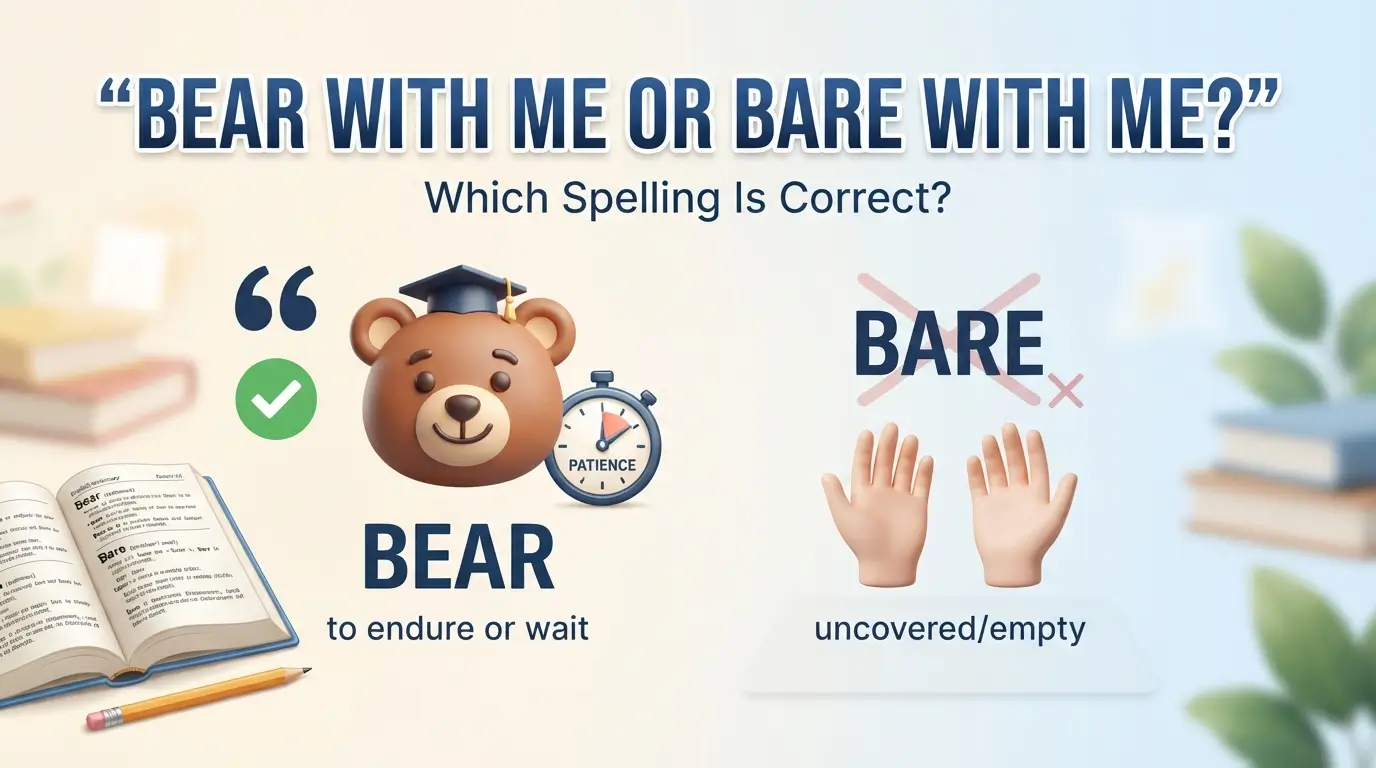
When you need to ask someone for patience, one small spelling choice can change the meaning of your sentence. Should you write “bear with me” or “bare with me”? The correct phrase is “bear with me.”
It means “please be patient with me” or “please tolerate this situation for a moment.” The confusion happens because bear and bare sound exactly alike, but they have very different meanings.
This question is common in emails, workplace messages, social media posts, school writing, and everyday conversation.
A person may know exactly what they want to say but still hesitate when typing the phrase. The mistake is easy to make because both words are real English words.
In this guide, you will learn the difference between bear with me or bare with me, where the phrase comes from, how it is used in American and British English, and which version you should use in professional writing.
You will also see simple examples, common mistakes, usage advice, and answers to frequently asked questions.
Bear With Me or Bare With Me – Quick Answer
“Bear with me” is the correct phrase when you want someone to be patient with you.
- Bear with me = Please be patient with me.
- Bare with me = Not the standard phrase. It is usually a spelling mistake.
The verb bear can mean to endure, tolerate, or deal with something difficult. So, when you say “Please bear with me,” you are asking someone to tolerate a delay, listen for a moment, or give you time.
Examples:
Please bear with me while I check the information.
Bear with me; I need a few minutes to finish this report.
Please bear with us while we fix the website.
The word bare has a different meaning. It can mean uncovered, exposed, empty, or without something.
Example:
The room had bare walls.
So, if you are asking someone to wait or be patient, always choose bear with me. Merriam-Webster defines bear with as being patient or forbearing with someone and records its first known use in this sense as 1538.
The Origin of Bear With Me or Bare With Me
The phrase “bear with me” comes from the verb bear, which has long been used to mean “endure,” “tolerate,” or “put up with.”
In this expression, bear has nothing to do with the animal. Instead, it describes the idea of enduring something that may require patience.
For example:
- Bear the pain = endure the pain.
- Bear the responsibility = carry or accept the responsibility.
- Bear with me = be patient with me.
The expression is centuries old. Merriam-Webster gives 1538 as the first known use of bear with in the sense of being patient or tolerant.
The confusion with bare comes from pronunciation. Bear and bare are homophones in standard English: they sound alike but have different spellings and meanings.
Bare, on the other hand, comes from a word meaning uncovered or exposed. You can have bare feet, a bare wall, or a bare room.
This creates an easy spelling trap. When people hear “bear with me,” they may connect the sound with the familiar word bare and type the wrong spelling.
Historical language sources also connect the expression to older forms of English, while Shakespeare used bear with in several plays, showing that the expression was already well established in English.
Why Do People Write “Bare With Me”?
The main reason is simple: the two words sound the same.
Compare:
- Bear > endure or tolerate
- bare > uncover or expose
Because pronunciation does not help you distinguish them, you need to remember the meaning.
A useful memory trick is:
Bear with me = Endure with me.
If you are asking someone to wait, listen, or be patient, use bear.
British English vs American English Spelling
There is no British vs American spelling difference in this phrase.
Both British English and American English use:
Bear with me
Not:
Bare with me
This is important because many English spelling differences do exist between the United States and the United Kingdom. For example:
| American English | British English |
| color | colour |
| center | centre |
| organize | organise |
| traveled | travelled |
| gray | grey |
| bear with me | bear with me |
As the table shows, bear with me remains the same in both varieties of English.
The phrase is also used in other English-speaking regions, including Canada, Australia, and New Zealand.
Bear With Me vs. Bare With Me
| Phrase | Meaning | Correct for asking for patience? | Example |
| Bear with me | Be patient with me | Yes | Please bear with me while I check. |
| Bare with me | Literally suggests exposing or uncovering | No | Usually a spelling mistake |
| Bear with us | Be patient with us | Yes | Please bear with us during the delay. |
| Bear with him/her | Be patient with that person | Yes | Please bear with him while he explains. |
| Bare | Uncovered or exposed | No | The walls were bare. |
Which Spelling Should You Use?
If you are asking someone for patience, use bear with me regardless of If your audience is American, British, Canadian, Australian, or international.
For American English
Use:
Please bear with me while I review the document.
This sounds natural in emails, customer service messages, presentations, and conversation.
For British English
Use the same spelling:
Please bear with me while I find the correct information.
British English does not change bear to bare.
For Commonwealth English
Countries such as Canada, Australia, and New Zealand also use bear with me when asking for patience.
For Global or Professional Writing
Bear with me is the safest choice.
It is widely understood and works in:
- Business emails
- Customer service
- Academic writing
- Presentations
- News writing
- Online communication
- Workplace chats
If you want an even more direct alternative, you can write:
- Please be patient.
- Please give me a moment.
- Please wait while I check.
- Thank you for your patience.
However, “bear with me” often sounds warmer and less abrupt.
Common Mistakes with Bear With Me or Bare With Me
Writing “bare with me”
Incorrect:
Please bare with me while I finish this.
Correct:
Please bear with me while I finish this.
This is the most common mistake.
Thinking “bear” refers to the animal.
In this phrase, bear does not refer to a large animal.
It is the verb bear, meaning to tolerate or endure.
Using “bare” because it sounds right
Pronunciation cannot help here because bear and bare sound alike.
Always check the meaning before choosing the spelling.
Writing “bare in mind”
A similar mistake happens with another expression.
Incorrect:
Bare in mind that the deadline is Friday.
Correct:
Bear in mind that the deadline is Friday.
Here again, bear carries the idea of holding or keeping something in mind.
Using “bear with me” when you mean “reveal”
If your meaning is to expose or uncover something, bare may be the correct word.
For example:
The investigation may bare the truth.
However, the more natural expression is often lay bare the truth.
The key is context: bear means endure or carry, while bare means uncover or expose.
Bear With Me or Bare With Me in Everyday Examples
The phrase bear with me is common in many types of communication.
In Emails
Please bear with me while I gather the remaining documents.
This is polite and professional.
Another example:
Bear with me while I confirm the meeting time.
In Workplace Messages
Please bear with me. I am checking the latest figures now.
This works well in Slack, Teams, and other workplace chats.
In Customer Service
Please bear with us while we resolve this issue.
Here, bear with us asks customers to remain patient.
Presentations
Bear with me while I explain this final point.
A speaker can use this when an explanation may take some time.
In News Writing
A journalist or writer may use the phrase when asking readers to follow a longer explanation:
Bear with us as we examine what happened.
On Social Media
The phrase is also common in casual posts:
Bear with me while I figure this out!
Or:
Bear with me I am still learning how this works.
In Formal Writing
Although bear with me is correct, some formal documents may benefit from a more direct phrase:
Please allow additional time while we review the application.
This sounds more formal than:
Please bear with me while I review the application.
Bear With Me or Bare With Me – Google Trends & Usage Data
Searches for “bear with me or bare with me” usually come from people who know the phrase but are unsure which spelling is correct. This makes the keyword a strong grammar and spelling search query.
The important distinction is between the phrase people intend to use and the spelling they sometimes type.
Bear with me is the established expression for asking someone to be patient. Bare with me is generally treated as a misspelling in this context.
Google Trends can be useful for comparing search interest in terms such as:
- bear with me
- bare with me
- bear with me meaning
- bear with me or bare with me
- please bear with me
Interest can vary by country and over time. Search volume may also rise when people encounter the phrase in emails, customer service messages, social media, workplace communication, or English-learning content.
What Usage Data Tells Us
The most useful conclusion is not simply which spelling receives searches. A misspelling can receive searches precisely because people are unsure about it.
For language questions, search volume does not automatically mean a spelling is correct.
For example, people may search “bare with me” because they want to know If it is correct. That does not make it the standard spelling.
For professional and educational writing, the recommended form remains:
Bear with me.
Bear With Me or Bare With Me: Comparison Table
| Variation | Correct? | Meaning | Best Use |
| Bear with me | ✅ Yes | Be patient with me | Everyday and professional writing |
| Bare with me | ❌ Usually incorrect | Expose/uncover with me | Not used for asking for patience |
| Please bear with me | ✅ Yes | Please be patient | Polite communication |
| Bear with us | ✅ Yes | Be patient with us | Business/customer service |
| Bear with him | ✅ Yes | Be patient with him | Talking about another person |
| Bear with her | ✅ Yes | Be patient with her | Talking about another person |
| Bear with them | ✅ Yes | Be patient with them | Talking about other people |
FAQs:
Is it “bear with me” or “bare with me”?
The correct phrase is “bear with me.” It means “please be patient with me.”
What does “bear with me” mean?
Bear with me means be patient with me, especially when something takes time or requires an explanation.
Is “bare with me” ever correct?
It can be grammatically possible if bare is being used literally to mean uncover or expose, but it is not the standard phrase for asking someone to be patient.
Why is “bear with me” correct?
The verb bear can mean to endure or tolerate. Therefore, bear with me means to tolerate or be patient with me. Merriam-Webster lists bear with in this sense as meaning to be patient or forbearing with someone.
Is “bear with me” British or American?
It is used in both British and American English. The spelling does not change between the two varieties.
Can I use “bear with me” in a professional email?
Yes. It is polite and common in professional communication.
For example:
Please bear with me while I review your request.
What is an easier alternative to “bear with me”?
You can use:
- Please be patient.
- Please give me a moment.
- Please wait while I check.
- Thank you for your patience.
Conclusion:
When choosing between bear with me or bare with me, the answer is clear: bear with me is the correct phrase when you are asking someone to be patient. The word bear works here because it can mean to endure, tolerate, or deal with something.
Bare, by contrast, means uncovered or exposed, so it does not normally belong in this expression.
There is also no British-American spelling difference to remember. Both varieties of English use bear with me.
The phrase is suitable for everyday conversation, emails, workplace messages, customer service, presentations, and many other situations.
The easiest way to remember it is to connect bear with endure. If you are asking someone to endure a delay or listen patiently, write “Please bear with me.”
If you write “bare with me,” readers will usually understand your intended meaning, but they may recognize it as a spelling mistake.
For clear, correct, and professional English, choose bear with me every time you mean “please be patient with me.”
Read More Posts:
- How to Use “Whether or Not” in Formal and Casual English
- Effect or Affect: Understand Difference as a Verb and Noun
- Its vs It’s Explained With Clear Examples (2026Guide)

Toni Morrison is a celebrated American novelist known for her powerful storytelling, rich characters, and lasting impact on literature. At GrammerNests.com, she shares insights that help readers appreciate language, writing, and literary expression.