To or too: Which one is correct? If you have ever paused while writing a sentence because you were unsure If to use to or too, you are not alone. These two words sound alike, but they have different meanings and grammatical jobs.
The confusion is common because to and too are homophones. They have the same pronunciation in many forms of English, but their spellings and meanings are different. Using the wrong word can change the meaning of a sentence or make your writing look careless.
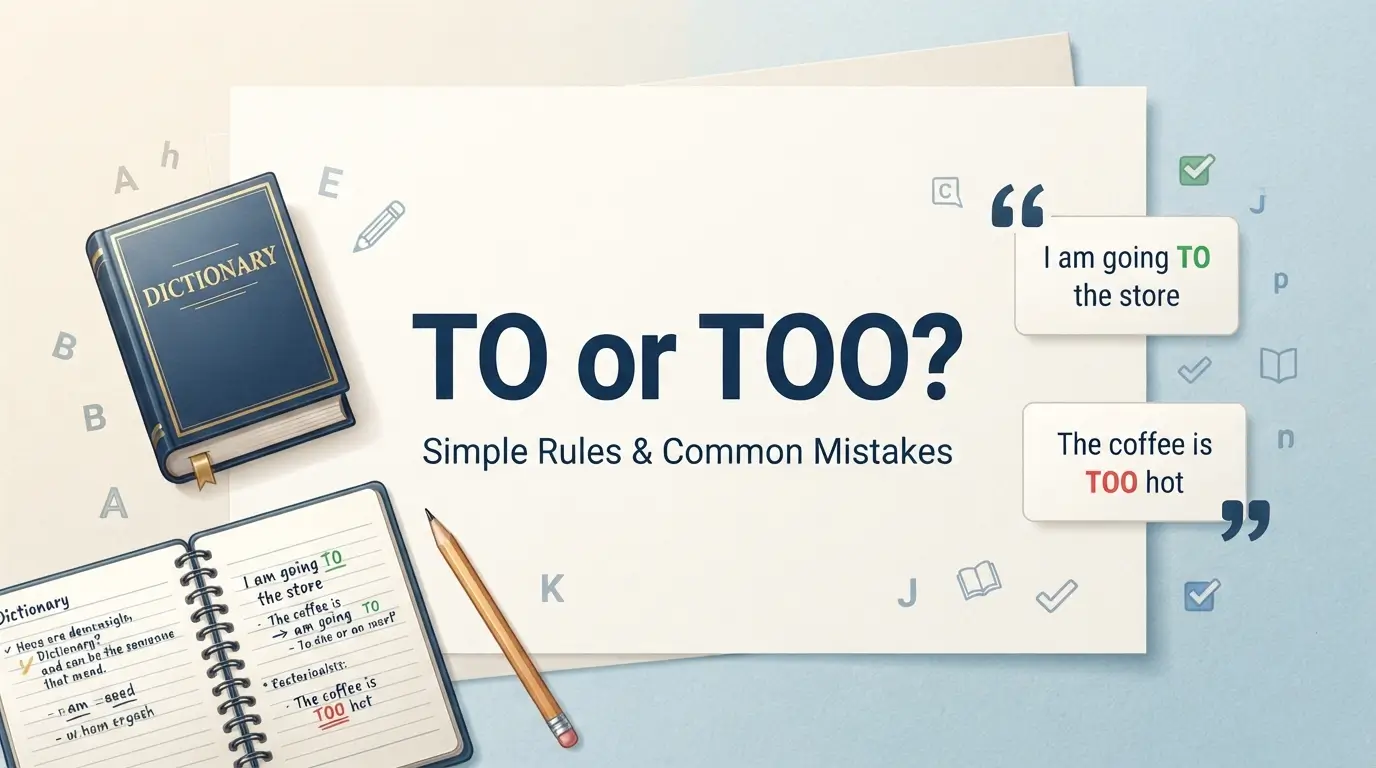
For example, “I want to go” is correct, while “I want too go” is wrong. But in “I want to go too,” the second word is correct because it means “also.”
Next, details give you a quick answer first, then explain the history, rules, common mistakes, and everyday uses of to or too. You will also learn if British and American English use different spellings and how to choose the right word in professional writing.
To or Too – Quick Answer
The easiest rule is:
- To usually shows direction, connection, or comes before a verb.
- Too usually means also or more than necessary.
Examples of “to”
Use to when talking about direction:
I am going to school.
Use to before a verb:
I want to learn English.
Use to to connect ideas:
She gave the book to me.
Examples of “too”
Use too when you mean also:
I want to come too.
Use too when something is excessive:
The coffee is too hot.
A simple memory trick is:
To = direction or action
Too = also or more than needed
To vs. Too at a Glance
| Word | Main meaning | Example |
| to | Direction | We went to London. |
| to | Before a verb | I want to sleep. |
| too | Also | I like it too. |
| too | Excessively | It is too expensive. |
There is also a third word that sounds similar: two. It means the number 2.
I have two books.
I want to read them too.
The Origin of To or Too
The words to and too have a long history in English. Their modern forms developed from older English words that had related sounds but different grammatical functions.
To comes from Old English tō, a word used to express direction, movement, or a relationship between things. Over time, its use expanded. Today, it can work as a preposition and as part of the infinitive form of a verb.
For example:
She walked to the store.
and:
She wants to walk.
Too developed from Old English tō, but its meaning changed over time. It became associated with meanings such as also, in addition, and excessively.
The extra o helped distinguish too from to in written English.
This is important because English spelling often preserves differences that are not obvious in pronunciation. Words can sound the same while having different meanings and grammatical roles.
That is exactly what happens with:
- to
- too
- two
They may sound alike in normal speech, but they are not interchangeable.
British English vs American English Spelling
There is no British-versus-American spelling difference between “to” and “too.”
Both British English and American English use the same spellings:
- to
- too
- two
The rules are also essentially the same.
For example, both varieties use:
I am going to work.
and:
I want some coffee too.
The major spelling differences between British and American English usually involve words such as colour/color, centre/center, and organise/organize. The words to and too do not follow this pattern.
British vs. American English Comparison
| Feature | British English | American English |
| Direction | to | to |
| Infinitive | to | to |
| Also | too | too |
| Excessively | too | too |
| Number 2 | two | two |
| Main spelling difference | None | None |
So, if your audience is in London, New York, Toronto, Sydney, or another English-speaking region, the correct spelling remains the same.
Which Spelling Should You Use?
Your choice depends on the meaning of the sentence, not the country where you live.
Use “to” for direction
We are going to the office.
She moved to Canada.
Use “to” before a verb.
I need to study.
He wants to help.
“too” for “also”
She wants to come too.
I watched the movie too.
Use “too” for “more than necessary”
The bag is too heavy.
This room is too cold.
For US English
Use the standard forms of to and too. There is no special American spelling.
UK and Commonwealth English
Use the same forms. British, Australian, Canadian, and other major English varieties generally use to and too in the same way.
Global writing
If you write for an international audience, focus on meaning rather than regional spelling. The safest approach is simple:
Direction/action > to
Also/excessive > too
Common Mistakes with To or Too
Because these words sound alike, mistakes often happen when people write quickly.
Mistake 1st: “I want too go.”
Wrong:
I want too go home.
Correct:
I want to go home.
Why? To comes before the verb go.
Mistake 2nd: “I like it to.”
Wrong:
I like this movie to.
Correct:
I like this movie too.
Here, too means also.
Mistake 3rd: “It is to expensive.”
Wrong:
The phone is to expensive.
Correct:
The phone is too expensive.
Here, too means more than is reasonable or wanted.
Mistake 4th: Confusing “too” with “two”
Wrong:
I have too brothers.
Correct:
I have two brothers.
Two is the number 2.
Mistake 5th: “Me too” vs. “Me to”
The correct expression is:
Me too!
It means “I feel the same” or “I do that also.”
For example:
“I love coffee.”
“Me too!”
Mistake 6th: “Too much” and “too many”
Use too much with uncountable nouns:
There is too much water.
Use too many with countable nouns:
There are too many people.
Mistake 7th: “Too” does not always go at the end
It often appears at the end:
I want to go too.
But it can also appear before an adjective or adverb:
The test is too difficult.
He runs too quickly.
To or Too in Everyday Examples
Understanding real-life examples makes the difference easier to remember.
In Emails
Professional emails often use to for actions and too for additional information.
I am writing to confirm the meeting.
I would like to ask a question.
Please send the document to me.
I would be happy to help too.
A common professional mistake is writing:
I look forward to hearing from you.
The correct version is:
I look forward to hearing from you.
In News Writing
News articles use to and too according to their normal grammatical roles.
The company plans to open a new office.
The price is too high for many buyers.
The minister is expected to speak today.
Several other countries may join too.
On Social Media
Social media posts are often informal, so spelling mistakes are common.
Correct:
I want to travel this summer too!
Incorrect:
I want too travel this summer to!
The first to introduces the verb travel. The second too means also.
In Formal Writing
Formal writing needs extra care because small errors can affect credibility.
Correct:
The study aims to examine the effects of social media.
Correct:
The results are too limited to support a conclusion.
Correct:
The findings may be useful to researchers too.
Comparison Table: To, Too, and Two
| Word | Meaning | Example |
| to | Direction | Go to school. |
| to | Before a verb | I want to learn. |
| too | Also | I want one too. |
| too | Excessively | It is too late. |
| two | Number 2 | I have two pens. |
To or Too – Google Trends & Usage Data
The search phrase “to or too” is mainly connected with grammar and spelling questions. People commonly search for it when they want a fast answer about which word belongs in a sentence.
Google Trends is useful for studying search interest by location and time. However, it is important to understand that Google Trends reports relative search interest, not the exact number of searches. Google explains that regional popularity is based on the proportion of searches in a place and time, rather than raw search volume.
Google Trends can compare search terms across countries and regions and allows users to examine interest over different periods.
Where Is “To or Too” Relevant?
The topic is especially useful in countries where English is widely taught or used, including:
- United States
- United Kingdom
- Canada
- Australia
- India
- Pakistan
- Philippines
- South Africa
- New Zealand
The exact level of search interest can change over time and by location. Grammar searches may also rise when students, writers, job seekers, and English learners need quick answers.
Search Context Matters
People searching “to or too” may be looking for:
- Grammar rules
- Spelling help
- English homework
- Writing correction
- Email writing
- English-language learning
- Difference between to, too, and two
- Sentence examples
Google also notes that Trends comparisons are not the same as raw search-volume measurements, so Trends should be used to understand patterns rather than to claim exact monthly search numbers.
To or Too: Quick Comparison
| Point | To | Too |
| Pronunciation | Usually the same | Usually the same |
| Meaning | Direction, connection, infinitive | Also, excessively |
| Before a verb | Yes | No |
| Shows direction | Yes | No |
| Means “also” | No | Yes |
| Means “excessively” | No | Yes |
| British spelling | to | too |
| American spelling | to | too |
| Example | I want to leave. | I want to leave too. |
FAQs:
What is the difference between “to” and “too”?
To usually shows direction or comes before a verb. Too means also or more than necessary.
I want to eat.
I want to eat too.
Is “to” or “too” correct?
Both are correct, but they have different uses. Choose the word based on the meaning of your sentence.
Is it “I love you too” or “I love you to”?
The correct sentence is:
I love you too.
Here, too means also.
Is “too much” correct?
Yes. Too much means more than is needed or wanted.
There is too much sugar in the tea.
Is “too many” correct?
Yes. Use too many with countable nouns.
There are too many questions.
Is “to” different in British and American English?
No. Both British and American English use to and too with the same meanings and spellings.
What is the difference between to, too, and two?
To shows direction or comes before a verb. Too means also or excessively. Two is the number 2.
I have two books to read too.
Conclusion:
Understanding to or too does not have to be difficult. The key is to focus on meaning. Use to when you show direction, connect something to another thing, or place it before a verb. Use too when you mean also or more than necessary. And remember that two is the number 2.
For example, “I want to go too” uses both words correctly. The first to introduces the verb go, while too means also.
There is also no British-versus-American spelling difference for these words. Writers in the US, UK, Canada, Australia, and other English-speaking regions use the same spellings.
If you are unsure, ask yourself one simple question: Does the word mean “also” or “excessively”? ‘es, use too. If it shows direction or comes before a verb, use to. With this simple rule and regular practice, you can avoid one of the most common English grammar mistakes.
Read More Posts:
- Toward or Towards in American and British English (2026Guide)
- English or Spanish: Language Comparison (2026Guide)
- Bear With Me or Bare With Me: Easy Way to Remember Guide

Emily Dickinson is one of America’s most influential poets, recognized for her unique style and thought-provoking poetry. Through GrammerNests.com, she contributes valuable perspectives on language, creativity, and the beauty of written expression.