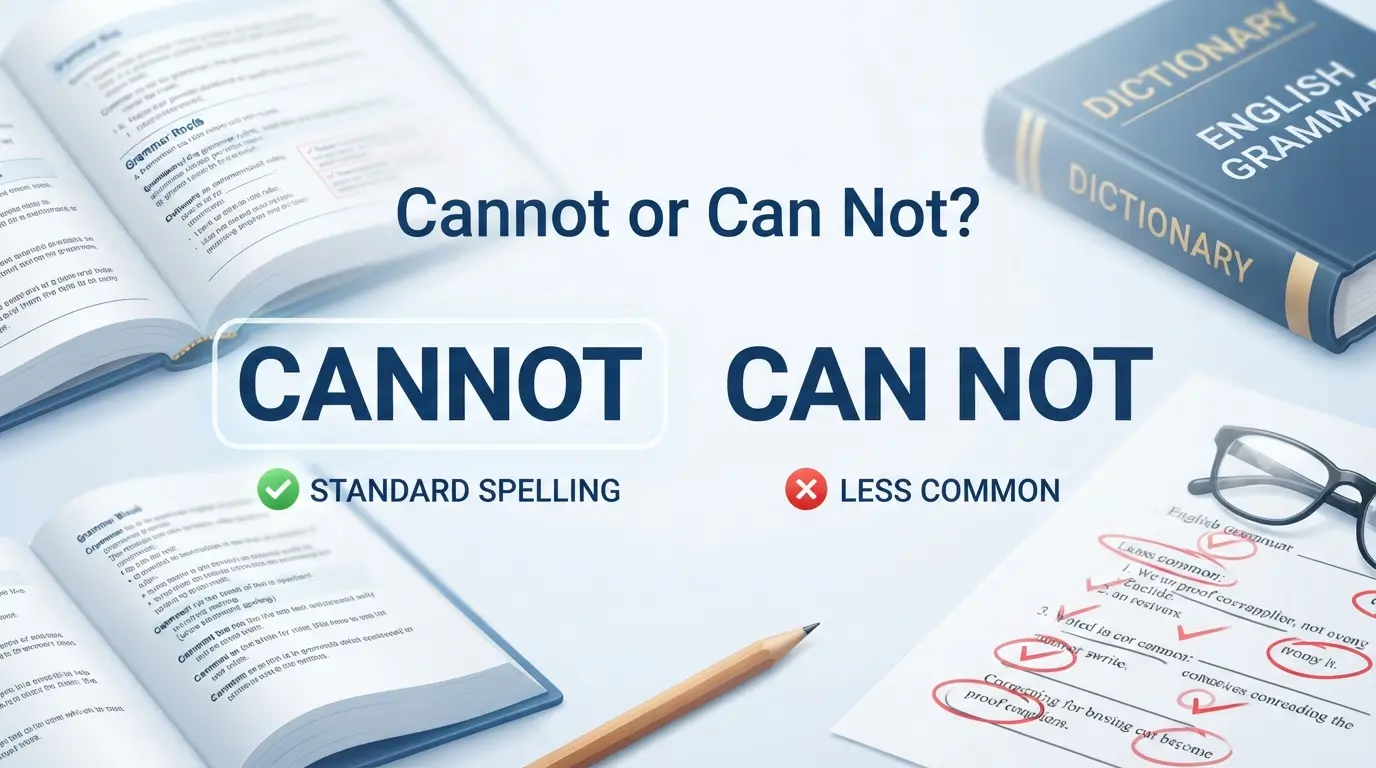
If you are unsure If to write “cannot” or “can not,” you are not alone. These two forms look almost identical, but they are not used in the same way. For most sentences, cannot is the correct and preferred spelling.
The word cannot is the standard negative form of can. It means that someone is unable to do something, something is impossible, or someone is not allowed to do something. For example, “I cannot attend the meeting” means “I am unable to attend the meeting.”
So why do people search for cannot or can not? The confusion often comes from the fact that many negative English forms use two words, such as “do not,” “will not,” and “should not.” This makes “can not” look natural.
Although, cannot is normally written as one word.
There is one important exception. Can not can be correct when not belongs to another part of the sentence, especially in expressions such as “not only but also.” This guide explains the difference with simple rules, examples, and professional usage advice.
Cannot or Can Not – Quick Answer
Cannot is the standard spelling in most situations.
Use cannot when you mean “am/is/are unable to,” “am/is/are not able to,” or “am/is/are not permitted to.”
Examples:
- I cannot swim.
- She cannot attend the meeting.
- We cannot solve the problem.
- You cannot park here.
- They cannot accept the offer.
Merriam-Webster says cannot is far more common than can not, especially in formal writing.
Can not is also possible, but it has specific uses. It is common when not belongs to another construction:
- She can not only sing but also dance.
- You can not only save money but also reduce waste.
Here, not ” does not belong to the phrase “not only but also,” so separating can and not is correct.
A simple rule is:
Use “cannot” for normal negation. Use “can not” when “not” has a separate grammatical role.
Quick comparison
| Form | Correct? | Main use | Example |
| cannot | Yes | Normal negative form | I cannot come. |
| can not | Yes, in special cases | Separate “can” + “not” | She can not only sing but dance. |
| can’t | Yes | Informal contraction | I can’t come. |
| cant | Usually no | Different word | The cant of the group was unusual. |
Cambridge defines cannot as the negative form of can, while Oxford also lists it as the normal negative form and notes that can’t is used informally.
The Evolution of Cannot.
The history of cannot is older than modern English spelling rules. Dictionaries trace the form back to Middle English. Collins gives its origin as 1350–1400, while Merriam-Webster records its first known use in the 15th century.
The word developed from the combination of can + not. Over time, the two parts became closely connected and were commonly written together as cannot.
This makes cannot unusual compared with many other negative forms. English normally keeps “not” separate:
- do not
- will not
- should not
- could not
- would not
But can + not developed a standard closed form:
- can > cannot
English also created the contraction can’t. Merriam-Webster records the first known use of can’t in the late 16th century.
The spelling difference exists because English allows both a standard closed form and, in certain grammatical situations, the separate words can not.
Importantly, cannot is not simply an American spelling or a British spelling. It is widely used across wide varieties of English.
British English vs American English Spelling
There is no major British-versus-American spelling difference between cannot and can not.
Both British and American English commonly use cannot as the normal negative form of can.
For example:
British English:
I cannot come tomorrow.
American English:
I cannot come tomorrow.
The basic rule is the same.
There can be differences in how often writers choose contractions, especially depending on the type of writing. In casual communication, can’t is very common. In formal writing, cannot is often preferred.
Some linguistic research has found differences in the frequency of cannot, can not, and can’t between British and American texts, but this does not change the basic modern spelling rule.
British vs American comparison
| Feature | British English | American English |
| Standard form | cannot | cannot |
| Informal form | can’t | can’t |
| Special construction | can not | can not |
| Formal writing | Prefer cannot | Prefer cannot |
| “Not only” construction | can not only | can not only |
The Government of Canada also recommends cannot in most cases and recognizes can not for emphasis or special grammatical structures.
So, if you are writing for a British, American, Canadian, Australian, or international audience, cannot is the safest standard choice.
Which Spelling Should You Use?
For most writers, the answer is simple: use cannot.
If you write for a US audience
Use cannot in formal writing:
The company cannot guarantee delivery by Friday.
In casual writing, can’t is also natural:
I can’t make it today.
If you write for a UK or Commonwealth audience
The same basic rule applies:
We cannot accept your application.
The contraction can’t is normal in informal communication.
If you write for a global audience
Cannot is the best choice because it is clear, standard, and widely understood.
This is especially useful for:
- websites
- academic articles
- business emails
- reports
- educational content
- professional documents
- international communication
If you are unsure, choose cannot.
Cannot vs can’t
The difference between cannot and can’t is mainly about style and formality, not meaning.
Formal:
I cannot attend the conference.
Informal:
I can’t attend the conference.
Both communicate the same basic idea. Merriam-Webster notes that can’t has the same meaning as cannot, but contractions are somewhat informal.
Common Mistakes with Cannot or Can Not.
The biggest mistake is using can not when you simply mean the negative form of can.
Mistake 1: Using “can not” for normal negation
❌ I can not understand this question.
✅ I cannot understand this question.
Mistake 2: Using “can not” in formal writing without a reason
❌ The company can not accept late applications.
✅ The company cannot accept late applications.
Mistake 3: Thinking “can’t” must always become “can not”
This is a common misunderstanding.
❌ I can’t go. > I can not go.
✅ I can’t go. > I cannot go.
The standard expanded form of can’t is normally cannot, not can not.
Mistake 4: Writing “cant”
❌ I cant attend the meeting.
✅ I cannot attend the meeting.
Cant without an apostrophe is a different word. It does not mean “cannot.”
Mistake 5: Changing “can not” in “not only”
Consider:
She can not only write well but also speak clearly.
This is correct because not only but also is a separate structure.
Changing it to:
She cannot only write well but also speak clearly.
would change the grammar and meaning.
Cannot or Can Not in Everyday Examples
The best way to understand the difference is to see it in real writing.
In emails
For professional emails, cannot is usually the better choice.
Dear Mr. Ali,
Unfortunately, I cannot attend the meeting on Monday. Could we arrange another time?
This sounds professional and clear.
In a casual email, you might write:
Sorry, I can’t attend the meeting today.
Both are correct. The choice depends on tone.
In news writing
News and formal reporting often use cannot:
Officials said the project cannot begin until the review is complete.
The form is direct and professional.
In social media
Social media allows more informal language:
I can’t believe this happened!
Here, can’t sounds natural and conversational.
However, cannot can be used for emphasis:
I cannot believe how quickly this year has gone.
In academic writing
Use cannot in most academic contexts:
The results cannot be explained by a single factor.
Avoid unnecessary contractions in formal academic writing unless your style guide allows them.
In business writing
Cannot is usually the safest option:
We cannot process the order until payment has been received.
It is clear and professional.
In everyday conversation
People commonly use can’t:
I can’t find my phone.
The full form cannot is still grammatically correct:
I cannot find my phone.
The second version may sound slightly more formal or emphatic.
In “not only” constructions
Here, can not is correct:
The software can not only reduce costs but also improve efficiency.
This is one of the most important exceptions to remember.
Cannot or Can Not – Google Trends & Usage Data
People often search “cannot or can not” because search engines show both forms, while grammar checkers may flag one of them in certain sentences.
It is important to separate Google search interest from actual language frequency. Google Trends measures search interest over time and by location; it does not directly measure how often writers use a word in books, emails, or conversations.
For actual usage, major dictionaries and language authorities provide a clearer answer: cannot is far more common than can not. Merriam-Webster, Collins, and the Government of Canada all identify cannot as the normal or preferred form.
Usage by English-speaking region
| Region | Preferred normal form | Informal form | Special form |
| United States | cannot | can’t | can not |
| United Kingdom | cannot | can’t | can not |
| Canada | cannot | can’t | can not |
| Australia | cannot | can’t | can not |
| International English | cannot | can’t | can not |
The important point is that the country does not normally determine If you should write “cannot” or “can not.” Context does.
If you are creating SEO content, educational content, or professional writing for a global audience, cannot should generally be your primary spelling.
Cannot vs Can Not vs Can’t: Comparison Table
| Variation | Meaning | Best use | Example |
| cannot | Unable, impossible, or not allowed | Standard and formal writing | I cannot attend. |
| can not | Can + separate “not” | Special grammatical structures | We can not only plan but also execute. |
| can’t | Same basic meaning as cannot | Informal writing and speech | I can’t attend. |
| cant | A different word | Not a replacement for cannot | The word has another meaning. |
A useful test is to ask:
Am I simply saying that someone is unable or not allowed to do something?
If yes, use cannot.
If not is part of another expression, such as not only, use can not.
The Chicago Manual of Style gives the same general advice: cannot is the negative form of can, while can not is rarely needed and can appear when “not” has a separate role.
FAQs:
Is “cannot” one word or two?
Cannot is one word. It is the standard negative form of can.
Example:
I cannot swim.
Is “can not” grammatically correct?
Yes, but it is used in specific situations. It is especially common when not belong to another structure, such as not only but also.
Example:
She can not only sing but also dance.
Which is correct: “cannot” or “can not”?
For normal negative sentences, cannot is the preferred form.
I cannot come today.
Use can not only when the sentence structure requires the words to remain separate.
Is “cannot” more formal than “can’t”?
Yes. Both have the same basic meaning, but can’t is a contraction and is more common in informal speech and writing. Cannot is usually better for formal or professional writing.
Is “can not” wrong?
Not always. It is correct in constructions such as:
He can not only play guitar but also piano.
It can also be used when the writer intentionally separates can from not, although such cases are uncommon.
Should I use “cannot” in academic writing?
Yes. Cannot is a clear and standard choice for academic writing.
Example:
This study cannot establish a direct causal relationship.
Is “cannot” British or American?
Cannot is used in both British and American English. It is also standard in Canadian and other varieties of English.
There is no need to change it based only on If your audience is British or American.
Conclusion: Cannot or Can Not?
The simplest answer to “cannot or can not?” is cannot. Use cannot as the standard one-word negative form of can when you mean unable, impossible, or not permitted.
For example:
I cannot attend the meeting.
She cannot drive.
You cannot enter without permission.
Can not is not always wrong. It has a specific role when not belong to another grammatical structure. The clearest example is not only but also:
The product can not only save time but also reduce costs.
For informal communication, can’t is also correct and very common:
I can’t come today.
For formal, academic, business, and professional writing, cannot is usually the safest choice. This rule works across British, American, Canadian, and international English. Major dictionaries and language authorities consistently identify cannot as the far more common form.
When in doubt, remember one simple rule: normal negative meaning = cannot; special “not” construction = can not.
Read More Posts:
- How to Use “Whether or Not” in Formal and Casual English
- Effect or Affect: Understand Difference as a Verb and Noun
- Its vs It’s Explained With Clear Examples (2026Guide)