Then or than is one of the most common English grammar questions. The two words look and sound very similar, but they have different meanings and jobs in a sentence. This small spelling difference can change the meaning of a sentence completely.
People often search for “then or than,” “then vs than,” and questions such as “Is it better then or than?” because both words are easy to mix up, especially when writing quickly. The confusion is even greater because than is often pronounced with a weak vowel in normal speech, making it sound close to then.
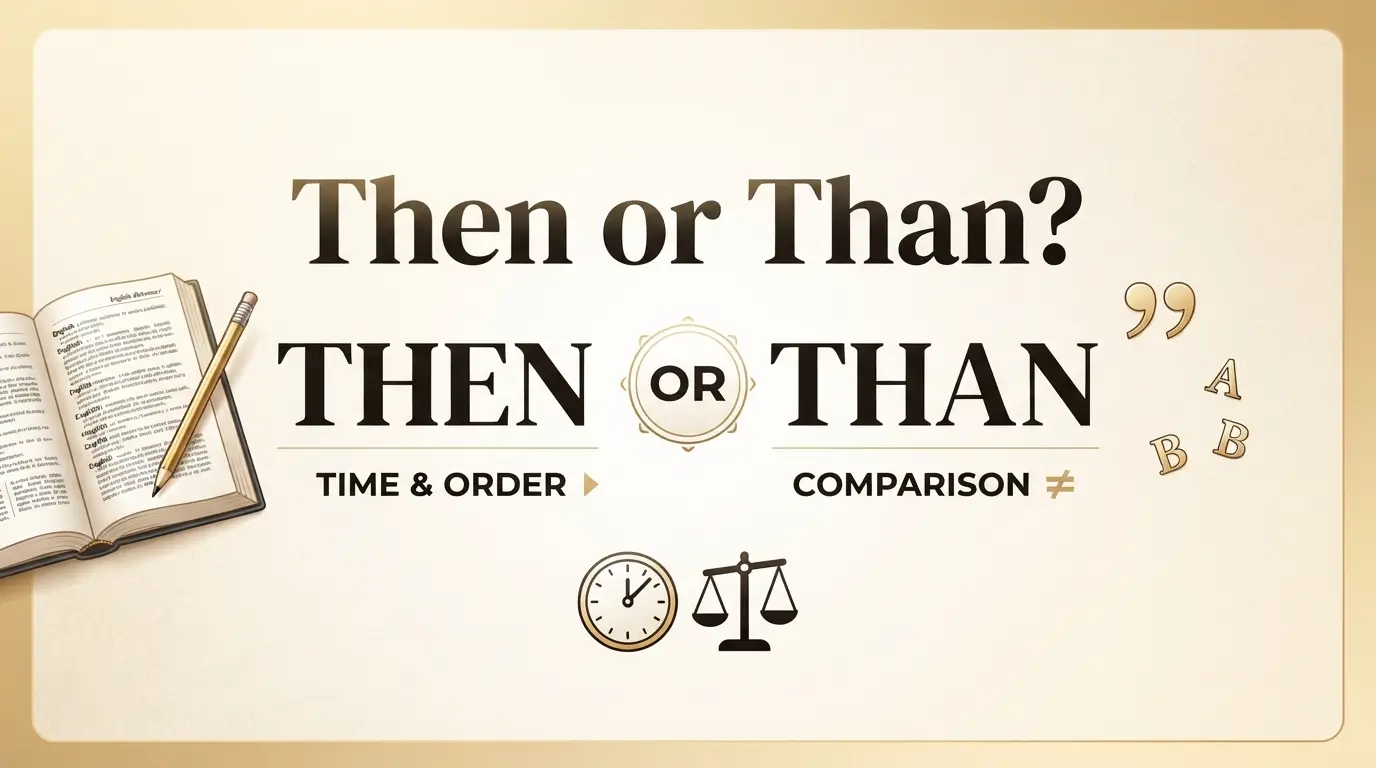
The good news is that the difference is simple. Then usually relates to time, order, or a result. Than is mainly used when comparing two people, things, actions, or ideas.
In this guide, you will learn the difference between then and than, where the words came from, how they are used in American and British English, common mistakes, everyday examples, and practical ways to remember which word to choose.
Then or Than – Quick Answer
The easiest rule is:
- Then = time, order, or result
- Than = comparison or difference
Use “then” for time or order
Then tells us when something happens or what happens next.
Examples:
- I finished my work, then I went home.
- We lived there then.
- First eat dinner, then watch the movie.
- If you study, then you may pass the test.
A simple memory trick is:
Then = when or next.
Use “than” for comparison.
Than is used to compare two things.
Examples:
- Sarah is taller than Anna.
- This book is better than that one.
- I would rather walk than drive.
- He earns more than his brother.
A simple memory trick is:
Than = comparison.
Then vs Than at a glance
| Word | Main meaning | Example |
| Then | Time or order | We ate, then we left. |
| Then | Result | If it rains, then we will stay home. |
| Than | Comparison | She is older than me. |
| Than | Preference | I would rather read than watch TV. |
So, if you are comparing two things, choose than. If you are talking about what happened next or when something happened, choose then.
The Origin of Then or Than
The history of then and than explains why these words can feel so confusing.
Both words have very old roots in English. They were not always clearly separated in spelling. Historical sources show that then comes from Old English forms such as þanne, þænne, and þonne. These forms could express ideas connected with time and circumstances.
Than also developed from related Old English forms. In fact, than and then were originally much closer than modern spelling suggests. Etymological evidence says that than developed from the same family of forms as then and was not clearly distinguished in spelling until around the 1700s.
Over time, English speakers began using the two forms for different grammatical purposes.
Then became strongly connected with:
- time
- sequence
- order
- consequences
- a particular point in the past or future
Then became strongly connected with:
- comparisons
- differences
- preferences
For example:
First we studied, then we took a break.
But:
This lesson is easier than the last one.
Modern dictionaries recognize these separate functions. Merriam-Webster defines then as an adverb used for time, sequence, and results, while than is used mainly to introduce the second part of a comparison.
The spelling difference is therefore not simply a random grammar rule. It developed through centuries of changes in English.
British English vs American English Spelling
One useful fact is that American and British English do not normally spell these words differently.
Both varieties use:
- then
- than
There is no standard American spelling such as then versus a British spelling such as than. The difference is based on meaning and grammar, not regional spelling.
Comparison table
| Usage | American English | British English | Correct example |
| Time | then | then | I was younger than. |
| Sequence | then | then | We ate, then left. |
| Result | then | then | If you agree, then we can start. |
| Comparison | than | than | She is faster than me. |
| Preference | than | than | I would rather stay than leave. |
| Difference | than | than | It costs more than expected. |
So whether you are writing for readers in the United States, United Kingdom, Canada, Australia, or another English-speaking country, the basic rule stays the same.
One important pronunciation point
In natural speech, than is often pronounced weakly. It may sound similar to then, especially in fast conversation.
For example:
She is taller than me.
The word than may not sound strongly different from then when spoken quickly.
That is one reason the mistake is common in writing.
Which Spelling Should You Use?
The answer is simple: use the spelling that matches the meaning, not the country.
For US readers
American English uses then for time and sequence and than for comparison.
Example:
I finished my homework, then I played games.
My phone is newer than yours.
For UK and Commonwealth readers
British English follows the same basic distinction.
Example:
We went shopping and then had lunch.
London is larger than many other British cities.
The same general rule applies in countries such as Canada, Australia, and New Zealand.
For international or global writing
If your website has a global audience, do not change then or than based on the reader’s country.
Instead, focus on the sentence’s meaning.
Ask:
Am I talking about time or order?
Use then.
Am I comparing something?
Use than.
This makes your writing correct for almost any English-speaking audience.
Common Mistakes with Then or Than
Because the words sound similar, several mistakes appear again and again.
Mistake 1st: “Better then”
Incorrect:
This option is better than the other one.
Correct:
This option is better than the other one.
Why? The sentence compares two options.
Mistake 2nd: “First this, than that”
Incorrect:
First finish your work, than go outside.
Correct:
First finish your work, then go outside.
Why? The sentence describes order.
Mistake 3rd: “More then”
Incorrect:
She has more then enough experience.
Correct:
She has more than enough experience.
The phrase more than expresses degree or comparison.
Mistake 4th: “Less than”
Incorrect:
The trip took less then two hours.
Correct:
The trip took less than two hours.
Again, this is a comparison of amount.
Mistake 5th: “Rather then”
Incorrect:
I would rather stay home then go out.
Correct:
I would rather stay home than go out.
The standard expression is rather than.
Mistake 6th: “If than”
Incorrect:
If you need help, than call me.
Correct:
If you need help, then call me.
Here, then shows the result or consequence.
A fast correction test
Try replacing the word.
If you can replace it with “next” or “at that time,” use then.
We finished dinner, then we left.
If you can replace it with “compared with,” use than.
This car is cheaper than that one.
This test works in many everyday sentences.
Then or Than in Everyday Examples
Knowing the rule is useful, but seeing the words in real situations makes the difference easier to remember.
In emails
Then:
I will review the document and then send you my comments.
Than:
The new proposal is more detailed than the previous version.
In professional emails, choosing the correct word helps your writing look polished.
In news writing
Then:
The team announced the decision and then released a statement.
Than:
The company reported higher sales than last year.
News writing often uses both words because it discusses events and comparisons.
On social media
Then:
Finish your work, then enjoy your weekend.
Than:
Nothing is better than a peaceful weekend.
Short social posts often contain spelling mistakes because people write quickly. The same grammar rules still apply.
In formal writing
Then:
The researchers collected the data and then analyzed the results.
Than:
The second method was more effective than the first.
Formal writing should use the correct form because small errors can affect clarity and credibility.
More everyday examples
Then
- I lived there then.
- We can talk then.
- First read the instructions, then begin.
- She smiled and then walked away.
Than
- He is older than his sister.
- This test is harder than the last one.
- I prefer tea than coffee.
- The blue shirt costs less than the red one.
Note that the preference example above is not standard English. The better form is:
I prefer tea to coffee.
But:
I would rather drink tea than coffee.
That distinction is useful for advanced learners.
Then or Than – Comparison Table
| Feature | Then | Than |
| Main function | Time, order, result | Comparison |
| Talks about time? | Yes | No |
| Used with comparisons? | No | Yes |
| Example | We left then. | She is taller than me. |
| Common phrase | Now and then | More than |
| Common phrase | If then | Rather than |
| Memory word | Next | Compare |
Common phrase patterns
Then often appears in:
- now and then
- back then
- by then
- until then
- first then
- if then
Than often appears in:
- more than
- less than
- better than
- worse than
- bigger than
- rather than
- other than
- different than
These patterns can help you recognize the correct word quickly.
Then or Than – Google Trends & Usage Data
Search interest around “then or than” reflects a common grammar problem rather than a difference in regional spelling.
Search behavior can vary by country, season, education level, and language background. People learning English as a second language may also search for phrases such as “then vs than,” “then or than meaning,” and “than or then in a sentence.”
It is important to be careful with Google Trends. Google Trends is mainly a relative search-interest tool, not a complete database of every search made on Google. A high-interest result does not automatically mean that one word is used more often in everyday English.
The words themselves are extremely common, but their functions are different. Then appears frequently in writing about events, steps, time, and results. Than appears frequently in comparisons and expressions of difference. Dictionary evidence supports these distinct grammatical roles.
Searches for “then vs than” are especially useful because they show that people are usually not asking which spelling is British or American. They are asking which word fits the sentence.
For global SEO content, this means an article targeting then or than should answer several related questions:
- What is the difference between then and than?
- Is it better then or better than?
- Is it more than or more then?
- When should I use then?
- When should I use than?
- How can I remember the difference?
This approach matches the practical intent behind the keyword.
Then or Than – Word Variations Side by Side
| Search phrase or variation | Correct form | Meaning |
| then or than | then / than | Depends on sentence |
| then vs than | then vs than | Comparing the two words |
| better then or than | better than | Comparison |
| more then or than | more than | Comparison or amount |
| less than | less than | Comparison |
| rather than | rather than | Preference/choice |
| first, then or than | first, then | Sequence |
| if then or than | if then | Condition/result |
| older than or than | older than | Comparison |
| now and then or than | now and then | From time to time |
Easy Ways to Remember Then vs Than
If you often confuse these words, use a simple memory system.
Remember “then” with “next”
First → then → next
Example:
First, wash your hands. Then prepare the food.
Remember “than” with comparison.
Think of than whenever you see words such as:
- more
- less
- better
- worse
- older
- younger
- bigger
- smaller
- faster
- slower
Examples:
My car is faster than yours.
This bag is smaller than that one.
Use the “comparison test”
Ask:
“Am I comparing two things?”
If yes, than is probably correct.
Ask:
“Am I describing what happens next or when something happened?”
If yes, then it is probably correct.
FAQs:
What is the difference between then and than?
Then usually refers to time, sequence, or a result. Than is mainly used to make comparisons.
Example:
We ate, then we left.
She is taller than me.
Is it “better then” or “better than”?
The correct phrase is “better than.”
Example:
This restaurant is better than the one we visited yesterday.
It is a comparison, so use than.
Is it “more then” or “more than”?
The correct phrase is “more than.”
Example:
The book costs more than $20.
Is it “first then” or “first than”?
Use “first, then.”
Example:
First, complete the form. Then submit it.
This describes a sequence.
Is “rather then” correct?
No. The standard expression is “rather than.”
Example:
I would rather walk than wait.
Are then and than spelled differently in British and American English?
No. Both British and American English use then and than in the same basic way. The difference is grammatical, not a US-versus-UK spelling rule.
How can I remember then and than?
Remember:
Then = next/time.
Than = comparison.
If you are comparing two things, use than. If you are talking about what happens next, use then.
Conclusion:
The difference between then or than is simple once you connect each word with its main job. Then is used for time, sequence, and results. Than is used mainly for comparisons and differences.
Use then in sentences such as:
First study, then rest.
Use than in sentences such as:
This test is easier than the last one.
The words may sound similar in fast speech, but their meanings are different. They are also not different British and American spellings. English speakers in both varieties use the same forms.
When you are unsure, stop and ask one question: Am I talking about what happens next, or am I comparing two things? If it is about time or order, choose then. If it is a comparison, choose than.
Once you learn this simple rule, common phrases such as more than, better than, rather than, first then, and if then become much easier to write correctly.
Read More Posts:
- To or Too: Simple Rules, Examples, and Common Mistakes
- Explained When to Use Cannot and Can Not in a Sentence
- How to Use Led and Lead Correctly in English (2026Guide)

Toni Morrison is a celebrated American novelist known for her powerful storytelling, rich characters, and lasting impact on literature. At GrammerNests.com, she shares insights that help readers appreciate language, writing, and literary expression.