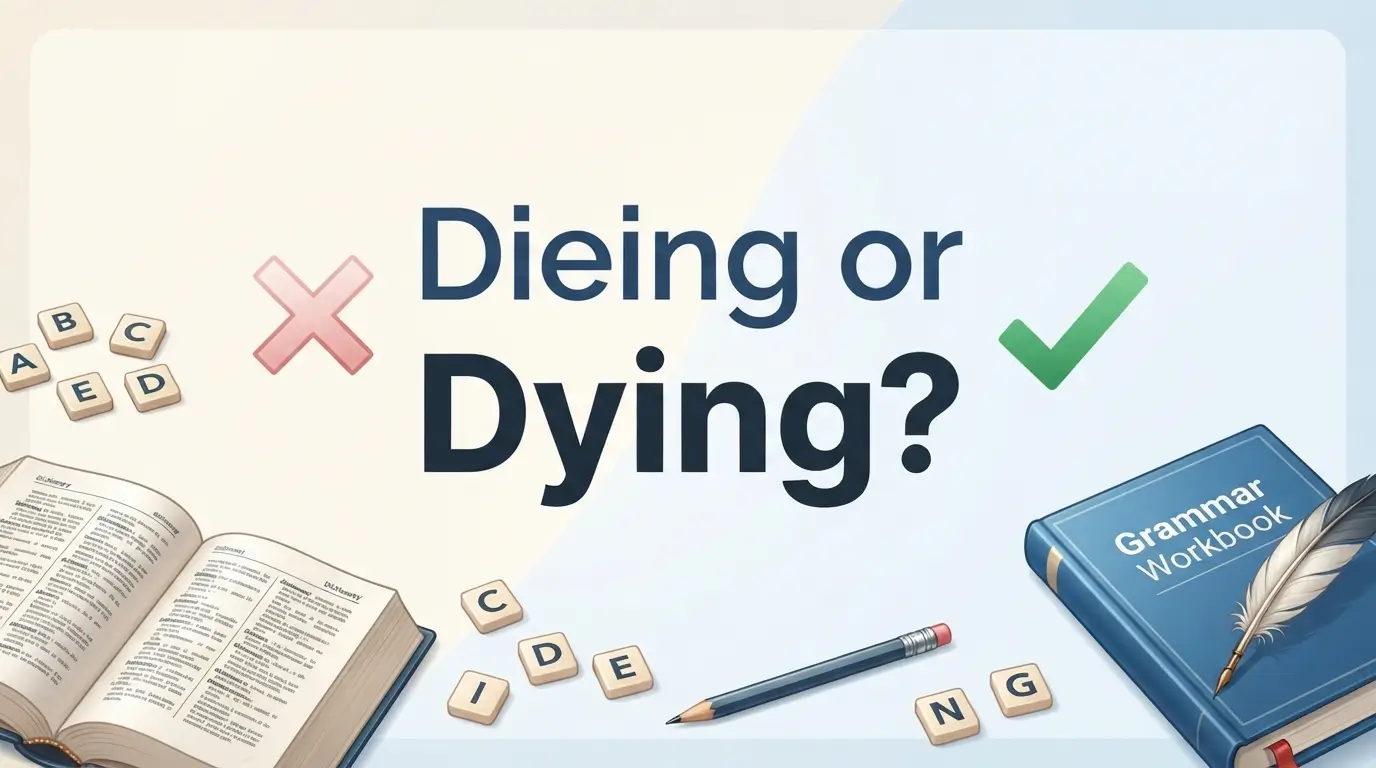
English spelling can be confusing, especially when a word changes its form. One small letter can make the difference between a correct word and a spelling mistake. “Dieing or dying” is a common example.
Many people know the verb die, but they are unsure what happens when they add -ing.
If you have ever typed dieing and wondered whether it looks right, you are not alone. This question appears often in searches because English has several spelling rules for verbs ending in -e.
Words such as make > making and write > writing drop the final e, so it is natural to wonder whether die follows the same rule.
The correct spelling for the normal present participle of die is dying. Dieing is generally incorrect when you mean the act of dying. However, dieing can appear as a rare technical term related to the word die, especially in manufacturing or printing.
Next, deeply explains dieing or dying, their origins, spelling rules, differences, common mistakes, everyday examples, and usage advice.
Dieing or Dying – Quick Answer
Dying is the correct spelling when you mean “in the process of dying” or “coming to an end.”
- ✅ The plant is dying.
- ✅ The old tree is dying.
- ✅ The patient was dying.
- ❌ The plant is dieing.
- ❌ The old tree is dieing.
Why does die become dying instead of dieing?
The spelling changes from ie to y before adding -ing:
die → dying
This helps avoid the unusual spelling dieing and follows a special English spelling pattern.
There is one important exception. Dieing can be a technical word connected to die, meaning a tool or process used to shape, cut, or form materials. For example:
The factory uses several dieing processes.
This use is uncommon in everyday English. For normal writing, if you mean “to be dying,” use dying.
The Origin of Dieing or Dying
The word die has a very old history. It comes from Old Norse deyja and is related to similar words in other Germanic languages. Over time, it developed into the modern English verb die.
The form dying developed from the need to create a present participle from die. English spelling does not always follow one simple rule. Some verbs ending in -ie change ie to y before -ing.
For example:
- die → dying
- lie → lying
- tie → tying
The spelling rule can be remembered as:
-ie + -ing → -ying
So:
die + ing → dying
The spelling dieing may look logical because it seems to follow the basic pattern of adding -ing. However, standard modern English uses dying for the verb die.
The confusion becomes greater because many other verbs simply drop a final e:
- make → making
- write → writing
- hope → hoping
- take → taking
But verbs ending in- i, e.g., follow their own pattern:
- lie → lying
- die → dying
- tie → tying
This is why dying is not simply die + ing.
British English vs American English Spelling
There is no major British-versus-American spelling difference between dying and dieing. Both British and American English normally use dying when referring to the process of death.
| Point | British English | American English |
| Correct spelling | dying | dying |
| Incorrect for normal use | dieing | dieing |
| Verb | die | die |
| Present participle | dying | dying |
| Example | The flowers are dying. | The flowers are dying. |
British and American English do have differences in other words:
- colour → color
- centre → center
- travelling → traveling
- organise → organize
But dying remains the standard spelling in both varieties.
So, whether you are writing for readers in London, New York, Toronto, Sydney, or elsewhere, dying is the safe and standard choice when discussing death or decline.
Which Spelling Should You Use?
For almost all normal writing, use dying.
For American readers
Use dying in emails, schoolwork, articles, reports, and social media.
Example:
“The flowers are dying because they need more water.”
British and Commonwealth readers
Use dying as well.
Example:
“The company is slowly dying because it failed to adapt.”
For a global audience
Dying is the best choice because it is widely recognized and accepted in standard English.
When can “dieing” be correct?
Dieing may appear in specialized contexts involving a die, a tool used to shape or cut material. This technical use is uncommon, however.
If you are talking about death, decline, or something losing life, choose dying.
Common Mistakes with Dieing or Dying
Here are some frequent mistakes.
Mistake 1st: Writing “dieing”
❌ The flowers are dieing.
✅ The flowers are dying.
Mistake 2nd: Confusing “dying” with “dyeing”
Dying means approaching death.
Dyeing means changing the color of something.
- The plant is dying.
- She is dyeing her clothes blue.
This is one of the most important spelling differences to remember.
Mistake 3rd: Using “dieing” because of the basic -ing rule
Some learners think:
die + ing = dieing
But English changes ie to y:
die → dying
Mistake 4th: Confusing “dying” with “die”
- I do not want to die.
- The animal is dying.
Use die after certain structures, such as to die. Use dying after forms of be, such as is dying or was dying.
Mistake 5th: Confusing “dying” and “dyeing”
Remember:
Dying = death
Dyeing = adding color
A simple memory trick is:
Dyeing has “dye” in it.
Dieing or Dying in Everyday Examples
Understanding the word in real sentences makes the spelling easier to remember.
In emails
Correct:
The flowers in the office garden are dying. Could someone water them?
Here, dying describes something losing life.
In news writing
Correct:
The small business is dying as customers move to larger online platforms.
Here, dying is used figuratively to describe decline.
On social media
Correct:
I’m dying laughing at this video!
This is an informal expression. It does not literally mean the person is dying. It means something is extremely funny.
In formal writing
Correct:
The researchers examined why certain species are dying at an increasing rate.
This is appropriate for academic or professional writing.
In everyday conversation
Correct:
My phone battery is dying.
This does not mean the phone is literally alive. It means the battery is almost empty.
Another figurative example
The old tradition is slowly dying.
Here, dying means the tradition is becoming less common or disappearing.
Dieing or Dying – Trends & Usage Data
Search interest for “dieing or dying” mainly comes from people checking the correct spelling. This makes sense because dieing looks like it could follow the normal verb + -ing pattern.
Usage is much clearer than the search question itself: dying is overwhelmingly the standard form when people mean the process of death.
The word appears across many contexts:
- health and medical writing
- news reports
- nature and environmental articles
- literature
- everyday conversation
- social media
- business writing
- figurative expressions
Search behavior can vary by country, but the spelling rule does not change significantly between wide English-speaking varieties. People in the United States, United Kingdom, Canada, Australia, and other English-speaking regions generally use dying for this meaning.
Google Trends data can also change over time because searches are influenced by news events, popular culture, education, and seasonal topics. Therefore, search volume should not be treated as a spelling rule.
The strongest practical test is simple: if you mean “in the process of dying,” write “dying.”
Dieing vs Dying: Comparison Table
| Word | Correct? | Meaning | Example |
| dying | ✅ Yes | In the process of dying | The tree is dying. |
| dieing | ❌ Usually no | Not the normal form of die | The tree is dieing. |
| dyeing | ✅ Yes | Coloring something | She is dyeing her hair. |
| die | ✅ Yes | To stop living | All living things eventually die. |
| died | ✅ Yes | Past tense of die | The plant died yesterday. |
The key difference is between dying and dyeing. These words sound similar but have completely different meanings.
Why Is “Dying” Spelled Without the “E”?
The easiest explanation is the special spelling change for verbs ending in -ie.
When -ing is added, ie changes to y:
Die > dying
The same pattern appears in:
lie > lying
tie > tying
This prevents forms such as lieing and tieing in standard English.
However, English spelling has many exceptions and historical patterns, so it is better to learn this as a common spelling rule rather than trying to build every form from pronunciation alone.
Is “Dieing” Ever a Word?
Yes, but this is where things can become confusing.
Dieing can occur as a specialized term related to die, especially in technical or manufacturing contexts. A die is a tool used to cut, shape, or form materials.
However, this technical word is rare compared with dying.
If your sentence is about:
- death,
- illness,
- plants,
- animals,
- decline,
- batteries,
- traditions, or
- something disappearing,
you almost certainly want dying.
FAQs:
Is it dying or dieing?
Dying is correct when you mean “in the process of dying.”
Example: The flowers are dying.
Why is dying spelled with a Y?
The ie in die, changes to y before -ing.
die → dying
This is also seen in lie → lying and tie → tying.
Is dieing ever correct?
Dieing can be used as a rare technical term related to a die, a tool used for shaping or cutting materials. It is not the standard spelling of the everyday verb die + -ing.
What is the difference between dying and dyeing?
Dying relates to death.
Dyeing means changing the color of something.
Example:
- The plant is dying.
- She is dyeing the fabric.
Is “dying” correct in British English?
Yes. Dying is the standard spelling in British English.
Is “dying” correct in American English?
Yes. American English also uses dying.
How can I remember the spelling of dying?
Remember this pattern:
die > dying
Also remember:
Lie > lying
tie > tying
Think: IE changes to Y before ING.
Conclusion
When choosing between dieing or dying, the correct answer is usually simple: dying. If you mean that a person, animal, plant, battery, business, tradition, or other thing is coming to an end, use dying.
The spelling comes from a special English pattern in which verbs ending in -ie change ie to y before adding -ing. That gives us die > dying, just as we get lie > lying and tie > tying.
There is no important British-American spelling difference here. Both varieties use dying for the normal meaning. Dieing may appear in rare technical contexts connected with a manufacturing die, but it should not be used as the ordinary present participle of die.
Also, do not confuse dying with dyeing. The first relates to death, while the second means changing color. When in doubt, remember the simple rule: die becomes dying.
Read More Posts:
- How to Use “Whether or Not” in Formal and Casual English
- Desert or Dessert: Grammar and Usage Rules Guide 2026
- Loosing or Losing: Correct Usage in English (2026Guide)

Emily Dickinson is one of America’s most influential poets, recognized for her unique style and thought-provoking poetry. Through GrammerNests.com, she contributes valuable perspectives on language, creativity, and the beauty of written expression.