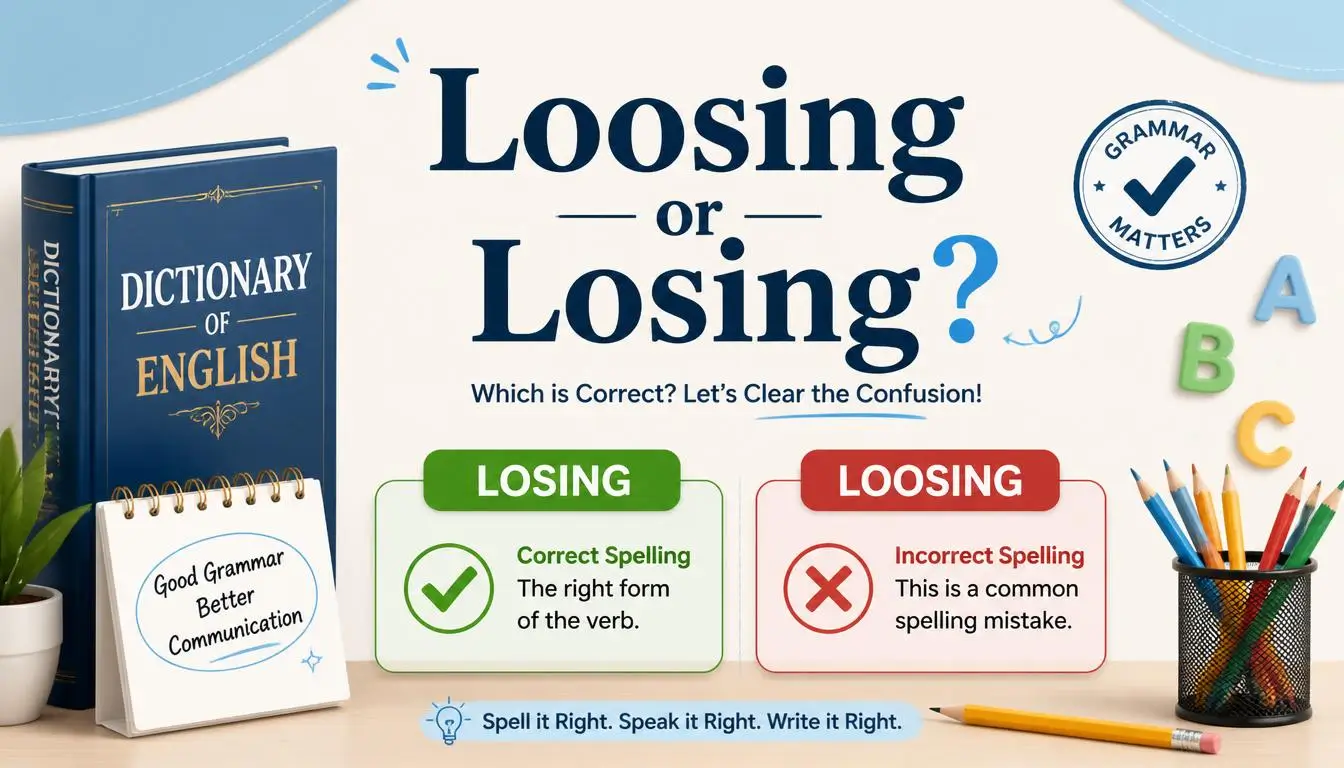
Loosing or losing? These two words look almost the same, but they have different meanings. One is a common spelling mistake, while the other is a correct English word with its own meaning.
If you have ever written a sentence like “I am loosing my phone,” you may have wondered whether the spelling is right. This confusion is common because loosing and losing differ by only one letter.
The correct choice depends on what you want to say. Losing means no longer having something, failing to win, or becoming less of something. For example, “I am losing my keys” means you cannot find or keep your keys.
Loosing, on the other hand, means releasing, freeing, or making something loose. It is much less common in everyday English.
Understanding the difference can help you avoid mistakes in emails, schoolwork, social media posts, and professional writing.
Next, Deeply explains loosing or losing, their origins, meanings, spelling, common mistakes, and real-world usage.
Loosing or Losing – Quick Answer
Losing is usually the correct word when you mean:
- Failing to keep something: “She is losing her phone.”
- Failing to win: “Our team is losing the game.”
- Becoming less: “He is losing weight.”
- Missing something: “I am losing interest.”
Loosing is also a real word, but it is rare. It means releasing, freeing, or making something loose.
Examples:
- “The guard is loosing the prisoners.”
- “He was loosing the horse from its rope.”
Simple Rule
If you mean not having something anymore or failing to win, use losing.
If you mean releasing or freeing something, use loosing.
| Word | Meaning | Example |
| Losing | Failing to keep or win something | “I am losing my keys.” |
| Loosing | Releasing or freeing something | “He is loosing the horse.” |
The Origin of Loosing or Losing
The difference between these words comes from two different verbs: lose and loose.
Lose is an Old English word related to loss and destruction. Over time, it developed the meanings we use today, such as failing to keep something, being defeated, or no longer having something.
The verb lose becomes losing when the ending -ing is added.
For example:
lose + ing = losing
The second o is removed because the base word is lose, not loose.
Loose has a different history. It is related to words meaning free, unbound, or not tight. Its verb form, loose, means to release or set free.
When -ing is added:
loose + ing = loosing
This creates the word loosing, but it is much less common.
The spelling confusion happens because lose, loose, losing, and loosing look very similar. Their meanings, however, are different.
British English vs American English Spelling
There is no major British-American spelling difference between losing and loosing. Both American and British English use losing when the meaning is related to lose.
For example:
- American English: “She is losing money.”
- British English: “She is losing money.”
The same spelling is used in both varieties.
The confusion is therefore not caused by different national spelling rules. It usually happens because lose and loose are easy to mix up.
| Word | American English | British English | Meaning |
| lose | ✓ | ✓ | Fail to keep or win |
| losing | ✓ | ✓ | Present participle of lose |
| loose | ✓ | ✓ | Not tight; free |
| loosing | ✓ | ✓ | Releasing or freeing |
Examples
Correct: “The team is losing the match.”
Correct: “The rope is loose.”
So, whether you write for a US, UK, Canadian, Australian, or international audience, losing is the correct spelling when you mean experiencing a loss.
Which Spelling Should You Use?
For most situations, use losing.
For US English
Use losing when talking about loss, failure, or reduction.
“I am losing my patience.”
UK and Commonwealth English
The same rule applies.
“She is losing confidence.”
British English does not normally change losing to loosing.
For Global English
If you write for an international audience, losing is the safest choice when you mean loss or failure.
Use loosing only when you genuinely mean releasing or setting free.
Quick Test
Ask yourself:
Do I mean “not keeping,” “failing,” or “becoming less”?
If yes, use losing.
Do I mean “releasing” or “setting free”?
If yes, use loosing.
Common Mistakes with Loosing or Losing
Mistake 1: “I am loosing my phone.”
Incorrect: “I am loosing my phone.”
Correct: “I am losing my phone.”
The sentence means you cannot keep or find your phone.
Mistake 2: “Our team is loosing.”
Incorrect: “Our team is loosing.”
Correct: “Our team is losing.”
A team loses when it does not win.
Mistake 3: “She is loosing weight.”
Incorrect: “She is loosing weight.”
Correct: “She is losing weight.”
The word losing means becoming less in this sentence.
Mistake 4: “Do not loose hope.”
Incorrect: “Do not loose hope.”
Correct: “Do not lose hope.”
Here, the base verb is lose, not loose.
Mistake 5: Confusing loose and lose
Loose usually describes something that is not tight.
“My shirt is loose.”
Lose describes failing to keep something.
“I do not want to lose my shirt.”
Remember:
Loose = not tight
Lose = no longer have or fail to win
Loosing or Losing in Everyday Examples
In Emails
Correct:
“I am sorry for losing the document.”
Correct:
“We are losing valuable time.”
Using loosing in these sentences would be incorrect.
In News Writing
News articles often use losing to describe elections, sports, money, jobs, or support.
“The company is losing customers.”
“The candidate is losing support.”
On Social Media
People often write:
“I am losing my mind!”
“Our team is losing again.”
These use losing because they refer to loss or a decline.
In Formal Writing
Use losing in professional and academic writing when discussing loss or reduction.
“The company risks losing its market share.”
“The country is losing valuable resources.”
Loosing should appear only when the intended meaning is releasing or freeing something.
Loosing or Losing – Google Trends & Usage Data
Search interest for “loosing or losing” comes mainly from people checking which spelling is correct. The confusion appears across English-speaking countries because the two words sound similar and look almost identical.
In general, losing is far more common in everyday English because the verb lose is used frequently. People lose games, money, jobs, keys, time, opportunities, and interest.
Loosing is much rarer because its meaning — releasing or freeing something — is less common in modern everyday writing.
Searches for this spelling question can appear in countries such as the United States, United Kingdom, Canada, Australia, India, Pakistan, and other countries where English is widely studied or used.
Usage also depends on context. Searches tend to come from:
- Students checking grammar
- English learners
- Bloggers and content writers
- Professionals checking emails
- Social media users
- People proofreading documents
Because language usage changes over time, Google Trends should be treated as a measure of search interest, not as a dictionary or grammar authority.
Loosing vs Losing: Comparison Table
| Feature | Losing | Loosing |
| Base word | Lose | Loose |
| Commonness | Very common | Rare |
| Main meaning | Failing to keep, win, or maintain | Releasing or freeing |
| Example | “I am losing money.” | “He is loosing the horse.” |
| Used in US English | Yes | Yes, but uncommon |
| Used in British English | Yes | Yes, but uncommon |
| Common spelling mistake? | Often confused with loosing | Often incorrectly used instead of losing |
| Best everyday choice | Yes | Usually no |
FAQs:
Is it losing or loosing?
Losing is correct when you mean failing to keep something, failing to win, or becoming less.
Example: “I am losing money.”
Is loosing a real word?
Yes. Loosing is a real word, but it is uncommon. It comes from the verb loose and means releasing or setting something free.
Is “loosing weight” correct?
No. The correct phrase is “losing weight.”
Example: “She is losing weight.”
Is it “losing my mind” or “loosing my mind”?
The correct phrase is “losing my mind.”
Is “lose” the same as “loose”?
No. Lose means to no longer have something or fail to win. Loose usually means not tight or securely fixed.
Why do people spell losing as loosing?
The mistake happens because lose and loose look and sound similar. People often add -ing to the wrong base word.
Is losing spelled differently in British English?
No. Losing has the same spelling in British and American English.
Conclusion:
The difference between loosing or losing is simple once you understand their meanings. Losing is the word you will need most of the time. It means failing to keep something, failing to win, or becoming less.
For example, you can be losing a game, losing money, losing weight, or losing interest.
Loosing is a real English word, but it is uncommon. It comes from loose and means releasing, freeing, or setting something loose. Because this meaning is less common, many writers never need to use loosing.
There is also no important British-American spelling difference here. Both varieties of English use losing for the common meaning of loss.
The easiest way to remember the difference is: lose > losing and loose > loosing. If you are talking about loss, failure, or reduction, choose losing. Use loosing only when you mean releasing or freeing something.
This simple rule will help you write clearly in emails, articles, schoolwork, social media, and professional documents.
Read More Posts:
- Whose or Who’s? The Simple Guide to Using Them Correctly
- Alot or A Lot: Correct Spelling Guide 2026
- Layed or Laid: British vs American English Grammar Rules

Emily Dickinson is one of America’s most influential poets, recognized for her unique style and thought-provoking poetry. Through GrammerNests.com, she contributes valuable perspectives on language, creativity, and the beauty of written expression.