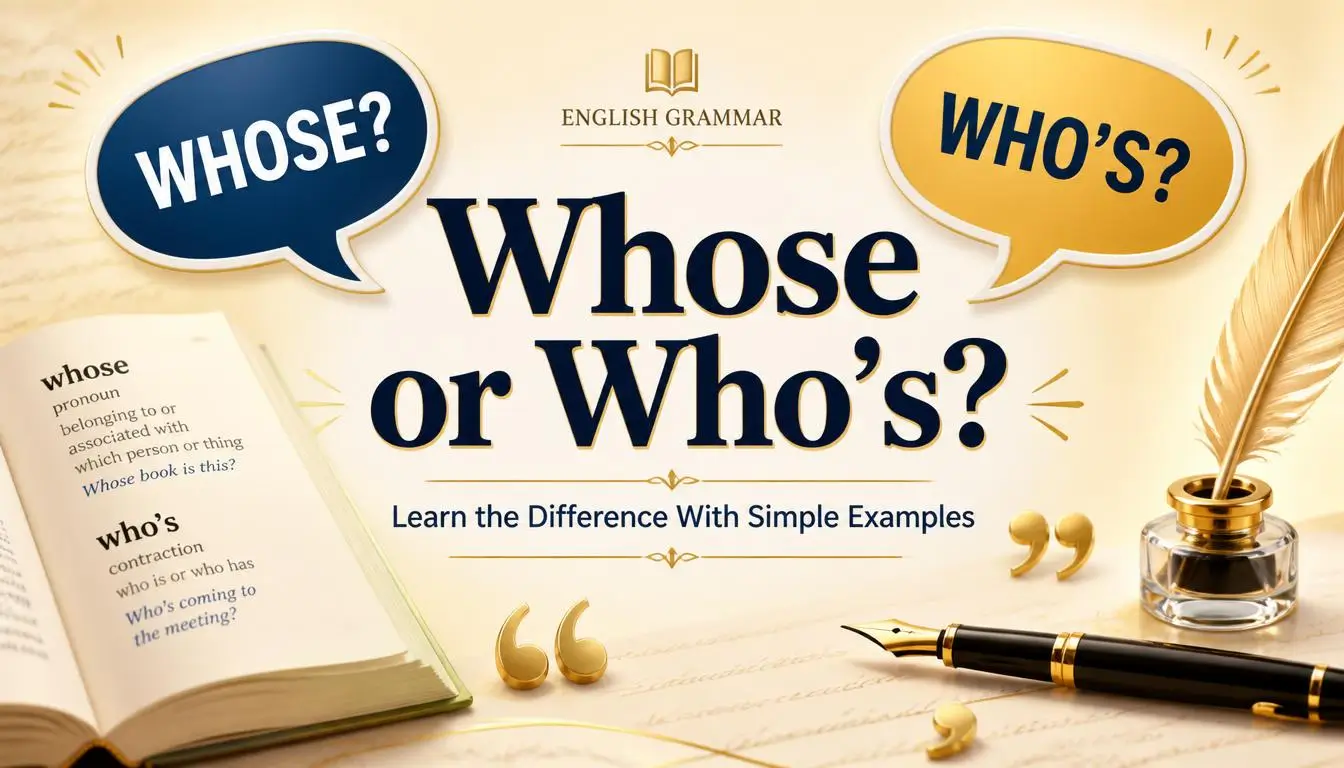
Choosing between whose or who’s can be confusing, even for strong English writers. The two words sound almost the same when spoken, but they have very different meanings and jobs in a sentence. One shows ownership, while the other is a short form of two words.
This small spelling difference causes many searches because whose and who’s are both common in everyday English.
People often pause when writing emails, school assignments, social media posts, or professional documents. The good news is that the rule is simple once you know what each word means.
Whose shows possession or asks about the owner of something. Who’s is a contraction of who is or who has. Learning this one rule can help you avoid one of the most common English grammar mistakes.
In this guide, you will learn the difference between whose or who’s, where the words came from, how they are used in British and American English, common mistakes, real-life examples, usage trends, and simple ways to remember the correct spelling.
Whose or Who’s – Quick Answer
The quick rule is:
- Whose = shows possession or asks about ownership.
- Who’s = short for who is or who has.
Examples with “whose”
- Whose phone is this?
- Whose jacket did you borrow?
- I know whose car is outside.
Here, whose refers to ownership.
Examples with “who’s”
- Who’s coming to dinner? = Who is coming to dinner?
- Who’s finished the report? = Who has finished the report?
- Who’s responsible for this? = Who is responsible for this?
Easy test
Try replacing who’s with who is or who has.
If the sentence still makes sense, use who’s.
Who’s at the door?
Who is at the door? ✓
But:
Whose bag is this?
Who is bag is this? ✗
Therefore, whose is correct.
The Origin of Whose or Who’s
The difference between whose and who’s comes from the history of English grammar.
The origin of “whose”
Whose comes from the older English forms of who. It developed as a possessive form, much like his, her, or their.
Over time, English speakers used whose to ask about or identify the owner of something:
- Whose book?
- Whose house?
- Whose idea?
The word has remained in English because it fills an important grammatical role: it expresses possession when the person or owner is unknown.
The origin of “who’s”
Who’s developed from a contraction. A contraction combines two words into a shorter form.
Who + is = who’s
and
Who + has = who’s
The apostrophe shows that letters have been removed.
For example:
- Who is ready? → Who’s ready?
- Who has called? → Who’s called?
The spelling difference exists because the two words perform different grammatical jobs. Whose is a possessive word, while who’s is a contraction.
British English vs American English Spelling
There is no major spelling difference between British and American English for whose and who’s.
Both varieties use:
- whose for possession
- who’s for who is or who has
| Meaning | British English | American English | Example |
| Possession | whose | whose | Whose coat is this? |
| Who is | who’s | who’s | Who’s coming? |
| Who has | who’s | who’s | Who’s finished? |
| Possessive question | whose | whose | Whose idea was it? |
| Formal expanded form | who is | who is | Who is responsible? |
Unlike words such as colour/color or centre/center, whose and who’s do not normally change between British and American English.
The same rule also applies in other major varieties of English, including Australian, Canadian, and New Zealand English.
Which Spelling Should You Use?
The answer depends on what you mean, not where you live.
For US English
Use whose when you mean ownership.
Whose desk is this?
Use who’s when you mean who is or who has.
Who’s your manager?
For UK and Commonwealth English
The same rule applies.
Whose keys are these?
Who’s joining us later?
For global English
If you write for an international audience, follow the same basic rule. There is no need to change the spelling based on the country.
For formal writing, you may choose the full forms who is and who has instead of who’s when you want a more formal tone.
For example:
Who is responsible for the project?
This sounds more formal than:
Who’s responsible for the project?
Whose or Who’s: Comparison Table
| Word | Meaning | Grammar | Example |
| whose | possession | possessive determiner/pronoun | Whose phone is ringing? |
| who’s | who is | contraction | Who’s at the door? |
| who’s | who has | contraction | Who’s finished the work? |
| whose | belonging to whom | possessive form | Whose decision was this? |
Common Mistakes with Whose or Who’s
Mistake 1st: Using “who’s” to show ownership
Incorrect:
Who’s book is this?
Correct:
Whose book is this?
The sentence asks about the owner of the book, so whose is correct.
Mistake 2nd: Using “whose” instead of “who’s”
Incorrect:
Whose going to the meeting?
Correct:
Who’s going to the meeting?
You can replace who’s with who is:
Who is going to the meeting?
The sentence works, so who’s is correct.
Mistake 3rd: Thinking the apostrophe means possession
This mistake happens because apostrophes often show possession in English:
- Sarah’s phone
- John’s car
- the teacher’s desk
However, who’s is different. Its apostrophe marks missing letters in who is or who has.
It does not show possession.
Mistake 4th: Confusing “whose” with “who”
Sometimes writers leave out the possessive form.
Incorrect:
Who phone is this?
Correct:
Whose phone is this?
Simple memory trick
Remember:
Who’s = Who is / Who has
Whose = ownership
If you can replace the word with who is or who has, choose who’s.
Otherwise, whose may be the correct choice.
Whose or Who’s in Everyday Examples
Knowing the rule is useful, but seeing the words in real situations makes the difference easier to remember.
In emails
Who’s available for a quick meeting tomorrow?
Here, who’s means who is.
Whose approval do we need before sending this?
Here, whose asks about the person whose approval is needed.
In news writing
Who’s behind the new campaign?
This means:
Who is behind the new campaign?
Another example:
Whose decision led to the change?
Here, whose asks about ownership or responsibility.
On social media
Who’s ready for the weekend?
This means who is ready.
Whose dog keeps appearing in my photos?
This asks who owns the dog.
In formal writing
Whose responsibility is it to approve the application?
This is a possessive question.
Who is responsible for approving the application?
This uses the full form instead of who’s and may sound more formal.
In everyday conversation
Who’s calling?
Whose keys are these?
Who’s bringing the food?
Whose turn is it?
These simple examples show how often both forms appear in normal English.
Whose or Who’s – Google Trends & Usage Data
Search interest for “whose or who’s” comes from a common grammar problem: the words sound alike but have different meanings.
People often search for this phrase when they are:
- Checking a sentence before publishing it.
- Writing an email or assignment.
- Learning English.
- Improving grammar.
- Preparing for an English test.
- Editing professional content.
- Comparing possessive forms and contractions.
Usage also varies by context. Who’s is especially common in conversational English because contractions are natural in speech and informal writing. Whose is common when people ask about ownership.
For example, searches and written usage may appear around phrases such as:
- whose phone
- whose house
- whose idea
- who’s coming
- who’s responsible
- who’s there
Google Trends can change over time and by country, so search popularity should not be treated as a grammar rule. The correct spelling depends on the meaning of the sentence, not on which form has more searches.
Whose vs Who’s: Side-by-Side Comparison
| Feature | Whose | Who’s |
| Main meaning | Possession | Who is / Who has |
| Has apostrophe? | No | Yes |
| Shows ownership? | Yes | No |
| Can mean “who is”? | No | Yes |
| Can mean “who has”? | No | Yes |
| Used in questions? | Yes | Yes |
| Used in formal writing? | Yes | Yes, though full forms may be preferred |
| Example | Whose bag is this? | Who’s using the bag? |
More examples
| Sentence | Correct word | Reason |
| ___ car is parked outside? | Whose | Asks about ownership |
| ___ coming with us? | Who’s | Who is |
| ___ finished the project? | Who’s | Who has |
| ___ idea was it? | Whose | Shows ownership |
| ___ your teacher? | Who’s | Who is |
| ___ name is on the list? | Whose | Possession |
FAQs:
What is the difference between whose and who’s?
Whose shows possession or asks who owns something. Who’s is a contraction of who is or who has.
Is “whose” possessive?
Yes. Whose is the possessive form related to who.
Example:
Whose phone is this?
Is “who’s” always short for “who is”?
No. Who’s can mean either who is or who has.
Examples:
Who’s coming? = Who is coming?
Who’s finished? = Who has finished?
Is “whose” the same in British and American English?
Yes. British and American English both use whose for possession and who’s for who is or who has.
Can I use “who’s” to show possession?
No. Who’s does not show possession.
Incorrect:
Who’s jacket is this?
Correct:
Whose jacket is this?
Is “whose” formal or informal?
Whose is normal in both formal and informal English. It can be used in conversations, emails, academic writing, and professional documents.
How can I remember whose vs who’s?
Use the replacement test. If you can replace the word with who is or who has, use who’s. If the sentence asks about ownership, use whose.
Conclusion: Whose or Who’s?
The difference between whose or who’s is simple once you focus on meaning. Whose is used for possession. It asks who owns something or identifies the person something belongs to. For example, “Whose laptop is this?” asks about ownership.
Who’s, on the other hand, is a contraction of who is or who has. For example, “Who’s coming?” means “Who is coming?”, while “Who’s finished?” means “Who has finished?”
British and American English follow the same spelling rules for both words, so your choice does not depend on regional spelling. The best way to avoid mistakes is to use the replacement test: replace who’s with who is or who has. If it works, use who’s. If you are talking about ownership, use whose.
Once you learn this simple rule, choosing between whose or who’s becomes quick and easy in emails, schoolwork, social media, and professional writing.
Read More Posts:
- Alot or A Lot: Correct Spelling Guide 2026
- Layed or Laid: British vs American English Grammar Rules
- Comma Before or After But? Examples Guide 2026

Toni Morrison is a celebrated American novelist known for her powerful storytelling, rich characters, and lasting impact on literature. At GrammerNests.com, she shares insights that help readers appreciate language, writing, and literary expression.