If you have ever stopped while writing a sentence and wondered, “Should I put a comma before or after but?”, you are not alone. This small punctuation question causes a surprising amount of confusion.
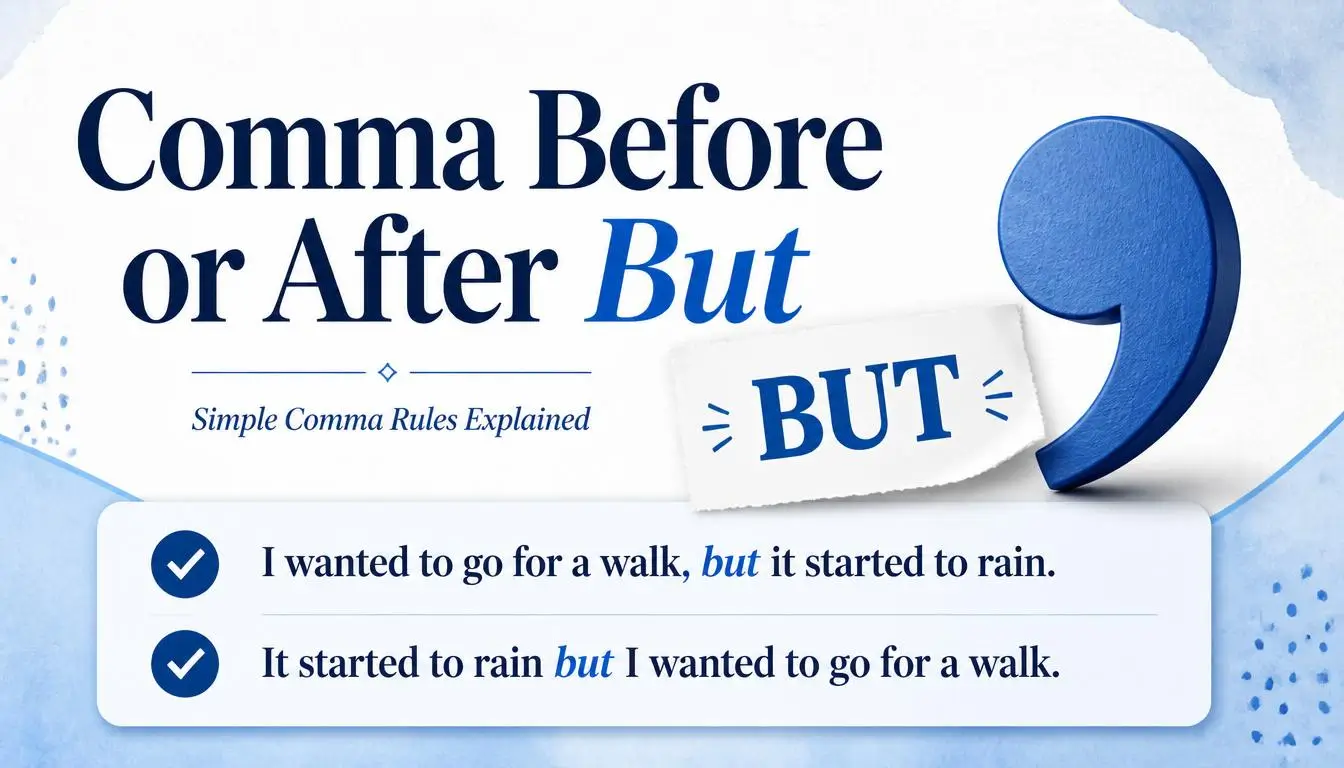
The good news is that the basic rule is simple: a comma usually comes before “but” when “but” joins two complete sentences, while a comma does not normally come after “but.”
For example: “I wanted to go, but I was too tired.”
However, the rule changes when “but” connects words or phrases instead of two independent clauses. You may also see a comma after “but” when another word or phrase interrupts the sentence.
People search for comma before or after but because they want to write correctly in school assignments, emails, articles, social media posts, business documents, and formal writing. Understanding the rule helps you avoid comma mistakes and makes your sentences easier to read.
This guide explains when to use a comma before “but,” when not to use one, and when a comma can appear after it.
Comma Before or After But – Quick Answer
The short answer is:
Use a comma before “but” when it connects two independent clauses.
- Correct: I wanted to call you, but I was busy.
- Correct: She studied hard, but she failed the test.
- Correct: We planned to travel, but the weather changed.
Both sides of “but” can stand alone as complete sentences.
I wanted to call you.
I was busy.
But you usually do not use a comma before “but” when it joins only words or phrases.
- Correct: I wanted to call but had no time.
- Correct: She is tired but happy.
- Correct: The movie was long but interesting.
You also normally do not put a comma directly after “but.”
- Incorrect: But, I was too tired to go.
- Better: But I was too tired to go.
A comma can appear after “but” when an interrupting phrase follows it:
- But, in my opinion, the plan is still useful.
- But, of course, we need more time.
So, the easiest rule is:
Complete sentence + but + complete sentence = comma before “but.”
This rule follows the standard use of commas with coordinating conjunctions. Cambridge explains that “but” is a coordinating conjunction used to connect contrasting ideas, while Purdue Writing Lab describes the comma-plus-conjunction pattern for joining independent clauses.
The Origin of Comma Before or After But
The phrase “comma before or after but” is not the name of an old grammar rule. It describes a modern punctuation question about where the comma should go when the conjunction but appears in a sentence.
The word comma has a long history. It comes through Latin from Greek komma, meaning a section or short clause. The original idea was connected to cutting a sentence into smaller parts.
The word but is much older. It comes from Old English forms such as būtan and butan, which carried meanings such as “outside,” “without,” or “except.” Its use as a conjunction developed later, eventually gaining the contrast meaning we use today.
Today, but is mainly used to show contrast:
I wanted to stay, but I had to leave.
The comma helps readers see where one independent clause ends and the next begins.
Importantly, the basic rule is not a spelling difference between British and American English. “But” is spelled the same in both varieties. The main question is punctuation and sentence structure.
British English vs American English Spelling
There is no British-versus-American spelling difference for “but.”
Both use:
- but
- comma
- comma before but
- comma after but
The important difference is not spelling. It is punctuation style and sentence structure.
British and American English generally follow the same core rule when but joins two independent clauses.
| Usage | British English | American English |
| Two independent clauses | I called, but she was busy. | I called, but she was busy. |
| Same subject, two verbs | I called but left a message. | I called but left a message. |
| Words or phrases | It was simple but useful. | It was simple but useful. |
| “But” at sentence beginning | But I disagree. | But I disagree. |
| Interrupting phrase | But, in fact, I agree. | But, in fact, I agree. |
| Spelling of “but” | but | but |
Cambridge notes that when main clauses are separated by and, or, or but, a comma is not normally needed when they have the same subject. A comma is more appropriate when the clauses have different subjects and are independent.
One important British-American difference
British and American English can differ in other comma rules, especially with lists.
For example:
British English:
I bought apples, oranges and bananas.
American English:
I bought apples, oranges, and bananas.
This is the famous Oxford comma difference. But it does not change the basic rule for “but.”
Therefore, do not assume that “comma before but” is an American spelling rule. It is a sentence-structure rule used across wide varieties of English.
Which Spelling Should You Use?
Because but has the same spelling in British and American English, you do not need to choose between two spellings.
Instead, choose your punctuation style based on your audience and writing situation.
For American English
If you write for a U.S. audience, use a comma before but when it joins two independent clauses:
The report is finished, but I need to check the numbers.
British English
The same rule works:
The report is finished, but I need to check the numbers.
Commonwealth English
Australian, Canadian, and other Commonwealth varieties generally use the same basic structure:
She wanted to attend, but she was ill.
For global English
If your writing is for an international audience, focus on clarity rather than regional punctuation preferences.
A simple test works well:
Can the words after “but” stand alone as a complete sentence?
If yes, a comma before but is often appropriate.
I wanted to leave, but it started raining.
Both parts can stand alone:
I wanted to leave.
It started raining.
If the second part cannot stand alone, you usually do not need the comma:
I wanted to leave but could not.
Common Mistakes with Comma Before or After But
Understanding the rule is easy. Applying it correctly takes practice. Here are some common mistakes.
Mistake 1st: Adding a comma before every “but”
Incorrect:
She is tired, but happy.
If “but” only connects two adjectives, no comma is needed.
Correct:
She is tired but happy.
Mistake 2nd: Leaving out the comma between two complete clauses
Incorrect:
I wanted to go, but I was too tired.
In many formal contexts, a comma is preferred because but connects two independent clauses.
Correct:
I wanted to go, but I was too tired.
Mistake 3rd: Putting a comma directly after “but”
Incorrect:
But, I don’t agree with this idea.
Usually:
But I don’t agree with this idea.
However, a comma can be correct if an interrupting expression follows:
But, in my view, the decision was reasonable.
The commas belong around in my view, not because “but” itself requires a comma.
Mistake 4th: Confusing a pause with a grammar rule
Writers sometimes add commas wherever they would pause while speaking.
That can cause errors.
For example:
She is talented, but hardworking.
The pause may sound natural, but the sentence simply joins two adjectives.
Better:
She is talented but hardworking.
Mistake 5th: Using a comma when “but” joins a short phrase
Incorrect:
He wanted to leave, but quickly.
Better:
He wanted to leave but quickly changed his mind.
The comma is not automatically required just because “but” appears.
Mistake 6th: Thinking “but” always needs a comma
It does not.
Compare:
The room was small but comfortable.
The room was small, but we enjoyed it.
In the first sentence, but connects adjectives. In the second, it connects two independent clauses.
Comma Before or After But in Everyday Examples
The rule becomes easier when you see it in real writing.
In emails
Correct:
I have completed the report, but I need to review one section.
Here, both sides can stand alone.
No comma needed:
I completed the report but forgot to attach it.
Here, the same subject, “I,” performs both actions.
In news writing
News writing often uses concise compound sentences:
The company expected strong sales, but demand remained weak.
The comma separates two independent clauses.
Another example:
Officials announced the decision, but they did not provide further details.
On social media
Social media writing can be informal, but standard punctuation still improves clarity.
I wanted to post this yesterday, but I forgot.
Or:
The update is simple but helpful.
In formal writing
Academic and professional writing benefits from clear sentence structure:
The study found a strong relationship, but more research is needed.
Or:
The method is simple but effective.
In creative writing
Writers can use but to create contrast and rhythm:
She was afraid, but she kept walking.
The comma makes the two contrasting ideas easy to see.
Comma Before or After But – Google Trends & Usage Data
Searches for punctuation questions such as “comma before or after but” reflect a broader interest in grammar and writing help.
Although, Google Trends does not provide a simple public number showing the exact worldwide volume for this specific grammar phrase.
Google explains that Trends data is relative search interest rather than a direct count of searches. It also warns that very low-volume searches may produce little or no usable Trends data.
This matters because a narrow grammar query can appear differently across countries and time periods.
What the search intent shows
People who search for this phrase are usually looking for one of these answers:
- Should I put a comma before “but”?
- Can I put a comma after “but”?
- Is the comma rule different in American English?
- Is the rule different in British English?
- Does “but” always need a comma?
- Why is there a comma before “but” in some sentences?
The topic is especially useful for students, English learners, bloggers, editors, copywriters, and professionals.
Google Trends allows users to compare search terms and explore interest by region, but the data should be treated as relative interest rather than a precise measure of total searches.
Comparison of common variations
| Search variation | What the user usually wants to know |
| comma before but | Whether a comma goes before “but” |
| comma after but | Whether a comma can follow “but” |
| comma before or after but | Complete punctuation rule |
| comma before but grammar | Grammar explanation |
| comma after but grammar | Rules for starting sentences with “but” |
| comma with but | General punctuation guidance |
| Do you put a comma before but | Quick grammar answer |
| comma before but in a sentence | Examples and sentence structure |
For SEO purposes, these variations naturally fit the same search intent. A useful article should answer the main question quickly and then explain the exceptions.
When Should You Use a Comma Before But?
Use a comma before but when it joins two independent clauses.
Example 1st
I wanted to buy the book, but it was too expensive.
First clause:
I wanted to buy the book.
Second clause:
It was too expensive.
Both are complete sentences.
Example 2nd
She applied for the job, but she did not get an interview.
Again, both sides can stand alone.
Example 3rd
The weather looked good, but the forecast predicted rain.
Both clauses contain their own subjects and verbs.
This is the classic independent clause + comma + but + independent clause pattern. Purdue Writing Lab identifies this as the standard comma-and-coordinating-conjunction structure.
When Should You Not Use a Comma Before But?
Do not automatically add a comma when but joins words, phrases, or closely connected parts of a sentence.
Adjectives
The test was difficult but fair.
Verbs
She wanted to stay but decided to leave.
Phrases
He works hard but without complaining.
Short constructions
The plan is simple but effective.
In these cases, but connects parts of the same grammatical structure rather than two independent clauses.
Can You Put a Comma After But?
Yes, but not simply because the word is “but.”
A comma may follow but when an interrupting word, phrase, or parenthetical expression comes next.
For example:
But, in fact, the results were different.
Here, in fact is an interrupting phrase.
Another example:
But, of course, everyone makes mistakes.
The commas surround of course.
Without the interruption, the normal form is:
But everyone makes mistakes.
So remember:
Comma before “but” = often used between independent clauses.
Comma after “but” = usually only when something interrupting follows.
Comma Before But – A Simple Test
If you are unsure, use this three-step test.
Step 1st: Find “but”
Look at the words immediately before and after it.
Step 2nd: Check the second part
Ask:
Can the words after “but” form a complete sentence?
Example:
I was tired, but I finished my work.
“Yes.”
I was tired but finished my work.
“No,” because “finished my work” does not have its own subject in this construction.
Step 3rd: Add the comma when needed
If but joins two independent clauses:
I was tired, but I finished my work.
If it joins parts of the same clause:
I was tired but finished my work.
This quick test will solve most comma-before-but questions.
FAQs:
Do you always put a comma before “but”?
No. Use a comma before but when it joins two independent clauses. When it connects words, phrases, or closely related parts of the same clause, a comma is usually not needed.
Should there be a comma after “but”?
Usually, no. A comma after but can be correct when an interrupting phrase follows it.
Example:
But, in my opinion, the plan is good.
Is “but” a conjunction?
Yes. But is a coordinating conjunction when it connects contrasting words, phrases, or clauses.
Is the comma-before-but rule different in British and American English?
The basic rule is the same. Both varieties use a comma when but joins two independent clauses. Differences between British and American punctuation are more noticeable in areas such as the Oxford comma.
Can a sentence start with “But”?
Yes. Starting a sentence with but is acceptable in modern English, especially in general and conversational writing.
Example:
The plan looked good. But we needed more information.
Some very formal writing styles may prefer combining the ideas.
Which is correct: “I tried but failed” or “I tried, but failed”?
Usually:
I tried but failed.
The two verbs share the same subject, I, so no comma is normally needed.
Which is correct: “I tried, but I failed”?
This is also correct.
Here, but joins two independent clauses:
I tried.
I failed.
Therefore, the comma is appropriate.
Can “but” have other meanings?
Yes. Besides showing contrast, but can mean “except” in sentences such as:
Everyone but Sarah attended.
It can also appear in expressions such as but for and all but.
Conclusion: Comma Before or After But
The answer to “comma before or after but?” is simpler than it first appears.
The main rule is this: use a comma before “but” when it joins two independent clauses.
I wanted to go, but I was busy.
When but joins words or phrases within the same clause, you usually do not need a comma:
The task was difficult but rewarding.
You also normally do not place a comma directly after but:
But I disagree.
A comma can appear after but when an interrupting expression follows:
But, in my opinion, the idea is useful.
There is no British or American spelling difference for but, and the core comma rule works in both varieties of English. The key is to look at the sentence structure rather than simply counting pauses.
When in doubt, ask one question: Does “but” connect two complete sentences? If the answer is yes, a comma before but is usually the right choice. This simple test will help you write clearer emails, essays, articles, social posts, and professional documents.
Read More Posts:
- Then or Than: Simple Rules to Get It Right Every Time
- Judgement or Judgment: British vs American English Guide
- Alot or A Lot: Correct Spelling Guide 2026