Choosing between alot or a lot seems like a small spelling question, but it can make a big difference in clear English writing. You may see “alot” in texts, social media posts, emails, and even casual online comments.
At the same time, teachers, editors, and spell-checkers usually mark it as an error. So, which form is correct?
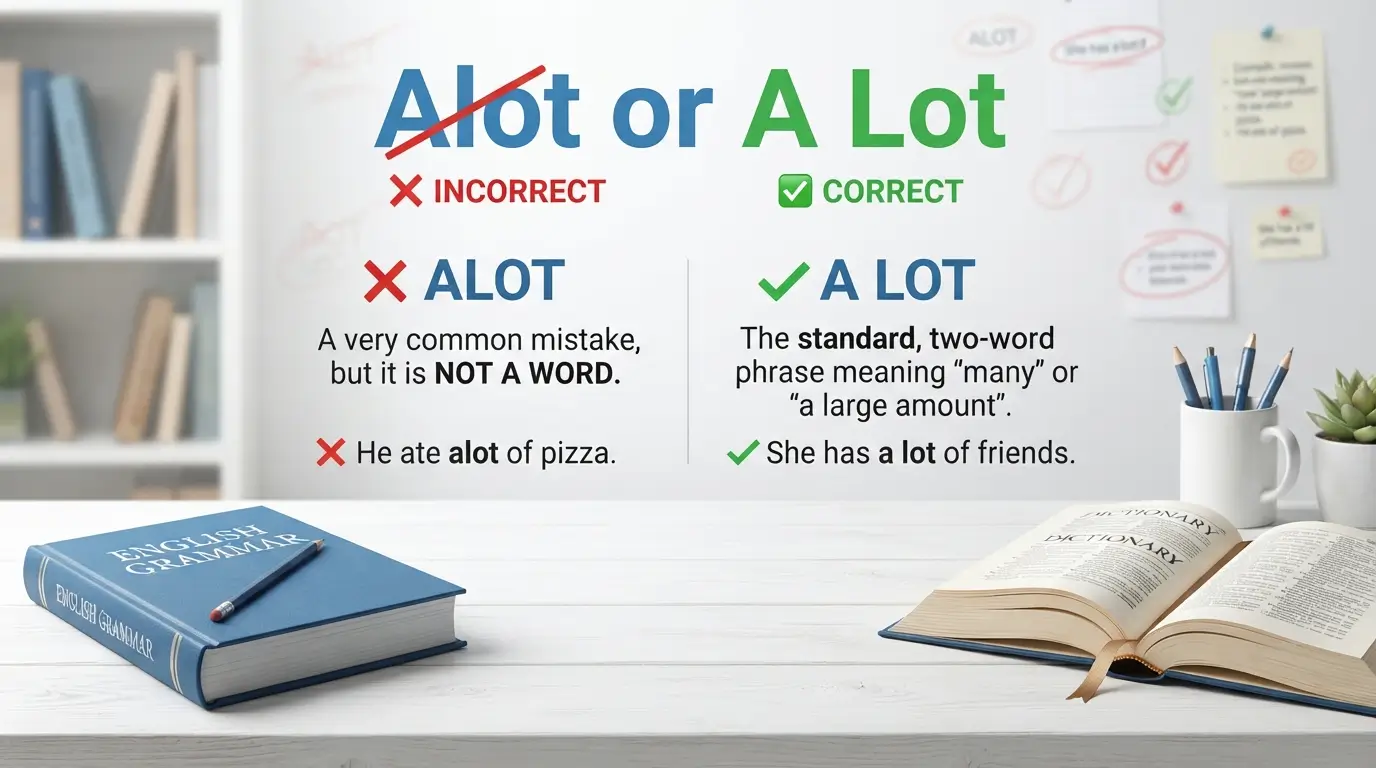
The answer is simple: a lot is the standard spelling. It is written as two separate words. It means “a large amount,” “many,” “very much,” or “often,” depending on the sentence. Alot is generally considered a misspelling, while allot is a real word with a completely different meaning.
People search for alot or a lot because the phrase sounds like one word when spoken. English also contains many words that were once separate but later joined together. This makes the confusion understandable.
This guide explains the difference, gives easy examples, explores the history of the phrase, and shows which form to use in American, British, Commonwealth, and global English.
Alot or A Lot – Quick Answer
The correct spelling is a lot, with a space.
Alot is not the standard spelling when you mean “many,” “much,” or “often.” Major English usage guides treat alot as an error.
Correct
- I have a lot of work today.
- She reads a lot.
- We learned a lot from the experience.
- There are a lot of people here.
Incorrect
- I have alot of work today.
- She reads alot.
- We learned alot from the experience.
There is also a third form: allot.
Allot is a correct word, but it has a different meaning. It means to give, assign, or distribute something.
- The manager will allot each employee two hours.
- We need to allot more time to this project.
A simple rule is:
A lot = a large amount or very much
Allot = assign or distribute
Alot = incorrect in standard English
Merriam-Webster describes a lot as a phrase made from the article a and the noun lot.
The History of Alot or A Lot
The history of a lot begins with the word lot.
The noun lot comes from Old English hlot, a word connected with an object used to decide something by chance. It could refer to a marked object, such as a piece of wood, used when people drew lots.
The word has Germanic roots and is related to words found in languages such as Dutch and German.
Over time, lot developed several meanings. It could mean a share, portion, destiny, or something assigned to a person.
The meaning eventually expanded into the idea of a large amount or number. The modern pronoun and adverb uses of a lot developed in the early 19th century. Dictionary.com records the expression in this sense from the early 1800s.
Why Does “Alot” Exist?
The spelling alot appears because speakers often hear a lot as one sound unit.
When people speak quickly, there is no obvious pause between “a” and “lot.” This can lead writers, especially English learners and young writers, to combine the two words.
The form alot has appeared in informal writing and historical print records, but it has not become the standard spelling. Etymological sources describe it as a misdivision of a lot.
So, although alot may look natural, standard English still requires the space.
British English vs American English Spelling
There is no British-versus-American spelling difference for this phrase.
Both American English and British English use:
a lot
They do not normally use alot as the standard form.
| Form | American English | British English | Meaning |
| a lot | Correct | Correct | A large amount, many, very much |
| alot | Incorrect | Incorrect | Nonstandard spelling |
| allot | Correct | Correct | To assign or distribute |
| lots of | Correct | Correct | Many or a large amount |
| a great deal | Correct | Correct | A large amount; more formal |
For example:
American English:
I have a lot of homework.
British English:
I have a lot of homework.
The spelling stays the same.
There can be differences between American and British English in words such as color/colour, center/centre, and organize/organise. But a lot is not one of those differences.
Oxford notes that a lot is common in English but can feel informal, especially in British English. In formal writing, alternatives such as much, a great deal, or a large amount may be better.
Which Spelling Should You Use?
The answer is easy for almost every audience:
If You Write American English
Use a lot.
- I have a lot of experience.
- She travels a lot for work.
Never use alot in professional or academic writing.
If You Write British English
Use a lot as well.
- There were a lot of people at the event.
- He talks a lot.
The same rule applies to British English.
If You Write Canadian or Australian English
Use a lot.
The spelling does not change simply because you are writing for another English-speaking country.
Write for a Global Audience
Use a lot.
This is the safest choice for websites, blogs, international emails, educational content, and online communication.
For formal writing, you may also replace a lot with a more precise word.
Instead of:
The study found a lot of problems.
You could write:
The study found many problems.
Or:
The study identified several significant problems.
The important point is that alot should not be used as a standard spelling in any of these varieties of English.
Common Mistakes with Alot or A Lot
Writing “alot” as One Word
This is the most common mistake.
❌ I have alot of questions.
✅ I have a lot of questions.
Remember: a + lot = a lot.
Confusing “A Lot” With “Allot”
These words look similar but have different meanings.
❌ The teacher will a lot ten minutes to each student.
✅ The teacher will allot ten minutes to each student.
But:
✅ The teacher has a lot of work today.
Allot is a verb.
A lot is a phrase.
Using “A Lot” Too Much in Formal Writing
The phrase is correct, but it can sound informal.
For example:
There are a lot of reasons for the change.
This is fine in everyday English.
In formal writing, consider:
There are many reasons for the change.
Or:
There are several important reasons for the change.
Confusing “A Lot” and “Lots”
Both can be correct.
- I have a lot of books.
- I have lots of books.
Lots of is often more informal.
Writing “A Lot” as “Alot” in Emails
Casual writing can encourage spelling shortcuts. However, workplace emails can be forwarded, saved, or read by managers and clients.
Use:
Thank you a lot for your help.
For a more professional tone, you could write:
Thank you very much for your help.
Alot or A Lot in Everyday Examples
Understanding real-life examples makes the rule easier to remember.
In Emails
Correct:
Thank you a lot for sending the information.
More professional:
Thank you very much for sending the information.
Incorrect:
Thank you alot for sending the information.
In Social Media
Social media is informal, but a lot is still the standard spelling.
I learned a lot from this trip.
We laughed a lot today.
There are a lot of great photos from this event.
You may see alot online, but seeing it often does not make it standard.
In News Writing
A news article might say:
A lot of residents attended the meeting.
However, professional news writing may prefer a more exact phrase:
Hundreds of residents attended the meeting.
Specific numbers are often stronger than vague expressions.
In Formal Writing
For essays, reports, and academic papers, a lot is grammatically correct but may be too informal in some contexts.
Instead of:
A lot of people believe that social media affects education.
You could write:
Many people believe that social media affects education.
Or:
A large number of people believe that social media affects education.
In Everyday Conversation
A lot is extremely natural in speech.
- I miss you a lot.
- She exercises a lot.
- We have a lot to discuss.
- He knows a lot about computers.
Alot or A Lot – Trends & Usage Data
Search interest for “alot or a lot” reflects a common spelling question: people often know what the phrase means but are unsure if it should be written as one word or two.
A key point is that search interest does not mean that both spellings are equally accepted. People may search for alot precisely because they are checking whether it is correct.
Dictionary and corpus evidence strongly favors a lot. One corpus-based analysis reported 211,375 instances of a lot compared with only 67 instances of alot in the Corpus of Contemporary American English data it examined.
Historical British National Corpus data has also shown that a lot greatly outnumbers alot, although the exact ratio differs by corpus and period.
Usage by Country
The spelling rule is consistent across major English varieties:
| Region | Standard Form | Nonstandard Form |
| United States | a lot | alot |
| United Kingdom | a lot | alot |
| Canada | a lot | alot |
| Australia | a lot | alot |
| New Zealand | a lot | alot |
| Global English | a lot | alot |
The important SEO and language point is this: “alot” has search visibility because people make the mistake or want to check the spelling. It is not evidence that “alot” has become the standard form.
Google search behavior can change over time, but standard dictionaries and professional usage guides continue to recommend a lot.
Alot or A Lot: Comparison Table
| Variation | Correct? | Meaning | Example |
| a lot | ✅ Yes | Many; much; very much; often | I read a lot. |
| alot | ❌ No | Usually intended to mean “a lot” | I read alot. |
| allot | ✅ Yes | Assign or distribute | We will allot two hours. |
| lots of | ✅ Yes | Many; a large amount | She has lots of books. |
| a great deal | ✅ Yes | A large amount | He has a great deal of experience. |
| many | ✅ Yes | A large number | Many students attended. |
| much | ✅ Yes | A large amount | We do not have much time. |
How to Remember the Correct Spelling
A simple memory trick can help:
A lot has two parts: “a” + “lot.”
You can even put another word between them:
a whole lot
a great lot
This shows that the phrase is not normally treated as one word.
For example:
We had a whole lot of fun.
You cannot write:
We had awholelot of fun.
The space in a lot is therefore easy to remember.
Another trick is to think of allot as an action:
Allot = assign.
For example:
The manager will allot each worker a task.
But:
The manager has a lot of tasks.
FAQs:
Is “alot” a correct word?
No. Alot is generally considered a misspelling of a lot in standard English. Use a lot when you mean “many,” “much,” “very much,” or “often.”
Is it “alot” or “a lot”?
The correct form is a lot, written as two words.
Correct:
I like this book a lot.
Incorrect:
I like this book alot.
Is “a lot” one word or two?
A lot is two words. The first word is the article a, and the second is the noun lot.
Is “allot” the same as “a lot”?
No. Allot is a verb meaning to assign or distribute something.
We will allot five minutes to each speaker.
A lot means a large amount or many.
We have a lot of speakers.
Can I use “a lot” in formal writing?
Yes, a lot is grammatically correct. However, it can sound informal in academic or highly formal writing. Depending on the sentence, many, much, a large number, or a great deal may be stronger choices.
Is “a lot” correct in British English?
Yes. British English uses a lot. The spelling is not different from American English.
Why do people write “alot”?
The phrase often sounds like one word when spoken. This can cause people to combine a and lot when writing. Informal online writing may also make the mistake more visible.
Conclusion:
When choosing between alot or a lot, the answer is clear: a lot is the correct standard spelling. Always write it as two words when you mean “many,” “a large amount,” “very much,” or “often.”
Alot is a common spelling mistake, but it is not the standard form in American, British, Canadian, Australian, or global English. Allot, on the other hand, is a real word. It means to assign, divide, or distribute something.
The phrase a lot has a long history. The word lot comes from Old English hlot, which was connected to shares and decisions made by chance. Its modern quantity and adverb uses developed much later.
For everyday writing, a lot is perfectly natural. For formal or academic work, consider words such as many, much, a great deal, or a specific number when possible.
The easiest rule is one you can use every time:
If you mean “many” or “very much,” write “a lot.” Never “alot.”
Read More Posts:
- Explained When to Use Cannot and Can Not in a Sentence
- How to Use Led and Lead Correctly in English (2026Guide)
- Then or Than: Simple Rules to Get It Right Every Time