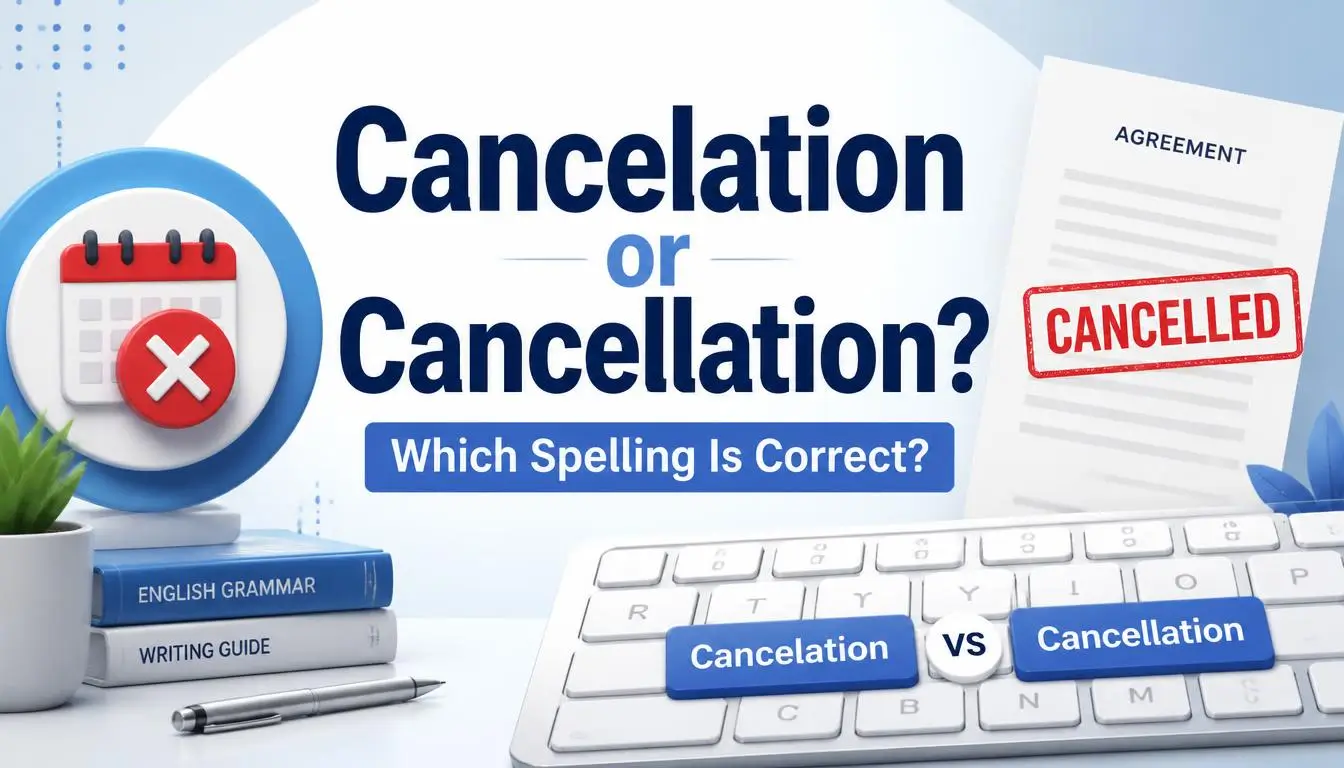
Words that look almost identical can create surprising confusion, and cancelation or cancellation is a perfect example.
If you have ever typed one spelling and wondered whether the other is more correct, you are not alone. Both forms appear in English, but they are not used with equal frequency.
People often search for cancelation or cancellation when writing emails, school assignments, business documents, travel notices, or online posts. The main question is simple: Which spelling should you use?
The short answer is that cancellation is the standard and much more common spelling in both British and American English. Cancelation is also a recognized spelling, especially in some American English usage, but it is far less common.
Understanding this difference can help you avoid spelling mistakes and choose the form that looks natural to your readers.
In this guide, we will explain the history of both spellings, compare British and American usage, examine common mistakes, and show you how to use the word correctly in everyday writing.
Cancelation or Cancellation – Quick Answer
Cancellation is the preferred spelling in most English writing.
Cancelation is also a valid spelling, but it is much less common.
Here are simple examples:
- Correct and common: The flight cancellation was announced this morning.
- Less common: The flight cancelation was announced this morning.
- Common: I received a cancellation email.
- Less common: I received a cancelation email.
The difference comes from how the word is formed from cancel.
The verb cancel ends in -el. When the suffix -ation is added, English can produce cancelation. However, the double-l form, cancellation, became the dominant spelling.
So, if you are unsure, choose cancellation. It is widely understood and accepted in American English, British English, and other varieties of English.
The Origin of Cancelation or Cancellation
The word cancellation comes from the verb cancel, which has a long history in English.
Cancel comes from the Latin word cancellare, meaning “to cross out” or “to make ineffective.” It was related to cancellus, meaning a lattice or grating. The idea of crossing something out eventually developed into the modern meaning of stopping, removing, or making something no longer valid.
English later formed the noun cancellation from cancel.
The spelling became interesting because English spelling does not always follow one simple rule. When a suffix is added to a word ending in a consonant, letters may sometimes be doubled.
This is why we see:
- cancel → cancellation
- control → controlled
- travel → travelling
- compel → compelling
However, spelling conventions can vary. As a result, cancelation also developed as an accepted form.
Over time, cancellation became much more common. Dictionaries and major publications generally recognize both forms, but the double-l spelling is the safer choice for most writers.
This is especially true when you want your writing to look standard and familiar.
British English vs American English Spelling
One common belief is that cancelation is strictly American and cancellation is strictly British. That is too simple.
Both spellings can be found in American English, while cancellation is strongly preferred in British English.
American English does show some spelling differences involving words ending in -l.
For example:
| Word | British English | American English |
| Cancel | cancel | cancel |
| Cancellation | cancellation | cancellation |
| Cancelled | cancelled | canceled |
| Cancelling | cancelling | canceling |
| Cancelation | uncommon | recognized but uncommon |
The important point is that American English often uses one l in forms such as canceled and canceling.
However, this does not mean that American English normally spells the noun as cancelation.
In fact, cancellation remains the more common spelling in American writing.
Comparison of Keyword Variations
| Variation | Correct? | Commonness | Recommended? |
| cancellation | Yes | Very common | Yes |
| cancelation | Yes | Less common | Usually no |
| Cancelllation | No | Incorrect | No |
| Cancelation | Yes | Less common | Usually no |
| Cancellations | Yes | Common plural | Yes |
| Cancelations | Yes | Uncommon plural | Usually no |
Therefore, if your goal is clear, professional English, cancellation is normally the best choice.
Which Spelling Should You Use?
Your choice can depend on your audience, but cancellation is the easiest option for most people.
For American English
Use cancellation in most situations.
For example:
The company announced the cancellation of the event.
Although cancelation may appear in American dictionaries and publications, it is much less familiar to many readers.
For British English
Use cancellation.
It is the standard spelling and will look natural to readers in the United Kingdom.
For Commonwealth English
Countries such as Canada, Australia, and New Zealand generally use cancellation in formal writing.
For Global or Online Writing
If your website has readers from different countries, cancellation is the safest choice.
It is widely recognized and avoids unnecessary confusion.
The same advice applies to professional emails, academic writing, resumes, reports, and business communication.
Simple rule: When in doubt, write cancellation.
Common Mistakes with Cancelation or Cancellation
The most common mistake is thinking that cancelation is the only correct American spelling.
That is not true.
Another mistake is adding too many letters:
❌ Cancelllation
✅ Cancellation
The incorrect version has three l’s in the middle.
Another problem occurs when writers confuse the noun with the verb.
For example:
❌ I cancellation my booking.
✅ I cancelled my booking.
✅ I canceled my booking.
Cancellation is a noun.
Cancel is a verb.
Compare these sentences:
- I need to cancel my reservation.
- The cancellation was unexpected.
- The airline cancelled the flight.
- The airline canceled the flight.
The last two examples reflect British and American spelling preferences.
More Common Errors
Wrong: Please confirm the cancelation.
Better: Please confirm the cancellation.
Wrong: We received three cancelllations.
Correct: We received three cancellations.
Wrong: The cancelation policy is unclear.
Better: The cancellation policy is unclear.
Using cancellation will help your writing match the form most readers expect.
Cancelation or Cancellation in Everyday Examples
The word cancellation appears in many areas of everyday life.
In Emails
Subject: Flight Cancellation Notice
We are writing to inform you about the cancellation of your flight.
This spelling is professional and natural.
In Business Writing
The company has a strict cancellation policy for appointments.
Business documents normally use cancellation because it is the more familiar standard form.
In News
News reports often use the word when discussing canceled events, flights, services, or contracts.
For example:
The sudden cancellation of the concert disappointed thousands of fans.
On Social Media
People may write:
Due to heavy rain, tonight’s event is subject to cancellation.
The word works well in both casual and formal posts.
In Travel
Hotels, airlines, and booking websites frequently use cancellation.
Examples include:
- Free cancellation
- Cancellation policy
- Cancellation fee
- Flight cancellation
- Hotel cancellation
In Formal Writing
The cancellation of the agreement must be confirmed in writing.
Here, cancellation is the preferred choice because formal writing benefits from familiar and widely accepted spelling.
Cancelation or Cancellation – Google Trends & Usage Data
Search interest can help explain why people continue to search for cancelation or cancellation.
The two spellings do not have equal popularity. Cancellation is far more common in general English usage and online searches.
Search behavior can vary by country, though. American users may encounter cancelation because American English sometimes prefers a single l in related forms such as canceled and canceling.
However, this pattern should not be applied automatically to the noun.
For example:
- American English: canceled
- American English: canceling
- American English: cancellation
This explains an important point: American spelling does not require cancelation.
When people search Google for cancelation or cancellation, they are often trying to solve a practical writing problem. They may be checking a business email, travel message, school assignment, website copy, or professional document.
Because cancellation has much broader usage, it is the stronger choice for general SEO content and global audiences.
Cancellation vs Cancelation: Which One Is Better?
Here is the easiest way to remember the difference:
| Situation | Best Choice |
| Formal writing | cancellation |
| Business email | cancellation |
| Academic writing | cancellation |
| British English | cancellation |
| Global audience | cancellation |
| American English | cancellation |
| Dictionary-recognized alternative | cancelation |
| SEO content | cancellation |
Although cancelation is not necessarily a spelling error, it is not usually the best choice.
If you want your writing to sound natural to the largest number of English readers, use cancellation.
FAQs:
Is cancelation or cancellation correct?
Both cancelation and cancellation are recognized spellings. However, cancellation is much more common and is the preferred spelling for most English writing.
Is cancelation an American spelling?
Cancelation can be found in American English, but it is not the main spelling used by American writers. Cancellation remains much more common.
Is cancellation British or American?
Cancellation is used in both British and American English. It is not limited to one variety of English.
Why does cancellation have two Ls?
The spelling developed from cancel plus the suffix -ation. The double-l form became the dominant spelling over time.
Is cancelation a spelling mistake?
Not necessarily. Cancelation is a recognized variant, but it is much less common than cancellation.
Should I use cancellation in formal writing?
Yes. Cancellation is the safest choice for formal writing, professional emails, academic work, websites, and business documents.
What is the plural of cancellation?
The plural is cancellations.
For example:
The airline announced several cancellations because of the storm.
Conclusion:
When choosing between cancelation or cancellation, the safest answer is simple: use cancellation in most cases. While cancelation is a recognized variant, it is far less common and may look unusual to many readers.
The double-l spelling works across British English, American English, and most other major forms of English.
It is also the natural choice for business writing, academic work, emails, websites, news content, and everyday communication.
It is also helpful to separate the noun from related verb forms. American English commonly uses canceled and canceling, while British English often uses cancelled and cancelling. However, both varieties commonly use cancellation.
So, if you need one spelling that is clear, professional, and widely accepted, choose cancellation. Remembering this simple rule can help you write with confidence whenever this confusing spelling appears.
Read More Posts:
- Travelling or Traveling in British & American English
- Loosing or Losing: Correct Usage in English (2026Guide)
- Anytime or Any Time: Grammar Rules Made Easy (2026Guide)