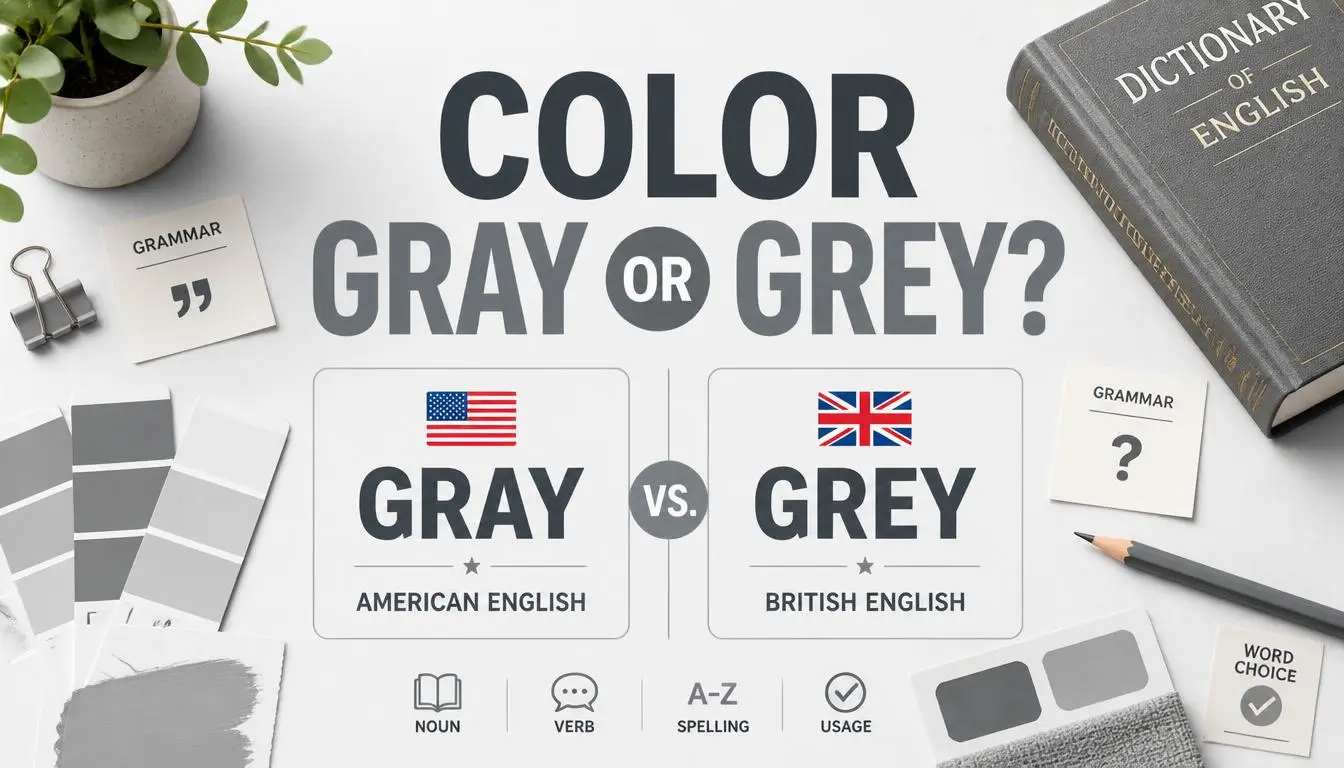
A single letter can create a surprising amount of confusion. Should you write color gray or grey? Both spellings are correct, but the preferred form depends mainly on the variety of English you use.
Gray is more common in American English, while grey is preferred in British English and is also widely used in Canada and other English-speaking regions.
People often search for “color gray or grey” when writing school assignments, emails, websites, product descriptions, or professional documents. They may know the meaning but want to avoid choosing the “wrong” spelling.
The good news is simple: neither spelling is incorrect. The difference is mostly regional and stylistic.
Next, this guide explains where the two spellings came from, when to use each one, common mistakes to avoid, and how usage differs across countries. By the end, you will know exactly whether gray or grey is the better choice for your audience.
Color: Gray or Grey
Gray and grey are two correct spellings of the same color.
- Gray → preferred in American English
- Grey → preferred in British English
- Grey → also common in Canadian English and other varieties
- Both mean a color between black and white.
Examples
American English:
She wore a gray dress.
British English:
She wore a grey dress.
The meaning does not change. Only the spelling changes.
Merriam-Webster confirms that both forms are accepted, with gray more frequent in US English and grey preferred in the UK, Canada, and elsewhere.
So, if you are writing for an American audience, choose gray. If your audience uses British English, choose grey.
The Evolution of Color Gray or Grey
The words gray and grey have a very old history. Both developed from the same English word.
The modern forms can be traced back to Old English grǣg, meaning “gray.” The word is also related to similar color words in other Germanic languages.
Over time, English spelling changed. Middle English writers used several forms, including variations such as grai, grei, greye, and gray. The Oxford English Dictionary records many of these historical spellings.
Eventually, gray and grey became the two main modern forms.
The difference between them became especially associated with regional English. Today, American English generally favors gray, while British English favors grey.
Interestingly, the spelling difference is relatively recent compared with the long history of the word. Etymological sources note that the distinct British grey and American gray preference developed in the modern period.
Why Are There Two Spellings?
English has many regional spelling differences. Some developed because English speakers in different countries gradually adopted different spelling conventions.
For example:
- color → colour
- favorite → favourite
- center → centre
- gray → grey
The gray/grey difference is therefore part of a larger pattern between American and British English.
British English vs American English Spelling
The easiest rule is:
American English → gray
British English → grey
Here is a quick comparison:
| English variety | Preferred spelling | Example |
| American English | gray | The sky is gray. |
| British English | grey | The sky is grey. |
| Canadian English | grey | She has grey eyes. |
| Australian English | grey | He bought a grey shirt. |
| New Zealand English | grey | The walls are grey. |
| International writing | Depends on audience | Follow your chosen style |
The distinction also appears in related words and expressions.
| American English | British/Commonwealth English |
| gray hair | grey hair |
| gray eyes | grey eyes |
| gray area | grey area |
| gray matter | grey matter |
| gray whale | grey whale |
| gray sweater | grey sweater |
| gray sky | grey sky |
There is one important point: do not switch between gray and grey randomly within the same piece of writing.
If you start an American English article with gray, keep using gray unless a proper name or official title uses grey.
Which Spelling Should You Use?
The best spelling depends on your reader.
If Your Audience Is American
Use gray.
For example:
The house has a gray roof.
She bought a gray jacket.
Scientists study gray matter in the brain.
This is the safest choice for US websites, school papers, business writing, and American publications.
If Your Audience Is British
Use grey.
For example:
The house has a grey roof.
She bought a grey jacket.
The walls were painted grey.
This fits British English conventions.
Your Audience Is Canadian or Commonwealth
Grey is generally the better choice.
Canadian English commonly uses grey, although some organizations and style systems may have their own preferences.
If You Write for a Global Audience
Either spelling can work.
The important thing is consistency. Choose one spelling based on your main audience and use it throughout the article.
For SEO content, this is especially useful. If your website targets US readers, gray should usually be your main spelling. If it targets UK readers, grey is generally more natural.
Common Mistakes with Color Gray or Grey
Even though the spelling is simple, several mistakes are common.
Mistake 1st: Thinking One Spelling Is Wrong
Incorrect idea:
“Grey is wrong because gray is the correct spelling.”
That is not true.
Correction: Both gray and grey are correct. Regional preference determines which one is more suitable.
Mistake 2nd: Mixing Both Spellings
For example:
She wore a grey shirt with gray shoes and a grey hat.
This is not necessarily grammatically wrong, but it can look inconsistent.
Better:
She wore a grey shirt with grey shoes and a grey hat.
Or:
She wore a gray shirt with gray shoes and a gray hat.
Mistake 3rd: Using “Grey” in American Copy Without a Reason
American readers will understand grey, but gray usually matches American spelling conventions better.
Mistake 4th: Changing a Proper Name
Some names and titles officially use Grey.
For example, Grey’s Anatomy uses “Grey” as part of its official title. Some brands and names also retain their original spelling.
In such cases, do not change Grey to Gray simply to match American spelling.
Mistake 5th: Confusing Gray With “Greyhound”
The word greyhound is normally spelled with grey, even in American English. Its history is not simply a reference to the animal’s color. Merriam-Webster notes that its first element has a different etymological history.
Color Gray or Grey in Everyday Examples
Understanding real-world usage makes the difference easier to remember.
In Emails
American English:
Please use the gray template attached to this email.
British English:
Please use the grey template attached to this email.
Both are correct.
In News Writing
A US publication may write:
Dark gray clouds covered the city.
A UK publication may write:
Dark grey clouds covered the city.
The style reflects the publication’s English variety.
On Social Media
Social media is less formal, so either spelling may appear:
Loving this gray outfit!
or:
Loving this grey outfit!
Your choice should match your usual writing style and audience.
In Formal Writing
Consistency matters more in formal writing.
US style:
The report examines the effects of gray areas in environmental policy.
UK style:
The report examines the effects of grey areas in environmental policy.
In Design and Fashion
Both forms are common:
- gray sofa
- grey sofa
- gray dress
- grey dress
- gray walls
- grey walls
Again, the spelling depends on the English variety.
Color Gray or Grey – Trends & Usage Data
Search interest for gray and grey reflects the same regional pattern seen in dictionaries and everyday writing.
In broad terms, gray is strongly associated with the United States, while grey is more common in the United Kingdom, Canada, Australia, and other regions where British spelling conventions have greater influence. Merriam-Webster describes gray as more frequent in American English and grey as preferred in Canada, the UK, and elsewhere.
Google Trends can also show regional differences in search behavior. However, search-volume comparisons should be treated as relative interest, not as a direct count of how many people use each spelling.
Search behavior can also change based on context. Someone searching for:
- gray color
- grey colour
- gray hair
- grey hair
- gray paint
- grey paint
may be influenced by regional spelling, product names, or the wording used on websites they already read.
For SEO, the best approach is not to force both spellings into every sentence. Instead, use the spelling that matches your target audience and naturally mention the alternative when explaining the difference.
Color Gray or Grey: Comparison Table
| Feature | Gray | Grey |
| Meaning | Color between black and white | Color between black and white |
| Correct spelling? | Yes | Yes |
| US English | Preferred | Less common |
| UK English | Less common | Preferred |
| Canadian English | Used | Commonly preferred |
| Australian English | Used | Commonly preferred |
| Pronunciation | Same | Same |
| Main difference | Regional spelling | Regional spelling |
| Example | gray shirt | grey shirt |
| Best for US SEO | Yes | Secondary variation |
| Best for UK SEO | Secondary variation | Yes |
The key point is simple: the words mean the same thing and are pronounced the same way.
FAQs:
Is it gray or grey?
Both are correct. Gray is preferred in American English, while grey is preferred in British English and commonly used in several other countries.
Is gray the American spelling?
Yes. Gray is the more common spelling in American English.
Is grey the British spelling?
Yes. Grey is the standard preferred spelling in British English.
Which is correct, gray color or grey colour?
Both can be correct, depending on your English variety:
- American English: gray color
- British English: grey colour
Notice that both words can change: gray/color follows American spelling, while grey/colour follows British spelling.
Do grey and grey have the same meaning?
Yes. They refer to the same range of neutral colors between black and white.
Is “gray” or “grey” better for SEO?
Neither is universally better. Use the spelling that matches your target audience. If you target US readers, gray is usually the better primary spelling. For UK readers, grey is usually better.
Should I use gray or grey in an academic paper?
Follow the spelling style required by your school, university, publisher, or country. Most importantly, stay consistent throughout the paper.
Conclusion:
The answer to color gray or grey is simple: both spellings are correct. The main difference is regional preference. Gray is the standard choice in American English, while grey is preferred in British English and is also widely used in Canada, Australia, and other Commonwealth English varieties.
The two spellings come from the same Old English word, grǣg, and their modern difference developed through changes in English spelling and regional usage.
If you write for Americans, choose gray. If you write for British or Commonwealth readers, grey is usually the better choice. For a global audience, either works, but consistency is essential.
Most importantly, do not worry that one form is grammatically wrong. The choice is mainly about regional English, audience, and style. Once you know your readers, choosing between gray and grey becomes easy.
Read More Posts:
- How to Use “Whether or Not” in Formal and Casual English
- Sit or Start: Correct Usage Guide With Examples
- Lie Down or Lay Down: How to Use Each Correctly

Toni Morrison is a celebrated American novelist known for her powerful storytelling, rich characters, and lasting impact on literature. At GrammerNests.com, she shares insights that help readers appreciate language, writing, and literary expression.