Lie down or lay down is a common English grammar question. You hear both phrases in daily conversations, songs, movies, and social media, so it can be hard to know which one is correct. The confusion becomes even greater because lie and lay are both real words, but they follow different grammar rules.
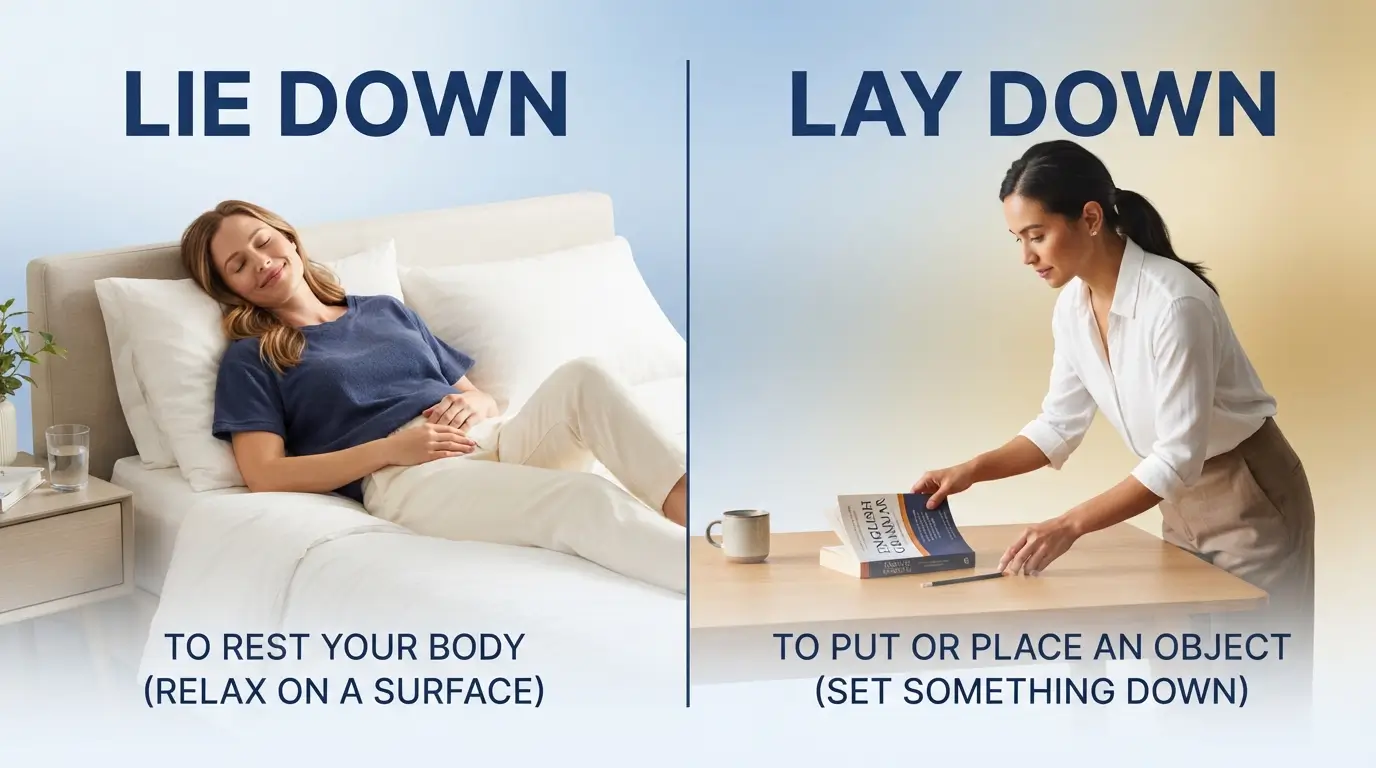
The simple answer is this: lie down is usually correct when you mean to recline or rest your own body. Lay down is correct when you mean to put something or someone down.
For example, you can say, “I need to lie down because I am tired.” However, you would say, “Please lay down the book.”
The problem is that the past tense of lie is lay. Therefore, “I lay down yesterday” is correct. This makes the whole topic confusing because lay can be both a present-tense verb and the past tense of lie.
In this guide, you will learn the difference between lie down or lay down, their history, common mistakes, regional usage, everyday examples, and an easy rule you can remember.
Lie Down or Lay Down
The main difference is whether the subject is resting itself or putting something somewhere.
Use “lie down” when you rest or recline.
I want to lie down.
Please lie down and rest.
The dog needs to lie down.
Here, the person or animal is doing the action to itself.
Use “lay down” when you put something somewhere.
Lay down the book.
She laid down her phone.
Please lay down the tools.
Here, an object receives the action.
The confusing part: “lay” is also the past tense of “lie.”
Present:
I lie down every afternoon.
Past:
I lay down yesterday.
Past participle:
I have lain down already.
So, remember:
| Meaning | Correct form | Example |
| Rest yourself | lie down | I need to lie down. |
| Put something somewhere | lay down | Lay down the book. |
| Past of lie | lay down | I lay down yesterday. |
| Past participle of lie | lain down | I have lain down. |
| Past of lay | laid down | I laid down the book. |
The key is to look at what receives the action.
The History of Lie Down or Lay Down
The confusion between lie and lay is not new. Both verbs have very old Germanic roots, but they developed with different meanings.
Lie comes from an Old English verb related to the idea of resting, reclining, or being in a horizontal position. Its basic meaning has remained fairly stable.
Lay comes from a different Old English verb meaning to put, place, or set something down.
Although their meanings are different, their forms became confusing because the past tense of lie is lay.
The basic forms are:
Lie:
- Present: lie
- Past: lay
- Past participle: lain
- Present participle: lying
Lay:
- Present: lay
- Past: laid
- Past participle: laid
- Present participle: laying
This creates a pattern that looks unusual:
I lie down every night.
Yesterday, I lay down early.
I have lain down already.
At the same time:
I lay the book down.
Yesterday, I laid the book down.
I have laid the book down.
The spelling difference is therefore not simply an American versus British English issue. The main distinction comes from the different verbs and their grammatical forms.
English learners often struggle with these verbs because lay appears as the present form of one verb and the past form of another.
British English vs American English Spelling
Unlike some spelling differences between British and American English, lie down and lay down follow essentially the same grammar rules in both varieties.
The major difference is usually not spelling. Instead, the problem comes from informal speech and regional habits.
In both American and British English:
I need to lie down.
is the standard form when you mean “rest.”
Likewise:
Lay down the book.
is standard when you mean “put the book down.”
However, in casual speech, some speakers use lay down when they mean lie down.
For example:
I need to lay down.
You may hear this often, especially in informal American speech, but traditional standard grammar recommends:
I need to lie down.
British vs American Comparison
| Meaning | American English | British English |
| Rest your body | Lie down | Lie down |
| Put an object down | Lay it down | Lay it down |
| Past of “lie” | Lay down | Lay down |
| Past of “lay” | Laid down | Laid down |
| Past participle of “lie” | Lain | Lain |
| Informal misuse | “I need to lay down” may occur | “I need to lay down” may occur |
| Standard grammar | Lie down | Lie down |
The important point is that the standard rule is the same on both sides of the Atlantic.
Which Spelling Should You Use?
Since the main issue is grammar rather than spelling, choose the form based on the meaning of your sentence.
For American English
Use lie down when the subject rests.
I am tired, so I am going to lie down.
Use lay down when someone puts an object somewhere.
Lay down your phone.
Although you may hear “I’m going to lay down” in casual American speech, “I’m going to lie down” is the standard grammatical form.
British and Commonwealth English
The same rule applies:
I need to lie down.
Lay down your bag.
British and Commonwealth readers will understand both forms, but standard written English maintains the distinction.
For Global English
If you are writing for an international audience, use the traditional grammar rule.
Ask yourself:
Am I resting, or am I placing something?
- Resting → lie
- Placing → lay
This simple question works in emails, academic writing, websites, reports, and professional communication.
Common Mistakes with Lie Down or Lay Down
Mistake 1st: “I need to lay down.”
This is probably the most common mistake.
❌ I need to lay down.
If you mean that you want to rest, write:
✓ I need to lie down.
Mistake 2nd: “Lay down and take a rest.”
If you are telling someone to recline, the standard form is:
✓ Lie down and rest.
However, if an object follows the verb, lay can be correct:
✓ Lay the baby down carefully.
Mistake 3rd: Forgetting the past tense
People sometimes think that “I laid down yesterday” is correct because they know lay is associated with resting.
But if you mean that you rested, the correct sentence is:
✓ I lay down yesterday.
Why?
Because:
lie → lay → lain
Mistake 4th: Confusing “laid” and “lain”
These forms belong to different verbs.
I have lain down.
means I have rested or reclined.
I have laid the book down.
means I have placed the book somewhere.
Mistake 5th: Saying “I have lay down”
This is incorrect.
❌ I have lay down.
The correct form is:
✓ I have lain down.
Mistake 6th: Using “lying” incorrectly
The present participle of lie is lying.
✓ She is lying down.
The present participle of lay is laying.
✓ She is laying the book down.
These two sentences have different meanings.
Lie Down or Lay Down in Everyday Examples
The best way to learn this rule is to see it in real situations.
In Emails
A casual message might say:
I have a headache, so I am going to lie down for a while.
A workplace message might say:
I am not feeling well and need to lie down for a short time.
When referring to an object:
Please lay the documents down on the desk.
In News Writing
News reports may describe someone resting:
The injured player lay down on the field.
Notice that lay is correct here because the sentence describes a past action of lying.
News writing may also describe someone placing something:
The officer laid the report down on the table.
Here, laid is the past tense of lay.
On Social Media
Informal posts often contain:
I just want to lie down and sleep.
You may also see:
I’m going to lay down for a few hours.
The second version is common in informal speech and online writing, but lie down is the standard form when the subject is resting.
In Formal Writing
Formal writing should maintain the distinction:
The patient was asked to lie down.
The assistant laid the documents down on the desk.
This makes the meaning clear and follows standard grammar.
More Everyday Examples
| Sentence | Correct? | Explanation |
| I need to lie down. | ✓ | Resting |
| Please lie down. | ✓ | Resting |
| Lay down the book. | ✓ | Putting something down |
| I lay down yesterday. | ✓ | Past tense of lie |
| I laid down yesterday. | ✗ | Wrong if you mean rested |
| I have lain down. | ✓ | Past participle of lie |
| I have laid down the book. | ✓ | Past participle of lay |
| She is lying down. | ✓ | Resting |
| She is laying down the book. | ✓ | Putting the book down |
Lie Down or Lay Down – Trends & Usage Data
Search interest for “lie down or lay down” comes mainly from people trying to solve a grammar problem. Students, English learners, writers, editors, and native speakers often search the phrase because the two verbs have overlapping forms.
Google Trends can show relative search interest over time and by location, but it does not determine which grammatical form is correct. Search data can also change based on education, language-learning trends, and regional usage.
The confusion is especially understandable in countries where English is widely learned as a second language. People encounter sentences such as:
I lie down every night.
and:
I lay down yesterday.
The changing form can make the rule seem harder than it is.
Usage by Country and Region
| Region | Standard form for resting | Common informal variation |
| United States | lie down | “lay down” |
| United Kingdom | lie down | “lay down” |
| Canada | lie down | “lay down” |
| Australia | lie down | “lay down” |
| New Zealand | lie down | “lay down” |
| International English | lie down | “lay down” |
The important lesson is that lie down remains the standard choice when the subject is resting.
Lie Down vs Lay Down: Comparison Table
Here is a quick side-by-side guide.
| Form | Verb | Meaning | Example |
| lie down | lie | Rest/recline | I want to lie down. |
| lay down | lay | Put/place something | Lay down the book. |
| lay down | lie, past | Rested/reclined | I lay down yesterday. |
| lain down | lie, past participle | Have rested | I have lain down. |
| laid down | lay, past | Put/placed | I laid down the book. |
| lying down | lie, -ing | Resting now | She is lying down. |
| laying down | lay, -ing | Placing now | She is laying down the book. |
The Easy Memory Trick
Think:
Lie = yourself.
Lay = something else.
For example:
I lie down.
I lay the phone down.
The moment you put an object after the verb, lay is often the correct choice.
FAQs:
Is it “lie down” or “lay down”?
Lie down is correct when you mean to rest or recline.
I need to lie down.
Lay down is correct when you mean to put something somewhere.
Lay down the book.
Is “I am going to lay down” grammatically correct?
In standard English, use:
I am going to lie down.
Here, you are talking about resting yourself. Lay requires an object when it is the present-tense verb meaning “put.”
Is “I lay down yesterday” correct?
Yes. Lay is the past tense of lie.
I lie down every afternoon.
I lay down yesterday afternoon.
What is the past tense of “lie down”?
The past tense is lay down.
Today: I lie down.
Yesterday: I lay down.
What is the past participle of “lie”?
The past participle is lain.
I have lain down for an hour.
Do not confuse it with laid, which belongs to the verb lay.
Should I say “lie down” in formal writing?
Yes. If you mean “rest” or “recline,” lie down is the standard form and is appropriate in formal writing.
Why do people say “lay down” instead of “lie down”?
Because lie and lay have similar sounds and overlapping forms. The past tense of lie is lay, which creates extra confusion. In casual speech, many speakers also use lay down for lie down.
Conclusion:
Knowing when to use lie down or lay down becomes much easier once you focus on meaning instead of memorizing isolated words. Lie down is the standard choice when a person or animal rests or reclines.
I need to lie down.
Lay down is used when someone puts or places something somewhere.
Lay down the book.
The biggest source of confusion is that lay is also the past tense of lie:
I lie down today.
Lay down yesterday.
I have lain down already.
At the same time, the verb lay has its own forms:
I lay the book down.
Laid the book down yesterday.
I have laid the book down.
These rules are the same in standard American, British, and Commonwealth English. While “lay down” is common in informal speech when people mean “lie down,” lie down remains the safest choice for standard writing.
When in doubt, remember one simple rule: lie for resting yourself, lay for putting something down. That shortcut will help you choose correctly in everyday and professional writing.
Read More Posts:
- Use to or Used to: British vs American English Guide 2026
- Whose or Who’s? The Simple Guide to Using Them Correctly
- When to Use Every Day or Everyday Explain With Examples

Emily Dickinson is one of America’s most influential poets, recognized for her unique style and thought-provoking poetry. Through GrammerNests.com, she contributes valuable perspectives on language, creativity, and the beauty of written expression.