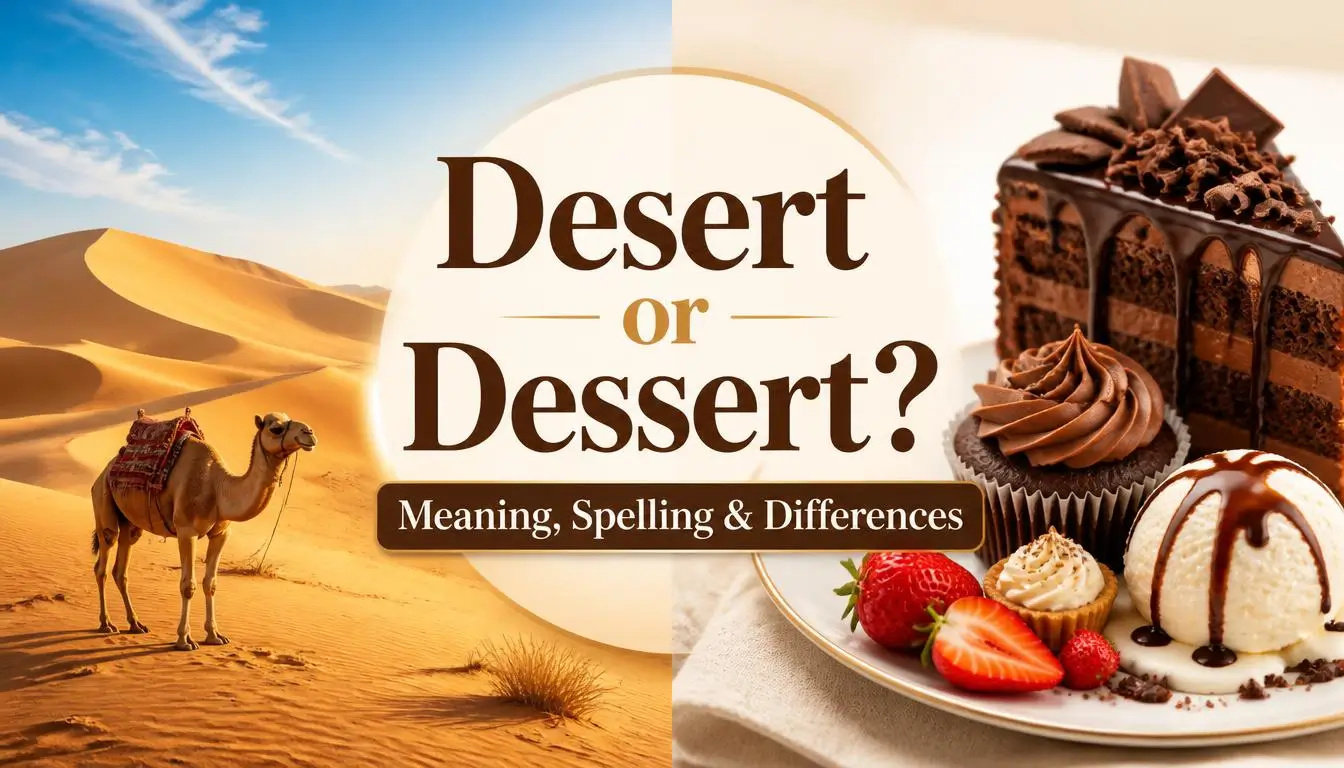
Desert or dessert? These two words look almost the same, but they have very different meanings. One can describe a dry, sandy region, while the other is the sweet food you enjoy after a meal. The only spelling difference is one extra s, yet that small letter can completely change your sentence.
This is why people often search for “desert or dessert,” “desert vs dessert,” or “how to spell dessert.” Students may see the words in schoolwork, writers may question them while editing an article, and English learners may confuse them in everyday conversation.
Even native speakers sometimes pause before typing one of them.
The good news is that the rule is simple. Desert usually means dry land or, as a verb, to leave someone or something. Dessert means a sweet course served after a meal. The extra s in dessert is your best memory clue.
Next, deeply explains the difference, origins, pronunciation, spelling, common mistakes, examples, and search trends so you can use both words correctly.
Desert or Dessert – Quick Answer
The quick answer is:
- Desert = a dry area of land with little rainfall.
- Dessert = a sweet food served at the end of a meal.
Examples
Desert:
The camel crossed the desert.
Dessert:
We had chocolate cake for dessert.
There is also another meaning of desert. As a verb, it means to leave or abandon someone or something.
He did not want to desert his team.
The pronunciation also helps. As a noun meaning dry land, desert is usually pronounced with stress on the first syllable: DEZ-ert. Dessert has stress on the second syllable: deh-ZERT. This difference in stress is also noted in common usage guides.
Easy memory trick
Remember:
Dessert has two S’s because you want Seconds.
So:
One S = desert → sand, sun, dry land
Two S’s = dessert → sweet food, seconds
This is not the historical reason for the spelling, but it is an easy way to remember it.
The History of Desert or Dessert
Although desert and dessert look almost identical, they developed from different historical paths.
Where does “desert” come from?
The noun desert, meaning dry or barren land, goes back through Middle English and Anglo-French to Latin dēserta, meaning uninhabited or deserted places. It is connected with the Latin verb dēserere, meaning to abandon or leave. Merriam-Webster records the first known use of desert in this sense in the 13th century.
This history helps explain why desert can also be a verb.
For example:
The soldiers decided to desert their post.
Here, desert means to abandon or leave.
Where does “dessert” come from?
Dessert has a different history. It came into English from French dessert, related to desservir, meaning to clear the table.
The word developed into the name for a course served at the end of a meal. Merriam-Webster gives its first known English use as 1600.
So the two words are not simply different spellings of the same word. They have different meanings and different etymological histories.
Why do they look so similar?
English contains many words borrowed from French and Latin. Over centuries, spelling and pronunciation changed as these words became part of English.
In this case, the similar appearance can make the words easy to confuse. But their meanings remain separate:
- desert → dry land or abandon
- dessert → sweet food after a meal
That is why spelling matters so much.
British English vs American English Spelling
Unlike words such as color/colour or center/centre, there is no standard British-American spelling difference between desert and dessert.
Both British and American English use:
- desert
- dessert
The meanings are also the same.
| Word | American English | British English | Meaning |
| desert | desert | desert | Dry land; also “to abandon” |
| dessert | dessert | dessert | Sweet food served after a meal |
The important point is that you should not choose the spelling based on whether your audience is American or British. Choose it based on meaning.
Examples in American English
We drove through the desert.
They served ice cream for dessert.
In British English
The desert is home to many unusual animals.
We had fruit and cake for dessert.
Both versions are correct.
This makes the pair easier in one way: you do not need to learn a regional spelling rule. You only need to remember which word matches the meaning.
Which Spelling Should You Use?
The correct spelling depends on what you mean, not where your reader lives.
Use “desert” for dry land
Use desert when talking about a dry region with little rainfall.
Examples:
- the Sahara Desert
- a desert climate
- desert plants
- desert animals
- a desert landscape
The desert becomes very cold at night.
Use “desert” to mean abandoning someone.
Use desert as a verb when someone leaves or abandons a person, place, duty, or responsibility.
He would never desert his family.
The soldiers were accused of deserting their posts.
Use “dessert” for sweet food
Use dessert when talking about food eaten after a meal.
Examples include:
- cake
- ice cream
- pudding
- pie
- cheesecake
- fruit
- pastries
Would you like dessert?
The restaurant offers several desserts.
What about global English?
For international websites, academic writing, business emails, and social media, the same rule applies:
Dry land = desert.
Sweet food = dessert.
You do not need to change the spelling for a US, UK, Canadian, Australian, or international audience.
Common Mistakes with Desert or Dessert
Because the words are so similar, several mistakes appear again and again.
Mistake 1st: “I love chocolate desert.”
Incorrect:
I ordered chocolate desert.
Correct:
I ordered chocolate dessert.
Chocolate is food, so the correct spelling is dessert.
Mistake 2nd: “Camels live in the dessert.”
Incorrect:
Camels live in the dessert.
Correct:
Camels live in the desert.
Camels may live in dry regions, so the correct word is desert.
Mistake 3rd: “We had ice cream for desert.”
Incorrect:
We had ice cream for desert.
Correct:
We had ice cream for dessert.
Ice cream is a sweet course, so use dessert.
Mistake 4th: “The dessert was extremely hot.”
If you mean a dry region, this is incorrect.
Correct:
The desert was extremely hot.
Mistake 5th: Confusing “just deserts” and “just desserts”
This is a special case.
The established expression is “just deserts,” with one s in the middle.
He finally got his just deserts.
Here, deserts does not mean dry land. It comes from a different historical noun related to what someone deserves. Merriam-Webster explains that this expression refers to a deserved reward or punishment.
So:
just deserts = a deserved reward or punishment
dessert = sweet food
This is one reason the pair can be especially confusing.
Desert or Dessert in Everyday Examples
Knowing the difference is useful in many types of writing.
In emails
Correct:
Thank you for joining us. Dessert will be served after dinner.
Incorrect:
Thank you for joining us. Desert will be served after dinner.
When discussing food, always use dessert.
In news writing
Correct:
Scientists are studying how animals survive in the desert.
Here, desert refers to an environment.
On social media
Correct:
This cheesecake is officially my favorite dessert!
Food posts commonly use dessert.
Another example:
Watching the sunset in the desert was unforgettable.
Here, desert refers to the landscape.
In formal writing
Academic and professional writing may use both words.
Desert ecosystems can support highly adapted plant and animal species.
And:
The hotel offers a selection of desserts after dinner.
The surrounding context makes the correct spelling clear.
In travel writing
Travel articles often use both words in the same paragraph:
After exploring the desert during the afternoon, we returned to the hotel for dinner and dessert.
This sentence is a useful way to remember the difference because both words appear together.
Desert or Dessert – Google Trends & Usage Data
Search interest around “desert or dessert” is mainly driven by spelling confusion, English learning, schoolwork, grammar questions, and everyday writing. The two words also belong to very different search topics.
Desert commonly appears in searches about:
- geography
- travel
- climate
- wildlife
- nature
- deserts of the world
- environmental science
Dessert is strongly connected with:
- recipes
- restaurants
- baking
- cakes
- ice cream
- food blogs
- menus
- holiday meals
Google Trends uses normalized relative interest rather than a fixed worldwide search-volume number, and results can change based on the selected country, date range, and search type.
For that reason, it is better not to treat a single search-volume figure as a permanent measure of popularity.
Historical Google-related spelling research also shows that desert has appeared among difficult spelling searches in several U.S. states, showing that this is not simply a rare classroom question.
The broader pattern is easy to understand: people search desert when the topic is usually land, climate, or geography, while dessert becomes more common in food-related contexts. Search interest can also rise around seasonal food topics and periods when people are actively looking for recipes.
For user-engaging writers, the key lesson is simple: do not treat the words as interchangeable keywords. They represent different search intents.
Desert vs Dessert: Comparison Table
| Feature | Desert | Dessert |
| Main meaning | Dry land with little rainfall | Sweet food after a meal |
| Spelling | One s | Two s’s |
| Common topic | Geography and climate | Food and dining |
| Part of speech | Noun, adjective, verb | Mainly noun |
| Pronunciation | DEZ-ert for dry land | deh-ZERT |
| Example | The desert is vast. | The dessert was delicious. |
| Memory clue | Sand and sun | Seconds and sweets |
| US spelling | Desert | Dessert |
| UK spelling | Desert | Dessert |
| Canadian spelling | Desert | Dessert |
| Australian spelling | Desert | Dessert |
A Simple Way to Never Confuse Them
If you still struggle with these words, use a two-step test.
Step 1st: Ask what the sentence is about
Is it about:
Land, sand, heat, climate, or abandonment?
Use desert.
Is it about:
Cake, ice cream, sweets, or the end of a meal?
Use dessert.
Step 2nd: Look at the S’s
Desert > one S
Dessert > two S’s
Remember:
Dessert has two S’s because you want seconds.
For most everyday situations, this simple trick is enough.
FAQs:
What is the difference between desert and dessert?
Desert usually means a dry region with little rainfall. Dessert means a sweet course served after a meal.
Is dessert spelled with one S or two?
Dessert is spelled with two S’s.
Is desert spelled with one S?
Yes. When you mean dry land, the word is desert, with one S.
Is there a British spelling of dessert?
No. British English uses dessert, just like American English.
How can I remember desert vs dessert?
Remember: dessert has two S’s because you want seconds. One S is desert, and two S’s is dessert.
Can desert be a verb?
Yes. Desert can mean to leave or abandon someone or something.
He decided not to desert his team.
Is “just deserts” correct?
Yes. The standard expression is “just deserts,” with one S in the middle. In this phrase, deserts means a deserved reward or punishment, not dry land or sweet food.
Conclusion:
The difference between desert or dessert is small in spelling but large in meaning. Desert, with one S, usually refers to a dry region with little rainfall.
It can also be a verb meaning to leave or abandon someone or something. Dessert, with two S’s, is the sweet food served after a meal.
The good news is that British and American English use the same spellings. You do not need to choose a regional version. Simply look at the meaning of the sentence.
If you are talking about sand, heat, land, climate, or leaving someone behind, choose desert. If you are talking about cake, ice cream, pudding, or another sweet course, choose dessert.
The easiest memory trick is “dessert has two S’s because you want seconds.” It is simple, quick, and useful for students, writers, professionals, and English learners.
Once you connect the spelling to the meaning, this common English confusion becomes easy to solve. When in doubt, check the context first and then count the S’s.
Read More Posts:
- Judgement or Judgment: British vs American English Guide
- Who or Whom: Differences, and Easy Examples (2026Guide)
- Then or Than: Simple Rules to Get It Right Every Time