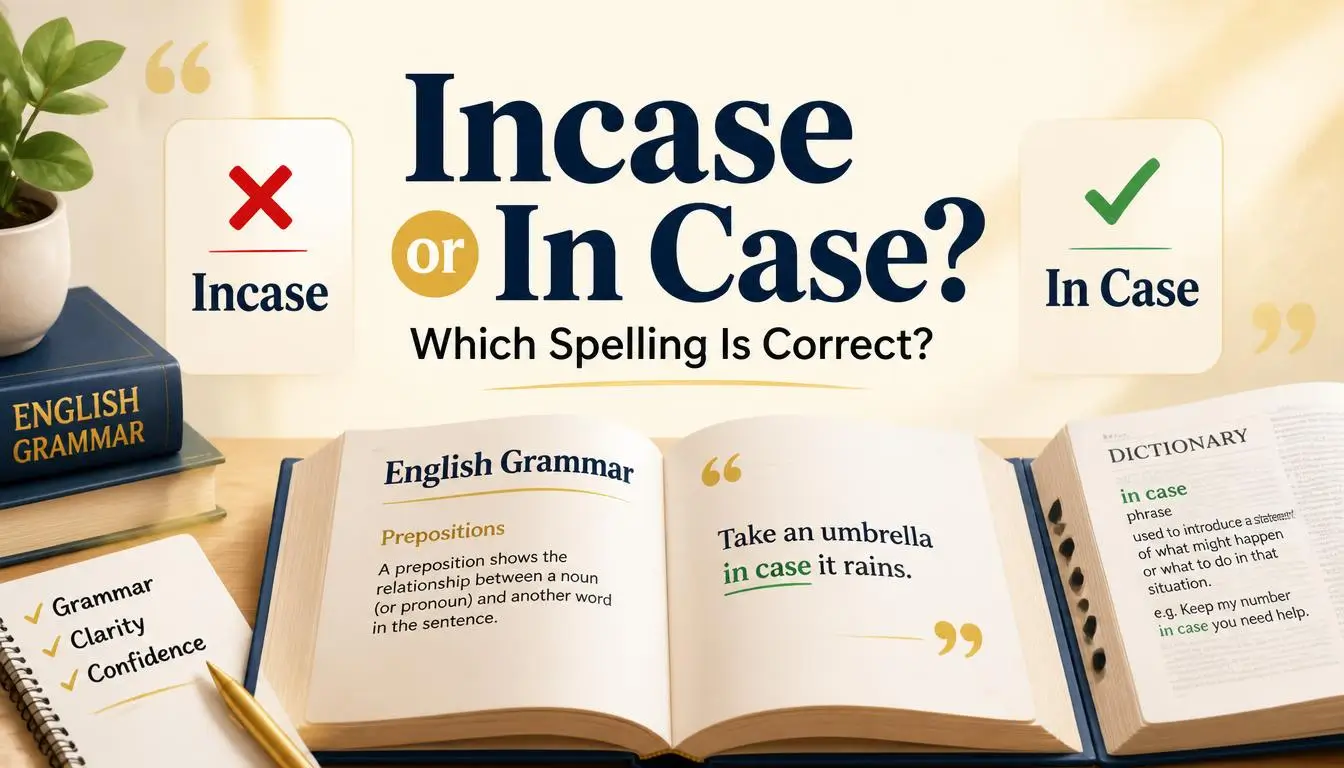
If you have ever paused while typing a sentence like “Take an umbrella incase it rains,” you are not alone. Incase or in case is a common spelling question because the phrase sounds like one word when spoken quickly. That makes it easy to join the two words together when writing.
The good news is that the rule is simple: “in case” is the correct spelling when you mean “if something happens” or “as a precaution.” “Incase” is not the standard spelling for this meaning.
Major English dictionaries list in case as a phrase used for a possible event or as a precaution. Merriam-Webster, for example, defines it as meaning “as a precaution” or “if.”
People search for this keyword because they want a quick answer before sending an email, writing an essay, posting online, or completing professional work.
This guide explains the difference, the history behind the phrase, British and American usage, common mistakes, and practical examples.
Incase or In Case – Quick Answer
In case is correct when you mean “if something happens,” “because something might happen,” or “as a precaution.”
Incase is incorrect when used as the one-word version of in case. It is usually a spelling mistake.
Correct examples
- Take an umbrella in case it rains.
- Save the document in case your computer crashes.
- Bring some water in case you get thirsty.
- Keep my number in case you need help.
- Take a jacket just in case it gets cold.
Incorrect examples
- Take an umbrella incase it rains. ❌
- Save the document incase your computer crashes. ❌
- Call me incase you need help. ❌
The same rule applies in British and American English. There is no British spelling in case and American spelling in case. Both varieties use in case.
A useful way to remember it is:
In case = two words.
If you can replace the phrase with “if” or “just to be safe,” you probably need in case.
For example:
Bring a charger in case your phone dies.
This means:
Bring a charger just to be safe if your phone dies.
Merriam-Webster also records in case of as a standard expression meaning “in the event of.”
The Origin of Incase or In Case
To understand why in case is written as two words, it helps to look at the history of the phrase.
The word case has a long history. English word case came through Middle English from Old French cas, which came from Latin casus, related to the Latin verb cadere, meaning “to fall.” Over time, case developed several meanings connected with a situation, event, condition, or circumstance.
The phrase in case developed from this idea of being “in a particular situation” or preparing for a possible situation.
Merriam-Webster records the first known use of in case in the 14th century.
Today, the phrase has two closely related uses.
In case = as a precaution
This is one of the most common uses.
Example:
Bring your coat in case it gets cold.
You bring the coat now because cold weather is possible.
In case = if something happens
The phrase can also introduce a possible condition.
Example:
Call me in case you need help.
Here, in case introduces the possibility that help may be needed.
Why does “incase” look natural?
English contains many words that began as separate words and later became compounds. Because in case is often pronounced quickly, it can sound like one unit.
For example:
“I brought snacks in case we get hungry.”
When spoken naturally, the space between in and case may not be strongly heard.
Writers may therefore type incase by mistake.
But pronunciation does not change the standard spelling. Modern dictionaries and spelling references recognize in case for this meaning.
An important exception: “incase” can appear in older sources
Historical dictionaries and older texts may contain incase as a verb meaning something like “to put into a case.” For example, older dictionary material records incase as a verb meaning to enclose in a case.
However, this is not the form modern writers should use for the phrase meaning “if” or “as a precaution.”
For modern standard English, use:
in case = if/as a precaution
And when you mean “to surround or cover,” the modern standard verb is usually:
encase = to enclose or cover something.
British English vs American English Spelling
One of the most important points is that British English and American English do not differ on the spelling of this phrase.
Both use:
in case ✅
Neither standard variety uses:
incase ❌
This makes the question different from spelling pairs such as colour/color, centre/center, or organise/organize.
Comparison table
| Form | British English | American English | Meaning |
| in case | ✅ Correct | ✅ Correct | If something happens; as a precaution |
| incase | ❌ Incorrect for this meaning | ❌ Incorrect for this meaning | Usually a spelling error |
| in-case | ❌ Not standard | ❌ Not standard | Unnecessary hyphen |
| in case of | ✅ Correct | ✅ Correct | In the event of |
| just in case | ✅ Correct | ✅ Correct | As an extra precaution |
Cambridge defines in case as meaning that something else might happen, while in case of something refers to a possible event or situation.
British English examples
- Take an umbrella in case it rains.
- Keep some cash in case the card machine does not work.
- Leave early in case there is traffic.
American English examples
- Take an umbrella in case it rains.
- Keep some cash in case the card machine does not work.
- Leave early in case there is traffic.
Notice that the spelling remains the same.
There can be small differences in how British and American speakers use in case in certain sentence patterns, but these are usage differences, not spelling differences. Some grammar references note differences in how the phrase can express precaution or a condition.
Which Spelling Should You Use?
The answer is easy:
Use “in case” in almost every normal situation where you mean “if something happens” or “as a precaution.”
For a US audience
Use:
in case
Example:
Please save a copy in case you need it later.
For a UK or Commonwealth audience
Use:
in case
Example:
Take an umbrella in case it rains.
International readers
Use:
in case
It is clear, standard, and widely understood.
For academic writing
Always write:
in case
Example:
The researchers collected additional data in case further analysis was required.
For business writing
Use:
in case
Example:
I have attached another copy in case the original file cannot be opened.
For social media
Even in casual writing, in case is the better choice.
Example:
Packed an extra charger in case my battery dies!
Casual writing allows abbreviations, slang, and informal expressions, but incase is still not the standard spelling of this phrase.
Common Mistakes with Incase or In Case
Several mistakes appear again and again.
Mistake 1st: Writing “incase” as one word
Incorrect:
I saved the file incase I need it later.
Correct:
I saved the file in case I need it later.
This is the most common mistake.
Mistake 2nd: Using “in-case”
Some writers add a hyphen.
Incorrect:
Bring a coat in-case it gets cold.
Correct:
Bring a coat in case it gets cold.
The phrase does not normally need a hyphen.
Mistake 3rd: Writing “incase of”
Incorrect:
Incase of emergency, call this number.
Correct:
In case of emergency, call this number.
The expression in case of is especially common in instructions, notices, safety information, and official writing.
Mistake 4th: Confusing “in case” with “encase”
This is an important difference.
In case means:
if something happens / as a precaution
Encase means:
to surround or cover something.
Examples:
Take water in case you get thirsty.
The device was encased in protective material.
These are completely different meanings.
Mistake 5th: Using “in case if”
Avoid combining the two.
Incorrect:
Take an umbrella in case it rains.
Better:
Take an umbrella in case it rains.
Or:
Take an umbrella if it rains.
Choose the structure that matches your meaning.
Mistake 6th: Confusing “in case” with “if”
The two can sometimes be close in meaning, but they are not always interchangeable.
Compare:
Take an umbrella in case it rains.
You are preparing now for a possible event.
If it rains, we will stay inside.
This describes what will happen if the condition occurs.
The key idea is preparation. In case often tells the reader that something is being done now because a future possibility exists.
Incase or In Case in Everyday Examples
The phrase in case appears in almost every type of English writing.
In emails
Professional emails often use in case when providing backup information.
Example:
I have attached the report again in case you did not receive the first copy.
Another example:
Please save my phone number in case you need to contact me.
Both are natural and professional.
In business writing
Businesses use it when discussing preparation and possible problems.
We created a backup system in case the main server fails.
Please keep the receipt in case you need to request a refund.
Additional staff will be available in case demand increases.
In news writing
News reports can use in case to describe preparation for possible events.
Emergency crews were placed on standby in case conditions worsened.
The phrase in case of is also common:
Officials issued instructions in case of severe weather.
In social media
The phrase is common in casual posts and captions.
Taking a jacket in case it gets cold tonight.
Charging my phone in case the power goes out.
Bringing extra snacks just in case!
In academic writing
Academic writers may use in case when describing safeguards or possible outcomes.
Additional samples were collected in case further testing was required.
The researchers recorded the data again in case an error had occurred.
In formal writing
The phrase is perfectly acceptable in formal English.
The documents were copied in case the original records were damaged.
So there is no need to replace in case with a more complicated phrase just because you are writing formally.
Incase or In Case – Google Trends & Usage Data
Search behavior shows why this spelling question continues to matter. People often search for phrases such as “incase or in case,” “is incase correct,” “in case or incase,” and “how do you spell in case.” Spelling-reference websites also report searches specifically asking whether incase is correct.
However, there is an important point about Google Trends: it provides relative search interest, not a simple count of all searches. Google Trends data is normalized, with values scaled from 0 to 100 within the selected time, location, and search settings.
Therefore, it would be misleading to give a fixed worldwide number for searches of incase without a specific Google Trends comparison, date range, country, and search category.
What the search pattern tells us
The practical pattern is clear:
| Search/Form | Typical reason for use |
| in case | Correct everyday English phrase. |
| incase | Common spelling mistake or spelling query. |
| in case or incase | Grammar/spelling question. |
| in case of | Safety, instructions, and formal contexts. |
| just in case | Extra precaution. |
Search interest can also vary by country and audience. English learners, students, professionals, bloggers, and people writing emails may search spelling questions more often because they want to confirm the correct form before publishing or submitting text.
The key user-engaging lesson is also useful: a misspelled keyword can have search demand without being the correct form to use in your article.
You can target the question “incase or in case” while consistently using in case in the actual copy.
Why “in case” is the dominant usage
The reason is simple: in case is the standard phrase and appears naturally in speech, emails, articles, books, instructions, and professional writing.
Incase, when it appears in this context, is generally an error rather than a British or American spelling variant.
Incase vs In Case: Comparison Table
| Variation | Correct? | Meaning | Example |
| in case | ✅ | If something happens; as a precaution | Take a coat in case it gets cold. |
| incase | ❌ | Usually a spelling error | Do not use this form for the phrase. |
| in-case | ❌ | Nonstandard form | Avoid the hyphen. |
| in case of | ✅ | In the event of | In case of fire, use the stairs. |
| just in case | ✅ | As an extra precaution | I brought extra money just in case. |
| encase | ✅ | To cover or enclose | The wires are encased in plastic. |
This table highlights an important point: encase is a real word, but incase is not the correct replacement for in case.
How to Remember “In Case” Easily
If you often type incase, use one of these memory tricks.
Think “two words, two ideas”
in + case
The phrase describes being prepared for a case, situation, or possibility.
Replace it with “if”
Try this:
Bring an umbrella in case it rains.
Replace in case with if:
Bring an umbrella if it rains.
The sentence changes slightly in meaning, but the conditional idea remains clear.
Use “just to be safe”
If you can naturally replace in case with just to be safe, you almost certainly need the two-word form.
I saved a copy in case my computer crashes.
=
I saved a copy just to be safe.
That is a useful quick test.
FAQs:
Is “incase” or “in case” correct?
In case is correct when you mean “if something happens” or “as a precaution.” Incase is not the standard spelling for this meaning.
Is “incase” a real English word?
In modern standard English, incase should not be used as the one-word version of in case. Historical sources may show incase with an older verb meaning, but modern writers normally use encase for “enclose” and in case for “if/as a precaution.”
Is “in case” one word or two?
It is two words.
Correct:
in case
Incorrect:
incase
Is “in case of” correct?
Yes. In case of is a standard expression meaning “in the event of.”
Example:
In case of emergency, call the number below.
Merriam-Webster lists in case of as a standard phrase.
Is “just in case” correct?
Yes. Just in case is completely correct and means as an extra precaution.
Example:
I brought an extra shirt just in case.
Do British people spell it “incase”?
No. British English uses in case. American English also uses in case.
Is “in-case” correct?
No. When used in the normal phrase meaning “if” or “as a precaution,” the standard spelling is in case, without a hyphen.
Conclusion:
The answer to “incase or in case” is simple: use “in case” as two words when you mean “if something happens,” “because something might happen,” or “as a precaution.”
The form incase is not the standard modern spelling for this phrase. This is not a British-versus-American spelling issue. Writers in both varieties of English use in case.
Remember the most common patterns:
- in case it rains
- in case you need help
- in case of emergency
- just in case
Also keep encase separate. It is a real verb meaning to surround or enclose something, so “in case” and “encase” have completely different jobs.
Whether you are writing an email, school assignment, business report, social media post, or website article, choosing in case will keep your writing clear and correct.
When in doubt, remember the simple rule: if you mean “just to be safe,” write “in case.”
Read More Posts:
- How to Use “Whether or Not” in Formal and Casual English
- Cancelled or Canceled: American vs British English Explained
- Comma Before or After But? Examples Guide 2026

Toni Morrison is a celebrated American novelist known for her powerful storytelling, rich characters, and lasting impact on literature. At GrammerNests.com, she shares insights that help readers appreciate language, writing, and literary expression.