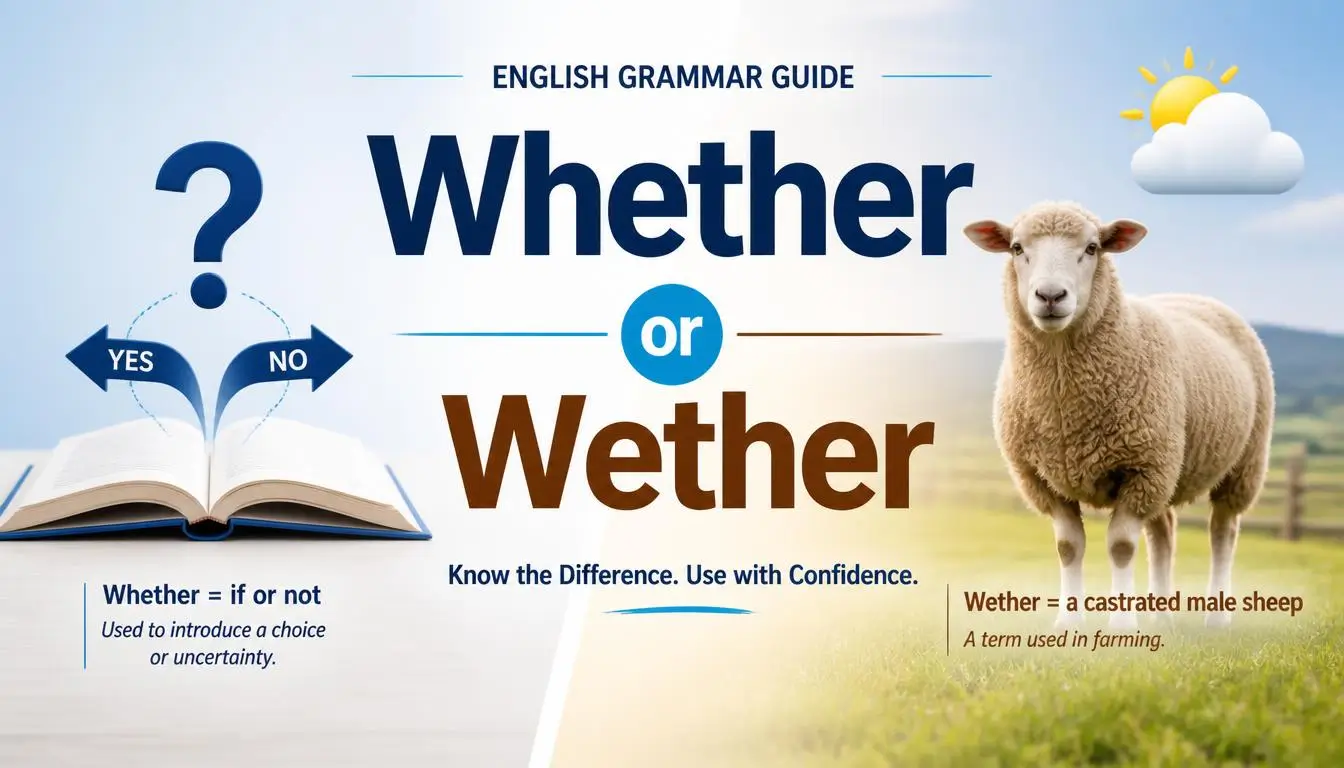
Words that sound alike can cause some of the most common spelling mistakes in English. “Whether or wether” is a perfect example. They look almost identical, sound very similar, and are easy to mix up when writing quickly. But these two words do not have the same meaning or use.
If you are writing an email, school assignment, blog post, social media caption, or professional document, choosing the right word matters.
Whether is a common English word used when talking about choices, possibilities, or uncertainty. Wether, on the other hand, is a rare word used mainly in farming and animal-related contexts.
Next, explains whether or wether in simple terms. You will learn which spelling is correct, where each word came from, how it is used in American and British English, and the mistakes writers often make. You will also see real-life examples that make the difference easy to remember.
Whether you are checking one sentence or trying to improve your spelling, this guide will give you a clear answer.
Whether or Wether – Quick Answer
Whether is the correct spelling in most everyday situations.
It is used to introduce two or more choices, possibilities, or alternatives.
Examples:
- I do not know whether she will come.
- We must decide whether to stay or leave.
- I am not sure whether this is correct.
- Tell me whether you agree.
Wether is a different word. It is a farming term for a castrated male sheep, especially one kept for wool or meat.
Example:
- The farmer moved the wether into another field.
Whether vs Wether at a Glance
| Word | Meaning | Common Use |
| Whether | Expresses a choice, possibility, or uncertainty | Everyday writing |
| Wether | A castrated male sheep | Farming and animal contexts |
So, if you are asking “whether” or “wether”, use whether unless you are specifically talking about a male sheep.
The Origin of Whether or Wether
The words whether and wether have different histories, even though they look and sound similar.
Whether comes from Old English hwæther, meaning “which of two” or “which one.” Over time, its spelling changed as English developed. The modern form whether became established in English.
The word is closely connected to the idea of making a choice between alternatives.
For example:
I cannot decide whether to go.
Here, whether introduces two possible outcomes: going or not going.
Wether has a different origin. It comes from Old English weðer, referring to a male sheep. The word has been used for centuries in farming vocabulary.
The spelling difference exists because these are two separate words with separate histories. Their similar pronunciation can make them confusing, but their meanings are not interchangeable.
This is an example of a pair of English words that look and sound similar while serving completely different purposes.
British English vs American English Spelling
There is no major British-versus-American spelling difference between whether and wether.
Both American English and British English use:
- whether for choices and uncertainty.
- wether for a castrated male sheep.
Comparison Table
| Feature | American English | British English |
| Choice or uncertainty | whether | whether |
| Castrated male sheep | wether | wether |
| Common everyday word | Whether | Whether |
| Farming term | Wether | Wether |
| Spelling difference | None | None |
For example, these sentences are correct in both varieties:
- American: I wonder whether he will arrive today.
- British: I wonder whether he will arrive today.
The same applies to wether:
- The farmer raised several wethers.
- The farmer raised several wethers.
Unlike words such as color/colour or favorite/favourite, whether/wether is not a case of American and British spelling rules.
Which Spelling Should You Use?
For almost every normal writing situation, choose whether.
For American English
Use whether when you are discussing:
- Choices
- Alternatives
- Uncertainty
- Possibilities
- Questions involving two outcomes
Example:
I need to decide whether I should apply.
Use wether only when discussing sheep.
For British and Commonwealth English
The same rule applies. Use whether for choices and uncertainty.
Example:
She asked whether the meeting had been cancelled.
Use wether when referring to the animal.
Global English
If you write for an international audience, whether is the safe choice whenever you mean “if” or are presenting alternatives.
A simple memory trick is:
Whether = choice or possibility.
Wether = sheep.
If you remember that wether is an animal term, you will avoid most mistakes.
Common Mistakes with Whether or Wether
The most common mistake is using wether when the writer means whether.
Mistake 1: Using “wether” for a choice
Incorrect:
I don’t know wether I should go.
Correct:
I don’t know whether I should go.
Mistake 2: Using “whether” for a sheep
Incorrect:
The farmer bought a whether.
Correct:
The farmer bought a wether.
Mistake 3: Confusing “whether” with “weather”
Whether and weather are also commonly confused.
Whether relates to choices or uncertainty.
I don’t know whether it will rain.
Weather refers to conditions such as rain, wind, snow, and sunshine.
The weather is rainy today.
A useful memory trick is:
- Whether = choice
- Wether = sheep
- Weather = conditions outside
Mistake 4: Using “whether” when “if” is better
In many sentences, whether and if can have similar meanings.
I don’t know whether he will come.
I don’t know if he will come.
Both can work in many contexts. However, whether is often preferred when clearly presenting alternatives.
We must decide whether to stay or leave.
Whether or Wether in Everyday Examples
Understanding the words in real situations makes the difference easier to remember.
In Emails
Whether is common in professional emails.
Please let me know whether you can attend the meeting.
I would like to confirm whether the report is ready.
Using wether in these sentences would be a spelling error.
In News Writing
News articles frequently use whether when discussing uncertainty or possible outcomes.
Officials have not confirmed whether the event will continue.
The company is considering whether to expand its operations.
Wether would appear mainly in news stories about farming or livestock.
On Social Media
People often use whether when discussing choices.
I can’t decide whether to watch a movie or read a book tonight.
I’m wondering whether I should buy this.
Because social media writing is often informal and fast, wether can appear as a typo.
In Formal Writing
Whether is very common in academic, legal, and professional writing.
The study examines whether social conditions affect educational outcomes.
The committee will determine whether the proposal meets the requirements.
Wether should only be used when the subject is the specific animal.
In Farming
This is where wether is appropriate.
The farmer separated the wether from the younger sheep.
Here, using whether would change the word into the wrong term.
Whether or Wether – Trends & Usage Data
Search interest for “whether or wether” usually comes from people trying to check the correct spelling. The confusion is understandable because the words are pronounced similarly.
In general, whether is vastly more common in everyday English than wether. Whether appears frequently in conversations, books, news stories, emails, academic writing, and online content. Wether has a much narrower use because it mainly appears in livestock and farming contexts.
Search behavior can also vary by country. English-speaking countries such as the United States, United Kingdom, Canada, and Australia regularly produce searches about spelling and word usage. The exact level of interest can change over time and may rise when people encounter the words in writing.
Google Trends should be viewed as a measure of relative search interest, not a direct count of how often a word appears in all English writing.
For everyday English, the practical conclusion is simple: whether is overwhelmingly the word most writers need. Wether is a specialized farming word.
Whether or Wether Comparison Table
| Word | Definition | Example | Frequency |
| Whether | Used for choices or possibilities | I don’t know whether she will come. | Very common |
| Wether | Castrated male sheep | The wether was moved to another field. | Rare |
| Weather | Conditions of the atmosphere | The weather is cold today. | Very common |
This three-word comparison is especially useful because whether, wether, and weather can all sound similar.
Easy Way to Remember
Think of the three words like this:
Whether > Which choice?
Wether > Which sheep?
Weather > What’s happening outside?
FAQs:
Is “whether” or “wether” correct?
Both are correct words, but they have different meanings. Whether is used for choices, alternatives, and uncertainty. Wether means a castrated male sheep.
Is “wether” a real word?
Yes. Wether is a real English word, but it is uncommon in everyday conversation. It is mainly used in farming and livestock contexts.
What is the difference between whether and wether?
Whether introduces a choice or possibility. Wether refers to a castrated male sheep.
Is whether the same as if?
Sometimes. For example, “I don’t know whether he will come” and “I don’t know if he will come” can have the same meaning. However, whether is especially useful when presenting alternatives.
Is whether spelled differently in British English?
No. Whether has the same spelling in British and American English.
Is wether the same as weather?
No. Wether is a type of male sheep. Weather refers to atmospheric conditions such as rain, wind, heat, and snow.
How can I remember whether or wether?
Remember this simple rule: whether means a choice, while wether means a sheep. If you are talking about a decision or possibility, choose whether.
Conclusion:
The difference between whether or wether is simple once you know what each word means. Whether is the word you will use in almost all everyday writing. It expresses a choice, possibility, or uncertainty, as in “I don’t know whether she will come.”
Wether is a much less common word. It refers to a castrated male sheep and is mainly used in farming or livestock contexts.
There is no British-versus-American spelling difference here. Both varieties of English use whether and wether in the same way. The main challenge is remembering their different meanings.
Also keep weather in mind. Weather describes conditions outside, while whether deals with choices, and wether refers to a sheep.
For emails, schoolwork, business writing, blogs, and everyday communication, whether is almost certainly the spelling you need. Use wether only when your subject is the animal.
Read More Posts:
- How to Use “Whether or Not” in Formal and Casual English
- 25 Words or Less: Complete Guide With Examples
- Travelling or Traveling in British & American English