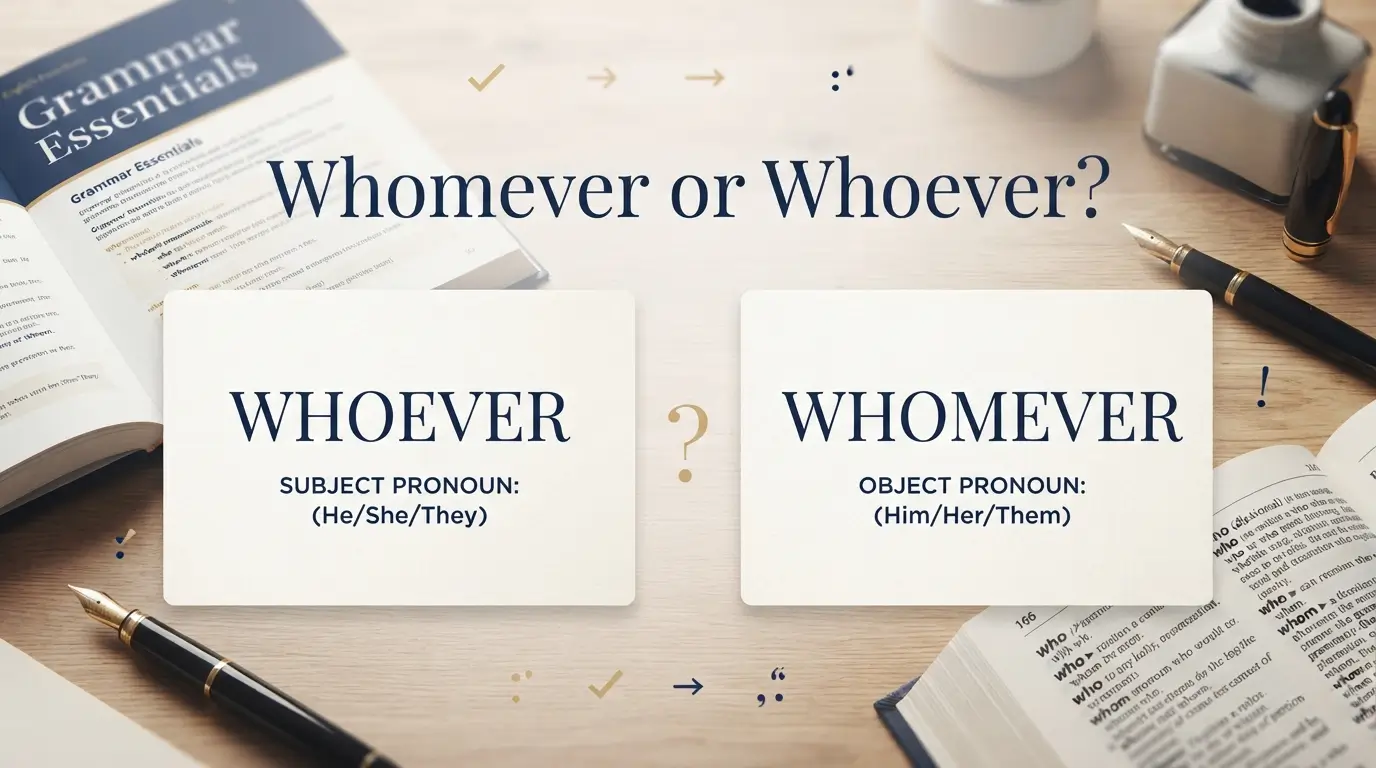
Choosing between whomever or whoever can feel tricky because both words refer to a person, and in everyday speech they often sound almost the same. The real difference is not spelling. It is grammar.
People commonly search for “whomever or whoever” when writing emails, school assignments, business messages, formal documents, or professional content.
They want to know which word is correct and whether one form is more appropriate in American or British English. The confusion usually comes from the older distinction between who and whom.
The quick rule is simple: whoever is traditionally used when the word acts as the subject, while whomever is used when it acts as the object. However, modern English is less strict. Whoever is now much more common, especially in informal writing and speech.
Cambridge notes that whomever is formal and that whoever is more common in informal use.
Next, explains the difference, history, regional usage, common mistakes, examples, and practical rules so you can choose confidently.
Whomever or Whoever – Quick Answer
Both whoever and whomever are correct words.
The difference is their grammatical role:
- Whoever = subject form
- Whomever = object form
Use “whoever” when the person does the action.
Whoever arrives first can choose a seat.
Here, “whoever” acts as the subject.
Another example:
Whoever wins the race will receive a prize.
The person represented by “whoever” acts.
Use “whomever” when the person receives the action.
Invite whomever you want.
Here, the person receives the action of inviting.
Another example:
Give the award to whomever you choose.
The person represented by “whomever” receives the award.
A useful test is to replace the word with he/him or they/them.
- He arrived first > Whoever arrived first.
- I invited him > I invited whomever.
Merriam-Webster describes whomever as the objective form of whoever, while also noting that whoever is common in both subject and object positions in actual modern usage.
Quick examples
| Sentence | Correct choice | Why |
| Whoever calls first gets the job. | Whoever | Subject |
| Choose whomever you like. | Whomever | Object |
| Whoever wins will advance. | Whoever | Subject |
| Give it to whomever you trust. | Whomever | Object |
| Whoever is responsible should explain. | Whoever | Subject |
| Talk to whomever you prefer. | Whomever | Object |
The History of Whomever or Whoever
The difference between whoever and whomever comes from the older distinction between who and whom.
The word who goes back to Old English hwā, meaning “what person” or “who.” It is related to older Germanic forms and ultimately connects to the Proto-Indo-European root kwo-, which appears in many question and relative pronouns.
Whom developed from the Old English form hwām, which was used for the object or dative form of who.
Later, English formed compounds by adding -ever:
- who + ever = whoever
- whom + ever = whomever
The history of whoever goes back to late Old English, while whomever appeared in the early 14th century.
The ending -ever adds a broad or indefinite meaning. For example:
- whoever = any person who
- whatever = any thing that
- whenever = at any time that
- wherever = in any place that
- whichever = any one that
So whoever basically means “any person who” or “the person who,” while whomever is its traditional object form.
Why do people confuse them?
English has changed over time. The distinction between who and whom remains in formal grammar, but whom is much less common in everyday speech.
Because people rarely use whom in casual conversation, many speakers naturally use whoever instead of whomever.
That is why both forms can appear in modern English, even when traditional grammar would recommend whomever. Merriam-Webster specifically notes that whoever is more common in actual usage in both positions.
British English vs American English Spelling
There is no major spelling difference between British and American English for these words.
Both varieties spell them:
- whoever
- whomever
The main difference is usage and formality, not spelling.
British English can use whomever, especially in formal contexts, but everyday British English also commonly uses whoever. American English follows the same basic pattern.
Cambridge lists whomever as a formal pronoun and explains that it means whoever when used as an object. It also notes that whoever is more common in informal speech and writing.
Comparison table
| Feature | American English | British English |
| Subject form | whoever | whoever |
| Traditional object form | whomever | whomever |
| Informal object usage | whoever is common | whoever is common |
| Formal object usage | whomever | whomever |
| Spelling difference | None | None |
| Overall preference | Whoever is more common | Whoever is more common |
Examples
American English:
Whoever finishes first can leave.
British English:
Whoever finishes first can leave.
Both are the same.
For a formal sentence:
American English:
Please contact whomever you consider appropriate.
British English:
Please contact whomever you consider appropriate.
Again, the spelling does not change.
Which Spelling Should You Use?
Your best choice depends on your audience and the level of formality.
For US readers
Use whoever in most everyday writing.
For example:
Whoever wants to join us is welcome.
When the word is clearly an object and the writing is formal, whomever may be appropriate:
Please send the documents to whomever you choose.
However, modern American English often accepts whoever in places where traditional grammar would expect whomever.
UK and Commonwealth readers
The same basic rule applies.
Use whoever as the subject and whomever when you want the traditional object form.
But do not force whomever into casual writing. It can sound formal or stiff.
For global English
If you want your writing to sound natural to the widest audience, whoever is usually the safer choice.
It is common, clear, and easy to understand.
Use whomever when:
- The writing is very formal.
- You are following traditional grammar.
- You want to preserve a formal tone.
- The word clearly functions as an object.
Common Mistakes with Whomever or Whoever
Understanding the subject-object rule can prevent most mistakes.
Mistake 1st: Using whomever as the subject
Incorrect in traditional grammar:
Whomever arrives first will get the ticket.
Better:
Whoever arrives first will get the ticket.
Why? The person arrives, so the pronoun is the subject.
Mistake 2nd: Using whoever after a preposition
Traditional formal form:
Give the package to whomever you choose.
Here, “whomever” is the object of to.
However, everyday English often uses:
Give the package to whoever you choose.
This is common and understandable, although whomever follows the traditional rule.
Mistake 3rd: Thinking whomever is always more correct
Some writers believe that whomever sounds smarter.
That is not true.
Using whomever when whoever is the subject can actually create an error.
Whomever wins the competition gets the prize.
Traditional grammar requires:
Whoever wins the competition gets the prize.
Mistake 4th: Choosing based only on what sounds formal
Formal writing does not mean every sentence needs whomever.
Always check the grammatical role first.
Ask:
Who is doing the action?
If the answer is the person represented by the word, use whoever.
Ask:
Who is receiving the action?
If the answer is the person represented by the word, traditional grammar uses whomever.
Mistake 5th: Forgetting the “he/him” test
When you are unsure, replace the word with he or him.
If he works, use whoever.
He wins the prize.
Whoever wins the prize
If him works, traditional grammar uses whomever.
I selected him.
I selected whomever
This simple trick works in many sentences.
Whomever or Whoever in Everyday Examples
These words appear in emails, news stories, social media posts, schoolwork, and formal documents.
In emails
Natural:
Whoever is available can join the meeting.
Formal:
Please forward this email to whomever you believe should receive it.
For most workplace emails, whoever will sound natural and clear.
In news writing
News writing may use either form depending on the sentence:
Whoever wins the election will face a difficult year.
Or:
The committee will interview whomever it considers qualified.
The second example follows the traditional object rule.
On social media
Casual writing usually favors whoever:
Whoever made this video is hilarious!
I will support whoever wins.
People rarely choose whomever in casual posts because it can sound overly formal.
In formal writing
Traditional grammar may favor whomever:
The scholarship will be awarded to whomever the committee selects.
But even here, modern usage can vary.
In academic writing
If your instructor or style guide expects traditional grammar, follow the subject-object distinction:
Whoever completes the study first may publish the results.
The award will be given to whomever the judges select.
Business writing
Clarity matters more than sounding sophisticated.
Instead of forcing whomever, you can sometimes rewrite the sentence:
Contact the appropriate person.
This avoids the issue completely.
Whomever or Whoever – Google Trends & Usage Data
Search interest for “whomever or whoever” reflects a common grammar question rather than a spelling difference. People usually search the phrase when they are unsure which form belongs in a sentence.
Google Trends data can vary by date, location, and search category, so it is better to treat search trends as a general indicator rather than an exact measure of word frequency.
In actual English usage, whoever is much more common than whomever. Dictionary sources also describe whomever as formal and note that whoever is more common in informal speech and writing.
Searches for the two forms are especially useful in countries where English is widely used, including:
- United States
- United Kingdom
- Canada
- Australia
- India
- Other English-speaking and English-learning regions
The context also matters.
Whoever appears naturally in:
- Everyday conversations
- Social media
- Emails
- News
- Blogs
- General websites
- Academic writing
Whomever appears more often in:
- Formal documents
- Legal-style writing
- Traditional grammar examples
- Formal business writing
- Sentences following prepositions
This difference helps explain why whoever feels much more natural to most modern speakers.
Usage comparison
| Form | Main use | Modern frequency | Tone |
| Whoever | Subject and common general use | Very high | Natural |
| Whomever | Traditional object form | Lower | Formal |
| Who | Direct question/subject | Very high | Natural |
| Whom | Object form | Lower | Formal |
The key point is that whoever and whomever are not British and American spellings. They are two grammatical forms of the same basic pronoun.
Whomever vs Whoever: Comparison Table
| Word | Meaning | Traditional role | Example |
| Whoever | Any person who | Subject | Whoever calls first can speak to me. |
| Whomever | Any person who | Object | Call whomever you choose. |
| Who | What person | Subject | Who called you? |
| Whom | What person | Object | Whom did you call? |
| Whosoever | Whoever | Formal/old-fashioned | Whosoever believes |
| Whomsoever | Whomever | Formal/old-fashioned | Give it to whomsoever you choose. |
In modern English, whosoever and whomsoever are much less common and can sound old-fashioned.
FAQs:
Is it whoever or whomever?
Both are correct. Traditionally, use whoever as a subject and whomever as an object.
Is “whoever” more common than “whomever”?
Yes. Whoever is much more common in modern English, especially in everyday speech and informal writing.
Is whomever grammatically correct?
Yes. Whomever is the traditional objective form of whoever. For example:
Give the message to whomever you choose.
Merriam-Webster defines whomever as the objective case of whoever.
Is “whoever” correct after “to”?
In traditional grammar, whomever is preferred after a preposition:
Give it to whomever you choose.
However, whoever is very common in modern English:
Give it to whoever you choose.
Cambridge notes that whoever is more common in informal speech and writing.
Is whomever more formal?
Yes. Whomever often sounds more formal than whoever.
Use it when traditional grammar or a formal style is important.
Is whoever used in American English?
Yes. Whoever is standard in American English and is extremely common.
Is whomever used in British English?
Yes. British English uses whomever, especially in formal contexts. But whoever is also widely used.
What is the easiest way to remember the difference?
Use the he/him test:
- He > whoever
- Him > whomever
For example:
He wins > Whoever wins.
I chose him > I chose whomever.
Conclusion:
The choice between whomever or whoever is mainly a question of grammar, not spelling. Both words are correct, and both mean roughly “any person who” or “the person who.”
The traditional rule is simple: use whoever when the word acts as the subject and whomever when it acts as the object.
For example, “Whoever arrives first can enter” uses whoever because the person acts. “Invite whomever you choose” uses whomever because the person receives the action.
British and American English do not have different spellings for these words. The bigger difference is formality.
Whoever is far more common in modern everyday English, while whomever has a more formal tone. If you are writing for a broad audience, whoever will often sound more natural. For formal writing, follow the traditional subject-object rule.
When unsure, use the simple he/him test. If “he” fits, choose whoever. If “him” fits, choose whomever.
Read More Posts:
- Ms or Mrs: Usage and Practical Examples Guide 2026
- Judgement or Judgment: British vs American English Guide
- Alot or A Lot: Correct Spelling Guide 2026