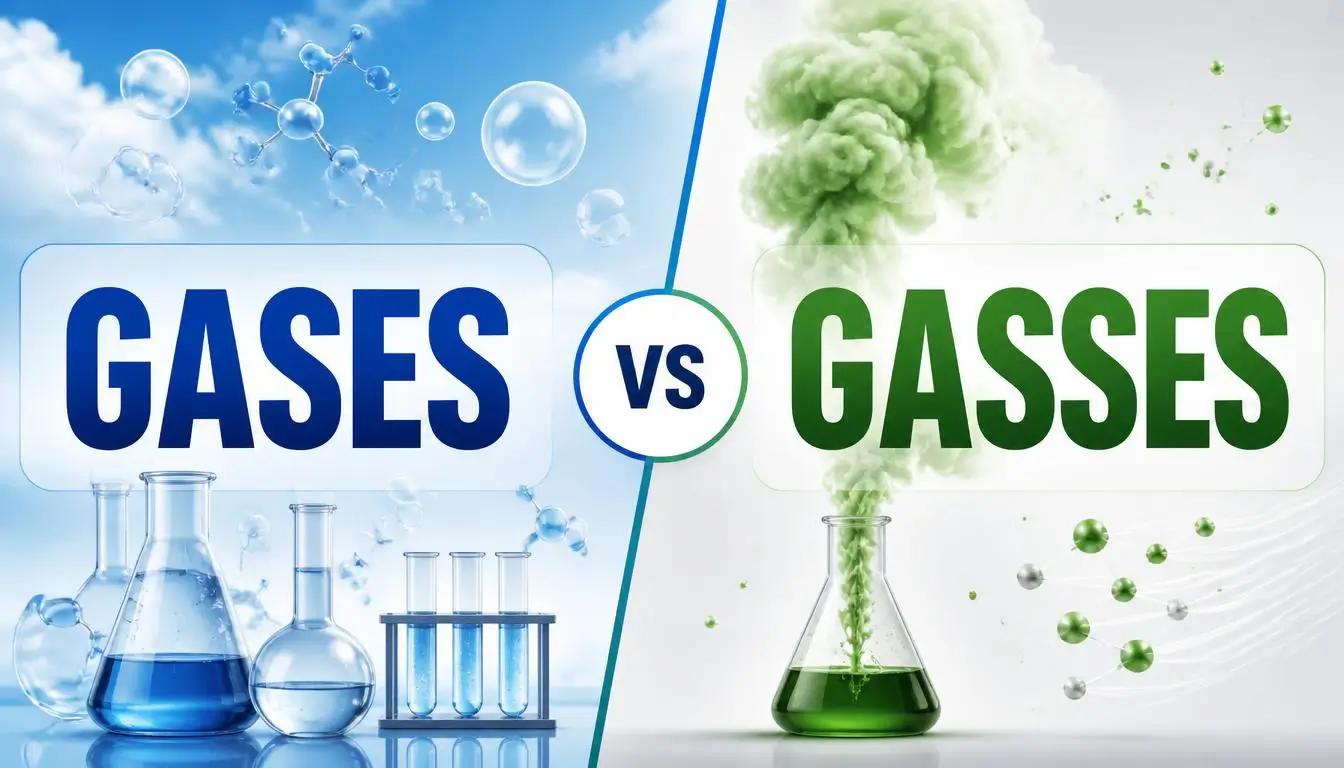
If you are unsure whether to write “gases” or “gasses,” you are not alone. Both spellings can be correct, but they do not always mean the same thing or follow the same usage pattern.
The confusion often comes from the words gas and gas, which have different plural and verb forms depending on meaning and English variety.
In most writing, gases is the correct plural form of gas. For example, “The atmosphere contains several gases.”
Although gasses can also be correct when it is the third-person singular form of the verb gas, meaning to expose someone or something to gas, or to fill with gas.
People often search for gases or gasses because spell-checkers may flag one form, or because they have seen both spellings in books, news reports, and online content. This guide explains the difference in simple terms.
You will learn when to use each spelling, where the words come from, how British and American English handle them, and which form is best for professional writing.
Gases or Gasses – Quick Answer
Gases is usually the correct plural of gas.
- Gas > gases = more than one gas.
- Gas > gasses = usually a verb form meaning “exposes to gas” or “fills with gas.”
Examples
Correct:
Scientists study different gases in the atmosphere.
Correct:
The factory releases harmful gases.
Also correct:
The machine gasses the food to preserve it.
So, if you are talking about more than one type of gas, use gases.
| Word | Meaning | Example |
| Gases | Plural noun | The gases in the atmosphere affect climate. |
| Gasses | Verb | The machine gasses the product. |
Simple rule:
If you mean several gases, choose gases.
The History of Gases or Gasses
The word gas has an interesting history. It comes from the Greek word khaos, meaning “chaos.” The modern word was introduced into European scientific language in the 17th century.
The Dutch chemist Jan Baptist van Helmont used a form of the word to describe substances that did not have a fixed shape or volume.
Over time, gas became the standard English spelling.
The plural form developed as gases. English usually changes the ending of words ending in -s or similar sounds when forming a plural. The added -es also makes the pronunciation clearer.
For example:
- gas → gases
- bus → buses
- class → classes
- glass → glasses
The spelling gasses exists because English also uses gass as a verb in some contexts. When the verb gas takes a third-person singular form, gasses can be used.
For example:
The engine gasses the fuel mixture.
Thus, the two spellings developed different roles:
- gases → plural noun
- gasses → verb form
This is why both words may appear in dictionaries and published writing.
British English vs American English Spelling
Both British and American English normally use gases as the plural noun.
The main difference appears with the verb gas.
In American English, gasses is commonly used as the third-person singular form:
The engine gasses the mixture.
British English may also use gasses, although technical usage can vary depending on the field and style guide.
The plural noun remains straightforward:
Different gases have different properties.
Comparison Table
| Meaning | American English | British English |
| More than one gas | gases | gases |
| A gas in general | gas | gas |
| Verb: exposes to gas | gasses | gasses |
| Verb: fills with gas | gasses | gasses |
| Scientific plural | gases | gases |
The key point is that gases is not simply an American or British spelling. It is the normal plural form in both varieties.
Which Spelling Should You Use?
Your choice depends mainly on what you mean.
For US readers
Use gases when you mean more than one gas.
Several gases are present in the atmosphere.
Use gasses when it functions as a verb.
The process gasses the liquid.
UK and Commonwealth readers
The same basic rule works.
Use gases for the plural noun:
The gases were released into the air.
Use gasses as the verb:
The equipment gasses the material.
For global audiences
If your content is written for an international audience, gases is usually the word you will need most often.
This is especially true for:
- Science articles
- School assignments
- Medical writing
- Environmental reports
- News articles
- Academic papers
- Technical documents
When you are talking about multiple types of gas, there is usually no reason to write gasses.
Common Mistakes with Gases or Gasses
The most common mistake is using gasses when the writer means multiple gases.
Mistake 1st: Using “gasses” as a plural noun
Incorrect:
The atmosphere contains many gasses.
Better:
The atmosphere contains many gases.
Mistake 2nd: Thinking “gases” is wrong
Some writers see the extra -es and think it should be gasses because “gas” ends in s.
But gases is the standard plural spelling.
Mistake 3rd: Confusing noun and verb forms
Compare these sentences:
The gases are harmful.
Here, gases is a plural noun.
The machine gasses the material.
Here, gasses is a verb.
Mistake 4th: Using “gasses” in science writing
If you are writing about oxygen, nitrogen, carbon dioxide, or other substances, gases is normally the correct choice.
Correct:
Greenhouse gases can affect Earth’s climate.
Quick Correction Guide
| Incorrect or confusing use | Correct form |
| Many gasses are present. | Many gases are present. |
| Several gasses were detected. | Several gases were detected. |
| Harmful gasses entered the room. | Harmful gases entered the room. |
| The device gasses the material. | The device gasses the material. |
Gases or Gasses in Everyday Examples
Knowing how the word works in real situations makes the difference easier to remember.
In Emails
Professional:
The test found several gases in the sample.
Technical:
Please review the report for information about the gases detected.
In News
Scientists are studying gases released by the volcano.
Here, gases is a plural noun.
On Social Media
Some gases in the atmosphere can trap heat.
Again, gases is correct because the writer means several types of gas.
In Formal Writing
The study examined how different gases react under high pressure.
In Technical Writing
The system removes harmful gases before they enter the environment.
As a Verb
The equipment gasses the container before sealing it.
In this sentence, gasses is a verb.
Gases or Gasses – Trends & Usage Data
Search interest for “gases or gasses” mainly comes from people trying to solve a spelling or grammar question. The search is especially relevant to students, writers, editors, teachers, and people preparing professional documents.
In general, gases have much wider usage because it is the standard plural noun. It appears frequently in science, education, environmental writing, medicine, chemistry, and news reporting.
Gasses has a much narrower use. It normally appears when gas is being used as a verb.
Usage can also vary by context and country. Search results from the United States, United Kingdom, Canada, Australia, and other English-speaking countries may show both forms, but that does not mean they are interchangeable.
For SEO content, the important distinction is search intent. Someone searching “gases or gasses” usually wants to know which spelling is correct. The clearest answer is that gases is the standard plural noun, while gasses can be a verb.
Comparison: Gases vs Gasses
| Feature | Gases | Gasses |
| Part of speech | Noun | Usually verb |
| Main meaning | More than one gas | Exposes to or fills with gas |
| Commonness | Very common | Less common |
| Science writing | Yes | Rarely |
| Academic writing | Yes | Only in specific contexts |
| Example | Different gases react differently. | The machine gasses the product. |
| Best choice for plural | Yes | No |
FAQs:
Is “gases” or “gasses” correct?
Both can be correct, but they serve different purposes. Gases is the normal plural of gas. Gasses is generally a verb form.
Is the plural of gas “gases”?
Yes. The standard plural form is gases.
One gas → two gases
Why is “gasses” sometimes correct?
Gasses can be the third-person singular form of the verb gas.
The machine gasses the product.
Is “gasses” an American spelling?
Not exactly. Gasses is a verb form that can be used in both American and British English. It is not simply an American spelling of gases.
Should I write “greenhouse gases” or “greenhouse gasses”?
Write greenhouse gases. Here, the word is a plural noun referring to several gases that contribute to the greenhouse effect.
Is “gases” used in British English?
Yes. Gases is the standard plural noun in British English as well as American English.
How can I remember the difference?
Use this simple rule:
Gases = more than one gas.
Gasses = someone or something gases something.
If you are talking about oxygen, nitrogen, carbon dioxide, or other substances, gases is almost certainly the word you need.
Conclusion:
The choice between gases or gasses becomes simple once you understand their grammatical roles. Gases is the standard plural noun for gas. Use it when you are talking about two or more gases, such as oxygen, nitrogen, carbon dioxide, or other substances.
Gasses has a different job. It is generally used as a verb, meaning that something exposes, treats, or fills something with gas. For example, “The machine gasses the product.”
This distinction applies across both American and British English. If you are writing a school assignment, science article, email, news story, or professional report, gases will usually be the correct choice when you mean multiple gases.
The easiest rule to remember is simple: gases = plural noun; gasses = verb. When in doubt, look at how the word functions in the sentence. That small check can help you avoid one of the most common spelling confusions in English.
Read More Posts:
- Complement or Compliment: A Simple English Guide 2026
- Truely or Truly: Easy Tips to Remember the Spelling
- Whomever or Whoever: Subject vs Object Explained Simply

Toni Morrison is a celebrated American novelist known for her powerful storytelling, rich characters, and lasting impact on literature. At GrammerNests.com, she shares insights that help readers appreciate language, writing, and literary expression.







