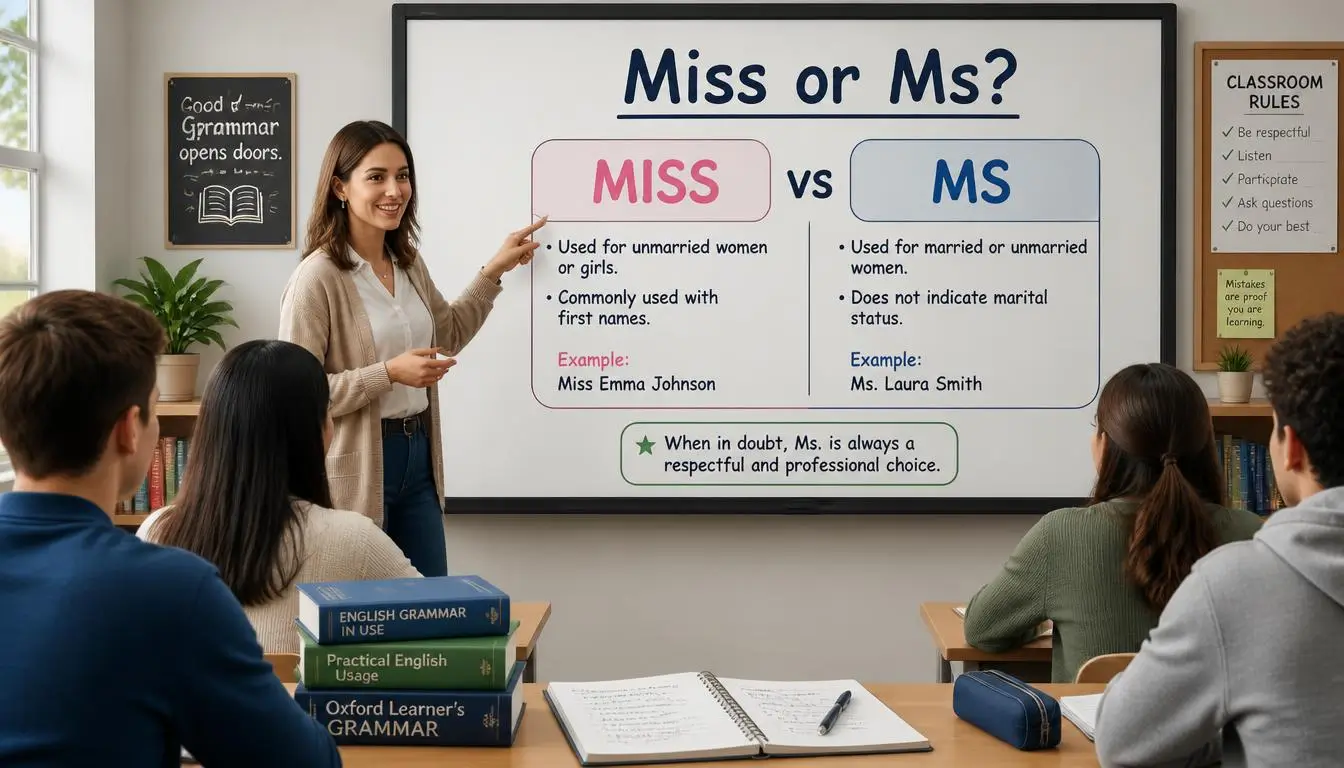
When addressing a woman, choosing between Miss or Ms can feel surprisingly confusing. Both are common English titles, but they do not mean the same thing. The main difference is whether you want to mention a woman’s marital status.
Miss is traditionally used for an unmarried woman or a girl. Ms is a neutral title that does not show whether a woman is married or single. Because of this, Ms is often the safest choice in professional writing when you do not know someone’s preference.
People often search for “miss or ms” because they want to write an email, fill out a form, address a letter, or speak politely to someone. They may also wonder about pronunciation, spelling, and when each title is correct.
This guide explains the difference between Miss and Ms, their history, correct usage, common mistakes, and examples. It also gives simple advice for American, British, and global English.
Miss or Ms – Quick Answer
Miss and Ms are both titles used before a woman’s name, but they have different meanings.
- Miss usually refers to an unmarried woman or a girl.
- Ms is a neutral title for a woman, regardless of whether she is married.
- Ms is often preferred in professional situations when marital status is unknown or irrelevant.
Examples
Miss:
Miss Emily Carter is our new teacher.
Ms:
Ms. Emily Carter is our new manager.
If you are unsure which title to use, Ms is usually the better professional choice.
Miss vs Ms at a Glance
| Title | Meaning | Common Use |
| Miss | Usually an unmarried woman or girl | Girls, young women, traditional use |
| Ms | Woman of any marital status | Business and professional settings |
| Mrs | Usually a married woman | Married women who use the title |
| Mr | Man of any marital status | Men |
One important point: Miss and Ms are not different spellings of the same word. They are different titles with different uses.
The Origin of Miss or Ms
The title Miss comes from the word mistress, which was once used as a respectful form of address for a woman.
Over time, mistress developed shorter forms. Miss became a common title for an unmarried woman.
For example:
Miss Jane Brown
The title Ms appeared much later as a neutral alternative.
The goal of Ms was to avoid making a woman’s marital status part of her title. This became especially useful in professional and formal settings.
Why Does Ms Exist?
Consider these traditional titles:
- Miss = unmarried woman
- Mrs = married woman
There was no simple equivalent for a woman when her marital status was unknown or not important.
Ms filled that gap.
It allows someone to address a woman politely without asking whether she is married.
Miss, Ms, and Mrs
The three titles can be understood like this:
| Title | Traditional Meaning |
| Miss | Unmarried woman |
| Ms | Marital status not stated |
| Mrs | Married woman |
Today, however, Ms is widely used regardless of marital status.
British English vs American English Spelling
There is an important difference between British and American usage, but the spelling of the titles themselves does not normally change.
Both varieties use:
- Miss
- Ms
- Mrs
The bigger difference is often punctuation.
American English
American English traditionally uses periods after abbreviations:
- Ms. Johnson
- Mrs. Smith
- Mr. Brown
However, Miss is normally written without a period because it is treated as a full title rather than an abbreviation.
British English
British English commonly leaves out the periods:
- Ms Johnson
- Mrs Smith
- Mr Brown
Again, Miss is written without a period.
Comparison Table
| Usage | American English | British English |
| Unmarried woman | Miss Johnson | Miss Johnson |
| Neutral female title | Ms. Johnson | Ms Johnson |
| Married woman | Mrs. Johnson | Mrs Johnson |
| Male title | Mr. Johnson | Mr Johnson |
| Period after Ms | Common | Usually omitted |
| Period after Mrs | Common | Usually omitted |
The key point is simple: Miss and Ms are spelled the same in both British and American English.
Which Spelling Should You Use?
The best choice depends on your audience and the situation.
For American English
Use Ms. when:
- You do not know the woman’s marital status.
- Writing a business email.
- You are addressing a customer.
- You want a neutral and professional title.
Example:
Dear Ms. Wilson,
Use Miss when the woman prefers that title or when referring to a girl or unmarried young woman in a context where that distinction is relevant.
British English
The same basic rules apply, but the title is often written without a period:
Dear Ms Wilson,
For Commonwealth English
Countries such as Canada, Australia, and New Zealand may follow conventions that vary by style guide and institution. Ms is generally a safe neutral choice in professional communication.
For Global English
If you are writing to an international audience, Ms is usually the safest option when you do not know the person’s preference.
The most important rule is:
Use the title the person prefers whenever you know it.
Common Mistakes with Miss or Ms
People often make small mistakes when choosing these titles.
1st. Using Miss for Every Woman
Incorrect assumption:
Miss Sarah Williams
This is not always wrong, but it may incorrectly suggest that Sarah is unmarried or prefers the title.
Better when marital status is unknown:
Ms Sarah Williams
2nd. Thinking Ms Means Married
Ms does not mean married.
It is a neutral title.
A married woman may use Ms, Mrs, or another preferred title.
3rf. Writing “Mss.”
The standard title is:
Ms
Not:
Mss
4th. Confusing Ms and Mrs
These are different titles.
- Ms = neutral
- Mrs = traditionally married woman
Example:
Ms Taylor
Mrs Taylor
5th. Using a Period in British English Automatically
In British English, you will often see:
Ms Brown
rather than:
Ms. Brown
Both conventions can be understood, but follow the style guide of your organization or publication.
6th. Ignoring Personal Preference
A woman may prefer Ms, Miss, or Mrs regardless of traditional rules.
When someone has clearly stated a preferred title, use it.
Miss or Ms in Everyday Examples
Understanding real-world examples makes the difference easier.
In an Email
If you do not know the recipient’s preferred title:
Dear Ms Parker,
Thank you for your message.
This is professional and neutral.
If the recipient uses Miss:
Dear Miss Parker,
You can use that title if you know it is preferred.
A Formal Letter
A formal letter may begin:
Dear Ms Anderson,
This is a common professional choice.
In News Writing
News organizations may use Ms when a woman’s marital status is not relevant.
Example:
Ms Carter said the project would begin next month.
On Social Media
Social media is usually less formal. Many people simply use their names without titles.
For example:
Emily Carter
However, a professional profile may use:
Ms Emily Carter
In Business Writing
For a customer or colleague:
We are pleased to welcome Ms Davis to the team.
This avoids making assumptions about marital status.
On Forms
Some forms ask users to select:
- Miss
- Ms
- Mrs
- Mr
Choose the title that matches your preference.
Miss or Ms – Google Trends & Usage Data
Search interest for “miss or ms” comes from people trying to understand the difference between these titles. The search is especially useful because the choice depends on social and professional context, not just spelling.
In general, Ms has become common in professional English because it does not require a person to identify as married or unmarried.
Usage can vary by country.
United States
Ms is widely used in workplaces, schools, business correspondence, and official communication.
United Kingdom
Ms is also widely accepted. British writing often uses Ms without a period.
Canada, Australia, and New Zealand
Ms is commonly understood and used in formal communication, although personal and institutional preferences can differ.
Global English
For international communication, Ms is often the safest neutral choice when you do not know the recipient’s preferred title.
Google Trends can show changes in search interest over time, but search volume does not directly measure how often people use a title in everyday speech. Search behavior and real-world language use are different things.
For professional writing, the practical rule is more useful than search popularity:
When in doubt, use Ms and respect the person’s stated preference.
Miss vs Ms: Comparison Table
| Feature | Miss | Ms |
| Refers to marital status | Traditionally yes | No |
| Usually used for | Unmarried women and girls | Women of any marital status |
| Professional use | Sometimes | Very common |
| Neutral title | No | Yes |
| American spelling | Miss | Ms. |
| British spelling | Miss | Ms |
| Pronunciation | “Miss” | Usually “Miz” |
| Can married women use it? | Yes, if they prefer, though traditionally associated with unmarried women | Yes |
| Can unmarried women use it? | Yes | Yes |
| Best when marital status is unknown | Not usually | Yes |
FAQs:
Is Ms for married or unmarried women?
Ms can be used for either. It does not show marital status.
Is Miss the same as Ms?
No. Miss traditionally refers to an unmarried woman or girl, while Ms is a neutral title.
Should I use Miss or Ms in an email?
If you do not know the woman’s preference, Ms is usually the safest professional choice.
How do you pronounce Ms?
Ms is commonly pronounced “miz.”
Miss is pronounced “miss.”
Can a married woman use Ms?
Yes. A married woman can use Ms if she prefers it.
Should I write Ms. or Ms?
In American English, Ms. is common. In British English, Ms is more common.
Is Miss more polite than Ms?
No. Neither title is automatically more polite. The appropriate title depends on the person’s preference and the context.
Conclusion:
Understanding Miss or Ms is simple once you know the main difference. Miss traditionally identifies an unmarried woman or girl, while Ms is a neutral title that does not reveal marital status.
Because of this, Ms is often the best choice in modern professional communication when you do not know how a woman prefers to be addressed.
British and American English generally use the same spellings, although American English often writes Ms. with a period, while British English usually writes Ms without one.
When writing an email, letter, form, or business document, focus on respect and accuracy. If a person has told you their preferred title, use it. If you do not know, Ms is usually a safe and professional choice.
The most important lesson is this: Miss and Ms are not interchangeable in every situation, and Ms provides a useful neutral option.
Read More Posts:
- Choose vs Chose: Examples for Everyday English
- Jist or Gist: British vs American English Explained (2026guide)
- Worse or Worst: How to Use Each Word Correctly