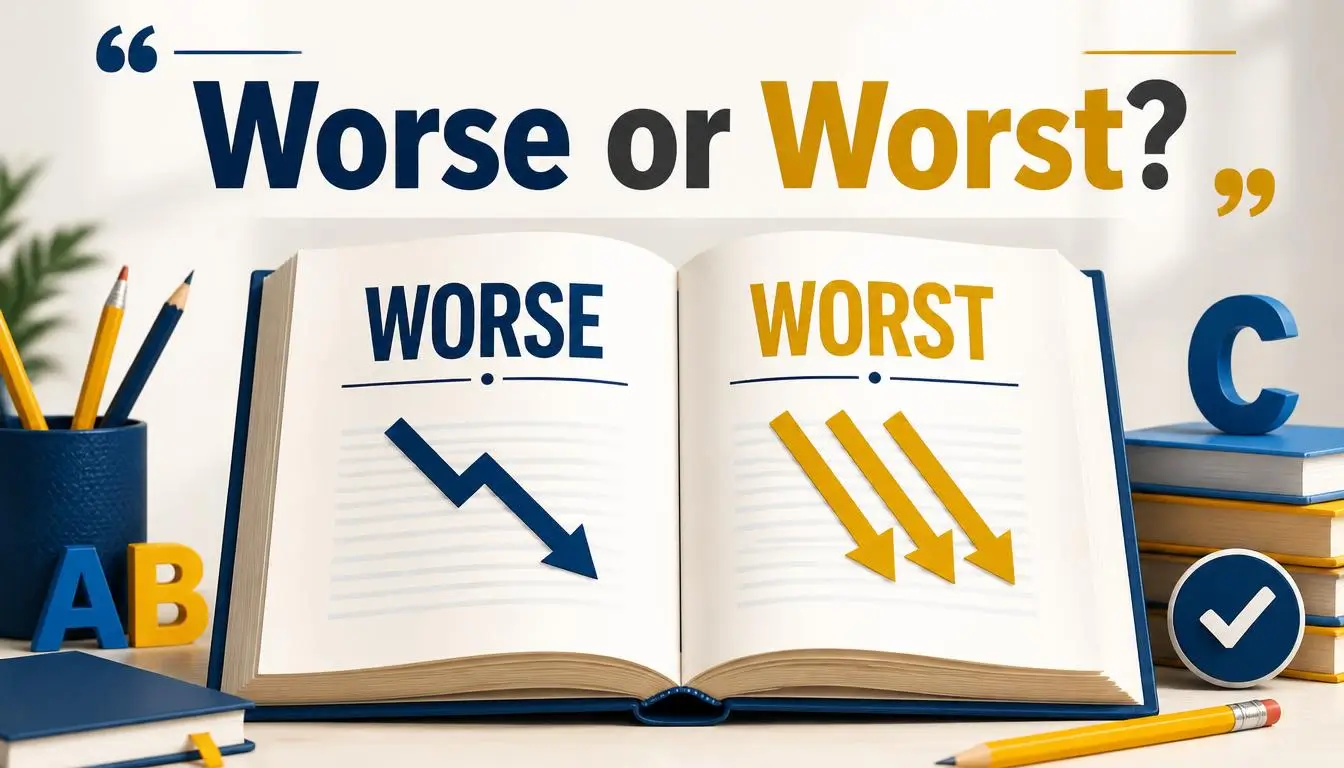
Choosing between worse or worst can be confusing because both words come from bad, and both describe something negative.
The difference seems small, but the grammar is important. Many English learners, students, and even native speakers pause when writing sentences such as “This is getting worse” or “This is the worst day of my life.”
The good news is that the rule is simple. Worse is normally used when comparing two things or one situation with an earlier state. Worst is used when something is at the lowest or most negative level in a group or situation.
Cambridge describes worse as the comparative form of bad, while worst is the superlative form.
People often search for “worse or worst” because the two words look and sound similar. Next, explains the difference, gives easy examples, covers common mistakes, and shows how the words work in everyday English.
Worse or Worst – Quick Answer
The quickest rule is:
- Worse = compare two things or conditions.
- Worst = compare three or more things, or describe the lowest possible level.
Think of the pattern:
Bad > Worse > Worst
| Word | Grammar | Basic meaning | Example |
| Bad | Base form | Not good | The weather is bad. |
| Worse | Comparative | More bad than something else | Today is worse than yesterday. |
| Worst | Superlative | Most bad in a group | Today is the worst day of the week. |
Examples with “worse”
- My headache is worse today.
- This movie is worse than the first one.
- The traffic is getting worse.
- Her second test was worse than her first.
- The problem became worse after the delay.
Examples with “worst”
- This is the worst movie I have seen.
- It was the worst day of my life.
- That was the worst mistake I made.
- He received the worst score in the class.
- This is the worst weather we have had this month.
A useful memory trick is:
Worse compares. Worst wins the “most bad” position.
Cambridge also notes that worse is commonly used with than, while worst often appears with the.
The Evolution of Worse or Worst
The words worse and worst are very old English words. They did not develop from modern spelling rules. Their forms come from Old English and Middle English.
Merriam-Webster traces worse to Middle English werse and worse, from Old English forms such as wiersa and wyrsa. Its first known use as an adjective dates to before the 12th century.
Worst also has a long history. Merriam-Webster traces it to Middle English werste and worste, from Old English wierresta and wyrsta. It was the superlative form related to the older form behind worse.
In simple terms:
bad > worse > worst
This is an example of an irregular comparison. English does not form these words as badder and baddest in standard modern English.
We say:
- bad
- worse
- worst
Not:
- badder ❌
- baddest ❌
Why do the spellings look different?
The spelling developed over hundreds of years. English has changed greatly since Old English. Words were written in different forms before modern English spelling became more stable.
That is why the relationship between worse and worst is not as obvious as the relationship between:
- tall > taller > tallest
- small > smaller > smallest
- fast > faster > fastest
The older history explains why worse and worst look unusual, but today you only need to remember their grammatical roles.
British English vs American English Spelling
There is an important point here: British English and American English do not normally spell these words differently.
Both varieties use:
- worse
- worst
So this is not like colour/color, centre/center, or travelling/traveling.
| Word | British English | American English | Difference? |
| Worse | worse | worse | No |
| Worst | worst | worst | No |
| Bad | bad | bad | No |
| Worsen | worsen | worsen | No |
| Worst-case | worst-case | worst-case | Usually no |
British English examples
- The situation is getting worse.
- That was the worst result.
- This is worse than I expected.
- It was the worst experience of my trip.
American English examples
- The situation is getting worse.
- That was the worst result.
- This is worse than I expected.
- It was the worst experience of my trip.
The grammar is essentially the same.
Cambridge gives both UK and US pronunciation information for the words, but the spelling remains worse and worst in both varieties.
A key point for writers
If you are writing for a US audience, use worse and worst.
You are writing for a UK audience, use worse and worst.
Are writing for an international audience, use worse and worst.
The choice is not based on geography. It is based on meaning and grammar.
Which Spelling Should You Use?
You do not need to choose between British and American spelling for worse or worst. Both are standard everywhere English is used.
Instead, choose the word based on the sentence.
Use “worse” for comparison.
Use worse when one thing is more negative than another.
Examples:
- This phone is worse than my old one.
- The weather is worse than yesterday.
- His second attempt was worse than his first.
- The traffic became worse after 5 p.m.
You can also compare something with its previous condition:
- My cold is getting worse.
- The pain became worse.
- The situation is getting worse.
Use “worst” for the highest degree of badness
Use worst when something is the most negative among several possibilities.
- This is the worst option.
- That was the worst performance.
- She had the worst score in the class.
- It was the worst storm of the year.
For US writers
There is no special American spelling. Write:
worse and worst
UK and Commonwealth writers
Again, write:
worse and worst
For global websites
Use the same forms. Your bigger concern should be clear grammar, not regional spelling.
Common Mistakes with Worse or Worst
The confusion between these words creates several common errors.
“Worst than” ❌
Incorrect:
This problem is worst than the other one.
Correct:
This problem is worse than the other one.
Why? You are comparing two problems.
“Worse of all” ❌
Usually incorrect:
This was worse of all.
Better:
This was the worst of all.
You are identifying the most negative item in a group.
“The worse day” ❌
Incorrect:
It was the worse day of my life.
Correct:
It was the worst day of my life.
You are describing the most negative day, so use worst.
“The worst than” ❌
Incorrect:
This is the worst than yesterday.
Correct:
This is worse than yesterday.
Use than with a comparative such as worse.
“Worst” when comparing two things
Suppose you have two restaurants.
Incorrect:
Restaurant A is worst than Restaurant B.
Correct:
Restaurant A is worse than Restaurant B.
You are making a direct comparison.
“Worse” for the most negative item
Suppose five students took a test, and one student had the lowest score.
You could say:
He received the worst score.
Not:
He received the worse score.
Confusing “worse” with “worst”
A simple test can help:
Ask yourself:
“Am I comparing?”
If yes, worse is often correct.
Ask:
“Is this the most negative one?”
If yes, worst is often correct.
Worse or Worst in Everyday Examples
These words appear everywhere: emails, conversations, news reports, social media posts, schoolwork, and professional documents.
In emails
Worse:
The delivery delay is worse than we expected.
Worst:
This is the worst delay we have experienced this year.
In news writing
Worse:
Officials said the damage could become worse if the rain continues.
Worst:
The storm caused some of the worst flooding in the region in years.
Both forms are common in news because journalists often compare conditions or describe extreme events.
Social media
People often use these words in short, informal posts:
Monday got even worse.
This is the worst day ever.
Things could not get worse.
That was the worst movie I have watched this year.
In formal writing
Both words are perfectly acceptable in formal English.
Example:
The economic situation became worse during the second quarter.
Example:
The report identified the worst-performing areas.
There is no need to replace these words with more complicated vocabulary.
“Even worse”
Even worse means something becomes more negative than an already negative situation.
The road was crowded. Even worse, it started raining.
“Worst of all”
Worst of all introduces the most negative part of a situation.
We lost our tickets, missed the train, and, worst of all, forgot our passports.
Cambridge specifically identifies phrases such as even worse, much worse, worst of all, and fear the worst as common uses.
“Fear the worst”
This means expecting a very bad result.
When the doctor called, she feared the worst.
“At worst”
This means the most negative possible result.
At worst, we may have to cancel the trip.
“If worse comes to worst”
This means if the situation becomes as bad as possible.
If worse comes to worst, we can stay home.
Cambridge notes that British English commonly uses “if the worst comes to the worst,” while American English commonly uses “if worst comes to worst.”
Worse or Worst – Comparison Table
| Feature | Worse | Worst |
| Meaning | More bad | Most bad |
| Grammar | Comparative | Superlative |
| Main use | Comparing | Showing the highest degree |
| Often used with | Than | The |
| Example | This is worse than that. | This is the worst one. |
| Number of items | Often two | Usually three or more |
| Previous condition | Yes | Not usually |
| Example phrase | Getting worse | The worst day |
| Common phrase | Much worse | Worst of all |
The most useful pattern is:
bad > worse > worst
For example:
The first test was bad.
The second test was worse.
The third test was the worst.
This gives you the complete comparison in one example.
Worse or Worst – Google Trends & Usage Data
People often search Google for “worse or worst” because the two words are easy to confuse. Search interest is usually connected to grammar questions, English learning, proofreading, and sentence correction.
However, Google Trends does not provide a permanent worldwide popularity score that can be treated as a fixed fact. Interest can change by country, season, education level, and search behavior.
A grammar query may also rise when students are studying, when exams are taking place, or when a particular phrase becomes popular online.
The important usage pattern is clearer than the exact search volume:
- Worse is very common in comparisons.
- Worst is very common when describing the most negative option or experience.
- Both words are standard in American, British, Canadian, Australian, and other major varieties of English.
- Searches such as “worse than or worst than” usually reflect confusion about comparative grammar.
- Searches such as “worse vs worst” usually seek a quick grammar rule.
Dictionary evidence also shows broad everyday use. Cambridge lists worse as the comparative form of bad and badly, while worst is the superlative form.
FAQs:
Is it “worse” or “worst”?
Both words are correct, but they have different uses. Use worse for comparisons and worst for the most negative level.
This is worse than yesterday.
This is the worst day of the week.
Is “worst than” correct?
No. In standard English, use worse than for a comparison.
Correct:
This movie is worse than the first one.
Is “worse” the comparative of “bad”?
Yes. The standard forms are:
bad > worse > worst
Worse is the comparative form, while worst is the superlative form.
Is “worst” the superlative of “bad”?
Yes.
bad > worse > worst
For example:
This is the worst restaurant in town.
Do British and American English spell “worse” differently?
No. Both British and American English use worse.
Do British and American English spell “worst” differently?
No. Both use worst. The difference between British and American English may affect pronunciation or other vocabulary and spelling choices, but not these two words.
Should I say “things got worse” or “things got worst”?
The correct phrase is:
Things got worse.
Here, you are describing a change from one condition to a more negative condition.
Should I say “the worst day” or “the worse day”?
Use:
The worst day.
You are saying it was the most negative day among the relevant days.
Can “worse” be used without “than”?
Yes. You do not always need than.
My cold is getting worse.
Things are getting worse.
The comparison can be understood from the context.
Can “worst” be used without “the”?
Yes, in some fixed phrases and structures.
For example:
Worst of all, we missed the flight.
Cambridge notes that worst commonly appears with a determiner such as the or your, but fixed expressions such as worst of all do not require one.
Conclusion:
The difference between worse or worst is simple once you understand the comparison pattern. Both words come from bad, but they have different jobs in a sentence.
Use worse when you compare one thing with another or describe something becoming more negative. For example, “Today is worse than yesterday” and “The weather is getting worse.”
Use worst when you describe the most negative thing, person, result, or situation in a group. For example, “This is the worst day of my life” or “That was the worst result in the class.”
Remember the easy three-word pattern:
Bad > Worse > Worst
There is also no British-versus-American spelling issue here. Both varieties use worse and worst.
When in doubt, ask yourself: Am I comparing two things? Use worse. Am I describing the most negative one? Use worst. This simple rule will solve most everyday grammar questions.
Read More Posts:
- Bougie or Boujee: Examples in Everyday Language
- Roll Call or Role Call: Usage Explained Guide 2026
- How to Use In Person and In-Person Correctly Examples Guide