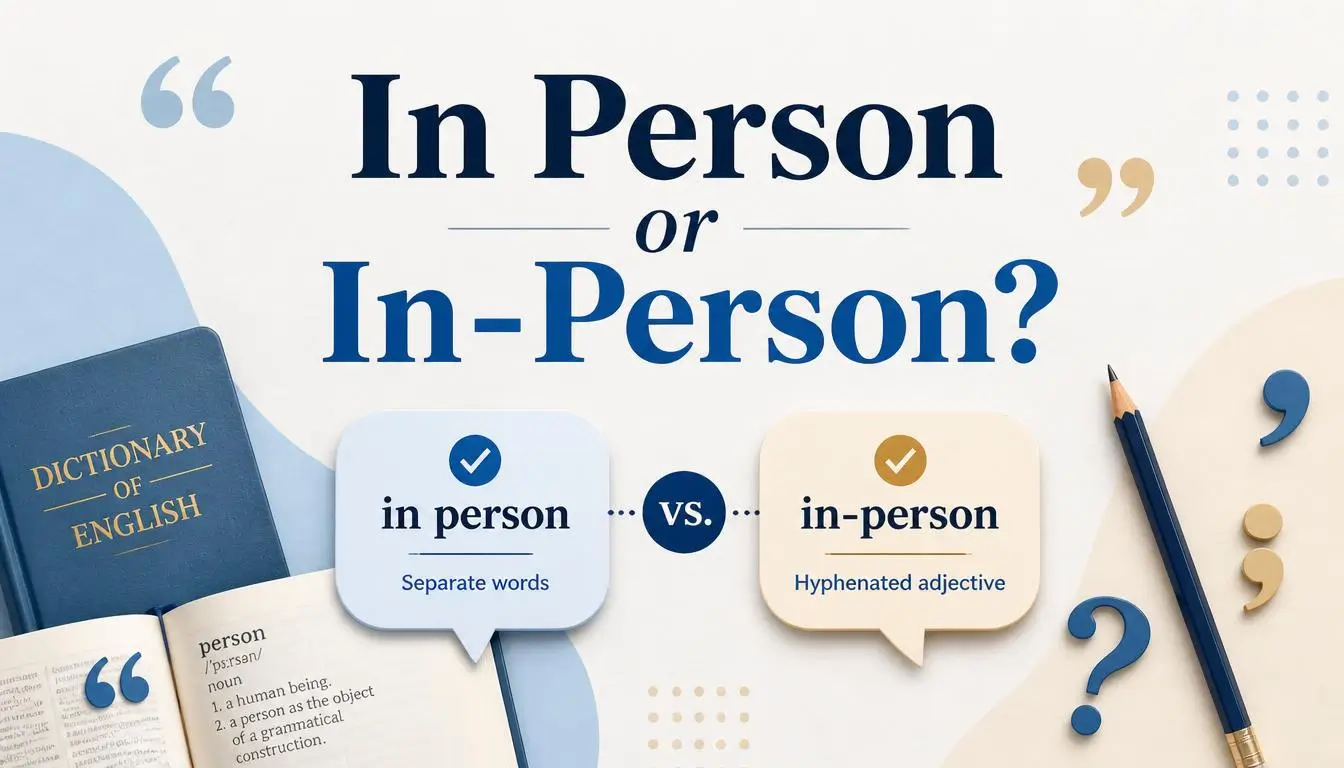
Words can look almost identical yet follow different grammar rules. “In person” and “in-person” are a perfect example. Both forms are correct, but they are used in different ways.
People often search for “in person or in-person” because they are unsure whether the phrase should have a hyphen.
This confusion often comes up in emails, resumes, business messages, school assignments, and formal documents. The answer depends on how the phrase works in the sentence.
In most cases, in person is written as two separate words when it comes after a verb or describes how something happens.
For example, “I want to meet you in person.” However, in-person is usually hyphenated when it comes before a noun and works as a compound adjective, such as “an in-person meeting.”
Understanding this small difference can make your writing clearer and more professional. This guide explains in person or in-person, their grammar, spelling, common mistakes, regional usage, and everyday examples.
In Person or In-Person – Quick Answer
Both “in person” and “in-person” are correct. The correct form depends on its position and grammatical role.
- In person = usually an adverbial phrase meaning physically present or face-to-face.
- In-person = usually a compound adjective placed before a noun.
Examples
In person:
I would like to speak with you in person.
She attended the interview in person.
In-person:
We scheduled an in-person interview.
The company offers in-person training.
A simple rule is:
Before a noun → use “in-person.”
After a verb or at the end of a sentence → usually use “in person.”
| Form | Typical use | Example |
| in person | Adverbial phrase | I met him in person. |
| in-person | Compound adjective | We had an in-person meeting. |
There are exceptions depending on sentence structure, but this rule works well for most everyday writing.
The Origin of In Person or In-Person
The phrase in person comes from the older expression in person, meaning physically present rather than represented by someone else.
The word person comes from Latin persona, which referred to a character, role, or person. Over time, English developed many expressions using person, including in person, meaning someone is physically present.
The original phrase was written as two words:
in person
The hyphenated form in-person developed later as English speakers began using the phrase directly before nouns as a compound modifier.
For example:
We spoke in person.
Here, “in person” explains how the speaking happened.
But:
We had an in-person conversation.
Here, “in-person” describes the noun conversation.
Hyphens are often used in English to make several words work together as one adjective. That is why in-person became common before nouns.
The spelling difference is therefore not really a British-versus-American spelling issue. It is mainly a grammar and sentence-position issue.
British English vs American English Spelling
Unlike words such as colour/color or centre/center, there is no major British-versus-American spelling difference here.
Both British and American English commonly use:
- in person
- in-person
The main difference is how the phrase functions in a sentence, not which country you are writing for.
Comparison Table
| Usage | American English | British English | Example |
| Adverbial phrase | in person | in person | I spoke to her in person. |
| Before a noun | in-person | in-person | We arranged an in-person meeting. |
| Physical attendance | in person | in person | He attended in person. |
| Compound adjective | in-person | in-person | They provide in-person support. |
So, whether you are writing for an American, British, Canadian, Australian, or international audience, the basic rule remains the same.
Which Spelling Should You Use?
Your choice should depend mainly on grammar and sentence structure, rather than your location.
For a US audience
Use in person when the phrase explains how an action happens.
I would prefer to discuss this in person.
Use in-person before a noun.
We offer in-person consultations.
For a UK or Commonwealth audience
The same rule generally applies.
She wants to meet in person.
They arranged an in-person appointment.
A global audience
If your content is designed for an international audience, follow standard English grammar. Do not change the spelling simply because your readers are from different countries.
The safest approach is:
Use “in person” when it functions as a phrase after the verb. Use “in-person” when it directly modifies a noun.
This makes your writing natural and easy to understand.
Common Mistakes with In Person or In-Person
Several mistakes appear frequently in emails, articles, and professional writing.
Mistake 1st: Adding a hyphen after the verb
Incorrect:
I want to talk to you in-person.
Better:
I want to talk to you in person.
Here, the phrase follows the verb talk and explains how the conversation will happen.
Mistake 2nd: Removing the hyphen before a noun
Less standard:
We scheduled an in person meeting.
Better:
We scheduled an in-person meeting.
Here, the phrase works together to describe meeting, so the hyphen helps show that the words form one compound adjective.
Mistake 3rd: Assuming one form is always correct
It is incorrect to think that only in person or only in-person is right.
Both can be correct.
Mistake 4th: Confusing “in-person” with “in person”
Remember:
I attended in person.
but:
I attended an in-person event.
The noun position changes the form.
Mistake 5th: Overusing the hyphen
You do not need to hyphenate the phrase every time it appears.
Incorrect:
Please visit us in-person.
Correct:
Please visit us in person.
In Person or In-Person in Everyday Examples
The phrase appears in many types of writing.
In Emails
Professional emails often use in person when suggesting a face-to-face conversation.
I would be happy to discuss this matter in person.
When describing a meeting, use in-person before the noun:
Would you be available for an in-person meeting next week?
News Writing
News articles may use both forms:
The minister answered questions in person.
The organization held an in-person press conference.
In Social Media
Social media posts often use the phrase informally:
It was great to finally meet you in person!
Or:
Join us for an in-person event this weekend.
Formal Writing
Academic and business writing may use both forms:
Participants were asked to attend in person.
The study included in-person interviews with participants.
In Resumes and Job Applications
Job descriptions frequently use in-person before nouns:
Conducted in-person interviews with customers.
Provided in-person customer support.
But when describing an action, use in person:
Met with clients in person to discuss project requirements.
In Person or In-Person – Comparison Table
| Variation | Correct? | Main function | Example |
| in person | Yes | Adverbial phrase | We met in person. |
| in-person | Yes | Compound adjective | We had an in-person meeting. |
| inperson | No | Not standard English | ❌ We met inperson. |
| in-personly | No | Not standard English | ❌ We discussed it in-personly. |
The two standard forms you should remember are in person and in-person.
In Person or In-Person – Google Trends & Usage Data
Search interest for “in person or in-person” reflects a common grammar question. People often search this phrase when they are unsure about hyphenation.
Usage also increased in importance as communication changed between online and physical interaction. Words such as:
- in-person meeting
- in-person class
- in-person interview
- in-person event
- in-person appointment
became especially common as organizations began distinguishing physical activities from virtual ones.
Google Trends can show relative search interest by country and over time, but it does not provide an exact count of all English-language usage. Search interest can also change because of education, workplace trends, online learning, and seasonal events.
The phrase is widely understood in American, British, Canadian, Australian, and other varieties of English. The grammatical distinction remains broadly similar across these forms of English.
For SEO writers, the important point is that users may search both “in person or in-person” and related questions such as “is in person hyphenated?” or “in-person meaning.” Using the correct form naturally throughout an article can help answer these different search intents.
FAQs:
Is “in person” one word or two?
In person is normally written as two words when it functions as an adverbial phrase.
I met her in person.
Is “in-person” hyphenated?
Yes. In-person is commonly hyphenated when it appears before a noun as a compound adjective.
We arranged an in-person meeting.
Is “in person” or “in-person” correct?
Both are correct. The choice depends on how the phrase is used in the sentence.
Is “in-person meeting” correct?
Yes. In-person meeting is a standard compound adjective followed by the noun meeting.
Should I write “meet in-person” or “meet in person”?
Write:
meet in person
For example:
I would like to meet you in person.
Is “inperson” a word?
No. Inperson is not the standard spelling. Use either in person or in-person, depending on the sentence.
Is the spelling different in British and American English?
Generally, no. Both varieties use in person and in-person. The main difference is grammatical function, not regional spelling.
Conclusion:
The choice between in person or in-person is easier once you understand the role of the phrase in a sentence. Both forms are correct, but they usually serve different purposes.
Use in person as a phrase when you mean physically present or face-to-face:
I would like to speak with you in person.
Use in-person when the phrase comes before a noun and works as a compound adjective:
We scheduled an in-person meeting.
This rule works well in American, British, and most other forms of standard English. It also applies across emails, business documents, news articles, social media posts, resumes, and academic writing.
The most important thing is not to choose a form based only on whether you are writing for a US or UK audience. Instead, look at the phrase’s position and function. If it describes how an action happens, use in person.
If it directly describes a noun, use in-person. Once you learn this simple distinction, you can use the phrase confidently and avoid one of the most common hyphenation mistakes in English.
Read More Posts:
- Lie Down or Lay Down: How to Use Each Correctly
- Color Gray or Grey: Correct Spelling Usage Guide 2026
- Cancelation or Cancellation: British vs American English Guide