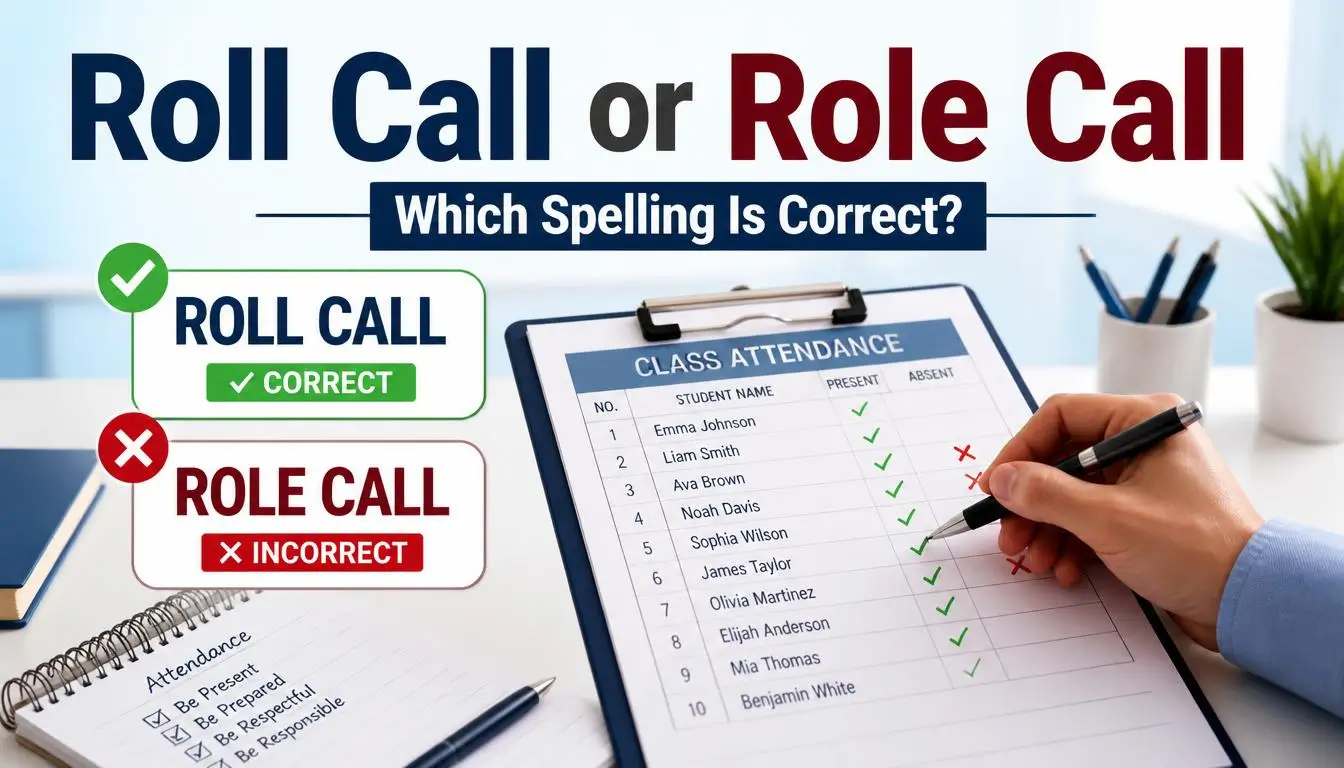
If you are writing “roll call or role call”, you may stop and wonder which phrase is correct. Both roll and role are real English words, but they have very different meanings. This makes the spelling easy to mix up.
The correct phrase for taking attendance is roll call. It refers to the act of reading a list of names and checking who is present. For example, a teacher may say, “The teacher took roll call before starting the lesson.”
Role call is usually incorrect when you mean attendance. The word role refers to a person’s function, part, or position in a situation. For example, “She played the role of a doctor in the movie.”
People often search for “roll call or role call” because the two words sound similar. This article explains the difference, gives simple examples, and shows which spelling you should use in American, British, and international English.
By the end, you will know exactly when to use roll call and when role belongs in a sentence.
Roll Call or Role Call – Quick Answer
Roll call is the correct spelling when you mean checking attendance.
Correct:
- The teacher took roll call.
- We have roll call at 8 a.m.
- The coach called roll before practice.
Usually incorrect:
- The teacher took role call.
The word roll means a list of names or people. So, roll call means calling the names on a list to see who is present.
The word role means a job, function, character, or part someone has.
Example:
- “The student was absent during roll call.”
- “He played the role of the main character.”
Roll vs. Role
| Word | Meaning | Example |
| Roll | A list of names; also to move by turning | The teacher checked the roll. |
| Role | A function, position, or character | She has an important role. |
| Roll call | Checking attendance | The officer conducted roll call. |
| Role call | Usually a spelling mistake for roll call | Avoid it for attendance. |
The Origin of Roll Call
The phrase roll call comes from the use of a roll as a list or register of names.
The word roll has a long history in English. It developed from words linked to a rolled document or list. In earlier times, important records and lists were often written on long pieces of material that could be rolled up.
Over time, roll also came to mean a written list of people. A person’s name could appear on a military, school, church, or official roll.
When officials called the names on the roll, the practice became known as roll call.
The word role has a different history. It came into English through French and was connected to a written part or character in a play. Today, role commonly means a person’s function, duty, position, or part.
This difference explains why roll call is correct for attendance. The phrase is based on the idea of calling names from a roll, not calling someone’s role.
British English vs American English Spelling
There is no major British-American spelling difference between roll call and role call.
Both American and British English use roll call when referring to attendance.
| English variety | Correct phrase | Example |
| American English | roll call | Roll call starts at nine. |
| British English | roll call | The teacher took roll call. |
| Australian English | roll call | Roll call was completed. |
| Canadian English | roll call | The officer conducted roll call. |
| International English | roll call | Students waited for roll call. |
The confusion is not really caused by British versus American spelling. Instead, it comes from the similar pronunciation of roll and role.
Other English words can have genuine regional spelling differences, such as:
- color / colour
- center / centre
- traveled / travelled
But roll call does not normally change to role call in British English.
Which Spelling Should You Use?
Use roll call when you are talking about attendance or a list of names being called.
For American English
Use roll call in schools, workplaces, military settings, meetings, and other formal situations.
Example:
“The teacher took roll call at the beginning of class.”
British and Commonwealth English
Use roll call as well. The same spelling works in the UK and other English-speaking regions.
Example:
“The register was checked during roll call.”
For Global English
If your readers come from different countries, roll call is still the safest and standard choice when you mean attendance.
If you are writing for a professional audience, avoid role call unless you truly mean something related to a person’s role.
Common Mistakes with Roll Call
Because roll and role sound alike, several mistakes are common.
Writing “role call” for attendance
Incorrect:
“The teacher completed role call.”
Correct:
“The teacher completed roll call.”
Confusing role with roll
Remember:
Roll = list
Role = function
This simple rule can help you remember the difference.
Using “roll call” when discussing someone’s job
If you are talking about a person’s function or responsibility, use role.
Correct:
“She has an important role in the project.”
You would not normally say:
“She has an important roll in the project.”
Confusing roll call with a roll
The word roll has several meanings.
- A roll of paper
- A bread roll
- To roll a ball
- A school roll
- Roll call
Context tells you which meaning is intended.
Roll Call in Everyday Examples
The phrase roll call appears in many types of writing and conversation.
In Emails
Example:
Please arrive before 9:00 a.m. because roll call will begin promptly.
This is suitable for a school, workplace, training session, or organized event.
In News Writing
News reports may use roll call when describing schools, police departments, military units, or public meetings.
Example:
Officers gathered for roll call before beginning their morning shifts.
On Social Media
People often use the phrase casually online.
Example:
Morning roll call! Who is already at work?
Here, roll call can be used in a playful way to ask who is present.
In Formal Writing
Example:
All participants must be present when roll call begins.
This sounds clear and professional.
Schools
Example:
The teacher took roll call before starting the lesson.
In the Military
Example:
Soldiers assembled for morning roll call.
The phrase has a long connection with military attendance and official lists.
Roll Call – Google Trends & Usage Data
Searches for “roll call or role call” are driven mainly by spelling confusion. People often know what they want to say but are unsure whether the first word should be roll or role.
The phrase roll call is far more established in standard English than role call when the meaning is attendance.
Usage also varies by context:
- Schools: checking student attendance.
- Military: checking members of a unit.
- Police: checking officers before shifts.
- Workplaces: checking who is present.
- Meetings: confirming participants.
- Online: informally asking who is present.
In countries where English is widely used, including the United States, United Kingdom, Canada, and Australia, roll call is the standard form.
Search interest can change over time and may increase around school terms, elections, military events, or major public events. However, popularity in search results does not change the correct spelling.
If you compare the two phrases, roll call is the clear standard choice for attendance.
Roll Call vs Role Call: Comparison Table
| Variation | Correct? | Meaning | Example |
| Roll call | ✅ Yes | Checking attendance | The teacher took roll call. |
| Role call | ❌ Usually no | Common mistaken spelling | Avoid this for attendance. |
| Roll | ✅ Yes | A list or register | His name is on the roll. |
| Role | ✅ Yes | Function or position | She has a key role. |
| Calling the roll | ✅ Yes | Reading names from a list | The officer is calling the roll. |
| Call the roll | ✅ Yes | Check attendance | Please call the roll. |
How to Remember Roll Call vs Role Call
A simple memory trick can make this difference easy.
Think:
Roll = Register
Both roll and register relate to a list of names.
So:
Roll call = calling names from a list.
For role, think about:
Role = Responsibility
A role is what someone does or the part they have in a situation.
For example:
- Roll call: “Is your name on the list?”
- Role: “What is your job or function?”
This trick works in most everyday situations.
FAQs:
Is it roll call or role call?
Roll call is correct when you mean checking attendance or calling names from a list. Role call is generally a mistake in this context.
Why is it called roll call?
It is called roll call because a roll can mean an official list of names. Calling the names on that list became known as roll call.
Is “role call” ever correct?
It can appear as a literal combination of the words role and call in unusual contexts, but it is not the standard phrase for attendance. Use roll call for attendance.
Is roll call one word?
No. The standard form is two words: roll call.
Is roll call used in British English?
Yes. Roll call is used in British English as well as American English and other major varieties of English.
What is the difference between roll and role?
Roll can mean a list of names, while role means a function, position, duty, or character.
What is another word for roll call?
Depending on the context, alternatives include attendance check, attendance check-in, register, or calling the register. In schools, “taking attendance” is also common.
Conclusion:
When choosing between roll call or role call, the correct phrase for checking attendance is roll call. The phrase comes from the idea of calling names from a roll, meaning an official list or register.
Role has a completely different meaning. It describes a person’s function, duty, position, or character. That is why “role call” is normally incorrect when you are talking about attendance.
There is also no important British-versus-American spelling difference here. Both varieties generally use roll call. The confusion happens because roll and role sound the same but have different meanings.
The easiest way to remember the difference is simple: roll = list, role = function. Use roll call in schools, workplaces, military settings, meetings, news writing, and everyday communication when names are being checked. Use role when discussing what someone does or the part they play.
If you remember that one rule, you will rarely confuse roll call and role call again.
Read More Posts:
- Dieing or Dying: British and American Usage
- Whether or Wether: How to Use Each Word (2026guide)
- Bougie or Boujee: Examples in Everyday Language

Toni Morrison is a celebrated American novelist known for her powerful storytelling, rich characters, and lasting impact on literature. At GrammerNests.com, she shares insights that help readers appreciate language, writing, and literary expression.







