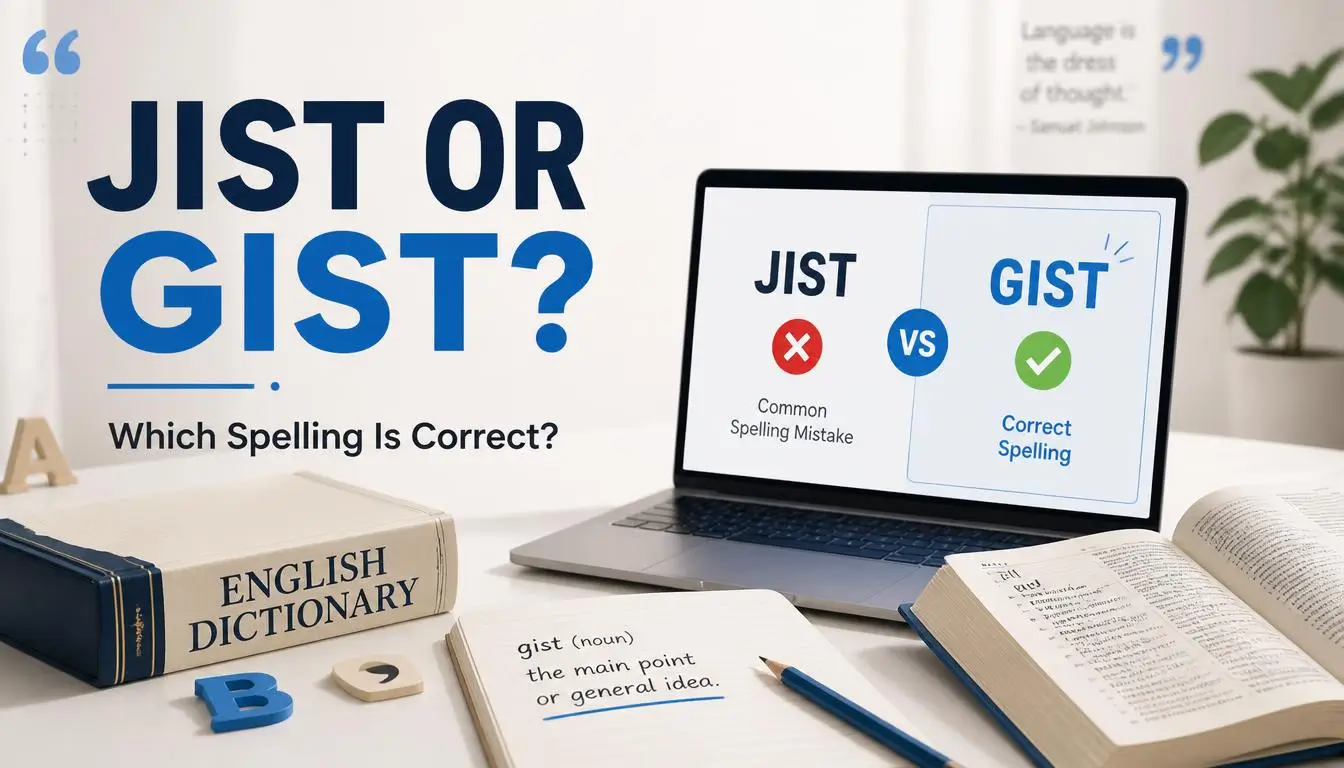
When you want to describe the main idea of something, choosing between “jist or gist” can be confusing. The two words sound almost the same, but only one is correct in standard English.
This is why people often search for “jist or gist” before writing an email, post, school assignment, or formal document.
The correct spelling is “gist.” It means the main point, basic meaning, or central idea of something. For example, you can say, “I did not read the whole report, but I understand the gist.”
“Jist” is a common spelling mistake. It is not the standard spelling of the word. The confusion likely happens because gist is usually pronounced with a soft “g,” making it sound like “jist.”
This guide explains the difference between jist or gist, where the word comes from, how it is used in American and British English, common mistakes, and real-life examples. By the end, you will know exactly which spelling to use.
Jist or Gist – Quick Answer
The correct spelling is gist.
Gist means the main point, general meaning, or central idea of something.
Correct:
I understand the gist of your message.
Incorrect:
I understand the jist of your message.
The word gist is pronounced like “jist.” This pronunciation is the main reason people sometimes spell it incorrectly as jist.
| Spelling | Correct? | Meaning |
| gist | ✅ Yes | Main point or general meaning. |
| jist | ❌ No | Common misspelling of “gist.” |
Easy way to remember
Think:
Gist = General idea
Both words begin with G, which can help you remember the correct spelling.
The Origin of Gist
The word gist has an interesting history. It comes from Old French and is connected to the French legal phrase “gist”, meaning “lies” or “rests.”
The word entered English through legal language. In older legal documents, phrases such as “the action gist” were used to describe where a legal case or matter rested.
Over time, the meaning changed. Instead of referring mainly to the basis of a legal action, gist came to mean the central point or essential part of something.
Today, the word is common in everyday English.
For example:
- “What is the gist of the story?”
- “I got the gist of the conversation.”
- “She explained the gist of the report.”
The spelling remained gist, even though the pronunciation developed a soft g sound.
This creates the modern confusion between gist and jist. When people hear the word spoken, they hear a sound similar to “jist.” They may then assume that the word begins with J.
However, the standard English spelling has always been gist.
British English vs American English Spelling
There is no spelling difference between British English and American English for this word.
Both varieties use:
gist
The incorrect form jist is not a standard British or American spelling.
| English Variety | Correct Spelling | Example |
| American English | gist | I understand the gist. |
| British English | gist | I understand the gist. |
| Canadian English | gist | She explained the gist. |
| Australian English | gist | I got the gist. |
| New Zealand English | gist | He knows the gist. |
| International English | gist | What is the gist? |
| Incorrect spelling | jist | ❌ Avoid this spelling |
Why Does “Gist” Sound Like “Jist”?
The confusion comes from pronunciation.
In gist, the letter g has a soft sound. It sounds similar to the j in words such as:
- job
- jump
- just
- journey
So:
gist → sounds like “jist”
But pronunciation does not change the spelling.
The same pattern happens in other English words where g has a soft sound, such as:
- giant
- gym
- gentle
- general
Therefore, remember that gist is spelled with G, not J.
Which Spelling Should You Use?
You should use gist in almost every English-speaking setting.
For a US audience
Use:
gist
Example:
I understand the gist of the article.
UK or Commonwealth audience
Use:
gist
Example:
She gave me the gist of the meeting.
For global English
Use:
gist
It is the standard spelling and is understood across major English-speaking countries.
There is no need to change gist to another spelling based on the country where your readers live.
If you are writing a professional email, academic paper, business report, website, or social media post, gist is the safe choice.
Common Mistakes with Jist or Gist
Because the word sounds like “jist,” several common spelling mistakes appear.
Mistake 1st: Writing “jist”
❌ I know the jist of the story.
✅ I know the gist of the story.
Mistake 2nd: Thinking “jist” is British English
Some people think jist may be a British spelling.
It is not.
British English also uses gist.
Mistake 3rd: Using “gist” as a verb
Gist is mainly used as a noun.
For example:
I understand the gist of his argument.
It is better to avoid unusual constructions such as:
I gisted the meeting.
Instead, say:
I summarized the meeting.
Mistake 4th: Confusing gist with a full explanation
The gist is the main idea. It does not mean every detail.
For example:
I read the report but only remember the gist.
This means the person remembers the main point, not all the details.
Mistake 5th: Confusing gist with summary
The words are related, but they are not the same.
A summary usually gives a shorter version of the important information.
The gist is the basic idea or main point.
Jist or Gist in Everyday Examples
The word gist is useful in many situations.
In Emails
You might use it when discussing a long message:
I read your email and understand the gist. I’ll review the details later.
Another example:
Could you give me the gist of the proposal?
News
News stories often contain many details. Someone may want only the main point:
What is the gist of the news report?
Or:
The article explains the gist of the new policy.
In Social Media
People often use gist in casual conversations:
I didn’t watch the whole video, but I got the gist.
Or:
Can someone give me the gist?
In Formal Writing
The word can also appear in professional and academic writing:
The gist of the argument is that education improves economic opportunity.
Another example:
The researcher clearly explains the gist of the study.
Everyday Conversation
You may hear:
I missed the meeting. What’s the gist?
This simply means:
“What was the main point?”
Jist or Gist – Google Trends & Usage Data
Search interest for “jist or gist” mainly comes from spelling confusion. People often search the phrase when they are unsure which form is correct.
The important point is that gist is the established English word, while jist is generally a misspelling.
Search behavior can vary by country. English-speaking countries may show different levels of interest depending on education, online writing habits, and how often people encounter the word.
Google Trends can also show differences between searches such as:
- “jist or gist”
- “gist meaning”
- “gist definition”
- “jist meaning”
- “how to spell gist”
However, search popularity does not mean that both spellings are correct.
A misspelling can receive many searches because people are trying to confirm whether it is correct.
For professional writing, dictionaries and standard English usage are more useful than search volume alone.
Gist vs Jist: Usage Comparison
| Variation | Standard English? | Typical Use |
| gist | ✅ Yes | Main point or idea |
| jist | ❌ No | Common spelling error |
| gist of the story | ✅ Yes | Main idea |
| gist of the conversation | ✅ Yes | Main meaning |
| gist of the email | ✅ Yes | Main point |
| jist of the story | ❌ No | Incorrect spelling |
Gist vs Jist: Simple Comparison
Here is the easiest way to remember the difference:
| Word | Spelling | Meaning | Example |
| Gist | G-I-S-T | Main point | I understand the gist. |
| Jist | J-I-S-T | Not standard English | ❌ Do not use it. |
The pronunciation can make the two forms seem similar, but the spelling is different.
Gist = correct
Jist = incorrect
How to Remember the Correct Spelling
If you often forget whether to use G or J, use this simple memory trick:
Gist = General idea
The G in gist can remind you of a general idea.
For example:
The gist is the general idea.
You can also remember that many English words use a soft G sound:
- gist
- giant
- gentle
- general
- gym
So hearing a “J” sound does not mean the word must begin with J.
FAQs:
Is it “jist” or “gist”?
The correct spelling is gist. “Jist” is a common misspelling.
What does gist mean?
Gist means the main point, basic meaning, or central idea of something.
Example:
I understand the gist of the conversation.
Is “jist” a real word?
In standard modern English, jist is not the normal spelling for the word meaning “main point.” Use gist instead.
Is gist spelled with G or J?
It is spelled with G:
G-I-S-T
Why does gist sound like jist?
The g in gist has a soft sound. It is pronounced like the j sound in “job” or “jump.”
Is “gist” the same in British and American English?
Yes. Both British English and American English use gist.
Can I use gist in formal writing?
Yes. Gist is a standard English word and can be used in emails, reports, articles, academic writing, and everyday conversation.
Conclusion:
If you are wondering whether jist or gist is correct, the answer is simple: gist is the correct spelling. It means the main point, central idea, or general meaning of something.
The confusion happens because gist is pronounced with a soft g, so it sounds like “jist.” However, the pronunciation does not change the spelling. Whether you write for an American, British, Australian, Canadian, or global audience, the standard spelling remains gist.
Use gist when you want to talk about the main idea of a story, email, conversation, report, article, or argument. Avoid jist in professional and academic writing because it is a common spelling error.
The easiest memory trick is “gist = general idea.” Once you connect the G with “general,” it becomes much easier to remember the correct spelling.
In short: Gist is correct. Jist is not.
Read More Posts:
- Master’s Degree: Capitalization and Apostrophe Rules
- Leafs or Leaves: Quick Answer and Usage Guide 2026
- Choose vs Chose: Examples for Everyday English

Toni Morrison is a celebrated American novelist known for her powerful storytelling, rich characters, and lasting impact on literature. At GrammerNests.com, she shares insights that help readers appreciate language, writing, and literary expression.







