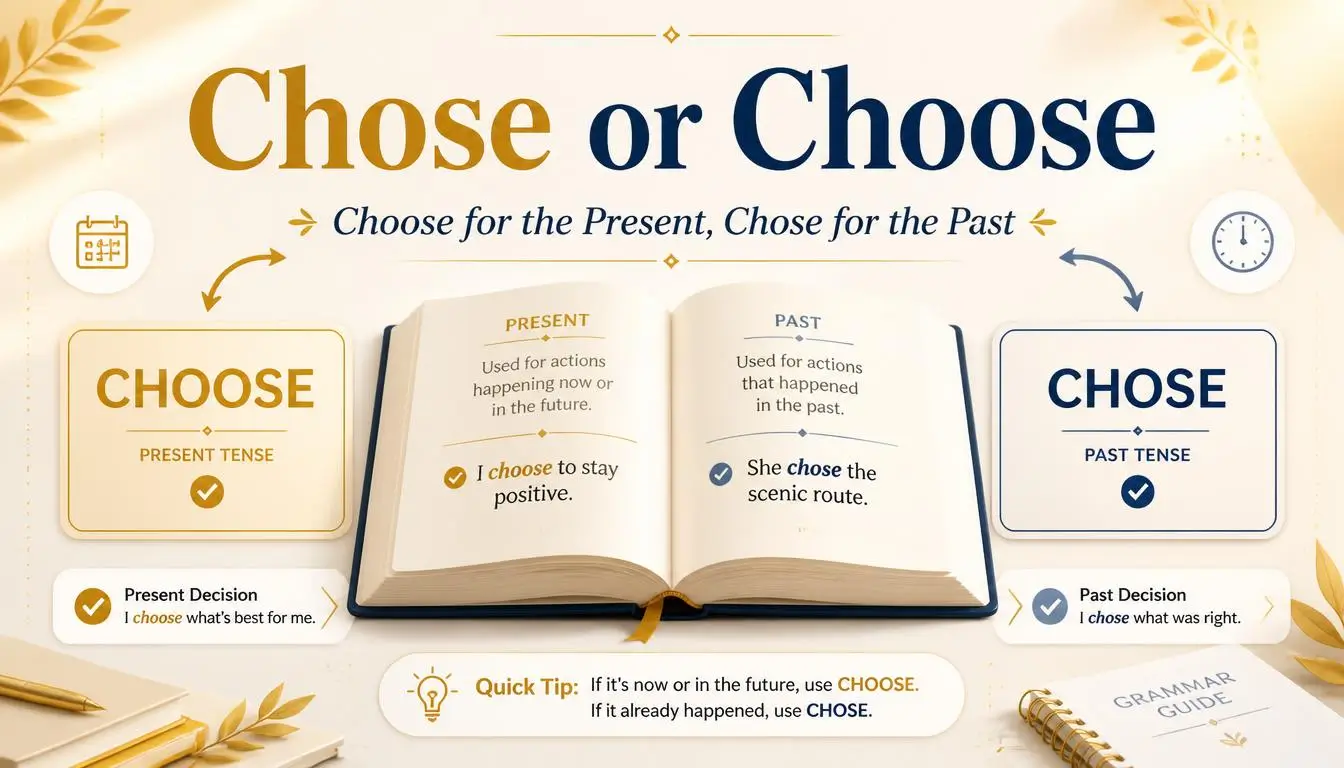
If you have ever stopped while writing and wondered whether chose or choose is correct, you are not alone. These two words look almost the same, but they are used in different situations. The main difference is tense.
Choose is the present-tense form, while chose is the simple past form.
This small spelling difference can change the meaning of a sentence. For example, “I choose tea” means you select tea now or usually.
“I chose tea” means you selected it in the past. Because both words come from the same verb, learners often mix them up in emails, schoolwork, social media posts, and professional writing.
Understanding chose or choose is useful because it helps you describe when an action happens.
Once you learn the simple tense rule, the difference becomes easy to remember. Next, this guide explains their meanings, origins, spelling, common mistakes, everyday examples, and usage patterns so you can confidently choose the correct word.
Chose or Choose – Quick Answer
Choose and chose are both correct words, but they have different grammatical uses.
- Choose = present tense
- Chose = simple past tense
- Chosen = past participle, normally used with have, has, or had
Examples
Choose:
I always choose coffee in the morning.
Chose:
I chose coffee yesterday.
Chosen:
She has chosen a new dress.
A simple way to remember the difference is:
Now = choose
Past = chose
Quick Comparison
| Word | Tense | Example |
| Choose | Present | I choose the blue shirt. |
| Chose | Past | I chose the blue shirt yesterday. |
| Chosen | Past participle | I have chosen the blue shirt. |
So, if you are talking about something happening now or regularly, use choose. If it already happened, use chose.
The History of Chose or Choose
The words choose and chose come from the same English verb. Their history goes back to Old English, where forms of the verb were used to describe selecting or deciding between options.
Over time, English changed the spelling and pronunciation of many words. The verb developed different forms for different tenses. Choose became the present form, while chose became the past form.
The vowel change may seem unusual, but it is not unique to this verb. English has several verbs that change their vowel when they move into the past tense.
For example:
- sing → sang
- drink → drank
- begin → began
- choose → chose
The spelling difference exists because these words represent different forms of the same verb.
Another important form is chosen:
She has chosen the red one.
Here, chosen is not normally used alone as the simple past form. You would say:
She chose the red one.
Not:
She chosen the red one.
Understanding these three forms makes the entire word family much easier.
British English vs American English Spelling
There is no major British-versus-American spelling difference between choose and chose.
Both British English and American English use:
- choose for the present tense
- chose for the simple past
- chosen for the past participle
The difference is grammatical rather than regional.
| Form | British English | American English | Meaning |
| Present | choose | choose | Select now or regularly |
| Past | chose | chose | Selected in the past |
| Past participle | chosen | chosen | Used with have/has/had |
| -ing form | choosing | choosing | Action in progress |
Examples in Both Varieties
British English:
We chose the train because it was cheaper.
American English:
We chose the train because it was cheaper.
The spelling is the same.
However, pronunciation can sometimes vary slightly between speakers or regions. That does not change the spelling or basic grammatical rule.
Which Spelling Should You Use?
You do not need to choose between British and American spelling when deciding between chose and choose. The correct word depends on when the action happened.
Use “Choose” for Present Actions
Use choose when someone is making a decision now, makes decisions regularly, or is being told to select something.
Examples:
Please choose one option.
I usually choose tea.
You can choose any seat.
“Chose” for Past Actions
Use chose when the selection happened in the past.
Examples:
I chose this university last year.
They chose the blue car.
She chose to stay home.
Use “Chosen” with Perfect Tenses
Use chosen with forms of have.
Examples:
I have chosen my topic.
She has chosen a new career.
They had chosen the location before we arrived.
For a Global Audience
If you write for an international audience, the same rule applies. Choose and chose are standard in both varieties of English.
The key is not regional spelling. The key is verb tense.
Common Mistakes with Chose or Choose
Because these words look similar, several mistakes are common.
Mistake 1st: Using “Chose” for the Present
Incorrect:
I always chose healthy food.
If you mean this is your regular habit, use:
I always choose healthy food.
Mistake 2nd: Using “Choose” for the Past
Incorrect:
Yesterday, I choose the red dress.
Correct:
Yesterday, I chose the red dress.
The word yesterday clearly places the action in the past.
Mistake 3rd: Confusing “Chose” and “Chosen”
Incorrect:
I have chose this option.
Correct:
I have chosen this option.
After have, has, or had, use chosen.
Mistake 4th: Writing “Choosed”
Incorrect:
She choosed the best answer.
Correct:
She chose the best answer.
Choosed is not the standard past form of choose.
Mistake 5th: Forgetting the Tense
Look at the time clue before selecting the word.
Words such as:
- yesterday
- last week
- last year
- earlier
- previously
often indicate that chose is needed.
Words such as:
- today
- usually
- often
- always
- now
may indicate that choose is appropriate, depending on the sentence.
Chose or Choose in Everyday Examples
Knowing the rule is useful, but seeing the words in real situations makes the difference easier to understand.
In Emails
Present:
Please choose your preferred meeting time.
Past:
We chose the Friday meeting time after discussing the options.
News Writing
Present:
Voters choose their preferred candidates during the election.
Past:
The committee chose a new chairman yesterday.
News writers use the form that matches the time of the event.
On Social Media
Present:
I choose happiness every day.
Past:
I chose this photo because it captured the moment perfectly.
In Formal Writing
Present:
Students may choose one of three research topics.
Past:
The researchers chose the second method for the study.
In Conversation
Present:
Which one do you choose?
Past:
Which one did you choose?
Notice another useful clue: after did, use choose, not chose.
Correct:
What did you choose?
Incorrect:
What did you chose?
This happens because did already carries the past tense.
Chose or Choose – Google Trends & Usage Data
Search interest for chose or choose often comes from people trying to solve a grammar or spelling question. Users may search both words together because they know the words are related but are unsure which one fits their sentence.
The important point is that choose is generally more common in everyday English because it is the present-tense form and appears in instructions, questions, habits, and general statements.
Chose is also common, but it appears when writers describe completed decisions.
Usage can vary by context:
| Context | More likely form | Example |
| Instructions | Choose | Choose a payment method. |
| Daily habits | Choose | I choose tea every morning. |
| Past events | Chose | I chose tea yesterday. |
| Questions with “did” | Choose | What did you choose? |
| Perfect tense | Chosen | I have chosen my answer. |
| Formal reports | Either | The team chose the final option. |
Search behavior can also vary by country because English learners often search for grammar comparisons such as chose vs choose, choose or chose, and choose vs chosen.
Rather than relying only on search popularity, the best approach is to understand the grammar rule. Once you know whether the action is present or past, the correct spelling is usually clear.
Chose vs Choose: Comparison Table
| Feature | Choose | Chose |
| Meaning | Select or decide | Selected or decided |
| Tense | Simple present | Simple past |
| Time | Now, regularly, or generally | Past |
| Example | I choose this option. | I chose this option. |
| Question | What do you choose? | What did you choose? |
| Common clue | usually, often, now | yesterday, last year, earlier |
| Correct with “did” | Yes | No |
| Correct with “have” | No | No — use chosen |
| Correct spelling | Yes | Yes |
Easy Memory Trick
Think of the vowel change like this:
Choose → Chose → Chosen
You can remember:
Today: choose. Yesterday: chose. With have: chosen.
This simple pattern covers most situations.
FAQs:
Is “chose” or “choose” correct?
Both are correct. Choose is the present-tense form, while chose is the simple past form.
What is the past tense of choose?
The past tense of choose is chose.
Example:
I chose the blue option.
Is “choosed” a word?
Choosed is not the standard past-tense form of choose. The correct past tense is chose.
Should I say “I choose” or “I chose”?
Use I choose for a present or regular action.
I choose tea every morning.
Use I chose for a completed past action.
I chose tea yesterday.
Is “I have chose” correct?
No. The correct sentence is:
I have chosen.
After have, use chosen, not chose.
Is “What did you chose?” correct?
No. The correct form is:
What did you choose?
Because did already marks the sentence as past tense, the main verb stays in its base form.
Do British and American English spell these words differently?
No. Both British and American English use choose, chose, and chosen in the same way.
Conclusion:
Understanding chose or choose is simple once you focus on tense. Both words are correct, but they belong in different situations. Choose is the present-tense form and describes selecting something now, regularly, or generally.
Chose is the simple past form and describes a decision that was completed in the past.
There is no British-versus-American spelling difference between these two words. Writers in both varieties of English use the same forms. The third form, chosen, is also important because it works with have, has, and had.
When checking your sentence, first ask when the action happened. If it is happening now or is a regular choice, use choose.
It happened before; use chose. If you use have, has, or had, use chosen. Remember the simple pattern: choose → chose → chosen. With this rule, you can confidently use these words in emails, school assignments, professional writing, social media, and everyday conversation.
Read More Posts:
- Effect or Affect: Understand Difference as a Verb and Noun
- Its vs It’s Explained With Clear Examples (2026Guide)
- Toward or Towards in American and British English (2026Guide)