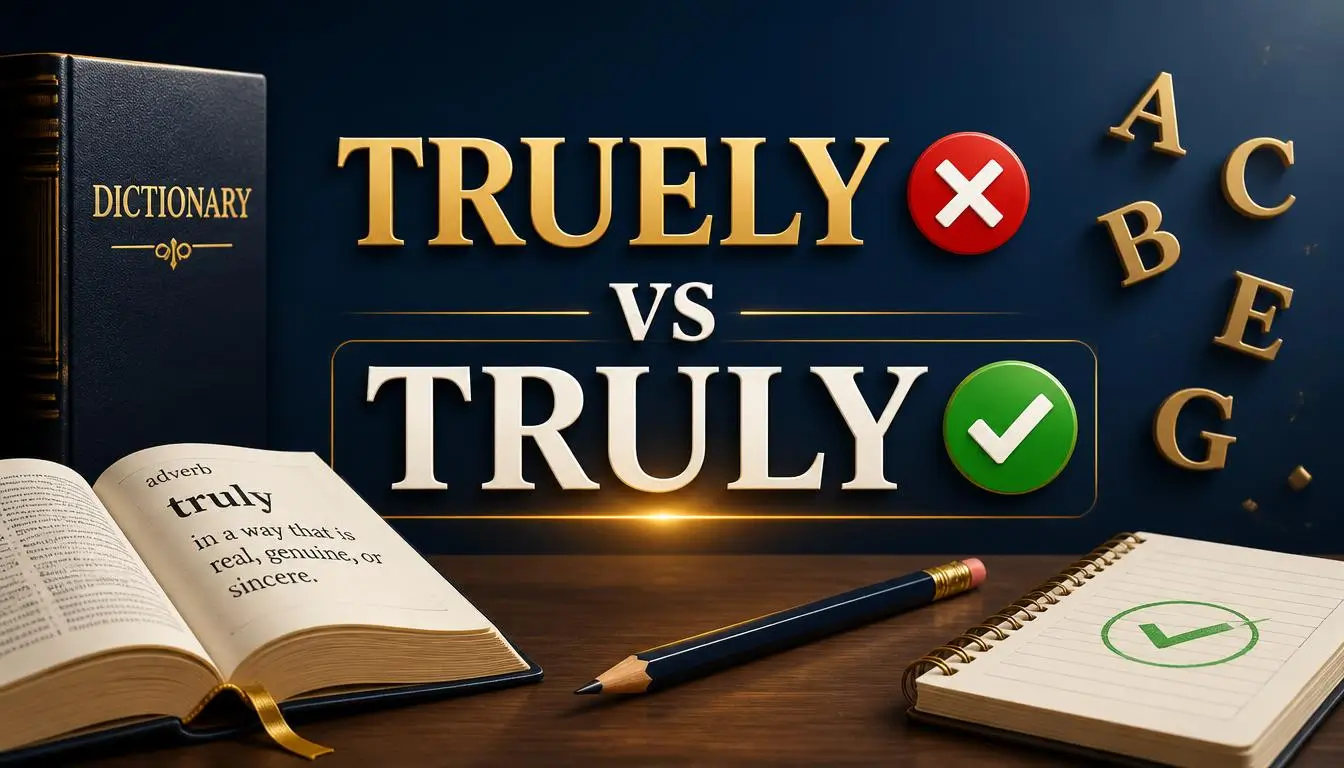
A single letter can make a big difference in English spelling. If you have ever typed “truely” and wondered whether it should be “truly,” you are not alone.
This is a common spelling question because the word comes from “true,” so it seems natural to write true + ly = truely. However, standard English does not follow that pattern here.
The correct spelling is truly. The spelling truely is a common misspelling in modern English. Truly is used in both American and British English, so you do not need to choose a different form based on your audience.
This guide explains truely or truly in simple terms. You will learn where the word came from, why the final e disappears, whether British and American English use different spellings, and how to use truly in emails, social media, news, and formal writing.
You will also see common mistakes, examples, usage patterns, FAQs, and an easy memory trick.
Truely or Truly – Quick Answer
Truly is the correct spelling.
Truely is a misspelling and should not be used in standard modern English.
Correct examples
- I truly appreciate your help.
- She is truly talented.
- We are truly sorry for the delay.
- He truly believes in his work.
- It was a truly wonderful experience.
Incorrect examples
- I truely appreciate your help. ❌
- She is truely talented. ❌
- We are truely sorry. ❌
The easiest rule is:
true − e + ly = truly
So, when you need the adverb, use truly, not truely.
Truly can mean really, honestly, sincerely, genuinely, truthfully, or completely, depending on the sentence.
The Origin of Truely or Truly
The history of truly helps explain why its spelling looks unusual.
The word is related to the adjective true. True comes from Old English forms such as trēowe, which carried meanings connected with being faithful, trustworthy, or true. The adverb has a much older history than modern spelling might suggest.
Old and Middle English used several forms, including forms such as treowliche, treuli, and treuly. English spelling was not fixed in the way it is today, so different forms could appear in historical texts.
Over time, truly became the standard modern spelling.
The confusion comes from adding -ly to true. Many English words keep their final e:
- nice > nicely
- safe > safely
- sincere > sincerely
Because of these examples, truely looks logical.
But English has exceptions. With true, the final e is removed:
true > truly
The historical record also shows that forms resembling truely existed in older English. Today, however, truely is treated as an archaic or incorrect spelling rather than the standard modern form.
British English vs American English Spelling
There is no British-versus-American spelling difference in this case.
Both forms of English use:
truly ✅
Neither standard British English nor standard American English uses truely as the normal spelling. Cambridge and other major dictionaries list truly as the standard word.
British vs American comparison
| Feature | British English | American English |
| Correct spelling | truly | truly |
| Incorrect spelling | truely ❌ | truely ❌ |
| Meaning | Really, sincerely, truthfully | Really, sincerely, truthfully |
| Part of speech | Adverb | Adverb |
| Example | She truly cares. | She truly cares. |
| “Yours truly” | Correct | Correct |
This makes truly easy to use internationally.
Whether your readers are in London, New York, Toronto, Sydney, or elsewhere, truly is the safe standard spelling.
Which Spelling Should You Use?
The answer is simple:
For a US audience
Use truly.
I truly appreciate your support.
For a UK or Commonwealth audience
Use truly.
We are truly grateful for your kindness.
Canada, Australia, or New Zealand
Use truly.
For global or content
Use truly.
There is no need to create separate versions for British and American readers.
If you are writing an email, article, school assignment, business letter, website page, or social media post, choose truly.
The important point is that truely is not an alternative regional spelling. It is normally a spelling error in modern English.
Common Mistakes with Truely or Truly
The most common mistake is keeping the e from true.
Mistake 1st: Writing “truely”
❌ I am truely sorry.
✅ I am truly sorry.
Mistake 2nd: Thinking “truely” is British
Some people believe truely may be British English.
That is not correct.
❌ British: truely
✅ British: truly
American English also uses truly.
Mistake 3rd: Using “true” instead of “truly”
True and truly are related, but they have different jobs.
- True is usually an adjective.
- Truly is an adverb.
Compare:
That story is true.
I truly believe you.
Mistake 4th: Writing “trully”
Another common misspelling is trully.
❌ trully
❌ truely
❌ truley
✅ truly
Mistake 5th: Writing “Yours truely”
The familiar letter closing is:
Yours truly,
Not:
Yours truely. ❌
Cambridge lists Yours truly as a conventional use of the word.
Truely or Truly in Everyday Examples
Truly is useful in many types of writing.
In Emails
You can use truly to show sincere thanks or regret.
I truly appreciate your quick response.
We are truly sorry for the inconvenience.
I truly value your support.
In News Writing
News writing may use truly to add emphasis.
This was a truly historic event.
The discovery was truly remarkable.
On Social Media
The word also works in casual posts.
I truly enjoyed today!
This place is truly beautiful.
I am truly grateful for everyone who supported me.
Formal Writing
Truly can make a statement sound sincere or emphasize an important point.
The findings truly highlight the need for change.
She truly understands the challenges facing the community.
This policy could truly benefit many people.
In Letters
You may also see:
Yours truly,
This is a traditional letter closing. Depending on the situation, it can sound more formal or old-fashioned than Best regards or Sincerely.
Truely or Truly – Google Trends & Usage Data
Search behavior around “truely or truly” shows why this spelling question remains useful for language websites and learners.
People often search the two forms together because truely looks plausible when someone applies the common adjective + ly pattern.
Search-oriented sources report that truly is much more widely used than truely, while searches for truely are largely connected with spelling checks and questions about the correct form.
However, it is important not to confuse search popularity with correctness. A misspelling can receive searches precisely because people are unsure about it.
Common search contexts
People may search:
- truely or truly
- is it truely or truly?
- how do you spell truly?
- truly meaning
- yours truly or yours truely
- truly or truely UK
- truly or truely American spelling
The question appears across English-learning and writing contexts, including students, bloggers, professionals, and people who use English as a second language.
The key usage pattern is simple:
Truly = standard English
Truely = common misspelling
Historical sources also show that truely has appeared as an older spelling, but that does not make it the correct choice in modern standard English.
Truely vs Truly: Comparison Table
| Variation | Correct? | Standard Today? | Example |
| truly | ✅ Yes | Yes | I truly agree. |
| truely | ❌ No | No | I truely agree. |
| trully | ❌ No | No | I trully agree. |
| truley | ❌ No | No | I truley agree. |
| true | ✅ Yes | Yes, but a different word | The statement is true. |
The main comparison is truly vs truely. Only truly is the standard spelling for the adverb.
How to Remember the Correct Spelling
Use this simple trick:
True loses the E
TRUE > TRU > TRULY
Or remember:
TRUE − E + LY = TRULY
Do not think:
TRUE + LY = TRUELY ❌
The correct form has no e between u and l.
You can also use a short memory sentence:
“Truly has no E.”
This is one of the easiest ways to remember the spelling.
FAQs:
Is “truely” or “truly” correct?
Truly is correct. Truely is a common misspelling in modern standard English.
Why is “truely” wrong?
The adverb formed from true is spelled truly. The final e is dropped before the spelling -ly.
Is “truly” British or American?
It is both. British and American English use truly.
Is “truely” a British spelling?
No. Truely is not the standard British spelling. British English uses truly.
Is “truly” an adverb?
Yes. Truly is an adverb. It can mean really, sincerely, genuinely, or truthfully, depending on context.
Is “Yours truly” correct?
Yes. Yours truly is the correct spelling. Yours truely is incorrect in modern standard English.
How can I remember “truly”?
Remember:
true − e + ly = truly
The word truly has no e after the u.
Conclusion:
The answer to truely or truly is clear: truly is the correct spelling in modern standard English. Truely is a common misspelling, although older forms of English did use similar spellings. Today, dictionaries and standard writing use truly.
The confusion is easy to understand because the word comes from true. It may seem natural to add -ly and write truely. But English spelling does not work that way here. The final e disappears:
true > truly
There is also no British-versus-American spelling issue. Whether you write for readers in the United States, United Kingdom, Canada, Australia, or a global audience, truly is the correct choice.
Use truly in emails, schoolwork, business writing, social media, articles, and formal documents. If you remember only one rule, remember this: true loses the e before becoming truly. That simple trick will help you avoid one of the most common spelling mistakes involving this word.
Read More Posts:
- Cancelled or Canceled: American vs British English Explained
- How to Use “Whether or Not” in Formal and Casual English
- Effect or Affect: Understand Difference as a Verb and Noun

Toni Morrison is a celebrated American novelist known for her powerful storytelling, rich characters, and lasting impact on literature. At GrammerNests.com, she shares insights that help readers appreciate language, writing, and literary expression.







